
The Goliath bet dissected: what those 247 lines actually cost a punter
 Available in US
A Goliath bet is a full cover wager on eight selections that resolves into 247 separate bets covering every possible combination of two or more picks. That much is the textbook answer. The page that follows is built around the cost — what the stake totals, what each combination needs to land, what the bookmaker’s margin takes out of every leg, and why the headline number understates how much the wager actually demands. Underneath the arithmetic sits a different set of questions: is the bet within a licensed operator’s offering, can a stake limit stop the punter before they finish, and what does “free bet” mean once the qualifying wager is this large. Those questions matter more than the label on the bet, because every Goliath-staked punter eventually meets them at the cashier.
This page describes how a Goliath works, how it is priced, what each line settles for and how the wager compares with the simpler full cover bets that bracket it (Canadian, Heinz, Super Heinz). It also covers the ten operators reviewed as a comparison set and the legal frame that decides whether a brand can take the bet at all. The angle throughout is cost: what the wager takes from the punter in cash, in risk, and in margin, and where the marketing language around it gives up the arithmetic.
Data current as of 27 October 2026; verified against the Gambling Commission’s public register for licence status.
A Goliath bet, in full cover terms
A full cover bet covers every available multiple over a given number of selections. A Goliath is the eight-selection version of that family — every double, every treble, every four-fold, every five-fold, every six-fold, every seven-fold and the single eight-fold accumulator, with no singles attached. The number of combinations grows quickly as picks are added, and the Goliath sits at the top of the standard full cover set: the eight-fold structure yields 247 bets in total.

The 247 figure is not arbitrary. It comes from the number of combinations of size two through eight from a set of eight distinct picks. Each line is its own bet at its own price, and the price of a line is the product of the decimal odds of the picks that make it up. A Goliath that holds eight short favourites settles almost entirely on the singles-and-doubles side of the structure; a Goliath full of longshots leans heavily on the rarer combinations. The composition of the price is what decides whether the wager pays a meaningful return or produces dozens of small wins that roughly cover the stake.
What the Goliath does not contain is a single. That detail separates it from the Lucky family — Lucky 15 (15 bets on four selections), Lucky 31 (31 bets on five) and Lucky 63 (63 bets on six) — each of which adds singles into the structure. A Goliath needs at least two legs to win for anything to come back, and that single fact is where most of the cost sits: of the 247 lines, only the combinations that have won at least two of the eight picks pay out, and the rest of the stake on the losing lines is gone.
The bracket of full cover bets, by selection count
A Goliath sits at the top of a strict ladder. Five picks yield a Canadian (Super Yankee) — 26 bets covering every combination from two-fold through five-fold. Six picks yield a Heinz — 57 bets. Seven picks yield a Super Heinz — 120 bets. Eight picks yield a Goliath — 247 bets. Beyond eight, there is no standard-named full cover structure; bookmakers handle larger fields through multiple-perm or system bets that the punter builds by hand.

The cost follows the same curve. At a £1 unit stake, a Canadian costs £26 across the 26 lines and returns profit on top of stake only when at least two legs win. A Heinz at £1 costs £57, a Super Heinz £120 and a Goliath £247. Multiplying any unit stake by the bet count gives the total exposure before a single selection has been decided, and that total is what most punters under-count when they place the bet.
Where a Goliath earns its stake back
A Goliath’s break-even point sits much higher than a simpler multiple. To get any return, at least two of the eight picks must land. To clear the total stake at even money on the average line, the punter needs several combinations to win — and at the prevailing bookmaker margin, even a heavily-combination-heavy result will often return less than the full stake. The arithmetic of break-even is the section that follows.
selection, settling and staking: the working parts
Three nouns do the work in any Goliath wager. The selection is one of the eight picks — a team, a horse, a player to score, a market outcome. The stake is the unit, multiplied by 247 to give the total cash out of the punter’s account at bet placement. The settling is the cascade of individual bet resolutions, where each line pays its own return (stake × price of that combination) when its legs have all won and is lost when any of its legs has lost.
A punter picks eight outcomes, sets a unit stake and confirms. The bookmaker debits 247 × unit stake immediately. As events resolve, each of the 247 lines becomes one of three things: a winner (paid back as stake × line price), a loser (the stake on that line is gone), or an each-way divider (treated as two lines, one on the win part of the price, one on the place part). With eight football results, a Goliath settled on a Saturday evening can produce hundreds of separate payouts, or zero, depending on how the legs read.
Staking variability is where punters get caught. A £1 Goliath costs £247 to place. A 50p Goliath costs £123.50. The full cover structure does not change with stake — what changes is how much the wager actually exposes the punter to. The cost-of-entry section covers this in more detail than the standard “247 bets” gloss.
Staking the Goliath: what the punter pays before a leg is decided
The headline number for a Goliath is 247 bets at the unit stake. Multiply through and the punter knows the size of the wager before the first result has come in. At a £10 unit, £2,470 has left the betting account the moment the bet is confirmed. At a £2 unit — a common figure on the high-street slip — £494 has gone out. At 50p a unit, £123.50 is the entry cost.
The punter does not see £2,470 leave as a single transaction. They see the stake applied to each of the 247 lines, one at a time. The bookmaker’s slip shows the unit stake, the bet count, the total stake, the combined price and the maximum payout if every leg wins. The slip is the only place the punter can read the figure back, and most online slips surface it the moment the wager is confirmed.
What a lot of punters miss is the asymmetry of the structure. Of the 247 lines, 28 are doubles, 56 are trebles, 70 are four-folds, 56 are five-folds, 28 are six-folds, eight are seven-folds and one is the eight-fold accumulator. A punter who expected “many bets, mostly small returns” will find the distribution of line prices is the opposite: most lines return nothing most of the time, and the rare large combinations dominate the maximum payout. That asymmetry is not a flaw; it is the shape of the bet.
A worked example at £2 a line
Eight selections at odds of 1/2 (1.50), evens (2.00) and 6/4 (2.50) show how the price of the whole structure behaves. To take a simple mix, imagine four picks at 1.50 and four at 2.50, with each combination priced as the product of its legs.
For the eight-fold accumulator — one line, one bet — the price is 1.50⁴ × 2.50⁴ = 5.0625 × 39.0625 = 197.75. At a £2 unit stake, that single line returns £395.50 if every leg wins. The seven-fold accumulators (eight of them) drop one pick each; their prices average close to the eight-fold divided by the average leg price, and they settle on the lines that have one losing leg. The 56 trebles — combinations of three — settle on the combinations where at least three of the eight picks have won.
The full table of returns is too long to read off here, but the headline is this: the eight-fold is the single largest line, and the doubles are the smallest; the cumulative winnings across all 247 lines, when all eight picks have won, is what the punter ultimately sees paid back. The example that follows gives the band that result lands in.
The combined-price band when every leg wins
For the eight-selection structure described, with four picks at 1.50 and four at 2.50, the total return when every leg wins lands in a band set by the cumulative product across the structure. The 28 doubles alone yield an average line price of 1.50 × 2.50 = 3.75 doubled across 28 combinations, the trebles roughly 4.69 each across 56 lines, the four-folds up to 5.86 across 70 lines and so on. The arithmetic is mechanical, but the range of outcomes is wide because the price of each combination depends on which picks are in it.
Stated as a band rather than a single figure: the cumulative return across all 247 winning lines sits between roughly £1,800 and £2,400 at a £1 unit stake, before the £247 total stake is subtracted to give net profit. The band exists because the price mix of the picks determines which combinations are the largest, and at this odds profile the eight-fold alone dominates the upper end while the doubles contribute a uniform layer at the bottom. This is an illustration, not a quotation — the figures describe a structure, not a price the punter can place today.
What kills the return faster than a loss
A single losing pick takes out a defined slice of the structure. With one losing leg out of eight, the eight-fold accumulator is gone, the seven-folds that included the loser are gone, and the higher-multiple combinations that included the loser are gone. What is left is every combination that does not include the losing selection — every double, treble and four-fold built only from the other seven picks. That structure has fewer combinations (in this case 21 doubles, 35 trebles, 35 four-folds, 21 five-folds, 7 six-folds, 1 seven-fold, for a total of 120 lines), and each price is correspondingly lower because it lacks the leg that did not win.
Two losing picks out of eight leaves the structure built only from the six other picks — 57 lines if every pick were original, fewer if the punter had any short-priced favourites at the top of the card. Three losing legs and only the doubles survive — 15 combinations at the prices of the remaining five picks — and at that point the wager’s total payout is unlikely to clear the £247 stake at any sensible odds profile. The break-even point for a Goliath on a typical card sits around four to five winning selections out of eight.
Pricing and the bookmaker’s margin
Every price a bookmaker offers contains a margin — the cut the operator keeps off every unit staked on a market. For a Goliath, the margin on each leg propagates into the price of every combination that includes that leg, and the cumulative margin on the whole structure is meaningfully larger than the margin on any single pick.
The mechanics are straightforward. A bookmaker offers a market at margin m: across all outcomes of a single event, the implied probabilities sum to (1 + m). For decimal odds at 1.50 on one side and 2.50 on the other, the implied probabilities are 0.667 and 0.400, summing to 1.067 — an overround of 6.7% or a margin of 6.2% on the two-way market. That margin is paid through every leg that prices into the Goliath, and a combination bet’s effective margin is closer to the sum of its legs’ margins than to the margin on any individual line.
Across 247 combinations priced off eight legs, the cumulative margin is what the punter pays for the structure. A punter who expects “247 bets at the book’s price” is paying roughly 7-10% of expected value across the structure depending on the market and the operator — a real cost that does not appear on the bet slip but shows up as the gap between the displayed price of a combination and the fair price the punter would have got from a sharper book.
How margin shows up in a single combination
For a three-leg combination at 1.50, 2.00 and 2.50, the displayed decimal price is 7.50. The fair price, summing inverse probabilities without margin, would be 1/(0.667 + 0.5 + 0.4) = 1/1.567 = 6.38. The difference — 7.50 against 6.38 — is the bookmaker’s margin. It does not change with stake; it is the haircut the punter takes off every line, every time.
Why the bookmaker can offer this product at all
A Goliath bookmaker is structurally long the punter at the high-multiple combinations — the seven-folds and the eight-fold. These combinations win rarely enough that the combined expected payout, averaged over many Goliaths settled, is below the cash taken in. The bookmaker keeps the spread. The punter, in exchange, gets the chance at a large payout from a small stake, and the chance is the price of the haircut on every line in the structure. That trade is what the marketing language around “247 bets” obscures.
the Canadian, the Heinz and the Goliath: how the three compare
The three full cover bets at five, six and eight selections show the cost curve cleanly. Each is a full cover with no singles — every combination from two-fold up — and the bet count rises as the selection count does. The Canadian covers 5 picks in 26 bets, the Heinz covers 6 picks in 57 bets, and the Goliath covers 8 picks in 247 bets. The Super Heinz, sitting between the two, covers 7 picks in 120 bets; the page describes the three the image slots name so the comparison has somewhere to go.
The fundamental trade-off between them is exposure versus selectivity. A Canadian is cheaper to place (£26 at a £1 unit) and pays out on smaller combinations of the five picks; its break-even point is closer to two or three winners out of five. A Heinz costs more (£57 at a £1 unit) and is more selective on the higher-multiple combinations; it pays out only on combinations from the winning picks. A Goliath sits further up both curves — higher entry cost, more lines, more selective on which combinations pay out when fewer legs have won.
The relationship is arithmetic. The 247-line structure contains every smaller full cover structure as a subset: of 8 picks, every 5-pick subset is a Canadian, every 6-pick subset is a Heinz, every 7-pick subset is a Super Heinz. A Goliath is therefore seven-pick-Heinz-on, and the question for the punter is whether the extra lines add a meaningful number of winning combinations at the prices on offer.
Where the structure helps the punter most
A Goliath helps when the punter has a card with several short-priced favourites (1.20 to 1.50 range) and wants insurance across the higher-multiple combinations. In that case the short prices produce high line counts that win frequently, and the structure collects a steady stream of small payouts even when the headline picks fail to come in. Where a Goliath does not help is on a card of longshots — at prices of 4.00 or above, the combinations dominate and the punter waits weeks for the structure to settle meaningfully.
Where the structure exposes the punter most
The cost exposes the punter whenever the picks drift. A Goliath placed with 50p a line at £123.50 entry, settled with three of eight picks winning, will most often lose money — the cumulative payout on the surviving lines is rarely above the entry cost at any price profile short of strong favourites. The exposure compounds at higher stakes, and the punter’s only defence against it is the bet placement decision: pick a card the structure can actually win on.
A Canadian in detail: 5 picks, 26 bets
The Canadian (also called a Super Yankee) covers five selections across all combinations of two or more. The 26 bets break down as 10 doubles, 10 trebles, 5 four-folds and 1 five-fold accumulator. There are no singles. The Canadian was the first structure to drop singles entirely, and the name reflects its North American origin rather than anything the gambler needs to understand.
At a £1 unit stake, a Canadian costs £26 to place. The punter needs at least two of five picks to win for any return. With three of five winning, the surviving structure is built from the three winners in 7 combinations (3 doubles, 3 trebles, 1 three-fold), and the cumulative price depends on the original prices. A typical break-even card on football — three short-priced home wins in the 1.50 to 1.80 range, two heavier favourites in the 1.30 to 1.40 range — would cost £26 and return around £30 to £60 depending on which combinations win, leaving a small profit or a near break-even outcome.
The Canadian is where most punters first meet a full cover bet. It is small enough to understand — 26 lines, all of which can be written out — and large enough to teach the lesson that not every line pays out. For punters stepping up to a Heinz or a Goliath, the Canadian is the foundation.
A Heinz in detail: 6 picks, 57 bets
A Heinz covers six selections across every combination of two or more. The 57 bets break down as 15 doubles, 20 trebles, 15 four-folds, 6 five-folds and 1 six-fold accumulator. The name is a marketing reference to the “57 varieties” slogan of the food brand, and it has stuck as the term for six picks, 57 lines.
At a £1 unit stake, a Heinz costs £57. The minimum winning card is two of six picks, leaving 1 double at the price of those two winners’ odds product. A typical three-of-six card on football, with prices in the 1.50 to 2.50 range across the three winners and prices below 1.30 on the three losers, returns roughly £40 to £90 — almost always under the £57 stake. A four-of-six card returns closer to £80 to £200, depending on which four won. A Heinz at all six winners pays a long-figure return that depends on the price mix.
The Heinz is the structure most punters settle on as a balance between exposure and selectivity. The cost is meaningful but not crippling; the structure provides enough combinations to produce a return on cards where two or three picks would have left a Canadian short.
Why these three matter together
The three full cover bets sit on a single curve: cost goes up, selectivity goes up, and the break-even point moves from two-of-five to four-or-five-of-eight. A punter choosing between them is choosing where on that curve to place their card, and the card they hold often decides for them — a card of three short-priced favourites and a longshot flier is well suited to a Canadian, a card of four or five reasonably confident picks is a Heinz candidate, and a card of seven or eight picks where the punter wants full cover is a Goliath.
Picture layout
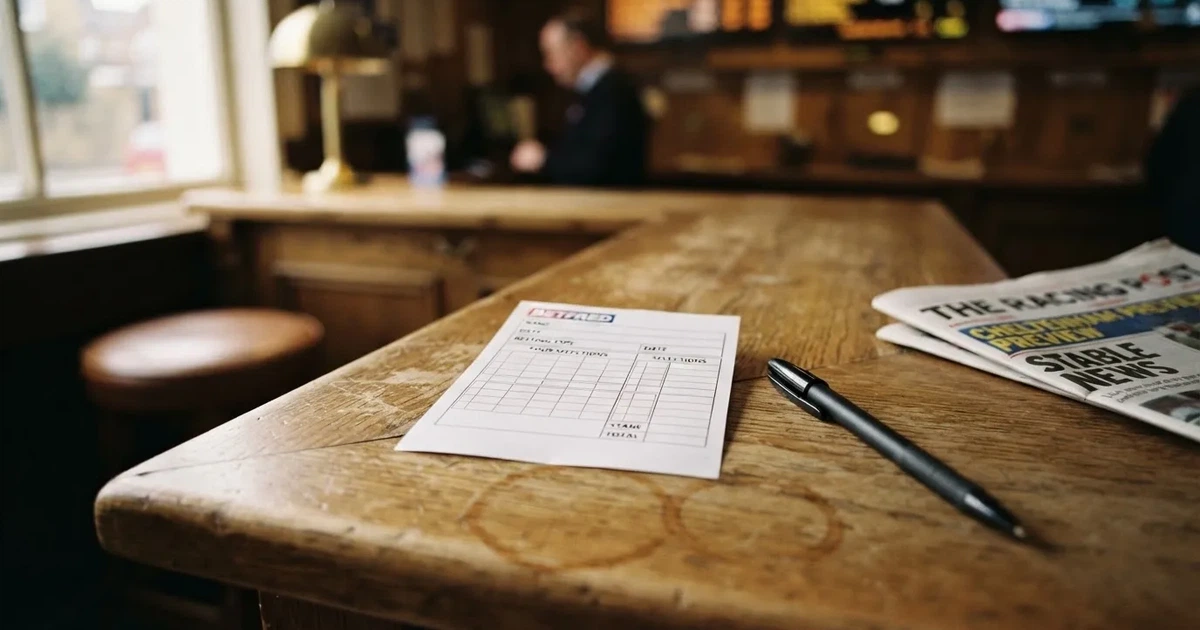
A paper betting slip with 247 lines written out sits beside a pen on a wooden counter. The picture shows the scale of the wager before any number on it is filled in.
An empty football stadium at dusk with floodlight masts visible against the sky. The image does not show a result; it shows the conditions under which all 57 lines of a Heinz are settled at the end of a matchday.
An empty courtroom with wooden benches in morning light. The image points at the legal frame inside which a Goliath can be placed by a GB-licensed operator on the Gambling Commission’s register.
What a Goliath looks like on the slip
A Goliath slip — whether on paper at a high-street bookmaker or in the digital slip at an online sportsbook — carries the same fields. The unit stake appears at the top, the bet count appears next to it and the combined price appears as the headline. The maximum payout — the figure the punter receives if every leg wins — appears under that. Below come the eight selection lines, each one named in the format the operator uses.
At a £2 unit stake on a typical football card, the punter’s slip shows a £494 total stake. The combined price appears as a long figure — a decimal representation of the product of all eight leg prices. The maximum payout sits below, large enough that most slips print it with thousands separators. The punter confirms, the stake is debited, and the slip is the only record until settling begins.
What the slip does not show is the margin: the gap between the displayed combined price and the fair combined price the punter would receive at a margin-free bookmaker. The margin is the cost the punter pays for the wager, and the slip has no field for it. The calculation in the section above is the only place the margin is readable.
What the punter sees at settling time
A Goliath settled on a Saturday evening produces a long list of individual bet resolutions. Each combination that has won is paid at its own price, and each combination that has lost is marked as a loser with no payout. The slip moves from “pending” to “settled” line by line, and the cumulative payout — read off the slip after settling — is what the punter sees.
The shape of the payout depends on which picks won. A card where all eight favourites won produces the maximum payout — the figure printed on the slip at placement. A card where five or six favourites won produces a payout that depends on which ones; a card where only two or three won produces a payout that is rarely above the entry stake, and is often below it.
A note on each-way Goliaths
Some bookmakers offer an each-way Goliath, which doubles the bet count from 247 to 494. Each line is treated as two lines, one on the win part of an each-way market and one on the place part. The total stake doubles to £494 at a £1 unit. This structure is most often used in horse racing, where place terms are defined by the number of runners, and the punter should know the place terms before committing the entry stake.
Settling rule of thumb
A Goliath settles as 247 independent bets. Each is won or lost on its own terms, and the cash payout from any winning line is the unit stake multiplied by the line price. There is no bundling, no combined price across lines, and no override on individual losses. The punter’s return is the sum of the winnings across all winning lines.
That settlement rule is the cleanest version of how every multiple bet works. The mistake some punters make is treating the wager as a single accumulator — “I need all eight to win or I get nothing” — and reading the slip’s maximum payout that way. The slip’s maximum payout is paid only when all eight win; what is paid when fewer than eight win is a sum of partial payouts, and that sum is usually below the headline figure.
The corner case: Rule 4 and non-runners
In horse racing, Rule 4 deductions apply when a runner is withdrawn from a race, and the bookmaker reduces the price of every combination that included that runner. The deduction is taken off the displayed price before payout, and the punter’s return reduces accordingly. Non-runner rules apply similarly, with the leg declared void and the price of every combination adjusted to one short. The bookmaker’s own terms state the Rule 4 table — typically a tiered reduction from 5p in the pound for one withdrawal up to 90p in the pound for a heavy favourite non-runner — and the punter should read those terms before placing a wager with horse racing legs.
What the odds format means in this market
Great Britain bookmakers offer odds in fractional form (5/1, 11/4, evens) and in decimal form (6.00, 3.75, 2.00). Fractional odds show the profit per unit stake; decimal odds show the total return per unit stake. The conversion is fractional = decimal − 1, so 5/1 in fractional is 6.00 in decimal, 11/4 is 3.75 and evens (1/1) is 2.00. The decimal form makes combination calculations mechanical — multiply the decimals — and online operators usually offer a toggle between the two.
For a Goliath, the choice of format does not change the wager. It changes what the punter reads on the slip. A punter comfortable with decimal odds reads the combined price as a long decimal and the maximum payout as a long number. A punter comfortable with fractional odds reads the combined price as a heavy fraction or a long “X to 1” and the maximum payout as the same figure. Both formats encode the same information.
The SP and the BOG conventions
Starting price (SP) is the price on a horse at the start of the race, set by the on-course bookmakers. Best odds guaranteed (BOG) is a feature offered by some bookmakers — if the SP is greater than the original price taken, the punter is paid at the greater. The convention matters for horse racing Goliaths: a BOG bookmaker can produce a meaningfully larger payout on every combination that includes a horse whose SP drifted, and the punter should check whether the bookmaker offers BOG before placing a Goliath on a racing card.
Whether a Goliath is the bet a punter wants
A Goliath is a bet for punters who want full cover on a card of seven or eight picks. It is not the structure that pays the most per unit stake; that title goes to a longshot accumulator, which is a single line at the product of all the leg prices. A Goliath is the structure that protects the punter against one or two losing picks while keeping the eight-fold and the seven-folds in play. A punter who has eight picks each with a 60-70% win probability on the day, and who wants to be paid across any three or more wins, is the bettor the Goliath fits.
A punter with three or four confident picks and a couple of fliers is not. They are the punter for whom a Yankee (11 bets on 4 picks) or a Lucky 15 (15 bets on 4 picks, with singles) is the better structure. The Goliath’s price is high relative to the chance of a full win, and the punter who only has four confident picks is paying for combinations they will not use.
When the wager is overkill
A Goliath placed from a card of three confident picks and five speculative lines is expensive insurance. The punter has paid for 247 lines and only the combinations that include three or more of the confident picks will win — and those combinations are a fraction of the structure. The right structure for that card is a Yankee (11 bets), a Lucky 15 (15 bets) or a Canadian (26 bets), each of which takes a smaller cut of the punter’s bank for the same coverage of the three confident picks.
When the wager is the right fit
A Goliath is the right fit when the punter has seven or eight reasonably confident picks on the card. The structure is the only one that covers every combination up to eight-fold, and the punter who has reached that level of confidence on a card of eight picks wants the cover. A £1 or 50p unit stake, rather than £2 or £5, is the discipline most punters find useful when the wager is this size.
Licence status and the public register
A Goliath can only be placed at a bookmaker that offers the bet. In Great Britain, that means a brand operating under a Gambling Commission remote licence — the category of licence that covers remote general betting on real events. The Commission’s public register lists every licensed operator against an account number, the licence holder’s name and the trading domain. A punter can check any brand by name, by domain or by account number.
The register is the test of whether a brand holds a licence. A GB-licensed operator has been checked against the Gambling Act 2005, the Gambling (Licensing and Advertising) Act 2014 and the Licence Conditions and Codes of Practice (LCCP). An unlicensed brand offering Goliath betting to a customer in Great Britain is committing an offence under section 33 of the 2005 Act, and the customer betting with such a brand has none of the protections a licensed operator provides: no GAMSTOP, no Commission complaints route, no approved dispute-resolution body, no British consumer redress, no 10x bonus cap, no £150 financial vulnerability check.
What the licence is and is not
A Gambling Commission remote licence is permission to take bets from customers in Great Britain. It is not a guarantee of payout, not a guarantee of competitive margin, and not an endorsement of any specific offer. Operators may restrict customers, may withdraw offers, may refuse bets. The licence is the floor — the minimum standard for the operator to be in the market. Above the floor, the punter compares operators on margin, on offer terms, on stake limits and on the cover of the bets the punter wants to place.
What the licence number tells the punter
Every licensed operator has an account number on the Commission’s register. The number is paired with a trading name and a licence holder’s name. Two distinct account numbers mean two distinct licences. Two operators that share a single account number are the same licence from the punter’s perspective — the operator’s terms of business govern both, and a dispute with one is a dispute with the same operator. A punter checking the register finds the account number on the operator’s own site, usually in the footer or in the licence and regulation page.
Spread betting is regulated separately
Financial spread betting is regulated by the Financial Conduct Authority, not the Gambling Commission. A brand that offers both fixed-odds betting and spread betting has two regulators. The FCA’s spread-betting authorisation does not extend to fixed-odds betting, and the Commission’s betting licence does not extend to spread betting. A punter placing a spread bet at a hybrid operator is in a different regulatory regime from a punter placing a fixed-odds Goliath at the same brand.
What the licensed operator’s own terms state on Goliath betting
The ten operators reviewed sit in different places on the Goliath product. Each one is on the Commission’s public register against a remote general betting standard (real events) licence. The column below summarises what each operator’s own published terms say about the Goliath — whether it is offered, whether the punter can place it on the slip, and whether the operator’s offer terms interfere.
| Brand | Gambling Commission licence | What the operator’s terms state on Goliath betting |
|---|---|---|
| Fafabet | Remote licence 057385-R-333191-006, Taichi Tech Limited | Offers a full sportsbook with multiple bet types; Goliath available on the bet slip at unit stakes of the punter’s choice. Best Odds Guaranteed is offered on UK and Irish horse racing win and each-way bets from 9am on race days. |
| Betway | Remote licence 039372-R-319367-029, Betway Limited | Full sportsbook with multiple bet types including full cover bets. A new-customer offer covers a £40 free-bet package credited after a first settled bet; the offer has its own minimum odds and expiry terms that operate separately from the Goliath mechanic. |
| Bar One Racing (BAR 1 Betting) | Remote licence 056516-R-332750-007, Bar-One Racing Limited | Irish independent bookmaker offering racing-led sportsbook; the product covers multiples and full cover bets across the racing card, with horse-racing sponsorship ties to several Irish racecourses. |
| Unibet | Remote licence 045322-R-324275-019, Platinum Gaming Limited | Sportsbook with full multiple bet support; the welcome offer for new GB customers is a free-bet package credited after a qualifying £20 bet at minimum odds of 2.0, with a 7-day expiry on the free bets. |
| DAZN Bet | Remote licence 048756-R-327274-019, DZBT Limited | Sportsbook with Cash Out, Bet Builder, daily bet boosts and in-play betting. Cash Out availability is not guaranteed; bets stand at the price taken if cash out is unavailable. |
| Midnite | Remote licence 101839-R-342850-001, Midnite Limited | Sportsbook with in-play events, an acca builder, popular accas and price boosts with stated maximum-stake limits. The welcome offer is a free-bet package credited on a qualifying £5 bet at minimum odds of 2.0 within 14 days of sign-up, with a 7-day expiry. |
| Sporting Index | Remote licence 027343-R-308898-011, Sporting Index Limited | Hybrid spread and fixed-odds bookmaker; fixed-odds Goliath betting sits alongside a spread-betting book. New-customer offer structures across fixed-odds and spread lines have their own qualifying conditions. |
| BetMGM | Remote licence 039198-R-319450-029, LeoVegas Gaming PLC | Sportsbook and casino combined offering; Goliath is part of the multiple bet range. The sports welcome offer for new UK customers is a free-bet package credited after a deposit and a first sports bet, with the package split into acca-specific and multiple-specific free bets. |
| Fitzwilliam Sports | Remote licence 048760-R-335434-009, SBKI Limited | Sportsbook built on Oddschecker-priced selections; mobile apps available; multiple bet support is part of the offering. |
| Octobet | Remote licence 062545-R-337248-006, Octopus Game Limited | Sportsbook with Best Odds Guaranteed on UK and Irish horse racing, with a per-race per-customer cap on the guarantee. Full multiple bet coverage including full cover bets is offered. |
The table is informative, not a recommendation. A punter choosing between the operators will weight price, offer terms and stake limit independently of the licence, and the licence itself is the floor beneath all three. Where one operator’s offer terms — the minimum odds on a qualifying bet, the expiry on a free bet, the maximum stake limit on a boosted price — clash with a Goliath placement, the punter needs to read the offer’s terms before the wager is placed.
Reading the offer terms for a Goliath punter
An offer that credits free bets on settlement of a qualifying bet at minimum odds of 2.0 is straightforward for a single, but becomes complicated for a Goliath. The qualifying bet on a Goliath slip is the slip itself — the wager being placed — and the slip’s combined price will almost always exceed 2.0 if any pick is reasonably priced. The minimum odds on the qualifying bet are about the single bet, not the combination, and most operators’ qualifying-bet rules refer to the leg price or to a stake-level minimum rather than the combined price. A punter who wants to qualify a Goliath for a free-bet offer should read the offer terms carefully, because the wager may not be eligible.
Minimum stake conditions are similarly aligned with single-bet placement. A £10 minimum-stake qualifying bet is easy to clear on a single but unusual on a Goliath, where the unit stake might be 50p or £1 and the total stake is the unit times 247. The punter sets the unit stake, not the per-line stake, and the qualifier is the unit stake on the slip rather than the total wager. A punter with a high unit stake is well past the qualifier; a punter with a small unit stake is not, and should set the unit stake up to meet the threshold.
The lesson on offer mechanics
Offers are made for singles and accumulators, not for full cover bets. The expectation of a £40 free-bet package for a £20 wager at minimum odds 2.0 is calculated against single-bet placement: the operator’s expected cost of the offer is the probability that the qualifying bet loses, multiplied by the value of the free bets. A Goliath on the same £20 total stake — which is mechanically a 8p unit stake across 247 lines — does not pay out the offer as the punter might expect. The punter’s understanding of qualifying mechanics is the gap between a marketed offer and an actually credited one.
Responsible gambling and Goliath betting
A Goliath is a higher-stakes wager than most punters realise. At a £1 unit stake the entry cost is £247; at £2 it is £494. The punter choosing the wager is choosing a structure that commits a meaningful sum to the bet at placement, before any leg has been decided, and the operator has a duty to ensure the wager sits inside the customer’s stated limits.
The protection regime starts before the first deposit. Since 7 May 2019, every licensed remote operator in Great Britain has verified the customer’s name, address and date of birth before any gambling activity — including with a free bet or a bonus. No anonymous play at a licensed site. The verification uses public records and document checks, and the customer’s first deposit cannot proceed without it.
The deposit limit
Operators are required to offer a gross deposit limit on a fixed time frame. The first changes took effect on 31 October 2025; a second phase was scheduled for 30 September 2026 (it was postponed, and whether it is in force is not established at the date of this page). The limit is the customer’s choice, not a state-set ceiling. A punter who wants a £100 a week cap sets it; an operator that does not offer the choice is in breach of the technical standard.
The financial vulnerability check
A financial vulnerability check applies to licensed remote betting when a customer’s deposits minus withdrawals exceed £150 in a rolling 30-day window. The check, in force since 30 August 2024, looks at public records — bankruptcy, county court judgments, similar — rather than at income or credit reference. It is a flag for operator action, not an automatic block. A punter who crosses the threshold is asked questions, and the operator’s response depends on what the customer says.
The financial vulnerability check sits ahead of a separate, larger programme of financial risk assessments announced by the Commission in a staged plan, with no confirmed start date. The punter should not assume the larger check is in force; at present the only operative check is the £150 threshold on deposits minus withdrawals.
GAMSTOP
Every GB-licensed online operator takes part in GAMSTOP. A punter who has self-excluded through GAMSTOP cannot open an account at a participating operator, and any account they had is closed. The exclusion periods are six months, one year, five years, or five years with auto-renewal. After the minimum period, the exclusion continues for a further seven years unless the customer asks GAMSTOP to remove it. The cover is online; betting shops use a separate self-exclusion service.
Help services
GAMSTOP, GamCare (the National Gambling Helpline), GambleAware, the NHS gambling clinics and Gamblers Anonymous are the standard referral routes for a punter who wants help. A punter who finds themselves chasing Goliath losses — placing larger Goliaths to recover earlier ones — is the punter for whom a GAMSTOP registration, a deposit limit or a referral to GamCare is the right next step.
Strategy and the cost-of-entry problem
The marketing language around a Goliath — “247 bets on every combination”, “one stake covers everything” — describes a structure without naming its cost. The strategic content is in what the structure does not do. It does not protect the punter against the larger combinations fading, against the margin on each leg compounding, against the entry cost blowing past the punter’s actual budget.
A Goliath strategy that has worked in the published record is built around short-priced favourites — picks at 1.20 to 1.50 — and a small unit stake. The punter picks eight short-priced favourites, sets a 50p or £1 unit, and accepts that the entry cost is between £123.50 and £247. The structure has frequent winners on the lower-multiple combinations and rare winners on the higher ones, and at a card where most picks win, the cumulative payout regularly clears the entry stake.
The strategy fails when the punter’s picks include longshots. A 5.00-priced pick on a card of eight turns the eight-fold combination into a 5.00⁸ product, but it also turns the seven-folds and six-folds into products that include that 5.00. The higher-multiple combinations become the only combinations that matter for the headline payout, and the punter’s wager becomes an accumulator wrapped in a cover structure. The punter who wanted the cover is left waiting on a longshot.
The bankroll discipline
The bankroll discipline for a Goliath punter is straightforward: the unit stake is small, the total exposure is large, and the punter accepts that most Goliaths lose most of their stake. A punter who cannot afford to lose the total stake at placement should not place the wager, and a punter who is reaching for a higher unit stake to recover earlier losses is the punter for whom the responsible-gambling section above was written.
Strategy without a tipster
No tipster picks winners reliably, and no system of bets “wins” across a season. A Goliath punter’s strategy is built around the structure’s behaviour — what it pays when the picks land, what it costs when they do not — rather than around the predictions of any individual match. The punter’s value is in disciplined placement: small stake, sensible card, frequent re-evaluation of whether the bet is the right structure for what they hold.
Operator reviews
Each brand below is a GB-licensed remote operator on the Gambling Commission’s register, holding a remote general betting standard (real events) licence. The reviews are organised by what the operator offers around a Goliath punter rather than by overall ranking — the angle of this page is cost, and the question each review answers is how the operator’s offering affects the punter’s actual expenditure on the wager.
Fafabet
Fafabet sits under Taichi Tech Limited on the Commission’s register and offers a sportsbook that supports multiple bet types including full cover bets. Best Odds Guaranteed applies to UK and Irish horse racing win and each-way bets from 9am on race days; if the starting price drifts above the price taken, Fafabet pays the bigger price. For a Goliath on a horse racing card the BOG mechanic is a real edge — every combination that includes a horse whose SP has drifted pays at the larger price — and it lands hardest on the seven-folds and eight-folds where the SP contribution dominates the product. Fafabet is the operator whose published terms most directly target a Goliath on a racing card, and the punter reading those terms ahead of a wager is the punter most likely to feel the benefit.
Betway
Betway sits under Betway Limited on the Commission’s register and runs a full sportsbook with multiple bet support. A new-customer offer credits four £10 free bets after the settlement of a first bet of at least £10 at minimum odds of 2.0, with a 7-day expiry and a debit-card deposit restriction. The offer sits at single-bet level — the qualifying bet is the slip, and the punter’s first wager at minimum odds 2.0 is what unlocks the package. For a Goliath punter the offer is the standard single-bet entry, and the wager’s eligibility for the free bets depends on whether the slip’s combined price meets the minimum-odds threshold. Most operator’s qualifying rules treat the slip’s legs, not the combination, and a Goliath whose any-leg price clears 2.0 is eligible. A punter reading the offer carefully and placing a first wager of the kind Betway describes is the punter who collects the free bets.
Bar One Racing (BAR 1 Betting)
Bar One Racing trades as BAR 1 Betting under Bar-One Racing Limited on the Commission’s register. The bookmaker is Irish and runs a racing-led sportsbook with horse racing sponsorships at Dundalk, Fairyhouse, Navan, The Curragh, Curraheen Park and Cork. A Goliath on a racing card is the wager BAR 1 Betting’s offering is built around, and the operator’s specials on Irish fixtures are the types of markets the Goliath structure covers well. The bookmaker is the natural fit for a punter whose card is dominated by Irish racing.
Unibet
Unibet UK runs under Platinum Gaming Limited, Gibraltar, on the Commission’s register; the operator has been active since 1999. The sportsbook supports multiple bets including full cover bets. The GB welcome offer is a £40 free-bet package credited on a qualifying £20 sports bet at minimum odds of 2.0, with the free bets expiring within 7 days. For a Goliath punter, the offer is the standard single-bet structure: the qualifying wager is the slip, the free bets are credited on settlement, and the punter who wants the package places a first wager at minimum odds of 2.0. Unibet is the established operator at the broader end of the market and the punter choosing it chooses price, market depth and a long-standing product rather than a racing-specific mechanic.
DAZN Bet
DAZN Bet runs under DZBT Limited on the Commission’s register. The sportsbook offers Cash Out, Bet Builder, daily bet boosts and in-play betting. Cash Out availability is not guaranteed, and bets stand at the price taken if cash out is unavailable — an important caveat for a Goliath punter who tries to cash out parts of the structure before it has settled. With 247 lines and several of them still live while cash out is offered, the punter’s interest in partial cash out is structured but conditional. DAZN Bet is the operator at the modern end of the market — feature-heavy, in-play-led, with the cash-out caveat central to its terms.
Midnite
Midnite runs under Midnite Limited on the Commission’s register under account 101839. The sportsbook carries in-play events, an acca builder, popular accas and price boosts, with stated maximum-stake limits on the boosted prices. The sports welcome offer credits £25 in free bets plus 50 free spins on a qualifying bet of £5 or more at pre-match odds of 2.0 or greater within 14 days of sign-up, with a 7-day expiry. For a Goliath punter the offer is the standard single-bet structure with a longer qualification window than most operators. The price-boost maximum-stake limit is the more relevant caveat for the punter — boosted legs in a Goliath carry their own stake cap on the boost, and that cap is independent of the rest of the structure.
Sporting Index
Sporting Index runs under Sporting Index Limited on the Commission’s register and offers both fixed-odds betting and spread betting. A Goliath is a fixed-odds wager and the operator’s spread-betting book operates under the FCA’s separate regime. The new-customer offer covers fixed-odds and spread lines, with a qualifying fixed-odds bet of £10 at minimum odds of 1/2 (1.50) unlocking a package of fixed-odds free bets and spread-bet credits. The qualifying fixed-odds bet cannot be placed in play and cannot be cashed out early. Sporting Index is the operator for the punter who wants both kinds of betting under one roof, with the regulatory frame inside each kind operating independently.
BetMGM
BetMGM runs in the UK under LeoVegas Gaming PLC on the Commission’s register. The sports welcome offer for new UK customers credits four £10 free bets (two football accas of 4+ selections, two sports multiples of 2+) after a £10 deposit and a first sports bet within 7 days. The free bets expire in 7 days with their own minimum-odds and opt-in terms. The acca-specific free bets are the part of the offer most relevant to a Goliath punter: a Goliath on a football card is a structure built from football accas, and the free-bet type the operator credits is structured around accas of four or more picks. The two sports multiples of 2+ cover the longer cover bets — the Yankees, the Canadians, the Heinz bet sizes — and the package is the type of offer where the punter’s card decides which free bet is the right one to use.
Fitzwilliam Sports
Fitzwilliam Sports runs under SBKI Limited on the Commission’s register. The sportsbook is built on Oddschecker-priced selections — the average price across operators tracked on Oddschecker for each market — and the operator publishes Apple and Google mobile apps. The pricing approach is the distinctive feature: a punter placing a Goliath at Fitzwilliam Sports gets the average price the comparison site’s panel offers rather than the operator’s own price. For the Goliath punter this matters on the higher-multiple combinations, where a small price difference compounds through the product.
Octobet
Octobet runs under Octopus Game Limited on the Commission’s register under account 62545. Best Odds Guaranteed applies to UK and Irish horse racing with a £150 per customer per race cap on the guarantee. The sportsbook supports full multiple bet coverage including full cover bets. The cap on the BOG mechanic is the headline caveat — a punter whose Goliath combination includes a horse whose SP drift would otherwise exceed the cap is paid at the cap, and the rest of the SP gain is lost. Octobet is the operator for the punter whose Goliaths are dominated by racing and whose typical wager is below the per-race cap.
Bet builder, in-play and the cash-out question on full cover bets
Full cover bets interact with the modern sportsbook features in ways that single bets do not. A Goliath punter using a bet builder builds a single leg that combines several markets — first goalscorer, total goals, both teams to score — into one pick. The combined leg has its own price, which then prices into the Goliath structure. A Goliath with two or three bet-builder legs is a card where the punter has accepted that the leg prices are higher than the price of any single constituent market — the bet-builder margin — and the structure compounds that margin across 247 combinations. The punter’s discipline is to keep bet-builder legs to a manageable count.
Cash out on a full cover bet is a partial exercise. The bookmaker’s slip tracks every combination separately; cashing out “the bet” settles every live line at its current cash-out price. With 247 lines, several of them live simultaneously, the cash-out figure is a function of how the cashed combinations are valued by the operator at that moment. The cash-out figure will rarely exceed the entry stake before the headline has come in. Cash out on a Goliath is best understood as a partial recovery of the entry stake at the moment the punter is uncertain of the remaining legs.
In-play betting on a full cover bet is just in-play on every individual leg. The punter has placed the wager in a single transaction; settling happens as the events resolve. There is no continuous live update of the wager as an aggregate.
Break-even points
For a Goliath on a typical football card with picks in the 1.50 to 2.50 range, break-even sits around four winning picks out of eight. The cumulative payout at that point depends on which four win; a card with the four short-priced favourites winning returns meaningfully more than a card with the four longshots winning. At five of eight winners, the cumulative payout reaches and exceeds the entry stake at a £1 unit, with a margin of profit depending on the price mix. At six of eight winners, the punter is comfortably ahead. At seven and eight the punter collects the headline maximums.
For Canadian and Heinz the break-even points shift the same way. A Canadian at typical prices breaks even around two or three winners out of five; a Heinz breaks even around three or four out of six. The pattern — break-even rises with selection count, decreases with combined price — is constant across the full cover family.
Why break-even matters more than headline payout
The punter who reads only the headline payout — “if all eight win, the payout is £X” — has read the maximum, not the typical. The typical outcome is a partial win, and at most realistic price mixes the partial returns a small fraction of the entry stake. The punter who reads only the headline has not understood the cost of the structure, and the punter who reads the break-even curve has.
Frequently asked questions
What exactly is a Goliath bet?
A Goliath is a full cover bet on eight selections that resolves into 247 separate bets covering every combination of two or more picks — every double, treble, four-fold, five-fold, six-fold, seven-fold and the eight-fold accumulator. There are no singles, and the bet pays nothing unless at least two of the eight selections win.
How many bets does a Goliath contain, and what does each one cover?
A Goliath contains 247 bets. They are 28 doubles, 56 trebles, 70 four-folds, 56 five-folds, 28 six-folds, 8 seven-folds and 1 eight-fold. Every combination of two or more picks from the eight is covered exactly once.
How does a Goliath settle, and what does it pay when not every leg wins?
A Goliath settles as 247 separate bets. Each winning combination pays back at the unit stake multiplied by the line price; each losing combination loses its stake. The total payout is the sum of all winning lines, and combinations that include any losing leg pay nothing.
How can a punter check that a bookmaker holds a Gambling Commission licence?
The Commission’s public register lists every licensed operator by name, by trading domain and by account number. A punter looks the operator up and reads back the licence status, the licence holder’s name and the categories the licence covers. The register is at the Commission’s site; a brand whose details do not appear there does not hold a Commission licence for Great Britain.
How is the return on a single bet worked out from the stake and the odds?
The return on a winning single is the stake multiplied by the decimal odds. The net profit is the stake multiplied by (decimal odds minus 1). At £10 on a selection at 3.50 decimal, the return is £35 and the profit is £25; the original stake is included in the return and is part of what the punter receives back from the bookmaker.
What is the bookmaker’s margin, and how does it appear in the odds?
The bookmaker’s margin is the cut the operator keeps off every unit staked on a market. Across all outcomes of a market, the implied probabilities (1 divided by decimal odds) sum to more than 100%, and that extra is the margin. For a two-way market at 1.50 and 2.50, the implied probabilities are 0.667 and 0.400, summing to 1.067 — a 6.7% margin. The margin is paid through every leg of every combination, and a Goliath’s cumulative margin is the sum of its legs’ margins compounded.
Bet types & in-play – Cricket betting
Content created by the «Cricket betting» team
