
MMA Betting Odds in Great Britain: How Prices Are Set, Where They Apply, and What They Cost
 Available in US
The two numbers next to a fighter’s name are not a prediction. They are a price — the amount a bookmaker pays back for every pound staked on one outcome — and the difference between the two prices and a “fair” market is where the bookmaker makes its living. That difference, called the margin or overround, is the single most important number on any MMA betting slip, and it is the one figure the bookmaker keeps quiet about. This guide is built around it. It explains how MMA odds work in Great Britain, which bookmakers serve a GB punter, what their offers really cost once the small print is read, and which readers each platform is genuinely built for.
Data current as of 27 October 2026, cross-referenced against the Gambling Commission’s public register of operating licences and each operator’s own published terms.
The shape of an MMA betting market
MMA betting starts with a fight card. A card lists the bouts a promoter is running on a given night, and each bout carries a set of markets — the different ways a punter can have a view on who wins, how, and at what point in the fight. The headline market is the moneyline, where the punter backs one fighter to win and the loser of that bet is simply the other name on the card. From the moneyline the rest of the book fans out: method of victory (by knockout, technical knockout, submission or decision), round groupings (in which round the fight ends), over/under on total rounds, and on the bigger cards a method-and-round combination that pays a much bigger price because it asks for two things to come true at once.

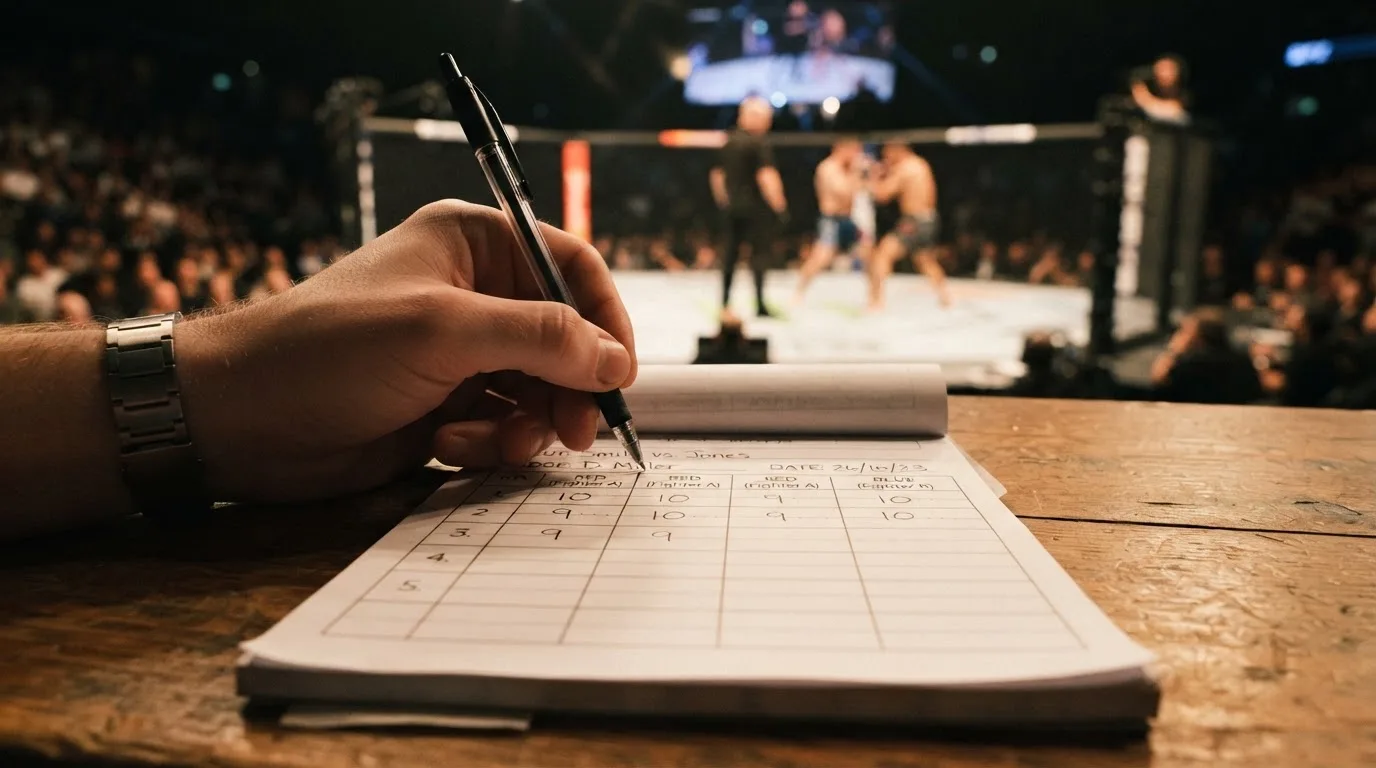
The way a fight is scored sits behind every decision market. Under the 10-point must system three judges score each round, with the round winner taking 10 points and the loser 9 or fewer, and an even round scored 10–10. A bout that goes the distance ends in a unanimous, majority or split decision. A bout that does not go the distance ends in knockout, technical knockout, submission, disqualification or — in the rarer case of an unintentional foul — a no contest. Punters who bet on a method of victory are betting on which of those terminal events the judges never have to weigh in on; punters who bet on a decision are betting on exactly the opposite, that all three judges score every round.
Three things set MMA odds apart from team sports. First, the contest is one-on-one with no draw, so a two-way market has two outcomes, not three; the maths of the margin is the simplest case in the book. Second, fights end inside a small number of rounds — non-title bouts normally run no more than three rounds, title bouts up to five — so round-grouping markets have a finite and well-bounded set of outcomes to price. Third, the result is binary in a way football and tennis are not: a fighter wins, loses, or the bout is ruled no contest, and there is no points-margin to settle against.
What an MMA price actually pays
Every decimal price quoted on a betting slip is a multiplier against the stake. A £10 bet at 2.50 returns £25 — the original £10 stake plus £15 of profit — if the fighter wins. A £10 bet at 1.40 returns £14 if the favourite wins. A £10 accumulator linking three fights at 2.00, 3.00 and 4.00 returns £10 multiplied by 24.00, which is £240, because the legs multiply into one price.
The arithmetic is the same across every sport; what changes is how many outcomes the price has to cover and how thin the spread between them is. In a two-way moneyline with no draw, the bookmaker has to make the two prices add up to less than 100% payout share — the proportion of every pound staked that the book returns in winnings across both outcomes in the long run — so that the difference, the margin, stays in the house. The tighter the spread, the lower the margin, and the cheaper the bet is for the punter in the long run.
How the margin is built into two prices
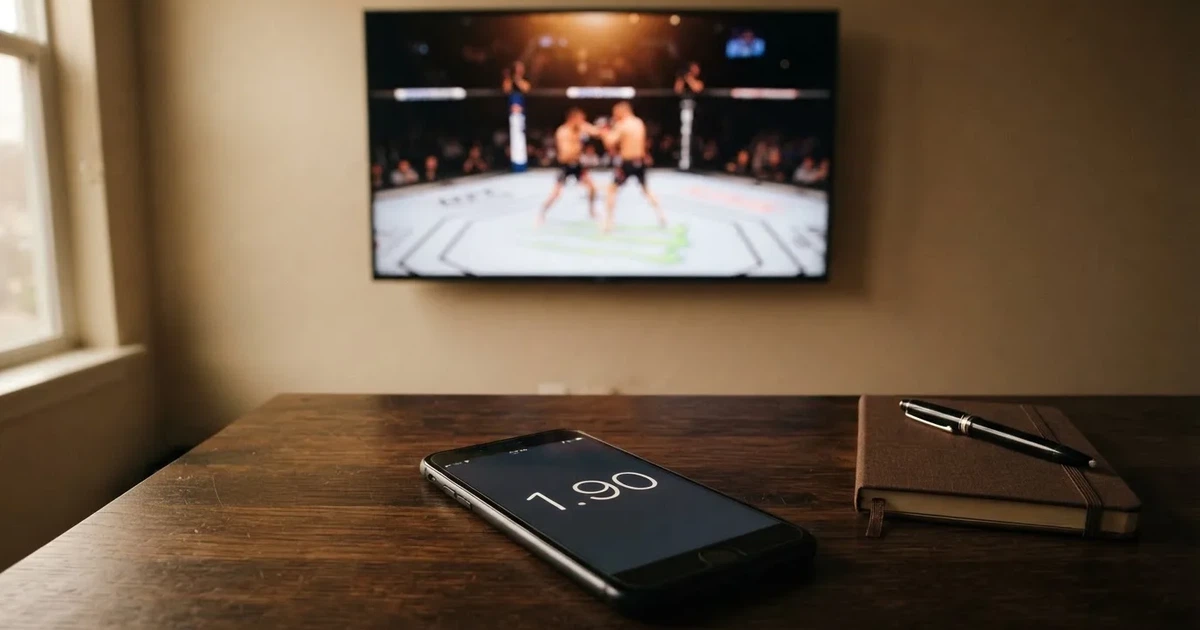
The illustration below uses a deliberately even two-way market priced at 1.90 / 1.90 — fractional 9/10 on either fighter, an example, not a quoted price. The payout share is calculated by adding the implied probabilities at each price. At 1.90 the implied probability is 1 ÷ 1.90, which works out to 52.63%. Two fighters at that price give a payout share of 105.26%, leaving a margin of about 5.26% — a band of roughly 5% in good markets, rising into the high single digits on the smaller props. Wider prices on the underdog and tighter ones on the favourite produce the same payout share, but the band of “what the house keeps” stays close to that 5% mark.
That band is the book’s edge, and it is what every promotional price on the slip is paying for. A “boosted odds” offer on a single fight has to be priced so that, after the boost, the bookmaker is still earning its margin across the whole card — which is why a boost on one fight is rarely free for the punter.
MMA bonuses and free bets: what they really cost
A welcome bonus is the cheapest-sounding number on a bookmaker’s homepage, and it is also the most expensive thing on the slip if it is read the wrong way. The headline number is rarely the cost. The cost lives in the wagering requirement attached to it, the minimum odds at which the qualifying bets must be placed, the deadline by which the bonus has to be cleared, and the cap on what the bonus is allowed to win.
The wagering requirement is the rule that turns a bonus into work. A £10 bonus at 10x needs £100 of qualifying bets before any of the bonus money can be withdrawn, and at 50x it needs £500. From 19 January 2026 the Gambling Commission capped wagering requirements on bonuses at 10x across all GB-licensed operators. That cap is a hard ceiling and not a target, and any bonus advertised above it is, by definition, an offer a GB-licensed bookmaker cannot legally run. Free bets with no wagering condition are not covered by the same cap, and a free bet whose stake is not returned with a win is, by construction, a bet on which the punter keeps the profit but loses the stake — which is why the headline “£30 in free bets” is rarely worth £30 in pocket.
Three numbers decide whether a bonus is worth claiming on an MMA bet:
- The wagering multiple. A multiple of 1x means the bonus is paid out as cash once the qualifying bet settles; a multiple of 5x to 10x means the bonus has to be turned over several times before it withdraws. The lower the multiple, the closer the bonus is to real money.
- The minimum price. Most free bets and bonus-qualifying bets carry a minimum decimal price — often 1.50, sometimes 2.00 — and bets placed below that price do not count towards the wagering. On an MMA underdog the price is rarely an issue; on a heavy favourite it is, because the favourite’s price is often shorter than the minimum.
- The deadline. A bonus that has to be cleared within 7 days asks for a different punter to one with 30 days. The shorter the deadline, the harder it is to clear the bonus through small, controlled bets, and the more the punter is pushed toward higher-stake, higher-margin action.
Then there is the cap on what the bonus is allowed to win. A free bet with a £100 maximum winning cap pays the punter the full price only up to that ceiling; beyond it, the book keeps the excess. On a heavy favourite, that ceiling is rarely reached. On a long-priced underdog, it can be the difference between a life-changing return and a smaller-than-expected one.
A welcome bonus is not a reason to open an account; it is a reason to read the small print before doing so.
MMA betting apps: how the platform changes the price
An app is not a market — the prices on it are the same prices the website offers, drawn from the same trading desk — but the platform on which the punter places a bet changes how much of the price the punter keeps. A bet placed through a mobile-only channel during a live fight is a bet made under time pressure, with one thumb on the screen and no time to compare prices elsewhere; a bet placed from a desktop, ten minutes before the bell, is a bet made with a comparison site open in the next tab.
The British market for sports-betting apps is mature, and the differences between the leading platforms are mostly in design, in how the live markets are presented, and in whether the app supports features like Bet Builder, partial cash out, or live streaming. The prices themselves move fight by fight and minute by minute, and an app’s edge is in how cleanly it lets the punter back or lay a position while the action is unfolding, not in offering a permanently better price.
What to look for in an MMA betting app
Four features decide whether an app is a fit for MMA. The first is the depth of the in-play offering — how many markets are priced during a fight, and whether method-of-victory and round-grouping markets stay live round by round. The second is the cash-out menu — whether the punter can take a price part-way through a fight, and whether the partial cash-out is offered or only the full position. The third is whether the app offers a same-game multi or bet-builder function that links two markets on the same fight, because combining a method of victory with a round grouping is the way MMA odds are typically built into a bigger price. The fourth is the speed of the live odds update — how often the in-play price refreshes, and whether the slip locks a price at the moment of placement or only at the moment of confirmation.
A fifth, less visible feature is the friction at withdrawal. An app that takes a day to process a withdrawal is not the same product as one that takes an hour, and the difference matters more on a sport where the punter may want to bank a winning position between fights rather than carry a balance across a whole card.
Live MMA betting and cash out
Live MMA betting — placing a bet after the first bell, while a fight is in progress — is the form of the market where the punter has the most information and the bookmaker has the least. The price moves on every landed strike, every takedown, every cut opened by an elbow; the trader is repricing the entire market round by round, and the slip is settled in real time.
Two features turn live betting from a fast-twitch gamble into something the punter can manage. The first is cash out — the ability to lock in a price before the fight is over, taking a smaller guaranteed return instead of waiting for the final bell. The second is partial cash out, which lets the punter bank part of the position and leave the rest running. On MMA in particular, partial cash out matters because a fight can flip on a single strike; locking half the position and leaving half the position open is a way of hedging that single moment.
Two features should be treated with caution. The first is the suspension of markets between rounds, where the bookmaker pauses the in-play offering for the sixty-second rest period. The second is the delay between the slip confirming a bet and the bet actually being placed, which can be several seconds on a busy app — long enough that the price the punter clicked is not the price the book honours.
Cash out, and what it really pays
Cash out is a price the book offers the punter to close the position early. That price is built from the live odds at that moment, with the book’s edge still inside it. A punter who backs a fighter at 3.00 and sees that fighter land a clean combination in round one will see the price shorten to roughly 1.60; a cash-out offer of 1.80 in that moment looks generous, but it is the book paying the punter slightly less than the live market would, in exchange for the punter giving up the chance of the fight continuing to its natural end.
The maths: a £10 bet at 3.00 returns £30 if the bet wins. If the live price is now 1.60, the fair cash-out is £16 — the same £30 discounted by the new probability. A cash-out offer of £18 is, on those numbers, the book paying £2 more than the strict market; an offer of £14 is the book taking £2 of edge on top of the underlying price. Whether cash-out is worth taking depends on how the punter reads the remaining rounds, and on whether the punter prefers a known return to a position that can still go either way.
MMA predictions and strategy: what a tip actually does
A prediction is a forecast of which fighter wins; a strategy is the rule the punter uses to turn forecasts into bets. The market for MMA predictions is large — tipsters, model-based projections, fight-by-fight breakdowns — and the difference between a tip and a strategy is the difference between a one-off view and a system the punter can apply across a whole card.
A tipster who picks fighters at, say, 60% accuracy on a flat £10 stake is doing one thing. A punter who prices every fighter before the card is published, identifies the fighters whose prices are wider than the punter’s own estimate, and stakes only on those, is doing something else. The first is paying for someone else’s view; the second is paying the bookmaker only when the book is wrong. Across a year of cards, the second produces a positive expected return on the bets that get placed; the first produces whatever the tipster’s record produces, after the tipster’s fee.
Bankroll, staking and the cost of being wrong
The bankroll is the total amount the punter has set aside for MMA betting, and the stake is the slice of it risked on a single fight. A punter with a £500 bankroll and a 2% stake plan risks £10 per fight; the same punter at 5% risks £25. The 2% plan survives a ten-fight losing streak with £400 still in the bank; the 5% plan survives the same streak with £250. The punter who sizes the stake as a fixed percentage of the remaining bankroll is buying themselves the ability to be wrong for a stretch without being wiped out.
The cost of being wrong on a single bet is the stake. The cost of being wrong on a parlay — an accumulator linking several fights — is the stake multiplied by the number of legs the punter got right and wrong. A four-fight accumulator at average odds of 2.50 per leg has a combined price of about 39, but the implied probability is 1 ÷ 39, or about 2.5%. The punter needs all four legs to land. Three out of four returns nothing, which is why accumulators are priced where they are and why the bookmaker is happy to feature them as the headline product on the slip.
A strategy is not a tip. A strategy is what the punter does when every tip is wrong.
Bet types and odds in MMA: what the markets are
The menu of MMA markets falls into three groups. The first group settles on the result of the fight: moneyline (who wins), method of victory (knockout, technical knockout, submission, decision), and the round groupings (in which round the fight ends, or over/under on the total number of rounds). The second group settles on in-fight events that do not decide the fight: total strikes landed, takedowns completed, fight ending in a specific method within a specific round. The third group links several markets into one price: a same-game multi that combines a method of victory with a round grouping, or a parlay that links fights across the card.
Each group has a different margin, and the deeper the market, the wider the margin tends to be. A two-way moneyline on a well-known UFC bout might sit at the bottom of the band discussed earlier; a method-of-victory market with four or five outcomes has a wider built-in edge; a round-grouping market with eight or nine outcomes is wider still; and a same-game multi linking two of those wider markets is the widest of the lot.
The combined bet, and how the prices multiply
A combined bet, also called a parlay or accumulator, is a single bet whose price is the product of the prices on its legs. A two-fight parlay at 2.00 and 3.00 has a combined price of 6.00, and the implied probability is 1 ÷ 6.00, or about 16.67%. The two legs individually implied 50% and 33.33%; combined, they imply 16.67%. The difference — 50% × 33.33% = 16.67% — is exactly the joint probability, but with no margin built in. With a margin, the two legs implied something like 52.63% and 36.36% each, and the parlay is priced so that the product of the implied probabilities is greater than the implied probability of the combined price. That difference is the book’s edge on the parlay, and it is the reason a same-game multi carries a wider margin than a single.
The combined bet is priced to reward the punter for the difficulty of getting several things right at once. The punter who places it is paying for that reward with a higher margin on every leg.
Where MMA can be bet on in Great Britain
There is no statutory list of permitted sports or markets in Great Britain. The Gambling Act 2005 licenses the operator, not the market, and once an operator holds a remote general betting standard licence for real events, the markets it offers are a matter of its own commercial choice and the Licence Conditions and Codes of Practice. The punter looking for MMA in Great Britain is not looking for a regulator-approved list of fights; the punter is looking for a licensed operator that has chosen to price the fights on the card.
The bigger promoters — UFC, Bellator (now PFL), ONE Championship, KSW — are priced by every leading bookmaker. Smaller promotions and regional cards are priced by the operators that have built out their MMA offering, and on those cards the depth of the market (how many fights are priced, how many markets per fight) is the difference between a thin offering and a useful one.
The structure of an MMA card
A UFC card typically runs in three layers. The early prelims are the lower-card fights, often featuring debutants or fighters climbing the regional ladder, and the markets are usually just the moneyline and a method-of-victory market. The prelims are the middle of the card, with a mix of up-and-coming fighters and established names on the way down, and the markets deepen to round groupings and over/under on total rounds. The main card is the headline fights of the night — typically five bouts, sometimes with a co-main and a main event — and the markets on those fights are the deepest, with the full menu including same-game multis, round-and-method combinations, and “fight goes the distance” markets.
The punter who bets on the early prelims is paying a wider margin for thinner information; the punter who bets on the main event is paying a closer margin with the most market depth but also the most public pricing and the least value. The middle of the card, where the market is deep enough to support a strategy but the prices have not yet been sharpened by the weight of money, is where the punter with a view tends to find the most room.
The top ten bookmakers for MMA in Great Britain
The table below sets the reviewed set against two matters that matter most for an MMA punter in Great Britain: the licence that authorises the platform to take a bet from a GB customer, and what the platform’s own terms say about the key features — in-play, cash out, bet builder, and live streaming — that an MMA punter uses. The matters named are the ones that recur across the cluster material; the column headings chosen here name them as they matter to a punter.
| Brand | Licence and licence holder | What the operator’s own terms state on the key features |
|---|---|---|
| Octobet | Remote licence 062545-R-337248-006 (Commission account 62545); Octopus Game Limited | Welcome offer is a 50%-back free bet up to £50 plus a £10 casino bonus; in-play markets, Bet Builder-style acca features and price boosts with maximum-stake limits are standard |
| Tote | Remote licence 054779-R-331321-008 (Commission account 54779); TDCO Limited | Pool-betting heritage, fixed-odds sportsbook, Best Odds Guaranteed on UK and Irish racing from 9am; sportsbook markets include MMA |
| BetUK | Remote licence 039198-R-319450-029 (Commission account 39198); LeoVegas Gaming PLC | Welcome offer pays four £10 free bets (two football accas of 4+ selections, two multiples of 2+), valid 7 days, with opt-in required |
| LiveScore Bet | Remote licence 056859-R-332720-005 (Commission account 56859); LiveScore Betting and Gaming (Gibraltar) Limited | Bet Builder allows up to 10 selections covering match result, BTTS, corners, total goals, player scoring and card markets |
| Sporting Index | Remote licence 027343-R-308898-011 (Commission account 27343); Sporting Index Limited | Fixed odds and spread betting in one app, in-play betting, Bet Builder for football, auto cash-out and Multi-Markets |
| Spreadex | Remote licence 008835-R-104580-022 (Commission account 8835); Spreadex Limited | Fixed odds and spread betting combined, one-click and partial cash out, Bet Builder across fixed or spread, live streaming of UK and Irish racing, greyhounds, tennis, NFL and selected football |
| bet365 | Remote licence 055148-R-331498-002 (Commission account 55148); Hillside (UK Sports) ENC | Bet Builder+ combining markets from one event pre-match and in-play, Super Boosts, Winnings Boosts on Bet Builders and selected singles, daily Bet Boosts |
| Dabble | Remote licence 065677-R-340363-005 (Commission account 65677); Dabble Sports UK Ltd | “Bet £10, Get £10 in Free Bets” on first deposit, minimum odds apply, 7-day free bet expiry, stake not returned with a win |
| Fafabet | Remote licence 057385-R-333191-006 (Commission account 57385); Taichi Tech Limited | Best Odds Guaranteed on UK and Irish racing win and each-way from 9am on race days; price paid is the bigger of original or SP |
| Kwiff | Remote licence 044448-R-323408-017 (Commission account 44448); Eaton Gate Gaming Limited | Trademark of Spryme Ltd, in-house “supercharge” price-boost feature on selected markets |
What the licences and features mean for an MMA punter
Every brand above is on the Gambling Commission’s public register against a licence holder authorised to take remote bets from customers in Great Britain. Several of them are run by the same parent group — a feature of the British market, not a flaw in it — and the Commission’s register is the place a punter checks to confirm a brand is who it says it is. The licence holder named on the register is the legal entity the punter’s bet is with; the trading name on the homepage may be a different brand from the same group.
Three of the brands above — Spreadex, Sporting Index and, in a different shape, BetUK — combine fixed-odds betting with another product. Spreadex and Sporting Index offer spread betting alongside fixed odds; BetUK sits inside the LeoVegas Gaming PLC group, which runs other brands under separate licences. The spread-betting side is regulated by the Financial Conduct Authority rather than the Commission, and spread bets can lose more than the original deposit, because the stake is the margin between the spread and the settle, not a fixed sum at risk. An MMA punter looking only for fixed-odds betting does not need to engage with the spread side, but the offer on the homepage is the same offer, and the punter should know which side of it they are on.
How the welcome offers compare
The welcome offers above are not interchangeable. Each has a different shape, a different cost, and a different fit for an MMA punter.
Octobet’s welcome offer is 50% back as a free bet up to £50, plus a £10 casino bonus. The free-bet side is straightforward: the punter stakes the qualifying bet, and if it loses, 50% of the stake — up to £50 — comes back as a free bet. The casino bonus is a separate product, governed by casino bonus rules, and the punter who wants only the sports side has to opt in to the sports offer alone if the operator allows that. Dabble’s “Bet £10, Get £10 in Free Bets” is the simplest of the offers: a single qualifying bet at minimum odds, settled, and £10 returned in free bets with a 7-day expiry and the stake not returned. BetUK’s four £10 free bets are tied to football accas and multiples — a punter who wants to use them on MMA may find the structure does not fit. Fafabet and Tote’s Best Odds Guaranteed offers are running promotions on UK and Irish racing, not on MMA, and an MMA punter who values BOG for racing is the right reader for them.
The cheapest-sounding offer is rarely the cheapest offer. The cheapest offer is the one with the lowest wagering multiple, the highest minimum price the punter can already meet, the longest deadline, and the smallest gap between headline value and what the punter actually keeps.
Which bookmaker fits which kind of punter
A punter who values price and is willing to shop around is best served by an operator with a deep MMA offering and a clean in-play menu — bet365 and LiveScore Bet sit in that space, with Bet Builder+ and a 10-selection Bet Builder respectively. A punter who wants spread and fixed odds under one roof is best served by Spreadex or Sporting Index, both of which combine the two products in a single app. A punter chasing a generous welcome offer is best served by Octobet or Dabble, where the headline number is large and the qualifying conditions are short; the cost is in the wagering rules, which the punter reads before staking. A punter who already has a betting account and wants Best Odds Guaranteed on racing alongside MMA pricing is best served by Tote or Fafabet.
No operator in the table above is the right fit for every punter, and no punter should open an account for the welcome offer alone.
How MMA betting is regulated in Great Britain
The Gambling Commission licenses the commercial market for betting in Great Britain under the Gambling Act 2005. Since the Gambling (Licensing and Advertising) Act 2014, an operator whose remote facilities are used in Great Britain needs a Commission licence wherever the operator itself is based — a Curaçao, Maltese or Gibraltar authorisation is not a substitute for a GB licence, and a brand that holds only an offshore licence is serving GB customers without the licence the Act requires. The Commission’s public register, searchable by business name, trading name, domain or account number, is the whole test of who holds one, and the punter checks the brand against it before opening an account.
Northern Ireland is outside the 2005 Act and runs under older legislation, so a “GB-licensed” operator is licensed for Great Britain — England, Scotland and Wales — and not for Northern Ireland. A punter in Belfast or Derry betting with a GB-licensed brand is betting under a different legal frame; the brand’s licence does not extend to that customer.
What the licence allows and does not allow
There is no statutory list of permitted sports or markets. The Commission’s licence categories — remote general betting standard (real events), remote general betting standard (virtual events), remote general betting limited, remote pool betting and remote betting intermediary — authorise the operator to take bets on real or virtual events, to run pool products, or to operate a betting exchange. The markets under each licence are the operator’s commercial decision, and the controls on them come from the Licence Conditions and Codes of Practice rather than from a list in the Act. A bookmaker running an MMA card is running it under the real-events licence, and the markets on the card are the markets the operator has chosen to price.
In-play betting is offered by GB bookmakers and is controlled by licence conditions and customer-protection duties. There is no statutory rule that says in-play is “unrestricted”; the limits are the operator’s own and the Commission’s social responsibility code. Esports are treated like any other event; virtual events are a separate licence category; novelty markets — politics, TV shows, awards — are offered by GB bookmakers without statutory prohibition.
Minimum age, identity checks and the absence of anonymous play
The minimum age for any gambling product in Great Britain is 18, and licensed remote operators verify the customer’s name, address and date of birth before the first deposit or bet. A GB-licensed MMA bookmaker is, by definition, not anonymous, and the punter who wants anonymity does not have it at a licensed platform. From 7 May 2019 the verification is required even when the customer is using a free bet or a bonus — the free-bet side does not unlock an anonymous route.
The Commission’s identity regime is a deliberate trade. The punter gives up anonymity and gains the protection of a licensed operator: a disputes route, a complaints procedure, source-of-funds checks at higher spend, and the platform’s GAMSTOP membership. The punter who wants anonymity is not the punter the licensed market is built for.
Bonus rules, advertising and the 10x cap
From 19 January 2026 the Gambling Commission capped wagering requirements on bonuses at 10x across all GB-licensed operators. A £10 bonus at 50x wagering — £500 of qualifying bets before withdrawal — was the kind of structure the cap is designed to end. The cap is a hard ceiling on the wagering side, not a target, and any bonus offered above it is, by definition, not a GB-licensed offer. Free bets with no wagering condition are not covered by the same cap, and the question of whether a free bet without wagering is itself subject to a money cap is not settled in the public record.
The cap also bans offers that mix product types — a promotion that requires the punter to bet on football to unlock free spins, or to play casino to unlock a sports free bet. Mixed-product offers were a routine feature of GB-licensed welcome packages; the ban removed them, and the punter looking for a clean sports-only bonus now finds one.
Advertising is not licensed by the Commission. It runs through the CAP Code (non-broadcast) and BCAP Code (broadcast), enforced by the Advertising Standards Authority alongside the Commission’s marketing conditions. CAP Code section 16 requires marketing to be socially responsible, of no strong appeal to under-18s, and without anyone who is or seems to be under 25 featuring in it. The “whistle-to-whistle” ban on TV betting ads from five minutes before a live sporting event to five minutes after — running since 1 August 2019 — is an industry code, not a law, and excludes horse and greyhound racing. The Premier League clubs’ voluntary withdrawal of gambling sponsorship from the front of matchday shirts from 2026/27 is a club-level arrangement and not a legal change.
Responsible gambling in Great Britain
GAMSTOP is the national multi-operator online self-exclusion scheme. A GB-licensed remote operator is required to be a member, and a punter who registers with GAMSTOP is blocked from opening a new account with every participating operator for the period they choose: six months, one year, five years, or five years with auto-renewal. After the minimum period the exclusion stays in place for a further seven years unless the customer asks GAMSTOP to remove it. GAMSTOP covers online sites and apps; the betting shops run a separate self-exclusion scheme.
The Commission’s financial vulnerability check is a public-record check that applies to licensed remote betting when a customer’s deposits minus withdrawals exceed £150 in a rolling 30-day window — the threshold took effect on 28 February 2025 under LCCP condition 3.4.4, in force since 30 August 2024. The check looks for bankruptcy orders, county court judgments and the like; it is not an income check and not a credit reference check. The wider financial risk assessments — the “affordability checks” that have featured in the press — are at an announced, staged plan published by the Commission on 7 July 2026, with no start date. The punter reading about them today is reading about an intention, not a rule.
Deposit limits are the customer’s choice. The Commission’s Remote Technical Standards require operators to offer a gross deposit limit on a fixed time frame — a feature a punter can set on the account, with the operator required to honour it. There is no state-set ceiling on stakes or losses; the cap the punter lives under is the cap they set themselves. The first changes to the deposit-limit framework took effect on 31 October 2025, a second phase was postponed to 30 September 2026, and the live status of the second phase is not established in the public record.
Help is available regardless of whether the punter is self-excluding. GamCare runs the National Gambling Helpline. GambleAware funds treatment and support. The NHS runs gambling clinics across Great Britain. Gamblers Anonymous runs peer-support meetings. The punter who feels the betting has stopped being entertainment has a route into help that does not require telling the bookmaker first.
What an unlicensed site does not offer
A bookmaker that takes bets from GB customers without a Commission licence is operating outside the 2005 Act. The operator is committing an offence under section 33 of the Act — on summary conviction up to 51 weeks’ imprisonment, a fine up to level 5, or both; six months in Scotland. The customer is not the target of that offence: no offence aimed at the punter who merely bets on an unlicensed site has been laid down in the Act. The cost of using an unlicensed site is the loss of the protections a licensed site offers — no GAMSTOP coverage, no Commission complaints route, no approved dispute-resolution body, no British consumer redress if funds are withheld, no 10x bonus cap, no £150 vulnerability check, no identity-verification regime that might have flagged a problem earlier.
The Commission’s enforcement is disruption, not blocking: cease-and-desist notices, search-engine referrals, work with registrars, hosts and payment providers. Court-order DNS blocking powers have been granted, or are about to be granted — the public record is not settled on the date. There is no blanket ISP block on unlicensed operators, and the punter who reaches an unlicensed site through a search engine has reached it because the Commission’s disruption has not yet caught up with the address.
The honest framing: a licensed site means identity checks, deposit limits, GAMSTOP, the 10x bonus cap and the vulnerability check, all of which the punter may find intrusive; an unlicensed site means none of those, plus the loss of British consumer protection if the operator decides not to pay. Neither is “the safe choice” by default; they are different products with different protections and different risks.
Crypto, bitcoin and the question of anonymity
There is no statutory rule for or against cryptocurrency deposits at GB-licensed operators, and no British named-account rule that requires payments to come from a UK bank account. The rule that does apply is the standard one: identity is verified before the first deposit, source of funds is checked at higher spend, and a credit card cannot fund a gambling transaction in any form, including via an e-wallet. A GB-licensed bookmaker that accepts crypto does so under those rules, and a punter funding an account with bitcoin at a licensed platform is identified, source-checked, and protected by the same framework as a punter funding with a debit card.
An offshore operator that holds no GB licence operates under its own house rules. Some accept crypto without identity verification. Some settle in crypto. Some advertise no KYC. None of them is a Commission-licensed platform, and none of them offers the protections the licensed platform offers — the 10x bonus cap, the GAMSTOP membership, the dispute-resolution route, the source-of-funds regime. The punter who values anonymity above all else is the punter the offshore market is built for, and the punter who values anonymity above all else is also the punter who has chosen, by that choice, to give up the British consumer protections.
A practical rule for the punter
A GB-licensed MMA bookmaker that advertises crypto deposits is a licensed bookmaker with a crypto deposit option. The licence is the protection; the deposit method is the rail. The punter reads the licence before reading the deposit page.
What an MMA punter pays: the margin, in one calculation
The margin is the cost the punter pays on every market they bet into. The illustration: take a two-way market priced at 1.90 on either fighter — fractional 9/10 each side, an example and not a quoted price. The implied probability on each side is 1 ÷ 1.90, which works out to 52.63%. Adding the two implied probabilities gives 105.26% — the payout share across both outcomes. The margin is 100% minus the payout share, which is the difference, or about 5.26%. Across a market with two outcomes, that is the band a competitive MMA moneyline sits in: roughly 5% in good markets, into the high single digits on the smaller props and same-game multis.
That band is the book’s edge on every pound the punter stakes on this market. A punter placing £100 across both sides of a 1.90 / 1.90 market expects, in the long run, to receive about £105.26 back — a net expected loss of about £5.26, before any promotional credit. The promotional credit is the book’s way of giving some of that edge back, but the credit is governed by wagering rules and minimum prices, and the punter reading the small print is reading what the credit actually costs.
How the margin scales across the menu
A four-way method-of-victory market — knockout, technical knockout, submission, decision — has four prices that together imply more than 100%. The margin on a four-way market sits higher than on a two-way, often in the 7-10% band on the bigger cards and wider on the smaller ones. A round-grouping market with eight or nine outcomes sits wider again. A same-game multi linking two markets is the widest, because the edge on each market compounds across the product. The punter who wants the closest margin bets the moneyline on a well-known fight on the main card; the punter who wants the widest menu pays for it on the prop markets and the same-game multis.
The punter comparing prices across bookmakers should compare the margin, not the headline price. Two moneyline prices of 1.90 / 1.90 and 1.91 / 1.91 look similar; the first carries a margin of about 5.26%, the second of about 4.74%. The difference is the book’s edge, and the punter is paying it on every stake.
Reading the bonus small print: a worked example
Take an offer: a £30 free bet, stake not returned, no wagering requirement, minimum decimal price 1.50, valid 7 days. The headline value is £30; the value to the punter is the expected profit on a £30 free bet at the price the punter chooses. A free bet at 2.00 returns £30 of profit if the bet wins; at 3.00, £60; at 5.00, £120. The expected value is the price minus 1, multiplied by the implied probability of winning at that price, which gives the average profit per £1 of free bet.
For a free bet at 2.00 with no wagering, the value of a £30 free bet is about £15 of expected profit — half the headline. For a free bet at 3.00, the expected profit is about £20. For a free bet at 5.00, about £24. The headline is £30 in every scenario; the value scales with the price the punter takes, and the punter is reading the small print for the price the free bet can be used at, not for the headline.
A free bet with a wagering requirement of, say, 1x is closer to cash than a free bet with no wagering requirement — because the punter gets the stake back on a win, which doubles the headline. A free bet with the stake not returned but no wagering requirement sits in between: the punter keeps the profit but has to clear the bonus once before withdrawing. The cheapest free bet is not the one with the highest headline; it is the one with the lowest wagering multiple and the highest minimum price the punter’s strategy can already meet.
Choosing an MMA bookmaker: a shortlist, not a ranking
The reviewed set above is not a ranking. Each platform is licensed, each operates inside the GB regulatory frame, and each is the right fit for a different kind of punter. The punter who wants the deepest MMA menu and the cleanest in-play experience will land on a platform with a strong Bet Builder and a wide live offering. The punter who wants fixed odds and spread betting in one app will land on a platform that combines the two. The punter who values Best Odds Guaranteed on racing alongside MMA pricing will land on a platform that runs the BOG promotion. The punter chasing the largest welcome offer will land on the platform with the highest headline, and will read the small print before staking.
A shortlist of three: a platform with deep MMA markets and a strong Bet Builder, a platform that combines fixed odds and spread, and a platform with the largest clean welcome offer. The punter reading this guide is the one who decides which of those three is the right fit.
MMA betting and the calendar: what the year looks like
UFC runs roughly one pay-per-view card a month, with additional Fight Night cards in between. Bellator (now operating as PFL Bellator) runs a smaller schedule. ONE Championship runs a heavier Asian-focused schedule, and KSW carries the European regional circuit. The bigger the card, the deeper the market; the smaller the card, the wider the margin on what is priced. The punter who plans a year’s betting builds the bankroll around the UFC calendar, treats Bellator and PFL as a secondary feed, and dips into the regional cards only when a fighter they follow is on the bill.
The cycle matters for the bankroll. A punter who blows the bankroll on the first pay-per-view of the year is the punter who has nothing left for the year’s biggest card. The punter who stakes a fixed percentage of the bankroll on each fight is the punter who is still in the game in December.
Where the punters who use these platforms actually are
The platforms reviewed above are the platforms a GB punter opens an account with; the punter doing so is the punter who has decided to bet into MMA at a licensed operator. The punter who is reading this guide is, by definition, the kind of punter who values the protection — the licence check, the GAMSTOP route, the dispute resolution — that an unlicensed site does not offer. The guide is written for that punter.
The reader’s check-list before placing the first MMA bet
Six checks, in order:
- The brand is on the Gambling Commission’s public register. The punter searches by domain, not by trading name, because several brands can run under one licensee.
- The bonus has been read in full — the wagering multiple, the minimum price, the deadline, the cap on winnings.
- The MMA market is deep enough to support the punter’s strategy — moneyline, method of victory, round groupings, in-play markets.
- The deposit and the withdrawal have been tested at small stakes, before the punter commits a bankroll.
- The punter has set a deposit limit on the account, and the punter is registered with GAMSTOP if self-exclusion is the right call.
- The punter knows how to reach GamCare, GambleAware, the NHS gambling clinics and Gamblers Anonymous, and is not afraid to use them.
The punter who has run through the check-list is the punter ready to place the first bet.
Frequently asked questions
How does MMA betting work?
A bookmaker posts a price on each fighter to win. The punter stakes on one name; if that fighter wins, the price is multiplied by the stake and returned as winnings, with the stake added on. The same shape applies to method of victory (knockout, technical knockout, submission, decision), round groupings, and combinations that link several markets into a single price. Most MMA bets settle at the bell, but method-of-victory bets on a decision settle only after the judges’ scorecards are read.
Where can MMA fights be bet on with high odds?
Every licensed bookmaker in the reviewed set prices the bigger UFC, PFL Bellator and ONE Championship cards, and the deeper the card, the more markets are offered. The widest prices on any single fighter are usually on the method-of-victory and round-grouping markets, because the more outcomes a market has to cover, the wider the spread between the longest and shortest price. The trade-off is the margin: a wider price on a longer-shot outcome sits inside a market with more edge, not less. A punter who wants high odds is choosing to bet into a wider margin.
Which are the top value MMA bets for a given weekend?
No one can answer that question in advance, because the prices change with the weight of money and the bookmaker has information the punter does not. A punter who wants to find value compares prices across bookmakers, looks for fighters whose prices are wider than the punter’s own estimate, and stakes only on those. A weekly tipster is a paid view; a strategy the punter can apply across every card is a system.
How can it be checked that a bookmaker holds a Gambling Commission licence?
The Commission’s public register is searchable by business name, trading name, domain or account number, and it lists every licensee authorised to take remote bets in Great Britain. The punter enters the brand’s domain — not the brand’s trading name, because several brands run under one licensee — and checks that the licence covers remote general betting standard (real events). The licence number on the register is the legal reference; the brand’s homepage is the marketing reference, and the two do not always match in name.
How is the return on a bet worked out from the stake and the odds?
In decimal odds, return equals stake multiplied by odds, and net profit equals stake multiplied by (odds minus 1). A £10 bet at 2.50 returns £25 — the original stake plus £15 profit. A combination bet multiplies the odds of the legs into a single price, and the stake is multiplied by the combined price. The same maths applies to a free bet whose stake is not returned, except that only the profit comes back: a £10 free bet at 2.50 returns £15, not £25.
What is the bookmaker’s margin and how can it be seen in the odds?
The margin is the share of every pound staked that the bookmaker keeps in the long run. In a two-way market priced at 1.90 on either side, the implied probability is 1 ÷ 1.90 on each outcome, which is 52.63%; the two together imply 105.26%, and the margin is the difference — roughly 5%. A wider spread across the prices, or more outcomes in the market, carries a wider margin. The punter comparing two bookmakers on the same fight should compare the implied margin, not the headline price, because the difference is the edge each book is charging.
Combat & motorsport – Cricket betting
Content created by the «Cricket betting» team
