
How to think about Gaelic football betting tips without losing the run of yourself
 Available in US
The data behind this page is current as of 27 October 2026 and was checked against the Gambling Commission’s public register.

Gaelic football has a peculiar place in the betting market. It is Ireland’s second national sport, organised by the GAA, watched in pubs in Dublin and Dingle and, increasingly, in front of a phone screen in Liverpool, Dubai and Sydney. It is also a thin market by Premier League standards: fewer matches, fewer televised fixtures, and a shorter in-running data feed than the sports that own the betting headlines. The tips that circulate online for it are therefore written by people working with less than the football tipster has, and a punter who reads the tip the same way reads it wrong.
This guide is not a tip sheet. No picks are given below, no matches are named, no scorelines are predicted, and no tipster service is reviewed as a route to a profit. What follows is a working description of how tips are actually built — form, line-ups, statistics, market prices, the bookmaker’s margin, staking discipline — and of what a tip costs the punter who acts on it. The honest reading of any Gaelic football tip is that it is an estimate of probability, dressed up as a forecast, with the bookmaker’s commission already taken out of the price. What is left is the punter’s question, not the tipster’s answer: is the price on offer larger than my own estimate of the chance?
The page closes with ten UK-licensed bookmakers, a worked example of how the margin lives inside the odds, a note on the Gambling Commission register, and the safer-gambling tools a licensed operator has to provide. The single licence check is the one move that costs nothing and changes the cost of every other decision on the page.
Bonuses, free bets and the price of a “free” credit
A bonus is the part of a betting offer most often misread, and on Gaelic football — where the typical welcome offer is a fixed-odds free bet, a Bet £X Get £Y in free bets structure, or a refunded stake if a first bet loses — the misreading costs real money. The marketing presents the credit as a gift. The terms convert it into a job.
What the welcome offer actually is
A “Bet £10, Get £10 in Free Bets” offer such as the one on Dabble hands the customer £10 in free bet credit after a qualifying £10 stake at minimum odds, with a 7-day expiry and the stake not returned on a win. The headline reads as a doubling. The arithmetic is more sober. A free bet whose stake is not paid back is worth its face value multiplied by the edge between the offered price and the true probability, divided by that price. On a 5/2 (3.50) selection at a bookmaker holding a typical margin, the free bet’s expected value sits well below its face. The punter is not being given £10. The punter is being given the chance to win a smaller amount, with a clock running.
BetTom’s split structure — 50% back as a free bet of up to £50 and a parallel 50% back up to £50 as free slot funds for casino play — is two different offers, each with its own conditions. Mixing them, or treating one half of the bundle as if it shared the rules of the other, is the kind of error the small print punishes.

Spreadex’s £60 in free bets for a £10 fixed-odds bet, with the 28-day qualifying window, is generous on its face and ordinary by the terms that govern the rest. The qualifying bet must be placed within 28 days of opening the account, the credit expires, and what is won from the free bet does not include the stake.
The bonus cap and the wagering multiplier
Since 19 January 2026, wagering requirements on bonuses at UK-licensed operators are capped at 10x. A £10 bonus with a 50x rollover required £500 of qualifying bets; under the cap, the same bonus can ask for no more than £100 of betting before it withdraws. The cap is real and it is a meaningful limit on the worst offers the market used to carry. It is not, however, a ban on bonuses, and it does not apply to free bets with no wagering condition — those are a separate product, governed by expiry, eligible markets, minimum odds and the no-stake-returned rule.
Mixed-product promotions, where claiming a sportsbook bonus requires a casino, bingo or lottery wager as well, are banned. The 10x cap and the mixed-product ban are the clearest consumer-side changes the Gambling Commission’s 2026 rules have made. Neither is a reason to take a bonus. Both are a reason to read the terms of one.
Why the bonus is a price, not a gift
The working view is the simplest one. A bonus has a face value, a wagering requirement, a minimum odds rule, a deadline and a list of eligible markets. Each of these costs something. A 7-day expiry on a free bet that the punter forgets to use is a free bet the punter has paid for, because the qualifying stake that unlocked it has already gone. A minimum odds rule of 1/1 (2.00) or higher on the qualifying bet is the bookmaker’s way of refusing to credit the offer against a price the punter would have taken anyway. An acca bonus capped at £1,000, such as Bet Ahoy’s 10% acca bonus, is large on the headline and small in the typical punter’s actual slip.
The honest use of a bonus is to take it only when its terms suit the punter’s existing staking plan, and to leave it on the table when they do not. The bonus exists because the bookmaker’s marketing believes it will change the punter’s behaviour. The punter who lets it do so has already paid the price of the offer.
Live betting and cash out on Gaelic football
In-running markets on Gaelic football are narrower than the equivalent markets on English football or on hurling, which sits in the same GAA calendar and offers the betting industry more televised fixtures. The in-play book for a GAA match is usually match result, next goal, total points bands, and on the more active sites a small set of player markets. Cash out, the offer to close a bet before the final whistle at a price the bookmaker sets, is broadly available on the bigger fixtures and patchy on the smaller ones.
How the live market is priced
A live market is set faster than a pre-match market but priced on less information. The bookmaker’s trader watches the same feed the punter watches, with the same delay, and updates the price as the match changes. The margin in a live Gaelic football market is not smaller than in a pre-match one; if anything, the wider spreads on a sport with thinner liquidity make the margin larger. A punter who treats the live market as a more accurate read of the match than the pre-match one is mistaking speed for precision.
The punter’s edge in-running, where one exists, comes from watching the match, not the market. A team reduced by a black card, a key forward who has gone off with a hamstring strain, a tactical switch at half-time — these change the probability of the next score in ways the bookmaker’s algorithm may not have caught up with. The same edges are not available to a punter who reacts to the price move rather than the on-pitch event that caused it.
Cash out and the punter’s two clocks
Cash out turns an open bet into a closed position, at a price the bookmaker sets. The price reflects the current live odds and a spread the bookmaker keeps, and it usually sits below the theoretical fair value of the bet. A punter taking cash out on a winning position is paying the spread to lock in a profit that the bet would have delivered at full time; a punter taking cash out on a losing position is paying the spread to limit a loss that the bet would have crystallised. Both are rational choices. Neither is a free option.
On Gaelic football, where in-play data is thinner and the cash-out price is therefore less accurate, the spread between the cash-out value and the fair value of the bet is wider. The cash-out button is most useful on a match where the punter has a strong read on what is about to happen and a weak read on how the bookmaker will reprice the next score. Where the punter has no such read, leaving the bet to settle at full time is usually the cheaper option.
What the live product is worth
A bookmaker with deep in-running markets, fast price updates, a working cash-out button and a televised fixture list for the All-Ireland championship and the provincial series is a more useful product for a Gaelic football punter than a bookmaker with a thin live book and a static in-play page. The punter pays for that product in margin: the deeper the book, the larger the operator’s need to balance the book on every event, and the wider the spread on the markets a smaller punter uses.
The honest test is whether the live product adds information the punter can act on faster than the bookmaker can reprice it. On a televised All-Ireland fixture, occasionally yes. On a Division 3 league match, almost never.
Predictions, strategy and the punter’s bankroll
Predictions and strategy are the part of the page a tipster would write for free. The honest version is shorter, duller and cheaper.
What a “tip” actually is
A Gaelic football tip in a public forum or a tipster service is one person’s estimate of the probability of an outcome, expressed as a recommended bet at a price the bookmaker is offering. The estimate is built from form, recent results, head-to-head records, team news, the venue, the weather, the league table, sometimes statistical models, and the tipster’s own read of the match. None of that makes the tip a forecast. A forecast is a statement that something will happen. A tip is a price the tipster believes is too large for the chance of it happening, and the difference between the two is the gap the punter is paying to misunderstand.
The punter who reads a tip as a forecast bets on whether the tipster is right. The punter who reads a tip as a price bets on whether the tipster’s estimate of probability is larger than the bookmaker’s. The first is gambling on the tipster. The second is using the tipster as a source.
Form, line-ups and the data the tipster is reading
Form is the most cited and the least reliable input. A team on a four-match winning streak is, on average, a slightly better team than its season record, but the average punter overweights recent results against season-long performance. The bookmaker has priced both into the market. A tipster pointing to a hot streak is pointing to something the bookmaker has already seen.
Line-ups matter more. The GAA allows up to fifteen substitutes per panel, of whom six may be used, and the named team is not final until close to throw-in. A late change to a starting fifteen moves the price. A punter with a confirmed line-up thirty minutes before throw-in and a fast bookmaker has an edge a tipster writing the day before does not. The edge is real, narrow, and closes the moment the rest of the market sees the same line-up.
Statistics on Gaelic football are improving but still partial. The GAA’s own records are public; the analytics community has built expected-points models and shot-quality models for the senior championship; some bookmakers carry in-play data feeds. The punter with a model, or a subscription to one, has a real edge in pricing the next-score market and the handicap line. The punter without one is reading the same form lines every other tipster is reading.
Value, the margin and the punter’s only real edge
A value bet is a price that is larger than the true probability of the outcome, after the bookmaker’s margin has been taken out. It is the punter’s only real edge, and it is not an edge against the bookmaker. The bookmaker has the same information the punter has, more of it, and a model that updates faster. The edge is in the punter’s estimate being closer to the truth on a particular match than the bookmaker’s price, for a particular reason — a line-up the market has not yet caught up with, a venue effect the model under-weights, a weather effect, a player returning from injury.
The bookmaker’s margin is the commission inside every price. A two-way market priced at 1.90 / 1.90 (decimal) — both outcomes at the same odds — is not a 50/50 market. The payout share, calculated as 1 divided by the sum of the inverse odds, is 1 ÷ (1/1.90 + 1/1.90), which works out to roughly 95.0% of every pound wagered. The remaining 5.0% is the bookmaker’s margin: the slice of every unit bet that the bookmaker keeps on average across all outcomes. A 5.0% margin means a 1.90 / 1.90 market is a fair 50/50 at a price of about 1.95 / 1.95, and the price the punter sees is the fair price minus 2.5% on each side. On a market priced at 1.85 / 1.85 the margin is 7.5% (with an overround of 8.1%), and the punter’s edge has to be larger to overcome it. On a more typical 1.83 / 1.83 line, the margin sits at 8.5% (with an overround of 9.3%). The margin is a band, not a number, and it varies by market, by bookmaker and by the time of day the price is taken.
The honest conclusion of this arithmetic is that the punter’s estimate has to be wrong by less than the margin, consistently and over a long run, for the punter to come out ahead. A tipster who is right more often than the bookmaker but who is right by less than the margin is, after commission, a tipster who loses the punter money.
Staking, bankroll and the discipline the tips do not teach
The most useful part of any betting strategy is the staking plan. A flat stake of 1% to 2% of a defined bankroll, on every bet, with the bet size independent of how the punter “feels” about the match, is the staking plan that gives the punter the longest run. Increasing the stake on a tip the punter feels strongly about is the staking plan that gives the bookmaker the largest single win.
The bankroll is a fixed sum, set aside for betting, never topped up from money earmarked for something else. The punter who adds to the bankroll after a loss is chasing. The punter who withdraws from the bankroll after a win is locking in the bookmaker’s margin. The punter who keeps the bankroll fixed and the stake flat is, in the long run, the punter whose results reflect the quality of the tips rather than the quality of the staking.
No staking plan makes a bad tip a good one. A 1% stake on a -EV bet is a small loss repeated many times; a 5% stake on the same bet is a large loss repeated fewer times. The arithmetic of the staking plan only matters once the punter has a real edge on the price.
Why no tip is ever certain
The honest answer is that every tip is a probability, and every probability is wrong by some amount, and the punter is betting on whether the tipster is less wrong than the bookmaker. A punter who treats any tip as a forecast, including a tip from a paid tipster service, is treating an estimate as a fact, and the bookmaker’s margin is the price of being wrong.
The corollary is that no punter, no tipster and no system can predict the outcome of a Gaelic football match with certainty. Anyone who promises a certain win is selling something other than a tip. A punter who acts on that promise loses real money on the page’s word.
Bet types, odds and the language of the slip
The slip on a Gaelic football fixture carries a smaller set of markets than an English Premier League slip, and the punter who treats the two as interchangeable pays for the confusion.
The basic markets
The match result market, a home win / draw / away win line, is the most common and the most heavily margined. The draw is rare in senior inter-county football and is priced accordingly; on a sport where matches can finish level, the draw carries a price the punter should read against the actual frequency of draws, not against the punter’s recollection.
The handicap market, a head-start expressed in points, lets the punter back a side at a shorter price with a worse start, or a longer price with a better start. The handicap is set in whole points on Gaelic football, and the line of 3.5 or 4.5 points is typical for a provincial match between two strong sides. The handicap’s margin is usually tighter than the match result’s, because the bookmaker is pricing a continuous range of outcomes rather than three discrete ones.
Total points, over/under a line of, typically, 16.5 or 17.5 for a senior championship match, is the second most common market. With goals worth three points and points worth one, the total points market behaves differently from the equivalent market in soccer, and a punter used to a 2.5-goal line has to reset.
The next-score market, available in-running, is the live market most worth understanding. A goal is worth three points, a point is worth one, and the live price of the next score depends on the field position, the time remaining and the rule change since 2025 that values a shot from outside the new 40-metre arc at two points.
The scoring rule that changes every points market
Since 2025, a shot from outside the 40-metre arc is worth two points: a goal from outside the arc becomes 3+2, a point from outside the arc becomes 1+1. The rule change moves every points market on a senior championship match, and a punter pricing a total points line or a handicap using pre-2025 data is pricing the wrong sport. The bookmaker has already repriced for the rule. The punter has to as well.
Odds formats and the conversion between them
UK and Irish bookmakers default to fractional odds, with decimal odds available on the same slip. A price of 5/1 fractional is 6.00 decimal, read as the multiplier on the stake that a winning bet returns; a price of evens is 2.00; a price of 11/4 is 3.75. The conversion is a/b to a÷b+1, and the punter who works in one format and reads the slip in the other pays a small, repeated conversion error that compounds across a season.
Short prices, where the fractional odds are less than evens — 4/6, 1/2, 2/5 — are called odds-on, and they sit on the side of the book the bookmaker prefers. A 4/6 shot is a 1.67 decimal, and a punter staking £10 returns £16.70, of which £6.70 is profit. The bookmaker’s commission is already in the price.
Accumulator, each-way and the other slips
The accumulator, a single bet whose odds are the product of the odds of each leg, is the slip on which the bookmaker’s margin compounds the most aggressively. A four-fold accumulator of 1.90 / 1.90 / 1.90 / 1.90 carries an individual margin of 5.0% on each leg, and the combined margin is larger than 5.0% because the margin is applied to each leg in turn. The accumulator is the bet the bookmaker likes most, the tipster the punter follows most often recommends, and the slip on which the punter’s edge, if any, is hardest to maintain.
Each-way betting — two equal-stake bets, one on the win and one on the place — is offered on outright markets and on some ante-post markets. The place terms vary by event and by bookmaker, and a punter assuming a quarter of the win odds for places one to four on a Gaelic football championship is assuming a rule the bookmaker may not be using.
Bet builder, the same-game multi that lets a punter combine several markets on one match into a single slip, is a fast-growing product on the bigger bookmakers. The margin on a bet builder is larger than the margin on the individual markets, because the bookmaker is pricing a correlation between the legs that the punter may not be pricing. A bet builder on the next goalscorer, the total points and the half-time result is a slip whose true price is harder to estimate than the slip’s headline.
Sports and tournaments: the fixtures the slip is built on
Gaelic football’s fixture list is built around the All-Ireland Senior Football Championship, the provincial championships that feed into it, the National League, and the club championships that run alongside the inter-county season. Each of these has a different shape in the betting market.
The All-Ireland Senior Football Championship
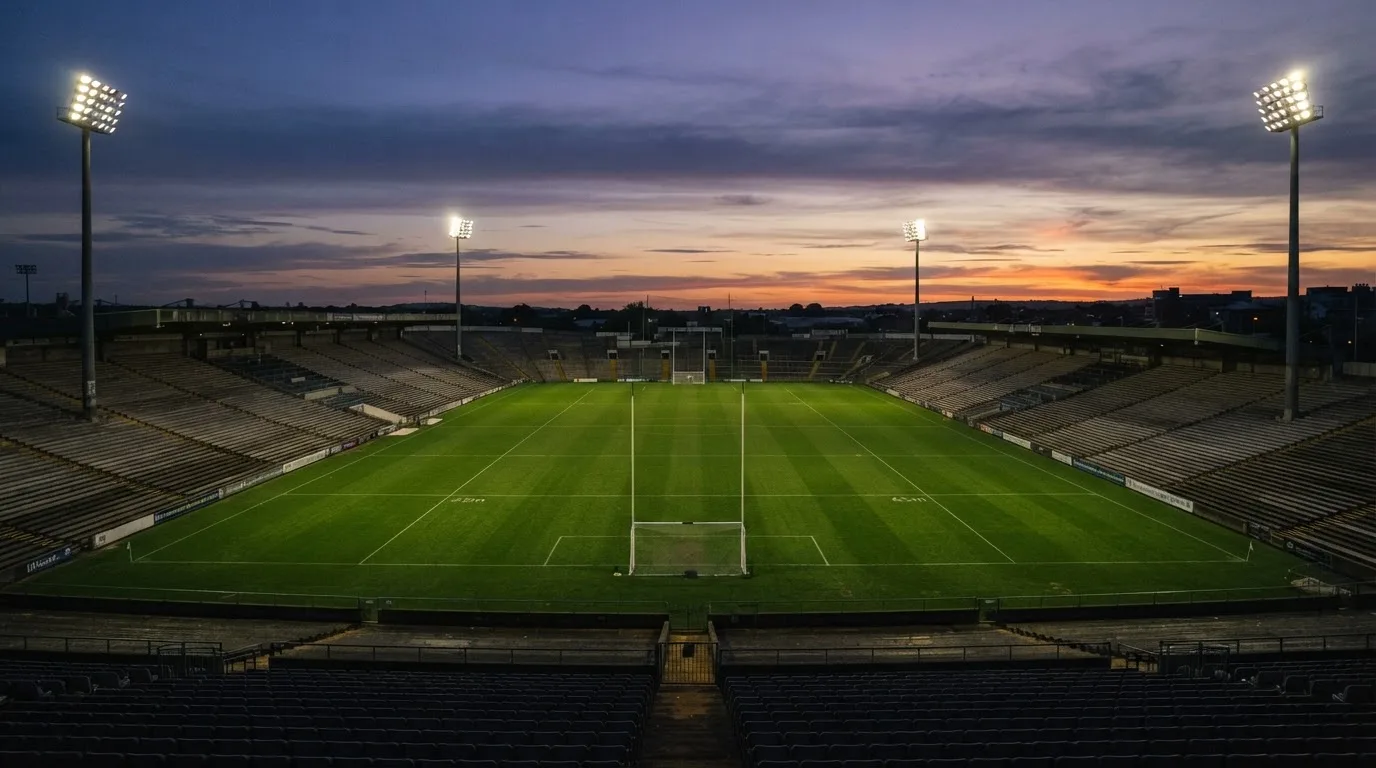
The All-Ireland Senior Football Championship is the senior inter-county knockout, run by the GAA, with the final held at Croke Park, Dublin, each year. The 2026 final, played on 26 July 2026, saw Mayo beat Kerry 1–20 to 1–17 for the county’s fourth title. Kerry hold the record for most All-Ireland Senior Football Championship titles, with 39. The championship’s provincial rounds and the All-Ireland series are the fixtures the betting market prices most heavily, and the televised matches are the ones the live markets cover most fully.
The senior inter-county match lasts 70 minutes, two 35-minute halves. Most other adult matches last 60 minutes, two 30-minute halves. The punter pricing a total points market off the duration of the match is pricing the right duration for the right fixture, and the two are not interchangeable.
The provincial championships and the National League
The provincial championships — Leinster, Munster, Connacht and Ulster — are the route into the All-Ireland series, and they run from late spring into summer. The provincial finals are televised and heavily priced. The earlier rounds are thinner in the market and live betting is patchier.
The National League runs through the winter and spring, with division 1, 2, 3 and 4 tiers, and a final at Croke Park. The league is a slower-burn fixture list with more matches and less of a knockout shape, and the betting market treats it as a form guide for the championship rather than a tournament in its own right. League matches are televised less often than championship matches, and the live markets are thinner.
The club championships
The club championships — the All-Ireland Senior Club Football Championship and its provincial feeders — run alongside the inter-county season and are a separate market. Club matches are harder to price, the squads are less well-known to a UK punter, and the live markets are sparse. A punter who treats a club fixture as a smaller version of an inter-county fixture is mistaking the structure of the competition. The teams are different, the pitches are different, and the bookmaker’s data is thinner.
The pitch and the GAA’s own geography
The Gaelic football pitch is a rectangular grass pitch 130 to 145 metres long and 80 to 90 metres wide, larger than a soccer pitch and oriented differently. A punter pricing a total points market on the assumption that the pitch behaves like a Premier League pitch is using the wrong reference, and the bookmaker’s data on GAA-specific home advantages is built from the right one. The home advantage in Gaelic football is large and well-documented, and a tip that ignores it is a tip that has not done its reading.
Ten UK-licensed bookmakers for Gaelic football
The ten bookmakers below are listed on the Gambling Commission’s public register against a licensee holding a remote betting licence for Great Britain. A place on this list is not a recommendation. It is a confirmation that the operator holds the licence the Gambling Act 2005 requires of any operator whose remote facilities are used in Great Britain. Several of the brands run under larger groups, and a few run under the same licensee — a punter comparing offers across them is comparing the marketing of one operator with the marketing of another, and the licence is the floor that holds for all of them.
The table below shows each operator, the Gambling Commission account number and licence holder, and what the operator’s own terms state on the offer. The punter’s job is to compare the offer, read the terms in full, and check the operator’s safer-gambling tools before staking.
| Brand | Gambling Commission licence | What the operator’s own terms state |
|---|---|---|
| Tote | Account 54779, held by TDCO Limited | Pool-betting operator with a long history on UK and Irish racing; Best Odds Guaranteed on UK and Irish horse racing from 8am on the day of the race, on single and multiple bets; the rule does not apply to ante-post, tote or pari-mutuel bets |
| Fafabet | Account 57385, held by Taichi Tech Limited | Best Odds Guaranteed on UK and Irish horse racing win and each-way bets from 9am on race days, paying the bigger of the starting price and the original price |
| Kwiff | Account 44448, held by Eaton Gate Gaming Limited | Supercharge feature can instantly boost the odds on a bet, for example from 2/1 to 20/1, on single or multi bets on any sport |
| DAZN Bet | Account 48756, held by DZBT Limited | Deposits start at £5 by debit card, Apple Pay, Paysafecard, Trustly and Skrill, and at £20 by PayPal, with no processing fees stated |
| Smarkets | Account 39173, held by Smarkets (Malta) Limited | Betting exchange licensed as a remote betting intermediary, with two-factor authentication, live charts, an order book view, a quick trade-out option and 24/7 live chat support |
| Bet Ahoy | Account 100094, held by Bet Ahoy Ltd | 10% Acca Bonus up to £1,000, Sub-Cover for player substitutions, Best Odds Guaranteed on UK and Irish horse and greyhound racing up to £100, and Double Result payout on UK and Irish racing |
| BetTom | Account 64959, held by Bet Tom Limited | Sports welcome offer is 50% back as a free bet of up to £50, with a parallel 50% back up to £50 as free slot funds for casino play; full terms apply |
| Dabble | Account 65677, held by Dabble Sports UK Ltd | Welcome offer is Bet £10, Get £10 in Free Bets on a first deposit for new customers, with minimum odds applying, a 7-day free bet expiry and the stake not returned |
| BetUK | Account 39198, held by LeoVegas Gaming PLC | Free bets exclude virtual sports, esports and non-UK/IE horse racing, and minimum odds apply |
| Spreadex | Account 8835, held by Spreadex Limited | New customer offer is £60 in free bets for a £10 fixed-odds bet, with the free bets usable across fixed odds and spread betting; the qualifying bet must be placed within 28 days of opening the account |
The table is the floor. The punter who reads only the headline of an offer reads the marketing of the offer, not the terms, and the marketing is the part the bookmaker has spent the most on. Tote’s BOG starts at 8am; Fafabet’s at 9am. Kwiff’s Supercharge can move a price from 2/1 to 20/1, and the move is a marketing-friendly description of a feature whose typical lift is much smaller. Smarkets runs as a betting exchange, where the punter is trading against other punters rather than against the bookmaker, and the slip, the cash-out button and the price-boost feature of a traditional bookmaker are not the same product. BetUK’s exclusion list — virtual sports, esports and non-UK/IE horse racing — is the kind of small print that decides whether a free bet is usable on the market the punter wants to bet on.
What the licence actually guarantees
A Gambling Commission remote licence means the operator is subject to the LCCP, the social responsibility code, the anti-money-laundering rules, the ban on credit-card gambling, the cap on bonus wagering, the GAMSTOP self-exclusion scheme, the dispute-resolution route, and the source-of-funds checks that apply above the financial vulnerability threshold. A punter at a licensed operator can complain to the Commission, can use an approved ADR body, and can have a dispute resolved by a British-recognised process. A punter at an unlicensed operator has none of these.
The licence does not guarantee a winning bet, a fair price or a tip that comes in. It guarantees the floor, and the floor is the part of the offer the marketing never talks about.
Overview: what a punter on Gaelic football is actually doing
A punter on Gaelic football in 2026 is betting on a thin, televised, GAA-organised market whose senior championship is decided in front of 80,000 people at Croke Park and whose club championship is decided on a Tuesday evening in front of a few hundred. The bookmaker’s margin on the senior championship is tighter than on the club game, the live markets are deeper on the televised fixtures, and the in-running data is patchier than on English football. The tips that circulate are built on form, line-ups and statistics the punter can read, with a margin the punter has to subtract to find the price. The free bets and acca bonuses are a price, not a gift. The bankroll is the punter’s only discipline that compounds.
The page above closes each of those threads in turn, in the order a punter actually meets them: the bonus first, because it is the part of the offer the marketing most loudly mis-sells; the live market second, because the in-running data on Gaelic football is the part of the product most often overestimated; the prediction and staking plan third, because the tip is only as good as the staking that delivers it; the bet types and odds fourth, because the slip is where the punter finally pays the margin; the tournament structure fifth, because a punter who does not know the difference between a senior championship fixture and a club fixture is pricing the wrong match; the operator comparison sixth, because the licensed floor is the one thing the offer has to clear before any of the rest matters.
The honest conclusion of the page is the one that opens it. A Gaelic football tip is an estimate. The estimate is dressed up as a forecast by the marketing, and the punter who pays for the dressing pays for the marketing. The bookmaker’s margin is the price of being wrong, the staking plan is the cost of being right slowly, and the licence check is the one move that costs nothing and changes everything else.
Legality, regulation and the Gambling Commission register
The legal frame for betting on Gaelic football in Great Britain is the Gambling Act 2005, the Gambling (Licensing and Advertising) Act 2014, and the Licence Conditions and Codes of Practice issued by the Gambling Commission. Northern Ireland is outside the 2005 Act and has its own older law, so a GB licence does not regulate Northern Ireland. Since 2014, an operator whose remote facilities are used in Great Britain needs a Commission licence wherever it is based. A Curaçao, Maltese or Gibraltar licence is not a substitute, and a brand that holds one of those is not licensed to take bets from a punter in Manchester or Glasgow. The register at the Commission’s website is the whole test of who holds a GB licence, and a punter can search it by business name, trading name, domain or account number.
A licence is not a recommendation. The register lists more operators than any single page can cover, and a place on a comparison is not a place on the register. The punter’s job is to confirm the licence, not to assume it.
The minimum age is 18, and the operator must verify the customer’s name, address and date of birth before the first deposit, before the first bet and before the use of any free bet or bonus. There is no anonymous play at a licensed site, and any brand offering anonymous play is not offering it under a GB licence. The credit-card ban, in force since 14 April 2020, covers credit cards and credit-card-funded e-wallet deposits; debit cards and bank-based payments are not covered.
GAMSTOP is the national multi-operator online self-exclusion scheme and a mandatory licence condition for online operators since 31 March 2020. Self-exclusion periods are six months, one year, five years, or five years with auto-renewal; after the minimum period the exclusion stays in place for a further seven years unless the customer asks GAMSTOP to remove it. GAMSTOP covers online sites and apps; betting shops use a separate service. A punter who has self-excluded through GAMSTOP is self-excluded from every licensed online operator, not from one. A punter who has not self-excluded but wants to limit their play can use the operator’s own deposit limits, time-out and product restrictions without enrolling in GAMSTOP.
The financial vulnerability check, in force since 30 August 2024 as LCCP condition 3.4.4, applies to licensed remote betting when a customer’s deposits minus withdrawals exceed £150 in a rolling 30-day window (in force since 28 February 2025). The check is a public-record check, not an income check, not a credit reference check, and not a tax check. Financial risk assessments, sometimes called affordability checks in the press, have been announced in a staged plan with no start date set. Deposit limits, set by the customer on a fixed time frame, are a separate tool and have been a licence requirement since 31 October 2025, with a second phase postponed to 30 September 2026. The state does not set a deposit or loss ceiling for betting; limits are the customer’s choice.
The player pays no tax on betting winnings in Great Britain. The bookmaker pays General Betting Duty, currently 15% on gross profits, with a remote rate of 25% applying from 1 April 2027 within the same duty on the remote slice of the book, while remote bets on UK horse racing, pool betting and in-person betting stay at 15%. The duty is the operator’s tax, not the punter’s, and whether the operator passes it on through the odds is not established. The Commission’s statutory levy is a separate charge, again the operator’s, not the punter’s.
Betting on an unlicensed site is not a criminal offence for the customer. It is, however, a position with no Commission complaints route, no ADR body, no GAMSTOP coverage, no 10x bonus cap, no £150 vulnerability check, and no British-recognised dispute resolution if funds are withheld. The honest framing is that licensed means checks, limits, GAMSTOP and the bonus cap, and unlicensed means none of those and a real chance of loss of funds. Neither is “the safe choice” by default.
Safer gambling tools and the help that is actually free
A licensed operator has to provide deposit limits, time-outs, product restrictions and self-exclusion, and the bigger operators add a Player Profile test, a budget calculator, a session timer and a reality-check pop-up. The tools vary by operator; the existence of the tools does not. Unibet’s safer-gambling page, for example, lists deposit limits, the Player Profile test, product restrictions, self-exclusion, live chat support and links to BeGambleAware, GamCare, GAMSTOP, Gambling Therapy and the BGC. Other licensed operators offer a similar set, with the same destination links.
The help that does not run through the operator is GamCare, which runs the National Gambling Helpline; GambleAware, which funds research and treatment; the NHS gambling clinics, which run in several regions; and Gamblers Anonymous, which runs peer-support meetings. A punter who is betting more than they can afford, who is chasing losses, who is hiding their betting from someone close to them, or who is betting to recover a loss, is a punter for whom the help line is cheaper than the next bet.
The punter who has self-excluded through GAMSTOP and is trying to find a way back in is the punter for whom the page above has nothing to offer. The offer was the self-exclusion. The follow-through is the self-exclusion holding.
Crypto, anonymity and the Gaelic football market
Gaelic football is not a market the cryptocurrency-friendly bookmaker has built around. The licensed UK operators in the table above are licensed by the Gambling Commission, and the Commission’s money-laundering rules require the operator to verify the customer, identify the source of funds and, above the financial vulnerability threshold, run the public-record check. A cryptocurrency deposit, depending on how it is processed, can fail the verification step or the source-of-funds step, and a licensed UK operator is not the venue at which a pseudonymous crypto bet on a GAA match is the easy product.
A brand that markets itself as a crypto bookmaker, accepts deposits in bitcoin or other cryptocurrencies, and does not hold a Gambling Commission licence is not licensed to take bets from a punter in Great Britain. The punter who opens an account with such a brand has no Commission complaints route, no ADR body, no GAMSTOP coverage, no British consumer redress if funds are withheld, and no recourse to the 10x bonus cap. The brand is also outside the LCCP, so its safer-gambling tools are voluntary, its bonus terms are not capped, and its verification threshold is its own. The brand is not “the same” as a licensed operator with a slower deposit route; the brand is an offshore product with offshore protections, and the punter pays the difference in consumer protection rather than in margin.
The licensed route is the only route under which a punter in Great Britain has the consumer protections the Gambling Act 2005 sets out. A punter who wants to bet in cryptocurrency on Gaelic football and who wants the GB protections cannot have both, because the two products are not the same product. The honest reading is that the licensed route is the route the regulation covers, and the offshore route is the route the regulation does not.
A note on the worked margin
The margin that sits inside every price on a Gaelic football market is the commission the bookmaker keeps, and the punter who does not see it pays it. A two-way market priced at 1.90 / 1.90 (decimal), equivalent to 9/10 on each side in fractional odds, is a useful illustrative example because the symmetry makes the arithmetic easy to read.
The payout share on a 1.90 / 1.90 market is 1 divided by the sum of the inverse odds. The inverse of 1.90 is 0.5263, and the sum of the two is 1.0526. The payout share is 0.9500, or 95.0% of every pound wagered. The bookmaker’s margin, calculated as 1 minus the payout share, is 5.0%.
A 5.0% margin is a band rather than a single number, and the band moves with the sport, the market, the bookmaker and the time of day. On a tighter market — a televised All-Ireland fixture, a heavily-liquidityed match result — the margin can sit closer to 3% to 4% on the win market. On a thinner market — a club fixture, a handicap line, a bet-builder leg — the margin can sit closer to 8% to 10%. The 5.0% figure is the central case for the kind of price the punter most often sees, and the band around it is the range the punter most often pays.
The punter’s edge, if any, has to clear the margin. A tipster who picks winners at a 55% rate on a 1.90 / 1.90 market is, after a 5.0% margin, picking winners at a rate that returns the punter less than the stake. A tipster who picks winners at a 60% rate is, after the same margin, returning the punter more than the stake. The break-even rate on a 5.0% margin is 52.6%, and the punter’s estimate of the tipster’s strike rate is the difference between a useful tip and an expensive one. The honest read of any Gaelic football tip is that the punter is betting on whether the tipster is more than 52.6% right, and the answer to that question is not on the slip.
Frequently asked questions
How does a punter bet on Gaelic football?
A punter opens an account with a Gambling Commission-licensed bookmaker, completes the age and identity verification, deposits by a method the operator accepts, and selects a market on a senior inter-county fixture, a provincial championship match, a National League game or a club championship tie. The basic markets are match result, handicap, total points and the next-score market in-play. The slip carries the stake and the odds, the bookmaker takes the bet and the result settles at full time or at the conclusion of the chosen market.
What is a value bet and why is no tip ever certain?
A value bet is a price that is larger than the true probability of the outcome, once the bookmaker’s margin is taken out. A tip is one person’s estimate of that probability, expressed as a recommended price. No tip is ever certain because every probability is an estimate and every estimate is wrong by some amount. The punter who acts on a tip is betting that the tipster is less wrong than the bookmaker by more than the margin, and the punter who treats a tip as a forecast is treating an estimate as a fact.
What is the bookmaker’s margin and how can it be seen in the odds?
The bookmaker’s margin is the slice of every unit bet that the bookmaker keeps on average across all outcomes of a market. It is the difference between 100% and the payout share, where the payout share is the sum of the inverse odds. A two-way market priced at 1.90 / 1.90 (decimal) carries a payout share of 95.0% and a margin of 5.0%; the same calculation on a 1.85 / 1.85 market gives a margin closer to 8.1%, and on a 1.83 / 1.83 market closer to 9.3%. The margin is a band, not a number, and the punter who does not see it in the odds pays it on the slip.
How is the return on a bet worked out from the stake and the odds?
The return on a winning bet is the stake multiplied by the decimal odds, with the stake included. A £10 stake at 3.50 returns £35, of which £25 is profit. A £10 stake at 1.50 returns £15, of which £5 is profit. A free bet whose stake is not paid back returns the profit only: a £10 free bet at 3.50 returns £25. A combination bet, sometimes called an accumulator, returns the stake multiplied by the product of the odds of each leg, with the stake included. The return is paid after the bet settles; the cash-out value is the bookmaker’s price for closing the bet early and is usually lower than the settled return.
How can a punter check that a bookmaker holds a Gambling Commission licence?
The Gambling Commission’s public register is searchable by business name, trading name, domain or account number, and the licence number is on the operator’s own terms page, usually in the small print at the bottom. The register confirms the licence category — remote general betting standard, remote betting intermediary, pool betting, and so on — and the licence holder. A brand that does not appear on the register, or that appears under a different name, is not licensed to take bets from a punter in Great Britain. The register is the whole test.
Which safer-gambling tools does a licensed bookmaker have to offer?
A licensed operator must offer deposit limits, time-outs, product restrictions and self-exclusion, and the operator must enrol the customer in GAMSTOP on request. The bigger operators add a Player Profile test, a budget calculator, a session timer and a reality-check pop-up, and the safer-gambling page links to GamCare, GambleAware, GAMSTOP, Gambling Therapy and the BGC. The help that runs outside the operator is the National Gambling Helpline at GamCare, the NHS gambling clinics and Gamblers Anonymous. The tools are free, they are mandatory, and the punter who does not use them is the punter who pays the bill the tools would have written off.
Rugby, cricket & Gaelic – Cricket betting
Content created by the «Cricket betting» team
