
How much does a boxing bet really cost the punter in 2026?
 Available in US
Prices current as of 27 October 2026; Gambling Commission public register and operator terms checked on the same date. Every figure is decimal odds unless stated.
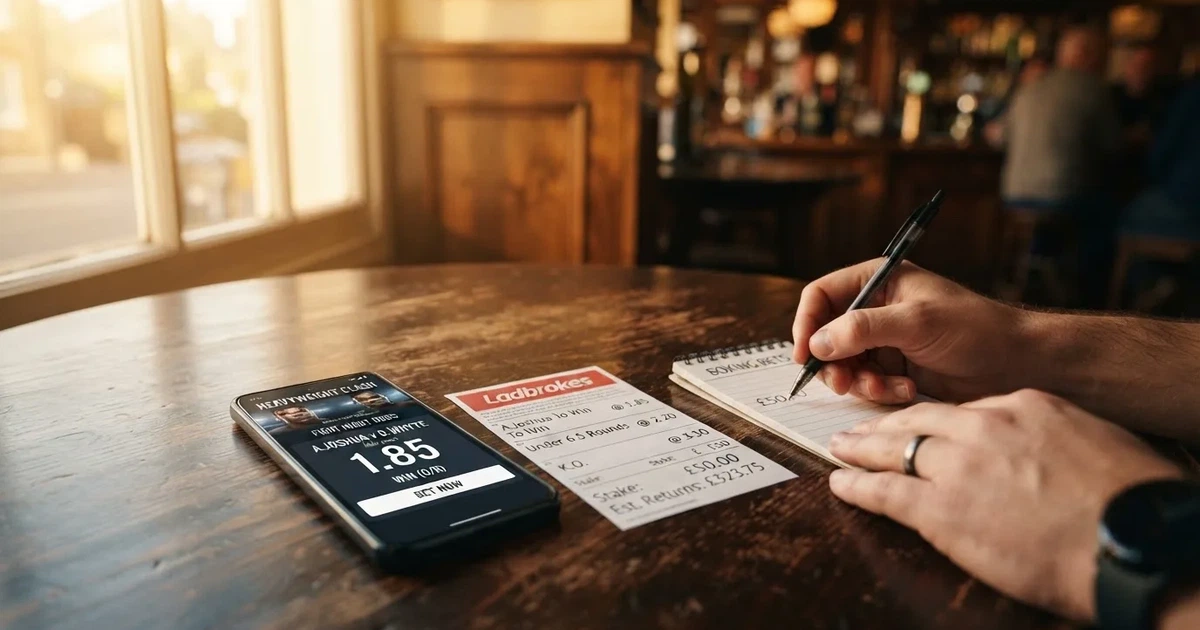
The number in the betting slip is not the number that matters. What sits underneath it — the bookmaker’s margin, the qualifying price on a “free” bet, the deadline, the cap on winnings, the rule on stake size — is the page’s subject. A punter who reads only the price is paying a fee they never see; a punter who reads the price and the layer under it knows what the bet costs before placing it.
This page works through that cost. It starts with the offers and the apps that shape the everyday experience of a £10 or £20 boxing punter, moves into live markets and the way in-play pricing is built, then the bet types — singles, accas, method-of-victory, round groupings, the betting exchange layer. From there, the sport itself: the bout formats, the sanctioning bodies, the calendar, and how a bookmaker turns a 12-round title fight into a market menu. Ten UK-licensed bookmakers follow, then the rules of who is allowed to take a bet in Great Britain, who pays no tax on winnings, what the credit-card ban and the GAMSTOP rule do, and how an unlicensed site differs from a licensed one in plain, non-alarmist terms. The crypto and anonymity question — boxing betting with bitcoin, litecoin, or any coin — is answered last, with the law it meets in the UK.
Welcome Offers and Free Bets in Boxing: What the Marketing Word Leaves Out
Every major UK bookmaker runs a sports welcome offer aimed at the new account holder, and the headline shape repeats: place a qualifying bet, receive a free-bet bundle, sometimes credited in chunks, sometimes paid as a single balance. The headline number is the free-bet total — £20, £30, £40 — and the qualifier is the thing to read.

Unibet’s sports welcome is “Get £40 in Free Bets when you bet £20”: a deposit and a sports bet of £20 or more at minimum odds of 2.0 (1/1), free bets expiring within 7 days of issue, restricted to new GB customers using a debit card or instant bank transfer. Coral’s sports welcome is the same shape — a £20 qualifying bet at minimum odds 2.0 (1/1) releases £40 in free bets within 7 days, expiring 7 days after issue, with opt-in required. The structure rewards the punter who places the qualifying bet on something they would have bet on anyway, and quietly punishes the punter who places it on a long shot just to unlock the bundle: at minimum odds of 2.0 the wagered bet has to be on something the bookmaker is roughly indifferent about, and the cost of “unlocking” £40 in free bets is the qualifying stake laid at a price that, on a long shot, the punter would not have picked.
BoyleSports offers £20 in free bets for a £10 qualifying bet on its UK app — a smaller qualifier for a smaller free-bet bundle, with an Irish-version parallel offering €30 in free bets for a €10 bet. Hollywoodbets structures a welcome differently: a £10+ deposit by card returns the stake as a free bet of up to £30 on the first qualifying losing accumulator (3+ legs, odds 4/1 or greater, settled within 7 days, one free bet per customer). That is a refund as a free bet, not a refund in money — a distinction the marketing tends to flatten. A £30 free bet whose stake is not paid back with a win is, on average, worth less than £30 in cash; the freebet-value formula on a long-priced acca decides how much less.
The free bet itself is governed by rules that the marketing does not name. Free bets are usually settled as stake-not-returned: a winning £10 free bet at odds 4.00 returns £30 profit, not £40. A free bet expires — Unibet and Coral use a 7-day window from issue. A free bet cannot be split across multiple selections in the same way as cash. A free bet is one-shot in a promotion that hands out a small handful: the punter who treats the bundle as a string of small, considered bets on fights they have already priced gets more from it than the punter who lets the bundle sit until the last day and lays it on whatever happens to be live.
Beyond the welcome, two recurring free-bet forms matter. Acca insurance refunds a losing accumulator as a free bet if exactly one leg lets the punter down. Enhanced odds / price boosts raise the headline price on a specific outcome, often the favourite in a high-profile fight, with the boost stake usually capped — Unibet, bet365, William Hill all run recurring boosts with stated maximum stakes. Each of these pays a smaller free-bet bundle on tighter terms; the cost is the cap on what can be staked, which the marketing copy does not foreground.
The post-19 January 2026 rule caps wagering requirements on bonuses at 10x: a £10 bonus at 50x rollover would have demanded £500 of qualifying bets, and under the cap that shape can no longer be offered. The cap does not yet cover free bets with no wagering condition, and there is no published cap on the pound value of a bonus — read the figure, then read the small print, and the small print is where the offer is paid for.
Accumulators and Acca Boosts in Boxing
Boxing accas are a small sport for the form — the weekly card carries fewer fights than a Premier League Saturday — so most punters string two or three bouts, occasionally four. William Hill’s Football Acca Boost shows the shape, even though it is a football promotion: 2+ legs at minimum odds 1/5 each, a 3% boost on a double rising to 200% on 20+ legs, maximum boost £10,000 per online bet, in force until 30 May 2027. Boxing accas are typically boosted at the short end of a similar curve: 3 legs at minimum combined odds of around 6.0 (5/1) is the usual pattern, and a small boost (5–25%) is paid as cash winnings, not free bet. The boost is paid in addition to the normal return, capped, and the maximum combined stake on the boosted acca is set by the operator.
The hidden cost is the same on every bookmaker: the accumulator multiplies margins, leg by leg, into one final price. A six-leg acca with a 5% margin per leg does not have a 5% margin — it has a 1 − (0.95^6) margin, roughly 26%, before the boost. The boost has to clear that before it makes the punter money, and a 10% acca boost on a 26%-margin price is, on average, still a losing structure. The acca is fun; the arithmetic is what the boost has to beat.
How to Read a “Risk-Free” or “Stake Back” Offer
Two words recur. “Risk-free” and “stake back” almost always mean a free bet refund, not a cash refund. Hollywoodbets’ losing-accumulator refund is the shape: cash stake on a losing qualifying bet, free bet back if the conditions are met, free bet settled stake-not-returned if it wins. A free bet refund carries the same expected value as a free bet welcome; the reader who treats “risk-free” as “no cost” is treating the offer as a gift. It is a credit, with a price, on terms.
Boxing Betting Apps: The Mobile Layer and What It Costs in Friction
A betting app is now the everyday way to place a boxing bet in the UK. Every brand in the comparison below ships an iOS app; most ship an Android app, with browser-based mobile fallback for the rest. The quality of the app matters because a boxing card is short — a main event, a co-main, three or four undercard fights — and the punter needs to find the bout, place the bet, and reach in-play within three taps.
bet365’s app, described in its App Store listing as the most downloaded sports betting app in the UK, pairs Bet Builder+ (combining markets from one event into a single bet, pre-match and in-play), Super Boosts, Winnings Boosts on Bet Builders and selected singles, and daily Bet Boosts with the in-play screen, live streaming of events worldwide, and a live tracker for following bets in play. William Hill ships its app with Best Odds Guaranteed on UK and Irish horse racing from 8 AM on race day. Betfred’s app, published by Done Brothers (Cash Betting) Ltd, covers 21 sports and over 2,000 casino-style games. DragonBet’s app is published by DragonBet Ltd, features Welsh football and rugby markets, racing, American football, in-play and bet-builder markets — a regionally-weighted sportsbook that nonetheless offers a full boxing menu.
Hollywoodbets, BoyleSports and Bet600 all publish UK apps; their stores are the practical place to compare a welcome offer’s small print before the punter deposits. Coral’s app inherits the Ladbrokes/Coral/LC International parent — the same parent as Gala Bingo and a wider LC International family — and shares the technical backbone across its brands.
The friction that costs the punter sits in three places. Verification. A licensed operator checks name, address and date of birth before the first deposit or bet (a rule in force since 7 May 2019, including with a free bet or bonus). The first deposit takes longer than a free-trial sign-up. Deposit floors. DAZN Bet deposits start at £5 by debit card, Apple Pay, Paysafecard, Trustly and Skrill, and at £20 by PayPal, with no processing fees — a typical floor across the market, and one that nudges the punter who wants to lay a small bet towards a debit card rather than PayPal. App permissions and notifications. A push-notification pop-up is not a fee, but a betting app that fires one every time a price moves is a friction of a different kind, and a punter who turns notifications off is a punter who misses the live price move on the fight they were waiting on.
The cost the app rarely flags is the betting exchange distinction. Matchbook runs a betting exchange where customers bet against other users; it ships Bet Builder, multiples, in-play betting and live streaming of horse racing and greyhounds. An exchange price has a smaller margin than a traditional bookmaker’s price because no bookmaker margin sits inside it — the back and lay prices are the market’s own. The punter pays for that in liquidity: a £2,000 lay on a less-popular undercard fight may not be matched, while the same stake on a Fury-Usyk main event clears in seconds. The exchange is the right tool for a punt on a price the punter considers wrong; the traditional bookmaker is the right tool for a punt on a fight the punter is reading better than the market.
Live Boxing Betting and Cash Out: Pricing the Unfinished Fight
A boxing bout is short, and a boxing in-play market is sharper than a football in-play market for one reason: the fight ends. A first-round knockout in a heavyweight title fight collapses the entire market to one outcome within three minutes, and the bookmaker’s algorithm has to reprice in real time. That makes live boxing betting both more interesting and more punishing to a punter who acts slowly.
GB bookmakers offer in-play boxing; the controls are the operator’s licence conditions and customer-protection duties, not a statutory framework. In practice the in-play market is a list of method-of-victory and round-grouping prices that move with every clean punch landed and every clinch. Method-of-victory prices swing hardest after a knockdown; round-grouping prices swing hardest after a cut opens and the doctor’s check is called.
Cash out is the bookmaker’s offer to settle the bet early at a price it sets. The cash-out price is the bookmaker’s own quote of what the bet is worth at that moment — it is not the price the punter could get on the exchange at the same time, and it is usually a worse price, because the cash-out quote carries the bookmaker’s own margin. The punter who cashes out a winning bet at a falling price has taken the bookmaker’s quote rather than letting the bet run; the punter who cashes out a losing bet to recover a fraction of the stake has paid the bookmaker to close a position. Cash out is a price the bookmaker names; the punter chooses whether to take it.
The cost in this corner of the market is the speed of the reprice. A cash-out quote updates every second on the betting app; the punter’s calculation of whether to take it is a slower calculation, and the bookmaker knows that. The punter who sets a cash-out threshold in their own head before the fight — “I take the cash out if it reaches 1.5 times my stake” — pays a smaller psychological price than the punter who watches the figure move and decides in the moment. The in-play market is honest; the cash-out button is a bookmaker’s price, with the same margin as any other bookmaker’s price.
A second cost sits in the market shape. Not every bookmaker offers in-play boxing; those that do offer fewer markets in-play than they do pre-match — method of victory and round groupings are common, while a “fight to go the distance” market is sometimes missing. The punter who plans to bet in-play on a method-of-victory market should check the bookmaker’s in-play menu before the first bell, not after.
How In-Play Boxing Prices Are Built
The bookmaker’s starting prices are set by a trader’s read of the form, the punch stats, the betting patterns of the wider market. Once the fight starts, the algorithm takes over: punch counts, landed shots, knockdowns, point deductions and the judges’ scorecards (when available) feed the price, and the bookmaker’s margin sits inside every new quote. The punter who reads the algorithm’s biases — a bookmaker that over-reacts to a single jab on a stats feed, an algorithm that has not yet priced in a cut over the eye — finds a thinner market; the punter who reads the bookmaker’s quote at face value is the punter the bookmaker is paid to find.
Boxing Betting Tips, Predictions and Strategy: What a Tip Is Worth
Boxing is one of the easier sports to read on form and one of the harder sports to read on outcome. The form is public: a fighter’s record, knock-out ratio, recent opponents, weight, reach, age, and the sanctioning body’s rankings are available in advance. The outcome is private: a single punch can end a fight, a single cut can stop a fight, a single bad round can swing a decision. A tip that reads the form is a good tip; a tip that reads the outcome is a guess.
Bankroll management is the strategy that does not require a model. A punter who bets 1–2% of a stated bankroll on a single fight, who keeps a record of every bet placed, and who reads the closing line — the bookmaker’s last price before the fight — is a punter who improves over years, not weeks. The closing line is the bookmaker’s best read of the fight; the punter who consistently takes prices better than the close, across hundreds of bets, is beating the bookmaker’s model. A punter who takes prices worse than the close, consistently, is paying the bookmaker a fee on every bet and not knowing it.
Value is the second strategy. A price of 2.50 (3/2) on a fighter the punter rates as a 50/50 shot — a 50% implied chance of winning — is a value bet: the punter’s estimate is better than the market’s. A price of 1.50 (1/2) on a fighter the punter rates as 50/50 is not a value bet, regardless of how the fight goes. Value is a relationship between a price and an estimate; it is not a property of the price alone, and the punter who bets on the favourite because the favourite is the favourite has not asked the only question the price can answer.
The third strategy is the betting exchange. An exchange price reflects the market of other punters, not a bookmaker’s margin. Matchbook and Betfair run exchanges licensed by the Gambling Commission as betting intermediaries. A punter who can lay a fighter — bet against the fighter winning — at a price they consider too short is using the exchange as a value tool, and the cost is the commission charged on net winnings.
A tip service is a different product. A tipster who sells picks sells words; the punter pays for the words and judges the tipster by return on investment, sample size, and the staking discipline the tipster recommends. A tipster with a long record, a stated staking plan, and an audited return is a different product from a tipster with a handful of highlighted wins and no losses shown. The former is a subscription; the latter is marketing. The punter who pays for tips pays for a record the punter can read; the punter who pays for a record the tipster is unwilling to show is paying the marketing budget of the tipster, not the tipster’s edge.
Boxing Bet Types and Odds: The Market Menu
Boxing is a market-dense sport for a small fight card. Every fight generates a core set of markets, with a long tail of more specialised prices for the marquee bouts.
Outright (win / draw / method). The market’s most common form: pick the winner, or pick the method (KO/TKO, decision, disqualification). The draw is priced long — the judges split decisions are not common in title fights, and the draw is a regular price at 12.00 to 25.00 (11/1 to 24/1) on a non-marquee bout. A draw bet is a market bet, not a value bet, and a punter who takes a long draw price should know the judges rarely split cards.
Method of victory. A separate price on the method — KO/TKO, decision, technical decision, disqualification. KO/TKO prices shorten as the fight progresses and a cut opens, a fighter’s legs go, or a knockdown is scored. A decision price lengthens when a fight goes deep and the judges’ cards begin to look split.
Round groupings. Round 1–3, 4–6, 7–9, 10–12 in a 12-round bout; or similar in shorter fights. The punter who bets “Usyk in rounds 10–12” is pricing the fighter’s cardio and the bookmaker’s read of it. Round groupings are usually smaller markets with wider margins than the outright, and the price carries that margin.
Fight to go the distance. A yes/no market on whether the fight runs the scheduled rounds. The price is short on a fight between two durable fighters with low KO ratios; long on a fight between a heavy-handed puncher and a fighter with a suspect chin.
Total rounds over/under. A line on the number of rounds the fight lasts, set by the bookmaker. A line of 8.5 rounds means over pays if the fight reaches the bell in round 9; under pays if the fight ends before.
Accumulators / bet builders. Multiple selections priced into a single bet. Boxing accas are typically short — two or three fights, occasionally four — and the bet builder combines markets from one fight. A bet builder on “Fighter A to win in rounds 4–6 AND the fight to end inside the distance” prices two outcomes on the same fight; the legs multiply, and so do their margins.
Each-way. Each-way betting is rarer in boxing than in horse racing, where the place terms are public and the punter knows the place fraction. In boxing, a “each-way” bet is usually a bet on the method (win by KO, win by decision) plus a stake on the fighter to win outright, and the bookmaker’s place terms depend on the operator. Read the small print before laying the bet.
How Boxing Odds Are Priced
A bookmaker’s price on a fighter is the trader’s read of the probability of winning, with the bookmaker’s margin layered on top. A two-way market with no draw — a price on each fighter — implies probabilities that sum to more than 100% once the margin is added. The sum above 100 is the overround. The margin is the overround minus the legitimate probability cost.
For a two-way market at 1.90 / 1.90, the implied probabilities are 1 ÷ 1.90 = 52.63% on each side, summing to 105.26%. The overround is 5.26%, and the bookmaker’s margin is the same 5.26% on this market — a thin book by boxing standards. The punter’s payout share is 1 ÷ 1.0526 = 95.00%; the bookmaker keeps 5.00% of every unit staked on this market, on average, before any account-level offer or boost. The same calculation on a method-of-victory market at 3.00 / 1.50 / 7.00 / 17.00 (KO, decision, draw, DQ) gives an overround nearer 12–15% — a wider margin, because the bookmaker is less sure of the distribution. Round-grouping markets carry wider margins still: the punter pays the bookmaker for the right to bet on a more specific outcome, and the price is a higher-margin price.
The takeaway: the headline price is not the cost; the headline price is the visible part of a market whose margin is set by how the bookmaker prices the rarer outcomes. An outright price of 1.50 on a heavy favourite looks cheap; the cost of a method-of-victory or round-grouping bet at the same event is the cost the headline price hides.
Boxing Betting Exchanges
A betting exchange lets punters back and lay outcomes. Matchbook operates a UK-licensed exchange with Bet Builder, multiples, in-play betting and live streaming of horse racing and greyhounds. The exchange price is the market of other punters’ views, with the exchange’s commission on net winnings layered on top. The exchange is the right tool for a punter who has a view of the price and wants to take the other side; it is the wrong tool for a punter who wants to place a small bet on an undercard fight that has not generated enough market interest. Liquidity is the cost.
Boxing as a Sport: Bouts, Sanctioning Bodies and the Calendar
Professional boxing runs 10 to 12 rounds for most championship bouts, with four-round fights common for newer professionals and six-, eight-, and ten-round bouts filling the middle of a card. Each round is three minutes, with a one-minute rest between rounds. A bout is won by knockout (a fighter cannot continue), technical knockout (the referee, doctor or corner stops the fight), a decision on the judges’ scorecards, or disqualification for fouls. A draw occurs when the judges score the fight level — a rare but priced outcome.
Four sanctioning bodies oversee world championships: the WBA, the WBC, the IBF and the WBO. A “world title fight” sanctioned by one of the four bodies carries a belt and a ranking consequence; a “unified” or “undisputed” fight is a bout contested for the belts of multiple bodies. The sanctioning body affects the title’s prestige, the mandatory-challenger rules, and the schedule. A punter betting on a title fight should know which body is sanctioning it and whether the belt is on the line; the same two fighters can fight for a WBA “regular” title and a WBA “super” title on different nights, and the price the bookmaker sets is partly a read on the sanctioning body’s politics.
The calendar runs year-round, with marquee cards in the UK and US most months, and the heavyweight title picture generating the most betting volume. The middleweight, light-heavyweight and welterweight divisions sit behind the heavyweights for market interest. Women’s boxing has grown as a betting category over the last five years, with championship fights in several weight classes; the market depth is smaller and the margins are wider, because the bookmaker has fewer data points to price from.
Olympics boxing and amateur boxing are a separate market. The Olympics run on a different ruleset, with shorter rounds and a different scoring system; the betting volume is concentrated around the Games and is otherwise small. The punter who follows amateur boxing for its betting edge is a punter betting on a thin market with a wide margin.
How a Punter Reads a Fight Card
A fight card reads from the bottom up. The early undercard fights feature developing fighters with short records; the prices are wider and the markets are smaller, because the bookmaker has less data. The co-main and the main event feature ranked fighters with full records; the prices are tighter and the markets are deeper, with method-of-victory and round-grouping prices accurate enough to beat on a value read.
The punter who reads a card top-down bets the largest stakes on the fights they have priced best, and the smallest stakes on the fights the bookmaker has priced worst — which is usually the early undercard, where the bookmaker’s algorithm is the punter’s main competition. The punter who reads the card bottom-up, betting the heaviest stakes on the undercard because the prices are wider, is paying the wider margin and not getting the bookmaker’s over-reaction in return.
Top 10 UK Bookmakers for Boxing Betting: A Cost-First Comparison
A bookmaker’s offer is not a ranking. The place in a list is not a licence, and the licence is not an offer. What follows is a comparison of the ten brands the Gambling Commission public register lists as holding a remote general betting standard licence for Great Britain, with the offer each one’s own terms state, and a verdict that costs the offer out.
| Brand | Licence and holder | What the operator’s own terms state on the offer |
|---|---|---|
| BoyleSports | Gambling Commission account 39469 (remote general betting standard, real events); Boylesports Enterprise | Sports welcome: £20 in free bets when a £10 bet is placed (UK players); €30 in free bets for a €10 bet (Irish players). UK app available. |
| Hollywoodbets | Gambling Commission account 53028 (remote general betting standard, real events); Hollywoodbets International UK Limited | Sports welcome: new players who deposit £10+ by card get their stake back as a free bet of up to £30 on their first qualifying losing accumulator (stake £10+, 3+ legs, odds 4/1 or greater, settled within 7 days); one free bet per customer. |
| Bet600 | Gambling Commission account 44731 (remote general betting standard, real events); Tyche Tech Limited | Pays Best Odds Guaranteed on horse racing: if the starting price is bigger than the early or show price taken, the bet is paid at the SP. |
| Tote | Gambling Commission account 54779 (remote general betting standard, real events); TDCO Limited | Pool-betting heritage: bets placed into a pool, with payouts determined by the pool size and the winning positions; Best Odds Guaranteed on UK and Irish racing from 8 AM on race day. |
| Unibet | Gambling Commission account 45322 (remote general betting standard, real events); Platinum Gaming Limited, Gibraltar | Sports welcome: “Get £40 in Free Bets when you bet £20” — deposit and sports bet of £20+ at minimum odds 2.0 (1/1), free bets expiring within 7 days, new GB customers using a debit card or instant bank transfer. |
| Coral | Gambling Commission account 54743 (remote general betting standard, real events; remote betting intermediary); LC International Limited | Sports welcome: “Get £40 in Free Bets when you bet £20” — deposit and sports bet of £20+ at minimum odds 2.0 (1/1), £40 in free bets issued within 7 days, expiring 7 days after issue, opt-in required. |
| DragonBet | Gambling Commission account 64908 (remote general betting standard, real events); DragonBet Ltd | App published by DragonBet Ltd, featuring Welsh football and rugby, racing, American football, in-play and bet-builder markets. |
| DAZN Bet | Gambling Commission account 48756 (remote general betting standard, real events); DZBT Limited | Deposits from £5 by debit card, Apple Pay, Paysafecard, Trustly and Skrill, and from £20 by PayPal, no processing fees. |
| Matchbook | Gambling Commission account 39504 (remote general betting standard, real events; remote betting intermediary); Triplebet Limited | Betting exchange: customers bet against other users; Bet Builder, multiples, in-play and live streaming of horse racing and greyhounds; commission charged on net winnings. |
| Betfred | Gambling Commission account 39544 (remote general betting standard, real events); Petfre (Gibraltar) Limited | App published by Done Brothers (Cash Betting) Ltd; covers 21 sports and over 2,000 casino-style games. |
BoyleSports
BoyleSports’ headline is the smallest of the welcome offers in the comparison — £20 in free bets for a £10 qualifying bet — and the lower qualifier is the point. A punter with a £10 bet already in mind lays it at the bookmaker’s terms and walks into £20 in free bets with the lowest possible outlay. The free-bet bundle is settled stake-not-returned in the usual shape, with a 7-day window typical of the market. The Irish parallel offer is irrelevant to a GB punter and the site makes that clear at the registration stage. BoyleSports offers a compelling entry point for those prioritising a lower qualification hurdle, albeit with a free-bet bundle that trails the top-tier £40 offers in total value.
Hollywoodbets
Hollywoodbets’ welcome is the most interesting shape in the comparison, because it is a refund as a free bet, not a free-bet bundle on a settled bet. The punter lays a £10+ acca of 3+ legs at 4/1 or greater, and if the acca loses the stake is returned as a free bet of up to £30. The structure rewards the punter who places an acca they would have placed anyway, and the cost is the qualifier: a losing acca is a losing acca, and the free bet is the only upside. The 7-day settlement window is the deadline, and a free-bet-only refund is a refund whose value the punter has to work out. Hollywoodbets suits a punter who already bets accas; the offer reads as a refund, not a gift.
Bet600
Bet600’s headline is the horse-racing Best Odds Guaranteed promise, not a boxing offer. The price that the punter takes before the off is upgraded to the starting price if the SP is bigger — a guarantee on racing, with boxing not in the BOG frame. The bettor who uses Bet600 for boxing is using a smaller bookmaker with a thinner boxing market, and the cost of that is the price depth on the undercard. Bet600 represents an excellent choice for racing enthusiasts seeking BOG protection; conversely, dedicated boxing bettors will find the platform’s niche focus less advantageous for their specific needs.
Tote
Tote is a pool-betting bookmaker: bets are placed into a pool and payouts are determined by the pool size and the position of the runner. The model is older than the fixed-odds model and produces different odds on the same fight — a Tote price on a heavy favourite will often be shorter than a fixed-odds bookmaker’s price, and a Tote price on a long shot will often be longer, because the pool takes a cut on every bet. Boxing is a small part of the Tote menu, and the punter who wants a fixed-odds price with a small margin is better served elsewhere. Tote caters effectively to those who prefer pool betting dynamics over fixed odds; however, it remains less suitable for bettors demanding precise, method-of-victory market certainty.
Unibet
Unibet’s £40 in free bets for a £20 qualifier is the market’s standard offer shape, with a 7-day expiry on the free bets and a 2.0 (1/1) minimum price on the qualifier. The cost is the qualifier: a £20 bet at 2.0 is a bet on a roughly 50/50 shot, and the punter who places it on a fighter they would have bet on anyway makes the welcome free. The punter who places it on a long shot to clear the qualifier pays a hidden cost in expected value, because a long shot at 2.0 is a mispriced shot, and the bookmaker’s price on a 50/50 outcome is the price the welcome is built around. Unibet is a strong pick for a punter with a £20 bet already priced; the welcome pays the same as Coral’s, and the in-app market depth and the acca-builder product are above the comparison’s median.
Coral
Coral’s welcome is identical in shape to Unibet’s — £40 in free bets for a £20 qualifier at 2.0 (1/1), 7-day expiry, opt-in required. The two products are differentiated by market depth, in-play quality, and the bet-builder product rather than by the welcome. Coral is part of LC International, the same parent as Ladbrokes and Gala Bingo; the apps share a technical backbone and the same in-play engine, and the punter who already has a Coral account inherits the parent group’s offers. Coral remains a compelling contender for those prioritising mobile functionality and market volume on major bouts. While the welcome matches Unibet’s £40 package, the decision between them typically hinges on personal preference regarding interface and specific bet-builder features.
DragonBet
DragonBet’s book is a regionally-weighted sportsbook: Welsh football and rugby, racing, American football, in-play and bet-builder markets. Boxing sits in the menu rather than at the centre, and the depth on the undercard is shallower than the larger bookmakers. The brand is licensed to DragonBet Ltd and is on the Gambling Commission register. DragonBet offers a uniquely regionalised experience, making it appealing for those who prioritise a local feel; meanwhile, it may not be the primary destination for serious boxing enthusiasts.
DAZN Bet
DAZN Bet’s headline is the deposit structure: £5 by debit card, Apple Pay, Paysafecard, Trustly and Skrill; £20 by PayPal; no processing fees. The deposit floor makes DAZN Bet accessible to a punter with a £5 bankroll, and the absence of deposit fees is a small but real cost saving. The bookmaker is licensed to DZBT Limited. DAZN Bet provides exceptional accessibility for those starting with smaller bankrolls due to its low entry threshold, though this comes at the expense of a more limited boxing selection compared to established giants.
Matchbook
Matchbook is a betting exchange, and the comparison is the wrong shape for a like-for-like. The exchange price carries no bookmaker margin — the price is the market of other punters, with Matchbook’s commission on net winnings layered on top. The cost of the exchange is the liquidity: a large lay on a thin undercard fight may not be matched, and a punter who wants to take the other side of a small market is waiting. The exchange is the right tool for a punter who has priced a fight and wants to take the other side at a market price; the bookmaker in the comparison above is the right tool for a punter who wants a fixed-odds price and a deep market. Matchbook stands out as the premier destination for those looking to lay outcomes rather than back them. For traditional back-betting, the exchange environment often provides less value than the pricing available at established bookmakers.
Betfred
Betfred’s app, published by Done Brothers (Cash Betting) Ltd, covers 21 sports and over 2,000 casino-style games — a sports-and-casino product rather than a sports-only book. The bookmaker is licensed to Petfre (Gibraltar) Limited. The boxing market is competitive with the comparison’s median, with method-of-victory, round-grouping and bet-builder markets standard. Betfred is the right pick for a punter who wants a sports-and-casino product in one app; the trade-off is a slightly wider margin on boxing markets than a sports-only bookmaker, because the casino product is part of the same licence and the same terms.
Boxing Betting in the UK: Legality, the Gambling Commission, and the Rule on Offshore
The Gambling Commission (UKGC), a non-departmental public body sponsored by the Department for Culture, Media and Sport, licenses the whole commercial market under the Gambling Act 2005, which covers Great Britain (England, Scotland and Wales). Northern Ireland is outside the Act and has its own older law; a “GB-licensed” bookmaker is not licensed in Northern Ireland, and a punter in Belfast is betting under a different legal frame. Since the Gambling (Licensing and Advertising) Act 2014, an operator whose remote facilities are used in Great Britain needs a Commission licence wherever it is based (sections 33 and 36 of the 2005 Act as amended); a Curaçao, Maltese or Gibraltar licence is not a substitute. There is no state monopoly and no cap on the number of licences.
The Commission’s public register can be searched by business name, trading name, domain or account number and is the whole test of whether a brand holds a licence. Every brand in the comparison above is listed against a remote general betting standard (real events) licence. Licensed operators use .com as well as .co.uk, so the domain proves nothing — a brand at example.com may be licensed; a brand at example.co.uk may not be. The register is the check.
There is no statutory list of permitted sports or markets. An operator holds a licence for a category and offers markets under its own rules and the Licence Conditions and Codes of Practice (LCCP). In-play betting, esports, virtual events, novelty markets and politics are all on offer; the controls are the operator’s licence conditions and customer-protection duties, not a statutory prohibition list. The punter is betting on whatever the licensed bookmaker offers; the bookmaker is licensed to offer whatever fits its category and its LCCP.
Betting exchanges — Matchbook, Betfair — run under a remote betting intermediary licence, a separate category from the general betting standard. Rates and rules specific to exchanges are stated only from each exchange’s terms. Financial spread betting, where the punter bets on a price moving up or down rather than on an outcome, is regulated by the Financial Conduct Authority, not the Gambling Commission, and losses can exceed deposits. A punter who bets on boxing with a financial spread betting product is using a different licence and a different rule; the losses can be larger than the stake.
The minimum age to bet is 18. A licensed operator checks name, address and date of birth before a customer can deposit or gamble (in force since 7 May 2019), including with a free bet or bonus. The punter who wants to bet anonymously cannot, at a GB-licensed site. A punter who bets at an unlicensed site can, but loses the protection that comes with the licence: no GAMSTOP coverage, no Commission complaints route, no approved dispute-resolution body, no British consumer redress if funds are withheld, and no application of the 10x bonus cap or the £150 vulnerability check. Honest framing: licensed = checks, limits, GAMSTOP, bonus cap, but also verification before the first bet; unlicensed = none of those protections and possible loss of funds. Neither is the “safe choice” by default.
What May Be Bet On
The question “is it legal to bet on boxing in the UK?” has a clean answer: yes, at a GB-licensed bookmaker, with the same identity-verification and self-exclusion rules as any other sport. Boxing is a permitted event under the remote general betting standard (real events) licence category; a bookmaker with the licence may offer the sport, and may offer in-play, method-of-victory and round-grouping markets, subject to its own terms and the LCCP.
The question “is it legal to bet on yourself in boxing?” is harder. Betting on a contest in which a participant has influence over the outcome is a question for the sport’s governing bodies and the Gambling Commission’s licence conditions. A boxer who places a bet on their own fight is acting against the rules of the sanctioning bodies, and the bookmaker’s anti-fraud controls will flag and void a bet identified as self-placed. The legal exposure is on the operator and the participant; the punter who backs a fighter on the basis of inside information is in a different category, and the law is silent on that corner in a way the page will not paper over.
Advertising, the CAP Code, and the Bonus Cap
Advertising is not licensed by the Gambling Commission. It runs through the CAP Code (non-broadcast) and BCAP Code (broadcast), enforced by the ASA, alongside the LCCP marketing conditions. CAP Code section 16: marketing must be socially responsible, must not be of strong appeal to under-18s, and no one who is or seems to be under 25 may be featured gambling or play a significant role (with an exception for marketing placed where a bet can be made directly). That rule concerns who may appear in the advertisement, not who may bet.
Promotion rules in force since 19 January 2026 cap wagering requirements on bonuses at 10x: a £10 bonus at 50x would have demanded £500 of qualifying bets, and under the cap no more than £100 of wagering is required. Mixed-product promotions — an offer that requires gambling on two or more product types, such as “bet on football to get free spins” — are banned. Whether the cap applies to free bets with no wagering condition, and any cap on the money value of a bonus, are not established. The punter who reads a £40-in-free-bets welcome does not see the cap, but the cap is the reason a £40-in-free-bets welcome is the shape it is.
The “whistle-to-whistle” rule is an industry code, not law: since 1 August 2019, betting advertisements are not shown on TV from five minutes before a live sporting event to five minutes after it, before the 9pm watershed (horse and greyhound racing excluded). The Premier League clubs’ withdrawal of gambling sponsorship from the front of matchday shirts from 2026/27 (sleeves and hoardings remain) is voluntary, not law. Neither rule governs what a punter does; both shape the marketing a punter sees.
Tax
The punter pays no tax on betting winnings in Great Britain. The operator pays General Betting Duty, currently 15% of gross profits, with a remote betting rate of 25% from 1 April 2027 alongside a continuing 15% rate for in-person and pool bets. Until that date the remote rate stays at 15%; whether operators pass duty through to odds is not established, and the punter is not charged duty. A professional gambler — a person whose betting is a trade — should ask HMRC or a tax adviser; the rules for trades differ from the rules for casual betting.
Responsible Gambling and Player Protection
A licensed UK bookmaker is required to provide tools the punter can use to limit spend, time, and loss. The framework is built on the LCCP, the Remote Technical Standards (RTS), and the operator’s own safer-gambling policies.
GAMSTOP is the national multi-operator online self-exclusion scheme and a mandatory licence condition for online operators since 31 March 2020. A punter who registers with GAMSTOP is excluded from all GB-licensed online betting and casino sites for a chosen period — six months, one year, five years, or five years with auto-renewal. After the minimum period the exclusion stays in place for a further seven years unless the punter asks GAMSTOP to remove it. GAMSTOP covers online sites and apps; betting shops use a separate service. A punter who self-excludes is not betting at a licensed site for the duration of the exclusion; the punter who bets at an unlicensed site during a GAMSTOP exclusion is betting at a site not bound by the GAMSTOP contract.
A financial vulnerability check (LCCP condition 3.4.4, in force since 30 August 2024) applies to licensed remote betting when a customer’s deposits minus withdrawals exceed £150 in a rolling 30 days (the threshold came into effect on 28 February 2025). The check is a public-record check (for example, bankruptcy or county court judgments), not an income check and not a credit reference check. The punter who hits the threshold is asked for a one-time check; the punter who clears the check continues to bet. Financial risk assessments (the “affordability checks” of the press) are announced in a staged plan, with no start date — the page writes “announced, staged, no start date” and not “in force”.
Deposit limits (RTS 12) are a customer-set limit on a fixed time frame, which the operator must offer. The first changes applied on 31 October 2025; a second phase was postponed to 30 September 2026, and whether it is in force is not established. The punter who wants a deposit limit can set one with the bookmaker; the punter who does not set one is betting on the bookmaker’s default. There is no state-set deposit or loss ceiling for betting: limits are the customer’s choice. The punter who sets a £50 weekly deposit limit and the punter who does not are using the same tools, in different ways.
Help exists outside the bookmaker. GamCare runs the National Gambling Helpline. GambleAware funds treatment and education. The NHS runs gambling clinics across Great Britain. Gamblers Anonymous runs peer-support meetings. The punter who is worried about their own betting or someone else’s can call any of these; the licensed bookmaker’s safer-gambling page links to the same set.
A punter who is not sure whether their betting is a problem can ask the question. The bookmaker’s safer-gambling page is the practical first stop, because the operator is required to interact with a punter who is showing patterns of harm. The punter who hides the question from the bookmaker is hiding it from the only actor with the data to see it; the punter who asks is using the licence the rule is part of.
Boxing Betting with Bitcoin, Litecoin and Other Cryptocurrencies
The short version: GB-licensed bookmakers do not, on the terms the comparison above names, offer crypto deposits as a standard payment method. The longer version is more useful.
A GB-licensed bookmaker takes debit cards, instant bank transfers, e-wallets (Skrill, Neteller, PayPal, Apple Pay, Trustly, Paysafecard in the brands that list them) and other bank-based methods. Cryptocurrency deposits are not listed as a standard payment method on the terms pages the comparison above reads. The LCCP does not prohibit crypto deposits, and the rule on a state list of permitted payment methods is not established; the practical fact is that the licensed bookmakers in the comparison do not promote crypto as a deposit method, and the punter who wants to deposit in bitcoin or litecoin is using a non-licensed platform, or a licensed platform that has chosen to accept crypto on its own terms (the latter is the exception, not the rule).
The punter who bets on boxing with bitcoin or litecoin at an unlicensed platform is in a different legal frame. The licensed protections — GAMSTOP, the 10x bonus cap, the £150 vulnerability check, the credit-card ban, the LCCP marketing rules — do not apply. The platform’s identity check is the platform’s own; the punter who passes the platform’s KYC is verified to the platform, not to the Gambling Commission. The platform’s dispute-resolution route is the platform’s own; the punter who has a complaint about a voided bet has no British consumer redress. The punter’s funds are held by the platform, not by an operator bound by the Commission’s rules on customer funds.
The cost the marketing rarely names: crypto deposits are pseudonymous on the blockchain and the punter’s wallet is the only record of the transaction. The punter who wants a record for tax purposes (in the UK, a punter who is a professional gambler, a record is needed; a casual punter does not declare winnings) is keeping a record from a non-licensed platform, on a non-licensed platform’s terms. The punter who wants the GAMSTOP protection, the Commission’s complaints route, and the British consumer redress of a licensed bookmaker is paying the verification step (name, address, date of birth) at the deposit, and that step is the cost of the protection.
For the punter who wants crypto exposure inside a GB-licensed frame, the practical route is to hold the crypto in a personal wallet, convert to sterling on a UK-registered exchange, and deposit by debit card or bank transfer at the licensed bookmaker. The conversion is a taxable event in the punter’s own frame, and the punter who treats the conversion as “free” is treating the exchange spread and any conversion fee as zero. The licensed bookmaker is the place the punter is protected; the crypto is the asset the punter holds. Holding the asset in a personal wallet is a different product from depositing it at a betting site, and the page is not recommending one over the other.
How Much Does a Boxing Bet Cost the Punter: The Margin Worked Out
A bookmaker’s margin is the overround on a market — the sum of the implied probabilities, minus 100%. For a two-way market (no draw) at decimal odds 1.90 / 1.90, the implied probabilities are 1 ÷ 1.90 on each side, summing to 105.26%. The overround is 5.26%, the bookmaker’s margin is 5.26% on this market, and the punter’s payout share is 1 ÷ 1.0526 = 95.00%. For every unit staked across the market, the bookmaker keeps roughly 5p in expectation; the punter receives roughly 95p.
A 1.80 / 1.80 market carries a 1 ÷ 1.80 = 55.56% implied probability on each side, summing to 111.11%, a margin of 11.11%, a payout share of 90.00%. A 1.95 / 1.95 market carries a 1 ÷ 1.95 = 51.28% implied probability on each side, summing to 102.56%, a margin of 2.56%, a payout share of 97.50%. The thinner the bookmaker’s margin, the more the punter keeps on average per unit staked — and the smaller the bookmaker’s edge, the more the punter’s own edge matters.
The band of margins a punter meets on a boxing card runs from roughly 2.5% on the outright favourite in a liquid two-way market (a heavy favourite against a clear underdog) to 12–15% on a method-of-victory market with three or four outcomes, and 15–20% on a round-grouping market with five or six groups. The 2.5% margin is a sharp price; the 15% margin is the bookmaker’s charge for pricing a less-frequently-bet market. A punter who bets on the heavy favourite in a two-way market is paying roughly 2.5p per unit; a punter who bets on the method of victory is paying 12–15p per unit. The marketing on the second bet looks like a more interesting market; the cost is a wider margin.
The cost of a free bet is calculated as the free-bet amount × (odds − 1) ÷ odds × the payout share of the market. A £20 free bet at odds 4.00 on a market with a 95% payout share is worth 20 × 3 ÷ 4 × 0.95 = £14.25 on average — a real value, less than the £20 headline, and the punter who treats the £20 free bet as a £20 cash bet is overstating the offer. The cost of a bonus is the wagering requirement: a £10 bonus at 10x rollover is £100 of qualifying bets at minimum price; the punter who clears the bonus with bets at minimum price keeps the bonus, less the margin the bookmaker keeps on the qualifying bets. The expected cost of clearing a £10 bonus at 10x on a market with a 5% margin is roughly £100 × 5% = £5; the punter who clears the bonus with bets at the bookmaker’s 5%-margin markets keeps the £10 minus £5 in expectation, a £5 net.
The conclusion: the headline offer is the visible part of a cost the page has now worked out. The punter who reads the cost is paying 2.5–20% margin per unit on the betting market, plus the free-bet value gap on the welcome, plus the expected cost of clearing any bonus with a wagering requirement. The punter who reads only the headline is paying the cost and not seeing it.
Choosing a Boxing Bookmaker in the UK: What the Decision Actually Is
A bookmaker is a tool, and a punter’s choice is a choice of tool. The welcome offer is the cheapest part of the choice to read; the market depth, the in-play product, the bet builder, the payment methods, and the app quality are the parts that cost the punter in time and missed prices.
A punter whose boxing book is a single-fight wager on a Saturday night wants a bookmaker with a deep outright market, a method-of-victory market, and round-grouping prices that have moved with the form. Unibet and Coral are the strong picks in the comparison for that punter. A punter whose boxing book is a serial undercard-and-accas reader wants a bookmaker with a long acca-insurance product, a generous acca boost, and an app that does not stutter when the punter places four bets in three minutes. BoyleSports’ low-qualifier welcome and Hollywoodbets’ losing-acca refund are built for that punter. A punter who wants to bet against a fighter, not for one, wants an exchange, and Matchbook is the only exchange in the comparison.
A punter whose bankroll is small — £5 deposits, £2 bets on undercard fights — wants a bookmaker with a low deposit floor and no processing fees. DAZN Bet is the strongest pick in the comparison for that punter. A punter whose bankroll is large — a £500 acca on a five-fight card — wants a bookmaker with a high maximum stake, a high acca boost cap, and a withdrawal process that does not require a phone call. Unibet, Coral and Betfred all fit; the choice is the app and the in-play product.
A punter who has self-excluded or is considering self-excluding has already made the most important choice. The bookmaker’s marketing will not make it for them. The punter who has not self-excluded but is reading the responsible-gambling section anyway is the punter who will set a deposit limit before the first bet, and that punter is the cheapest to serve and the most likely to keep the cost down.
Boxing Betting in the UK: The Terms a Punter Ought to Know
The page’s working vocabulary, in the British usage the bookmakers and the Commission themselves use.
Gambling Commission (UKGC). The regulator licensing the whole commercial market in Great Britain under the Gambling Act 2005.
Gambling Act 2005. The statute covering Great Britain; Northern Ireland has its own older law. A GB-licensed bookmaker is licensed in GB, not the UK.
Operating licence. The licence a bookmaker holds. The remote general betting standard (real events) licence is the relevant one for a boxing bet at a GB-licensed site; the remote betting intermediary licence is the exchange licence.
LCCP. Licence Conditions and Codes of Practice — the rules every licensed operator follows. The 10x bonus cap and the £150 vulnerability-check threshold are LCCP conditions.
Public register. The Commission’s list of licensed operators, searchable by business name, trading name, domain or account number. The whole test of whether a brand holds a licence.
GAMSTOP. The national multi-operator self-exclusion scheme. A mandatory licence condition for online operators since 31 March 2020.
Safer gambling. The framework of tools and rules the operator and the Commission use to keep gambling safe — deposit limits, timeouts, self-exclusion, the vulnerability check.
Wagering requirement. The amount the punter must bet to clear a bonus. Capped at 10x since 19 January 2026.
General Betting Duty. The operator’s tax, currently 15% of gross profits. The punter pays no tax on winnings.
Best Odds Guaranteed (BOG). The bookmaker’s promise to pay the starting price if it is bigger than the price taken. Standard on UK and Irish horse racing; rarer on boxing.
Price. Decimal (6.00, 3.75, 1.50) or fractional (5/1, 11/4, evens). Decimal 2.00 = evens = 1/1. Odds-on = shorter than evens; odds-against = longer than evens.
Stake. The amount the punter lays. Return = stake + winnings; profit = return − stake.
Single. One selection. Double. Two. Treble. Three. Accumulator (“acca”). Four or more. Each-way is two bets of equal stake; the stake doubles.
Bet builder / same-game multi. A single bet combining markets from one event.
Cash out. The bookmaker’s offer to settle the bet early at a price it sets — usually a worse price than the punter could get on the exchange at the same moment.
Betting exchange. A platform where punters back and lay against each other, with the exchange charging commission on net winnings. Back and lay are the two sides of an exchange bet.
Spread betting. A bet on a number moving up or down, regulated by the FCA, where losses can exceed the deposit. Not the same product as a fixed-odds boxing bet.
Trixie (4), Patent (7), Yankee (11), Lucky 15, Super Yankee/Canadian (26), Heinz (57), Goliath (247). Multi-leg bet structures; the total stake is the unit stake × the number of bets. Boxing rarely uses them; horse racing uses them more.
Rule 4 deduction. A bookmaker rule adjusting payouts when a runner is withdrawn. Standard in racing; not standard in boxing.
Ante-post. A bet placed before the final field is confirmed. Boxing’s card is usually final by fight week, so ante-post boxing is rarer than ante-post racing.
Non-runner. A runner withdrawn from the event. The bookmaker voids the bet; in an acca, the leg is removed and the acca stands on the remaining legs.
Closing the Page: What the Cost of a Boxing Bet Actually Is in 2026
The punter who reads only the headline price pays a fee they never see. The punter who reads the headline price, the bookmaker’s margin, the welcome’s qualifier, the free bet’s expiry, the bonus’s wagering cap, the credit-card ban, the verification step, and the GAMSTOP rule pays a smaller fee and sees the protection it buys.
The cost of a boxing bet, in the simplest terms, is the bookmaker’s margin on the market (2.5–20%, depending on the market’s depth and specificity), plus the free-bet value gap on any welcome offer (the difference between the headline £20/£30/£40 free bet and its expected value at the bookmaker’s own prices), plus the expected cost of clearing any bonus with a wagering requirement (roughly 5% of the rollover turnover on a 5%-margin market), minus the protection of the licence (GAMSTOP, the 10x bonus cap, the LCCP marketing rules, the Commission’s complaints route, and British consumer redress). The punter who bets on boxing at a GB-licensed bookmaker is buying the protection for the cost of the verification step; the punter who bets at an unlicensed site is paying a lower headline price and giving up the protection, with no recourse if the operator withholds funds.
The 10 operators in the comparison hold a Gambling Commission remote general betting standard licence for real events. The brand in the comparison whose offer the punter’s own bet plan most rewards is the brand whose welcome and markets fit the punter’s bankroll and staking discipline. The place in the comparison is not the licence, the licence is not the offer, and the offer is not the verdict. The verdict is the punter’s own read of the cost — and the page is the working-out.
Frequently Asked Questions
How do I bet on boxing?
Pick a licensed UK bookmaker, register an account, complete the identity check (name, address, date of birth — the operator is required to verify before the first deposit), deposit by debit card or a bank-based method (credit cards are banned for gambling in Great Britain), and find the fight on the sportsbook. Outright (pick the winner), method of victory (KO/TKO, decision, disqualification), round groupings, and the draw are the standard markets. Place the bet, watch the fight, and the bet settles automatically on the result.
How does boxing betting work in the UK?
A GB-licensed bookmaker offers boxing markets under a remote general betting standard (real events) licence issued by the Gambling Commission under the Gambling Act 2005. The bookmaker sets a price on each market; the price reflects the bookmaker’s view of the probability of the outcome, with the bookmaker’s margin layered on top. In-play markets, method-of-victory markets, round-grouping markets, and accumulators are standard. The punter is not charged tax on winnings; the operator pays General Betting Duty. Self-exclusion is via GAMSTOP; deposit limits and timeouts are set with the bookmaker.
How do I bet on boxing online?
Use a GB-licensed bookmaker’s website or app, not an unlicensed platform. Verify your identity at registration (the operator checks name, address, date of birth before the first deposit), deposit by debit card or a bank-based method, place the bet from the betting slip. The licensed bookmaker’s site lists its licence number; the Commission’s public register confirms the licence. The punter who bets at an unlicensed platform gives up the licence’s protections — GAMSTOP, the 10x bonus cap, the Commission’s complaints route, and British consumer redress.
How do I check that a bookmaker holds a Gambling Commission licence?
Use the Commission’s public register. Search by business name, trading name, domain, or account number. The register lists the licence category, the account number, the licence holder, and the trading names under the licence. A licensed bookmaker’s site will also display the licence number in the footer of the homepage, and that number should match the register. A bookmaker at a .com address may be licensed; a bookmaker at a .co.uk address may not be — the domain proves nothing, the register is the whole test.
How is the return on a boxing bet worked out from the stake and the odds?
Return = stake × decimal odds. Profit = stake × (decimal odds − 1). A £10 bet at decimal odds 3.00 returns £30 (£10 stake + £20 profit); a £10 bet at decimal odds 1.50 returns £15 (£10 stake + £5 profit). A free bet settled stake-not-returned returns the profit only: a winning £10 free bet at odds 3.00 returns £20, not £30. For a combination bet (an accumulator), the legs multiply into one price: a treble of three fights at 2.00, 3.00 and 4.00 is a single price of 24.00, and a £10 stake returns £240.
What is a bookmaker’s margin and how does it show in the odds?
A bookmaker’s margin is the overround — the sum of the implied probabilities of all outcomes in a market, minus 100%. For a two-way market at 1.90 / 1.90, the implied probabilities are 1 ÷ 1.90 = 52.63% on each side, summing to 105.26%, a margin of 5.26% and a payout share of 95.00%. The punter keeps roughly 95p of every unit staked across this market on average; the bookmaker keeps roughly 5p. A 1.80 / 1.80 market carries an 11.11% margin and a 90.00% payout share; a 1.95 / 1.95 market carries a 2.56% margin and a 97.50% payout share. Method-of-victory and round-grouping markets carry wider margins (10–20%) because the bookmaker is pricing less-frequently-bet outcomes.
Combat & motorsport – Cricket betting
Content created by the «Cricket betting» team
