
How badminton betting odds actually work — and what they cost
 Available in US
Badminton is a thin market on British bookmaker sites: most of the year it sits behind a tab the bettor has to open, and during the All England Open, the BWF World Championships or a Sudirman Cup week it pushes its way back towards the front. The prices on those markets carry a margin — a slice of every pound staked that the bookmaker keeps whatever the result. Read the odds as a margin, not as a tip, and most of the marketing language around badminton betting falls away. This page walks through how the odds are built, where the margin lives, which markets actually go live in-play, what a UK welcome offer is worth once its terms are costed in, and how to check that the brand taking the stake is on the Gambling Commission’s register. Currency: 27 October 2026, verified against the Gambling Commission’s public register.

In-play badminton markets and what cash out actually settles to
In-play badminton is one of the harder live markets to time. The game is short — 21 points, rally scoring, best of three — and the bookmaker’s algorithm has to reprice the match from every rally. The odds on a match winner swing on every point, and on a service change late in the second game a 1.40 favourite can briefly become 2.20. The market that moves most is match winner after one game, because the second-game leader in badminton has won roughly three quarters of matches historically; that prior is what the in-play price bakes in.
A bookmaker running a clean in-play product on badminton needs a data feed at rally level, and only a handful do it well. Most UK-licensed sites offer in-play on the men’s and women’s singles at the BWF World Tour events and the All England, and a smaller set covers the doubles. The undercard of a futsal and greyhound meeting is what most sites run — badminton at lower-tier BWF events is rarer. bet365 and Unibet sit at the heavier end of badminton in-play coverage at British sites; Ladbrokes, Smarkets and Hollywoodbets cover the top of the tour; London Bet, Bet Ahoy, Fitzwilliam Sports, Kalooki and Fafabet list badminton only at the headline tournaments, with in-play often limited to match winner. That asymmetry is what to check on the betting slip before the first deposit: a site that covers only match winner in-play leaves the bettor with no way to trade out of a losing position once the match is live.

Cash out turns a live bet into a closing trade. The bookmaker offers a price that reflects the current state of the match minus its own margin, and the bettor can take it. Two things follow. First, the cash-out price is rarely as good as the lay price on a betting exchange, because the exchange does not have to keep a margin on every quote; the difference is the cost of an instant close. Second, cash out is suspended during the rally in most implementations — the price is locked out between the serve and the end of the point — and during that window the bettor sits on a position they cannot exit. On badminton specifically, where a game can swing on a single net cord, that suspended window matters. A bettor who intends to trade out of a position should check whether the brand’s cash-out button stays live during the rally, or only between points.
Two ancillary in-play tools are worth naming. Live streaming of BWF events is rare at UK bookmakers because the BWF holds its own broadcast rights; bet365 has historically carried some World Tour streams, and the coverage varies tournament by tournament. A live scoreboard with point-by-point data is more common and does most of the work: the bettor sees the score tick over and the odds move with it. Without a live scoreboard, in-play on badminton is closer to guessing than trading.
The economics of in-play badminton come down to turnover and liquidity. The volume on a BWF Super 500 final is a fraction of the volume on a Premier League Saturday, so the margin the bookmaker keeps is wider to compensate for the thinner liquidity. That wider margin shows up in the prices the bettor sees: a 1.85 / 1.85 pair on the final of a Super 500 sits closer to 1.80 / 1.80 at the same operator on a comparable two-way football market. The bet on badminton in-play is paying a higher price for the same uncertainty, and that is the cost the bettor should price in before clicking through.
Predictions, tipsters and the cost of being wrong
Badminton is a sport where form is short and bookmakers are quick. The BWF rankings update weekly and a player’s run to a semi-final moves them 10 places or more. Models built on year-old form are usually stale; models built on head-to-head are worse, because the head-to-head record between two top-ten players is often decided by the last meeting at the same venue. The honest prediction is that the best public information — recent matches, current form, rest days in a tournament week — is already in the bookmaker’s price, and the bettor’s edge has to come from something the price has not captured. There usually is not one.
Tipsters who sell badminton picks operate in a market with thin liquidity and few public data sources, and that combination makes verified track records hard to come by. The standard checks apply: a tipster should publish settled picks, not just winners; the record should be checked at a third-party service; the staking plan should be disclosed; and the tipster’s results should be split by market, not lumped together. A tipster who claims 60% winners on match winner at average odds of 1.70 has a profitable record only if those numbers hold at settled stakes, and the only way to know is to watch the record across hundreds of bets, not the last weekend.
Statistical software for badminton is mostly server-side: feeds that track serve direction, rally length and unforced errors are sold to national associations and betting operators, not to retail punters. What a retail punter can use is the BWF’s own tournament pages, the player profiles, and the head-to-head record at the same event. None of those is an edge by itself — the bookmaker has them too — but they are the basis of an honest reading.
Bankroll management is where the bettor’s discipline matters most. Badminton is a streaky sport: a top player can drop a game in a tournament and lose the run, and the variance week to week is wider than it looks. A flat stake of 1-2% of bankroll per bet keeps the bettor in the game through a cold run, and a record of stakes and closing prices is the only way to see whether the model is working. A model that is right 55% of the time at average odds of 1.90 is breaking roughly even after margin; one that is right 53% of the time is losing slowly. The difference is invisible over a weekend and obvious over a season.
The cheapest prediction is the one the bettor does not place. A bookmaker’s price on an event with thin liquidity is set wide to protect the bookmaker, and the bettor pays the cost in the margin. There are tournaments where the smart bet is no bet.
Bet types, odds formats and how a price is read
Three things sit behind every badminton price: the format of the odds the bookmaker publishes, the type of bet being priced, and the margin the bookmaker has loaded into the book. They are worth pulling apart.
Decimal odds are the standard at every UK-licensed online bookmaker. A price of 1.90 means a £10 stake returns £19, of which £9 is profit and £10 is the stake. A price of 6.00 means a £10 stake returns £60. Decimal odds include the stake in the return, which is why the calculation is a single multiplication: return = stake × odds. Profit is return minus stake, or stake × (odds − 1). Fractional odds, the older British form, separate stake and profit: 5/1 means £5 of profit for every £1 staked, so the decimal equivalent is 6.00. 11/4 means £11 of profit for every £4 staked, decimal 3.75. Evens, the British shorthand for 1/1, is decimal 2.00. A conversion that comes up often: 9/10 is decimal 1.90, because the £9 of profit per £10 staked is 0.9 above the even-money break-even.
The bookmaker’s margin is the slice of every pound staked on a market that the bookmaker keeps, regardless of which outcome wins. The maths is straightforward. On a two-way market with decimal odds 1.90 and 1.90, the implied probabilities are 1 ÷ 1.90 = 52.63% on each side, which sum to 105.26%. The 5.26% above 100% is the overround; the bookmaker’s margin is 5.00%. The payout share — what the bookmaker returns to bettors on a unit staked across the market, in the long run, after all outcomes have settled — is the reciprocal of the sum of implied probabilities: 1 ÷ 1.0526, or 95.00%. So a market priced at 1.90 / 1.90 keeps 5p in the pound for the bookmaker and pays back 95p.
The same arithmetic on a tighter pair of odds shows what the bettor is paying for liquidity. Two decimal odds of 1.50 and 3.00 imply 66.67% and 33.33%, totalling 100.00% exactly — that is a fair book with zero margin, which no commercial bookmaker ever publishes. A real bookmaker on a similar two-way event will sit closer to 1.45 and 2.75, implying 68.97% and 36.36%, totalling 105.33%, an overround of 5.33% and a margin of 5.1%. The cost of the bookmaker’s service is typically viewed as this overround.
Badminton markets the bookmaker typically prices are match winner, handicap, total games (over/under 2.5), set winner after one game, and occasionally correct score. Match winner is the tightest market on a balanced match because the bookmaker has the most data on it; handicap and total games carry a wider margin because the bookmaker is pricing a derivative of the underlying match. Same-game multiples — a bet builder that combines match winner and total games into one bet — multiply the margins on the legs, and the combined price is worse than the price of either leg on its own. That is why a bet builder on badminton looks generous on the slip and is expensive once the legs are priced individually.
Combination bets, the British accumulator or “acca”, multiply the prices of the legs together. Four legs at 1.90 each combine to a price of 1.90⁴ = 13.03. A £10 stake returns £130.30 if all four win. The margins compound in the same direction: each leg carries its own margin, and the combined book is wider than any one leg. An acca is a leveraged bet on the bettor being right four times, and the marketing language around “acca insurances” and “acca boosts” does not change that arithmetic.
Each-way bets are two bets of equal stake: one on the win, one on the place. The place terms vary by market and operator, and on badminton the place terms are usually a quarter of the win odds for a place in the final of a large field. On a two-player final, each-way does not pay because there is no place to settle against.
Cash bonus, free bet, bet credit — these are different things, and the cost of each is different. A cash bonus sits in the withdrawable balance and is paid back with a win; a free bet or bet credit is paid out as winnings only, with the stake not returned. A “risk-free” first bet that is refunded as a free bet when it loses is a free bet, not a refund in cash. The arithmetic of the free bet is straightforward: the value of a £10 free bet at odds of 4.00 is the expected value of £30 of profit, multiplied by the payout share of the market it is wagered on. At a market with a 95% payout share, the value is £28.50. That is the realistic ceiling; the marketing line is the £10.
Tournaments, disciplines and the calendar that drives the calendar
The international calendar runs through the Badminton World Federation (BWF), the governing body founded in 1934 as the International Badminton Federation. BWF runs the BWF World Tour, the BWF World Championships (since 1977), the Thomas Cup for men’s teams and the Uber Cup for women’s teams, the Sudirman Cup for mixed teams since 1989, and the Olympic badminton tournament, an official Summer Olympic sport since 1992 with mixed doubles added four years later. The All England Open Championships, held since 1900, is the oldest of the lot and is treated by the tour as the headline event of the year outside the Olympics and the World Championships.
The structure of a badminton match shapes what can be bet on. A match is the best of three games; each game is played to 21 points with rally scoring; at 20–20 play continues until one side leads by two; at 29–29 the next point wins. There are five disciplines: men’s singles, women’s singles, men’s doubles, women’s doubles and mixed doubles. Each of those five carries its own BWF ranking, its own seedings, and its own betting market where the bookmaker offers one.
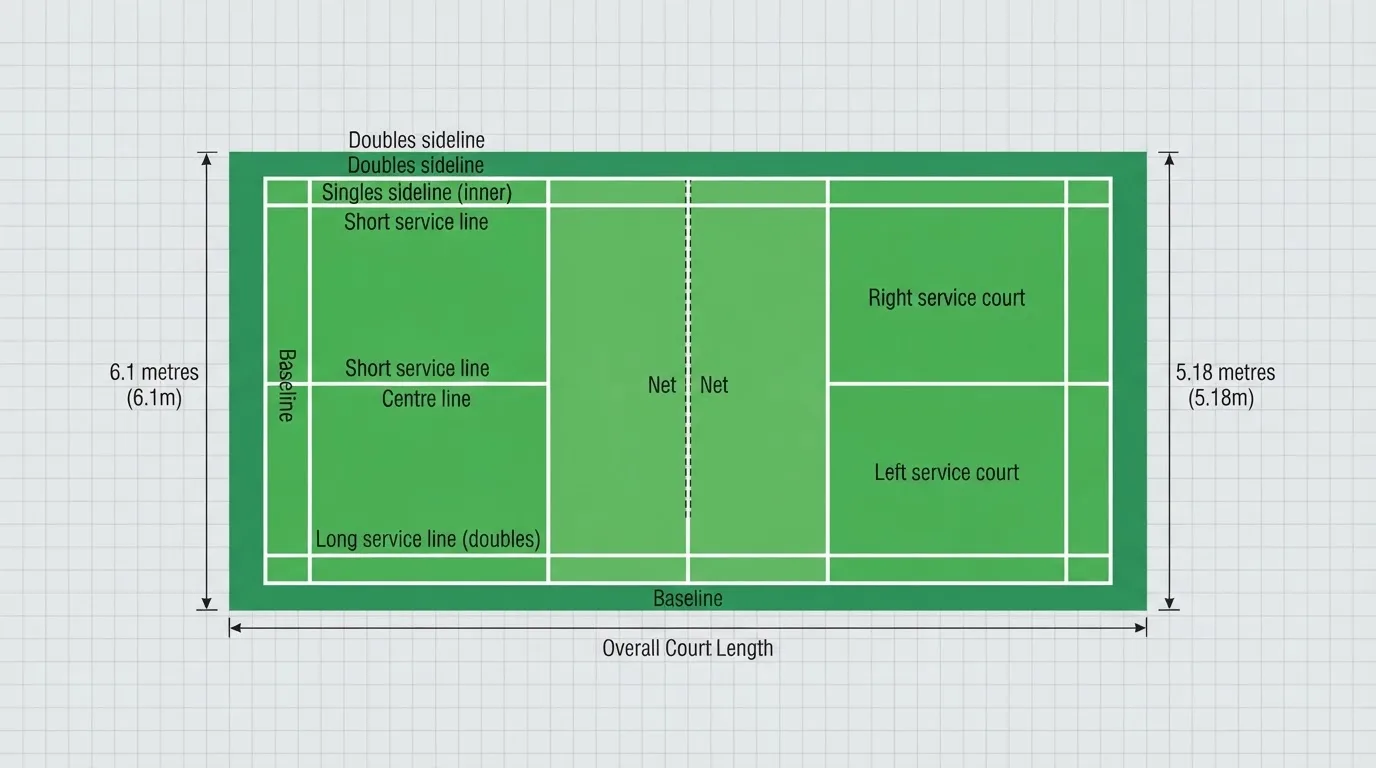
The court is the same across disciplines: 13.4 m long, 6.1 m wide for doubles, 5.18 m wide for singles, with a net 1.55 m high at the edges and 1.524 m at the centre. None of those numbers change the bet, but they explain the geometry the bookmaker’s data feed is built on, and they explain why doubles matches run shorter than singles on average.
The two-year rhythm of the team cups — Thomas, Super and Sudirman alternating in the same two-year cycle — drives the calendar. A Thomas Cup year is heavier on men’s team matches; a Sudirman Cup year is mixed. The BWF World Tour runs through the year with Super 1000, Super 750, Super 500, Super 300 and Super 100 events, with the BWF World Tour Finals at the end of the year. The Olympics every four years and the Commonwealth Games every four years on a different cycle add their own windows. A bettor planning to follow the tour needs that calendar, and most licensed UK bookmakers publish a futures market on the headline events once the draw is set.
How the ten featured bookmakers compare on badminton
The ranking below is a comparison of ten UK-licensed online bookmakers on the fields a badminton bettor checks before the first bet. The set comes from the Gambling Commission’s public register of remote betting licence holders and is not a recommendation; the ranking reflects the spread of the licence categories and the offer type each brand publishes on its own site. Several of the brands are operated by groups that hold multiple licences — for example Ladbrokes runs under LC International Limited, Unibet UK runs under Platinum Gaming Limited — and the licence number is the only piece of evidence that settles a brand’s place on the register.
| Brand | Licence holder and account number | What the operator’s own terms say |
|---|---|---|
| Ladbrokes | LC International Limited · account 54743 | App-rated 4.66 in the GB App Store; published by Entain Operations Limited; sports welcome for new GB customers |
| Bet Ahoy | Bet Ahoy Ltd · account 100094 | New-customer offer framed as a £10 stake for £10 in free bets, split £5 sports and £5 acca |
| Fitzwilliam Sports | SBKI Limited · account 48760 | Dublin-based bookmaker with capped membership; “High Stakes Welcome” subject to compliance criteria; instant deposits and fast withdrawals |
| London Bet | Thistle Bet Limited · account 66162 | App combines sports betting on a fixed sport set with Pragmatic Play casino and live in-play |
| Unibet | Platinum Gaming Limited · account 45322 | Brand operating since 1999; sports welcome: stake £20 or more at minimum odds 2.0 to claim £40 in free bets, expiring within 7 days, new GB customers funding by debit card or instant bank transfer |
| Smarkets | Smarkets (Malta) Limited · account 39173 | Open-bank-transfer deposits instant from £10 to £10,000; UK debit card deposits instant from £10 to £15,000; withdrawals processed within 6 hours from £10 to £100,000 |
| Fafabet | Taichi Tech Limited · account 57385 | Best Odds Guaranteed on UK and Irish horse racing win and each-way bets from 9am on race days |
| bet365 | Hillside (UK Sports) ENC · account 55148 | Official global betting partner of the UEFA Champions League; described as the most downloaded sports betting app in the UK; Bet Builder+, Super Boosts, Winnings Boosts on Bet Builders and selected singles, daily Bet Boosts; in-play betting and live streaming |
| Hollywoodbets | Hollywoodbets International UK Limited · account 53028 | Sports welcome: deposit £10 or more by card, first qualifying losing accumulator (stake £10+, 3+ legs, 4/1 or greater, settled within 7 days) refunded as a free bet up to £30 |
| Kalooki Sportsbook | Kalooki Sportsbook Limited · account 57730 | Operated by Kalooki Sports Book Ltd (company number 12938274); GAMSTOP member |
Smarkets sits on a betting intermediary licence rather than a remote general betting standard licence. That category is the regulatory frame for a betting exchange, where users back and lay against each other rather than against the bookmaker. The margin sits with the backer and the layer rather than with the platform, which is why the prices on an exchange tend to be tighter than the prices on a traditional bookmaker. The trade-off is liquidity: the exchange has lower liquidity than a major bookmaker on a badminton match, especially outside the headline tournaments.
The other nine brands sit on the remote general betting standard (real events) licence, which covers fixed-odds betting on real sporting events. That is the licence category every UK-facing online bookmaker on badminton needs, and the presence of a brand’s domain on the Commission’s register against one of those accounts is the test of who is licensed. Some of the licence holders — Smarkets Malta, LC International, Hillside, SBKI — are not British companies, which is fine: the test under the Gambling (Licensing and Advertising) Act 2014 is whether the operator has a Commission licence at all, regardless of where it is based.
The welcome offers above are quoted as each operator’s own terms state them, not as a recommendation to claim. Two points are worth pulling out. First, the Unibet offer carries an explicit minimum-odds clause: the £20 or more must be placed at minimum odds of 2.0, and the free bets expire within 7 days. A bettor who lays the qualifying stake at odds just above 2.0 and lets the free bets lapse is the bettor the offer is built for. Second, the Hollywoodbets offer refunds a losing accumulator as a free bet rather than as cash, with a £30 cap and a 7-day settlement window. The bettor who understands that is the bettor who keeps the welcome value; the bettor who expects a cash refund has misread the term.
bet365’s row is the longest because its product set is the longest. Bet Builder+ combines markets from one event into a single bet, available pre-match and in-play; Super Boosts and daily Bet Boosts are the same promotional structure across the rest of the major UK bookmakers, and the value of a price boost depends on the margin of the underlying market. A boost on a margin of 8% is worth less than a boost on a margin of 4% on the same selection.
The shape of UK betting regulation for badminton
The Gambling Commission licenses the commercial betting market in Great Britain under the Gambling Act 2005. The Act covers England, Scotland and Wales; Northern Ireland sits outside it under older law, so a GB-licensed bookmaker is licensed for Great Britain and not for Northern Ireland. Since the Gambling (Licensing and Advertising) Act 2014, an operator whose remote facilities are used in Great Britain needs a Commission licence wherever it is based. A Curaçao, Maltese or Gibraltar licence is not a substitute. There is no state monopoly and no cap on the number of licences.
A licence category matters because it sets the boundary of what the operator can offer. The relevant category for a badminton bet at a UK-facing site is remote general betting standard (real events), which covers fixed-odds betting on real sporting events. A separate category, remote general betting standard (virtual events), covers virtual events; the same operator often holds both. A betting exchange sits on a different category, remote betting intermediary. A bookmaker running spread betting on sports needs an FCA authorisation rather than a Commission licence, because financial spread betting is regulated by the FCA, not the Commission — that distinction sits behind Spreadex Sports, which is FCA-authorised for spread betting and Commission-licensed for fixed-odds betting and warns that spread betting losses can exceed deposits.
The Commission’s public register can be searched by business name, trading name, domain or account number, and is the whole test of whether a brand holds a licence. The ten brands above are listed on the register against the licence numbers shown; the only verification is the register itself. The brand’s own home page is not the test — licensed operators use .com and .co.uk interchangeably, and the domain proves nothing. A punter who wants to check a brand’s licence looks up the trading name on the register and reads the licence categories and licence holder against it. That is the cost-free check.
There is no statutory list of permitted bets or markets. An operator holds a licence for a category and offers markets under its own rules and the Licence Conditions and Codes of Practice. Badminton is not a regulated market in the sense that football or horse racing is, and the bookmaker decides which events to offer and which markets to price. In-play betting is offered by UK bookmakers under the operator’s licence conditions and customer-protection duties; that it is offered is a feature of the operator’s product, not a legal conclusion that in-play is unrestricted. No statutory cap on stakes in sports betting was found; operators set their own maximum stakes and may restrict customers.
The minimum age is 18, and identity verification has applied since 7 May 2019: name, address and date of birth are verified before a customer can deposit or gamble, including with a free bet or bonus. That is the cost of betting at a licensed UK site — the bettor gives up anonymity in exchange for the protections the licence carries.
Responsible gambling, the protections and where to get help
The single biggest practical difference between a UK-licensed bookmaker and an unlicensed one is the set of protections the licence enforces. They are not abstract.
GAMSTOP is the national multi-operator online self-exclusion scheme, and since 31 March 2020 it has been a mandatory licence condition for online operators. A customer can self-exclude for six months, one year, five years, or five years with auto-renewal. After the minimum period the exclusion stays in place for a further seven years unless the customer asks GAMSTOP to remove it. GAMSTOP covers online sites and apps; betting shops use a separate service. Every UK-licensed online bookmaker takes part in GAMSTOP, and a self-excluded customer cannot open a new account at any of them during the period. Kalooki Sportsbook is a named GAMSTOP member in the Commission’s register entry; the rest of the featured set is part of the same scheme through their licences.
A financial vulnerability check applies to licensed remote betting when a customer’s deposits minus withdrawals exceed £150 in a rolling 30 days. It is a public-record check — bankruptcy or county court judgments, for example — not an income check and not a credit reference check. The check has applied since 28 February 2025 under LCCP condition 3.4.4, in force since 30 August 2024. A separate, heavier set of financial risk assessments has been announced in a staged plan by the Commission, with no start date as of the Commission’s article of 7 July 2026; the position is announced, staged, no start date, and not in force.
Deposit limits are the customer’s tool. A licensed operator must offer a gross deposit limit on a fixed time frame, and the first changes have applied since 31 October 2025; a second phase was postponed to 30 September 2026 and whether it is live is not established. There is no state-set deposit or loss ceiling for betting — the ceiling is the customer’s choice. Timeouts, self-exclusion through the operator, and reality checks are standard tools at UK-licensed sites, and Fitzwilliam Sports names instant deposits, fast withdrawals, timeouts and deposit limits alongside its responsible-gambling signposting.
The independent help lines are GamCare (the National Gambling Helpline), GambleAware, NHS gambling clinics and Gamblers Anonymous. Fitzwilliam Sports links to GambleAware, GamStop and Gamblers Anonymous on its home page. Those are the routes the bettor takes when a stake has stopped being entertainment, and a responsible bookmaker makes those routes visible.
The bettor who uses an unlicensed site gives up those protections. The list is not abstract: no GAMSTOP coverage, no Commission complaints route, no approved dispute-resolution body, no British consumer redress if funds are withheld, not bound by the £150 vulnerability check, not bound by the bonus cap. The site also has no obligation to verify identity before the first deposit, which is sometimes presented as a feature. It is not. The cost of skipping the licence is the loss of every protection above, plus the cost of having no British route to recover funds if the operator stops paying. Honest framing: licensed sites verify identity and offer limits; unlicensed sites do not, and the lack of verification is a feature of the bettor’s exposure, not of their freedom.
Bonuses, free bets and the price the bettor pays
Welcome offers, free bets, acca insurances and price boosts are not free money. They are pricing structures, and the price is in the small print.
A cash bonus sits in the withdrawable balance and pays back with a win. A free bet or bet credit pays out winnings only, with the stake not returned. A “risk-free” first bet refunded as a free bet is a free bet, not a refund in cash. A price boost is a temporary increase in the price of a single selection, with the bookmaker taking the margin hit on that selection rather than across the market. An acca insurance refunds a losing accumulator as a free bet when one leg lets the bet down, with terms that limit the refund and the markets it applies to. A cashback is a percentage of losses returned, usually as a free bet or as bonus money with a wagering requirement.
The promotion rules in force since 19 January 2026 cap wagering requirements on bonuses at 10x. A £10 bonus at 50x would have needed £500 of qualifying bets; under the cap no more than £100 of qualifying bets is needed. Mixed-product promotions — an offer that requires the customer to gamble on two or more product types, such as “bet on football to get free spins” — are banned. Whether the cap applies to free bets with no wagering condition, and any cap on the money value of a bonus, are not established. The bonus is the headline number; the cap is what the offer is worth in practice.
Three examples drawn from the featured set. Unibet’s sports welcome is “Get £40 in Free Bets when you bet £20”, with a deposit and sports bet of £20 or more at minimum odds of 2.0 (1/1), free bets expiring within 7 days of issue, for new GB customers using a debit card or instant bank transfer. The qualifying bet is a real bet at minimum odds of 2.0; the £40 is paid as free bets whose stake is not returned with a win. A £10 free bet at odds of 4.00 has a gross payout of £40 of profit; net of the margin of the market it is wagered on, the value is closer to £30. The £40 is the headline; the realistic value is closer to £30 minus the £20 the bettor had to stake first.
Hollywoodbets’ sports welcome is a refund as a free bet of up to £30 on the first qualifying losing accumulator, with stakes of £10 or more, three or more legs, odds of 4/1 or greater, settled within 7 days. One free bet per customer. A £30 free bet on an acca at average odds of 4/1 returns £120 of profit before margin; the realistic value depends on the markets the free bet is allowed on and the time window.
Bet Ahoy’s offer is “Bet £10 & Get £10 in Free Bets”, split £5 sports and £5 acca. The £5 sports free bet is paid out as winnings only, with the stake not returned; the £5 acca free bet is the same, restricted to an accumulator. A £5 free bet at average odds of 3.00 returns £10 of profit before margin. The headline is £10; the realistic value is closer to £8 across the two free bets, before any market restriction.
The arithmetic of a free bet is the same in every case. Value = free-bet amount × (odds − 1) ÷ odds × payout share of the market. A £10 free bet at odds of 4.00 on a market with a 95% payout share is worth £10 × 3.00 ÷ 4.00 × 0.95 = £7.13. That is the realistic ceiling; the headline is the £10.
The cost of clearing a cash bonus is the expected loss of the turnover at the margin of the market the bonus is being cleared on. A £100 cash bonus with a 10x wagering requirement and a £1,000 turnover at a market margin of 5% costs £50 on average. A £100 cash bonus with a 50x wagering requirement and a £5,000 turnover at the same margin costs £250. The cap on wagering requirements cuts the second number; it does not change the underlying arithmetic.
What an offer is worth is the difference between the realistic value of the free bet and the realistic cost of the qualifying stake and the bonus turnover. The marketing line is the bigger number; the small print is the smaller one.
How to check a licence, what the terms really say, and what to do next
Three checks before a stake. First, look up the brand on the Gambling Commission’s public register by trading name or domain. The account number is the unique identifier; the licence categories tell the bettor what the brand is licensed to offer; the licence holder tells the bettor who is responsible for the brand. A brand that does not appear on the register against a current licence is operating without one.
Second, read the small print on the welcome offer. The minimum odds, the qualifying stake, the expiry window, the markets the free bet can be used on, and the cap on the refund are the five clauses that decide what the offer is worth. The headline number is what the bookmaker wants the bettor to remember; the small print is what the bettor pays.
Third, set a deposit limit before the first deposit. A licensed UK bookmaker must offer a gross deposit limit on a fixed time frame, and a£1-a-day ceiling is as valid as a £500-a-week ceiling. The limit is the bettor’s first line of defence against a losing run, and the cost of setting it is zero.
Two costs the bettor always pays and never sees. The bookmaker’s margin sits inside every price, and a market priced at 1.90 / 1.90 keeps 5.26% of every pound staked across the market. The verification cost sits behind the first deposit: a UK-licensed bookmaker checks name, address and date of birth before the customer can deposit or gamble, including with a free bet or bonus. The first cost is the price of betting at a margin; the second is the price of betting at a licensed site. Both are visible once the bettor looks for them.
One cost the bettor does not pay. There is no tax on betting winnings in Great Britain. General Betting Duty is the operator’s tax on gross profits, currently 15% on remote bets until 1 April 2027 when a new remote betting rate of 25% applies, with UK horse racing, self-service betting terminals, pool betting and in-person betting staying at 15%. Whether operators pass duty on through odds is not established; the bettor’s tax position on a winning bet is nil in the general case, and a professional gambler asks HMRC or an adviser. The check is “I pay no tax on winnings” for the recreational bettor; the rest is for the operator’s accountant.
Frequently asked questions
How do I bet on badminton?
Pick a UK-licensed bookmaker on the Gambling Commission’s public register, set a deposit limit, fund by debit card or open bank transfer (credit cards are banned for gambling in Great Britain), open the badminton tab — usually under “Racket sports” or “Other” — and pick a market. The minimum bet, usually £0.10 or £1, sits in the betslip-box; the stake is what the bettor sets; the return is the stake multiplied by the decimal odds. Identity is verified before the first deposit.
How can I check a bookmaker holds a Gambling Commission licence?
Open the Commission’s public register and search by the brand’s trading name, the licence holder’s company name or the domain. The account number, the licence categories and the licence holder’s name should match the brand’s own home page. A brand that does not appear on the register, or appears under a different licence category from the one it claims, is not what it says.
How is the return on a bet worked out from the stake and the odds?
Return = stake × decimal odds. Profit = return minus stake, or stake × (odds − 1). A £10 stake at decimal odds of 1.90 returns £19, of which £9 is profit. A £10 stake at decimal odds of 6.00 returns £60, of which £50 is profit. Fractional odds convert to decimal by dividing the first number by the second and adding 1.
What is the bookmaker’s margin and how can it be seen in the odds?
The margin is the slice of every pound staked the bookmaker keeps on a market, calculated as 1 minus the payout share. The payout share is the reciprocal of the sum of the implied probabilities (1 ÷ decimal odds for each outcome). A two-way market priced at 1.90 / 1.90 implies 52.63% on each side, summing to 105.26%; the 5.26% above 100% is the bookmaker’s margin, and the payout share is 95.00%. Tighter prices mean a lower margin; wider prices mean a higher margin.
How do fractional odds such as 5/1 convert to decimal odds such as 6.00?
Conversion: decimal odds = (a ÷ b) + 1, where a/b is the fractional price. 5/1 becomes (5 ÷ 1) + 1 = 6.00. 11/4 becomes (11 ÷ 4) + 1 = 3.75. 9/10 becomes (9 ÷ 10) + 1 = 1.90. Evens, the British shorthand for 1/1, is decimal 2.00. Decimal odds include the stake in the return; fractional odds separate stake and profit.
Tennis, darts & cue sports – Cricket betting
Content created by the «Cricket betting» team
