
Football accumulator bets: how an acca pays, what it costs and where to place one in Great Britain
 Available in US
Last updated 27 October 2026 · Licence claims verified against the Gambling Commission’s public register
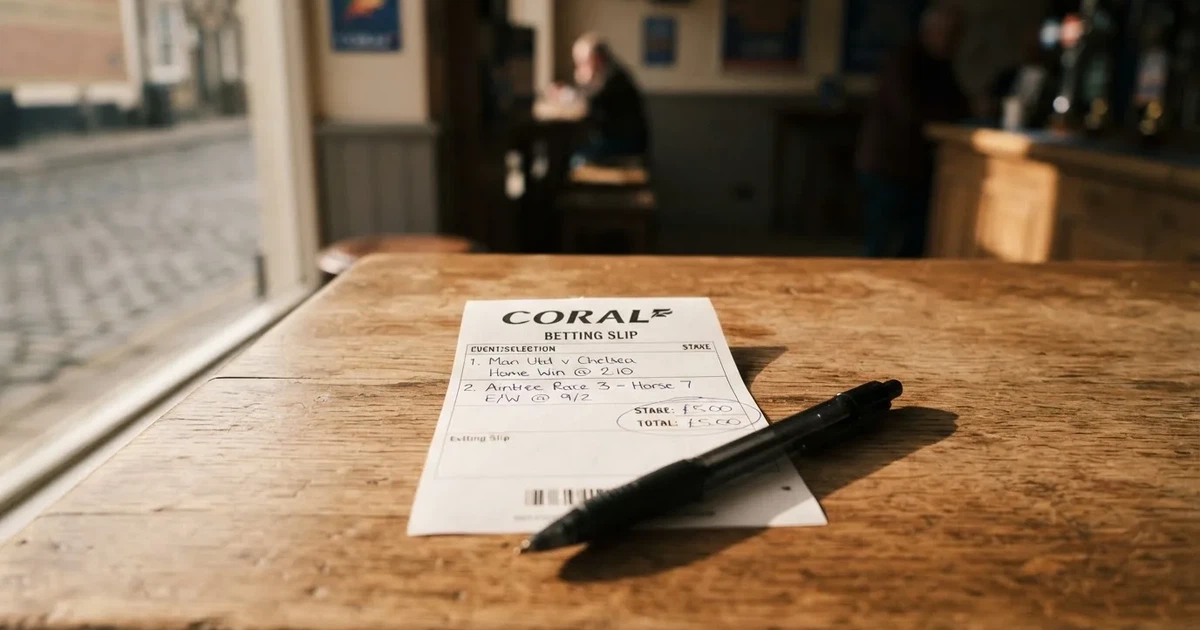
An accumulator — “acca” to most British punters — is a single bet that links two or more selections. Every leg has to win, or the whole thing loses. That single rule is the source of both the appeal and the cost: the odds multiply into a price much bigger than any single leg, and the probability of every selection winning collapses at the same rate. The football accumulator sits at the centre of bookmaker marketing for a reason: it pays out rarely, and when it pays, it pays large. The arithmetic underneath the headline figure is what this page works through, because that arithmetic is the same whether the bet is a four-fold Saturday acca or a fifteen-leg longshot, and the difference between what an acca is “worth” and what it costs is the difference between a £500 return and a £500 turnover you have to grind through before any of it is yours.
The page is written for the British reader placing fixed-odds bets with bookmakers licensed by the Gambling Commission. Odds below are decimal unless flagged, and where the comparison uses fractional form (5/1, evens, 6/4) the decimal sits beside it.
How an accumulator pays: the mechanics of a multi-leg bet
A single bet on one match is settled at the price the bookmaker quoted at the moment the bet was struck. Two singles, struck as two separate bets, are paid as two separate bets. An accumulator is a single stake on two or more selections whose prices are multiplied into one figure, and the whole stake is lost if any single leg fails.

That is the whole definition, and every other property follows from it. The price of an acca is the product of the decimal odds of its legs: a treble of 1.50, 2.00 and 2.50 prices at 1.50 × 2.00 × 2.50 = 7.50, so a £10 stake returns £75 if all three win. The downside is geometric in the same direction. Each leg carries its own probability of losing — the bookmaker’s margin (also called overround) sits inside every price — and the more legs added, the smaller the chance the whole thing lands. A 1.50 leg is roughly a two-in-three shot at the bookmaker’s quoted probability. Multiply six of them and you have a price of around 11.4, but a probability of winning near one in twelve, and the operator’s edge has compounded at every step.
A leg that ties — a void, a push, a match abandoned and treated as not played — drops out of the calculation and the remaining legs settle at their combined price. The bookmaker pays the reduced acca as if the void had never been on the slip. The slip’s stake is not refunded leg by leg; the surviving legs still have to win, and the original stake rides on them at the reduced odds.
A leg that is settled as a loss ends the bet, whatever happens to the other selections afterwards. There is no partial payout on an accumulator: a four-fold that goes three from three and loses on the fourth returns nothing. The structure rewards all-or-nothing punting and quietly penalises close results, since a single late goal in any leg voids the return.
Worked example: a £10 treble
Take three illustrative selections — a home win priced at 1.50, a draw at 2.00 and an away win at 2.50 — into a treble at a £10 stake. The decimal price of the accumulator is the product of the three legs:

- 1.50 × 2.00 × 2.50 = 7.50
The return on a winning bet is stake × price: £10 × 7.50 = £75. The profit — what lands in the punter’s account beyond the original £10 — is £65. None of the £10 stake is at risk in the sense of being returned separately; it is folded into the £75 figure, and the bookmaker pays £75 or nothing. The price is illustrative, not a quoted one, and the actual price of any real treble depends on the selections and the bookmaker’s margin at the time of placing.
If one of the three legs is voided, the treble becomes a double of the two surviving legs: 1.50 × 2.50 = 3.75 in the example, and £10 × 3.75 = £37.50 returns if both surviving legs win. If a leg loses outright, the bet is over and the £10 is gone.
The shape that matters to a punter is not the return on the all-winning case — that is the marketing figure — but the ratio of that return to the expected cost of the bet over a long series of attempts. Each leg carries a margin, and the multiplied price carries compounded margin. A bookmaker quoting 1.50 on a two-out-of-three shot is not offering fair odds; fair odds on a two-out-of-three shot would be 1.50 exactly, and the operator is offering it at the same price the fair market would clear at, which means the operator is taking no margin on that particular leg but is also offering no value. Real quoted prices always come in tighter than the true probability would justify, and the gap is the bookmaker’s cut. A punter who strings five of these together is paying the bookmaker’s cut five times.
Acca, parlay, combo bet: what the different words mean
The British term is accumulator or acca. The American term is parlay. “Combo bet” and “multi” are the operator-facing names some sites use. The number of legs is what separates one type from the next: two selections is a double, three is a treble, four or more is an accumulator in the strict sense. All of these are single bets; they win together or lose together, and the stake rides on the multiplied price.
A single is the baseline — one selection, one price, settled on its own. A double multiplies two prices. A treble multiplies three. A four-fold multiplies four. The British convention treats anything from four legs upward as the “acca”, though many punters call any multi-leg combination an acca regardless of size.
An each-way accumulator is a different beast. It is two bets of equal stake — one on the win part of each selection, one on the place part — so the total stake doubles. Each-way terms depend on the market: horse racing each-way terms are typically a quarter or a fifth of the win odds on the place half, but on football the place market is a separate proposition and the each-way version of a football acca is unusual. The British football acca almost always means the win-only version.
A system bet or full cover bet is a structured way of covering several legs with multiple smaller bets rather than one big acca. The Trixie, the Yankee, the Heinz and the Goliath — names that sound like they were invented by a marketing department in 1972 — are combinations of doubles, trebles and singles laid out across the chosen selections. They cost more than a single acca because the punter is paying for several bets at once, but they pay out something when one leg lets the acca down. The arithmetic of each is fixed, and a punter can price a Trixie before placing it the same way they would price an acca: by multiplying the legs.
Full cover bets in numbers
A Trixie covers three selections in four bets — three doubles and one treble. A £2 unit stake means £8 staked in total. The treble leg settles at the multiplied price, the doubles at their respective products, and any return comes from whichever parts win.
A Yankee covers four selections in eleven bets — six doubles, four trebles and one four-fold accumulator. A £1 unit stake is £11 staked. The four-fold is where the headline return sits; the doubles and trebles cushion the bet when one or two legs let the side down.
A Heinz covers six selections in fifty-seven bets — fifteen doubles, twenty trebles, fifteen four-folds, six five-folds and one six-fold. A Goliath covers eight selections in two hundred and forty-seven bets — the full works from doubles up to the eight-fold. A Lucky 15 is the same as a Yankee with single bets added: four singles, six doubles, four trebles and one four-fold, fifteen bets in all. The “Lucky” prefix and the unit stake are the only differences.
The unit stake on a full cover bet is per line, not per bet as a whole. A Lucky 15 at £1 per line is £15 staked; a Goliath at £1 per line is £247. Punters with a smaller bankroll often run full-cover bets at 10p or 20p per line precisely because the total stake balloons quickly. The reward for the higher stake is the cushion: a Goliath pays out on combinations even when three or four of the eight legs let the bet down.
The mathematics of these structures is fixed. There is no bookmaker’s edge in how the bets are arranged — the edge sits inside each leg’s individual price — but the punter is paying the edge once per leg per bet, and a Goliath on eight legs involves eight legs’ worth of margin multiplied across two hundred and forty-seven bets. The bookmaker’s take compounds at the same rate as the payout, which is the reason full-cover bets look attractive and quietly cost more than they seem.
In-play accumulators and bet builders: where accas get re-priced
A bet builder — also called a same-game multi — is an accumulator whose legs all come from one match: result, both teams to score, total goals, first goalscorer, corners, cards. The legs are correlated, and the price the operator quotes already adjusts for the correlation. A bet builder on a 1-0 home win plus under 2.5 goals pays less than the product of the two standalone prices, because the bookmaker knows the two outcomes are not independent.
A live accumulator is a multi-leg bet struck while one or more of its legs are already in play. Some operators allow this and others do not; those that do reprice aggressively, since in-play prices move faster than pre-match and the operator has more information about the state of the match when the bet is struck. A live acca on a match where one team has already scored typically offers worse prices on the result leg than the same match would have offered pre-kickoff, and the operator is usually within its rights to suspend the market mid-event.
Cash out is a feature that lets the punter settle a bet early at a price the bookmaker offers at that moment. Cash out on a winning four-fold after three legs have landed offers a return that is less than the full four-fold price but more than the stake — the bookmaker is offering to take the bet off the punter’s hands at a mid-price. Cash out is not a guarantee and is not always available: the operator’s own terms typically say cash out availability is not guaranteed and unsettled bets stand if cash out is unavailable.
Acca insurance is a promotion offered by some operators — a refund as a free bet if one leg of a qualifying acca lets the bet down, usually with a minimum number of legs and a minimum stake. The refund is a free bet, whose stake is not paid back with a win; the punter receives the free-bet value if the next bet wins, not the full cash equivalent. Operators describe these in their own terms and the page treats them as such.
Settlement, voids and the rules that govern an acca
A leg is settled as a win when the selection wins outright at the price the bookmaker quoted. A leg is settled as a loss when the selection loses outright. A leg is voided — and the rules vary by operator — when:
- the match is abandoned before completion (some operators void all bets, others settle on the score at the point of abandonment)
- the match is postponed beyond a deadline (often 24 or 48 hours, sometimes longer)
- a selection involves a player who does not start (first goalscorer markets, for instance)
- the operator’s own rules specify a void for that market (some bookmakers void anytime scorers on first goalscorer markets when the named player comes on as a substitute)
A voided leg drops out of the accumulator and the bet settles on the remaining legs at the multiplied price. The stake does not get refunded piecemeal: the £10 stake on a treble with one voided leg rides on the surviving double, and the punter wins or loses the £10 on that double. The operator’s terms specify how voids are handled for each market, and the punter reads those terms before staking, particularly on the markets where voids are common — anytime scorers, player-specific markets, markets tied to whether a player starts.
Each-way bets are settled separately on the win part and the place part. An each-way treble at £10 each way is a £20 stake; the win part and the place part are settled independently on each leg.
Non-runners in horse racing void that leg of the bet. In football the equivalent is a player who does not start, and the rule for voids is operator-specific.
Rule 4 deductions apply when a horse is withdrawn from a race and the bookmaker reduces the odds on the remaining runners by a stated amount. Football accumulators do not typically attract Rule 4 deductions, since Rule 4 is a horse-racing rule, but the operator’s terms specify the equivalent treatment for football markets where a selection becomes unavailable after the bet is struck.
The bookmaker’s margin: what the price already includes
Every price a bookmaker offers contains a margin — the cut the operator keeps on every pound staked across the market. The margin sits inside the odds, not on top of them, and it is the same number read two ways: a 95% payout share is a 5% margin. A margin of 5% on a market means the operator keeps 5p of every £1 staked across all outcomes, before any settlement costs. Margins on Premier League match result markets typically sit between 2% and 7% at major bookmakers; less popular leagues and exotic markets can be wider, sometimes above 10%, and the margin on a heavily promoted “enhanced odds” price is often higher than the standard price, since the promotion pays the bookmaker to advertise the bigger number.
The margin is invisible in the price a punter sees. The 1.50 quote on a Premier League home win looks like a price; what it actually contains is a probability estimate from the bookmaker’s traders, plus a margin that has been applied to all three outcomes. Across the three outcomes of a 1X2 market, the inverse prices — 1 ÷ decimal odds for each outcome — sum to more than 1, and the excess over 1 is the margin. A market with 1.50, 4.00 and 7.00 prices sums to 1 ÷ 1.50 + 1 ÷ 4.00 + 1 ÷ 7.00 = 0.667 + 0.250 + 0.143 = 1.060, a 6% margin. A market with 1.45, 4.50 and 8.00 sums to 0.690 + 0.222 + 0.125 = 1.037, a 3.7% margin.
The punter’s job is not to eliminate the margin — that is impossible at a licensed bookmaker — but to choose markets where the margin is tight and selections where the price has drifted past the true probability. Both are small edges and both are eroded by the compounded margin on an accumulator.
The compounded margin is the cost an acca carries that a single does not. A five-leg acca at an average 4% margin per leg does not carry 20% margin overall, since margins do not simply add, but the compounded edge is meaningfully larger than 4%. The margin on a multi-leg bet grows with the number of legs, and the growth accelerates as the price gets longer. A bookmaker’s headline “100/1 acca!” offer is built on a structure where each leg carries its own margin and the combined book is wider than any single market.
Settlement: how a winning accumulator hits the account
A winning accumulator settles in one transaction when the final leg is decided. The bookmaker credits the return — stake × price — to the punter’s account and the bet is closed. The settled bet appears in the account history as a single line with the full return, regardless of how many legs it had; the punter does not see a running tally of leg-by-leg returns, and individual legs do not credit partially.
A losing accumulator settles as a loss when any leg loses outright. The stake is deducted at the moment the losing leg is decided. Cash out, where offered, settles the bet at the cash-out price offered by the bookmaker and the bet closes at that figure; the punter takes the smaller return rather than waiting for the remaining legs.
Settlement disputes — when a leg is settled differently from how the punter read the match — go through the operator’s complaints route and, if unresolved, through an alternative dispute resolution (ADR) provider approved by the Gambling Commission. The ADR route is available only at licensed operators; an offshore brand carries no Commission-approved complaints channel and the punter has no recourse to a British body.
A settled acca is final once the operator has confirmed the result. Most markets settle within minutes of the deciding event; markets tied to player actions (first goalscorer, anytime scorer) settle when the operator’s traders confirm the result, which can take longer when the action is close. Markets tied to tournament outcomes settle after the final is played, regardless of when the punter struck the bet.
UK bookmakers offering football accumulators: the licensed shortlist
The ten operators below are the brands whose domains appear on the Gambling Commission’s public register against a remote general betting licence for Great Britain, in the order set for this comparison. Each is described on what it offers for accumulator betting, what its own terms say on the subject and where the licence sits. The list is not a ranking: a position is not a recommendation, and a licence is a baseline condition of trading in Great Britain, not an endorsement. All ten offer football accumulators as standard, and the differences between them are in the surrounding product — cash out, bet builder, price boosts, in-play pricing, acca insurance — and in the small print each brand puts on its acca offers.
The licence number sits beside each operator as a reference for the punter’s own check; the public register is the only test of who holds a licence, and it is searchable by business name, trading name, domain or account number.
| Operator | Gambling Commission licence | Account on the operator’s own terms |
|---|---|---|
| Betfred | Remote licence 039544-R-319290-010, account 39544, held by Petfre (Gibraltar) Limited | Bet Builder, Sub Switch, Extra Places and in-play betting across the sportsbook; acca pricing on the standard sportsbook terms |
| Lottoland | Remote licence 038991-R-319408-020, account 38991, held by EU Lotto Limited | Sportsbook offering football accumulators alongside the lottery product; GB customers under a Commission licence |
| Sporting Index | Remote licence 027343-R-308898-011, account 27343, held by Sporting Index Limited | Spread betting product alongside fixed-odds football; fixed-odds accas on the standard sportsbook terms |
| Swifty Sports | Remote licence 058957-R-334734-006, account 58957, held by Swifty Global (UK) Ltd | Best Odds Guaranteed, Cash Out, daily price boosts and live streaming; Bet Builder listed as coming soon |
| BetMGM | Remote licence 039198-R-319450-029, account 39198, held by LeoVegas Gaming PLC | Acca-friendly welcome offer for new UK customers; sportsbook with Bet Builder and in-play markets |
| Fafabet | Remote licence 057385-R-333191-006, account 57385, held by Taichi Tech Limited | Best Odds Guaranteed on UK and Irish horse racing; football accumulators on the standard sportsbook terms |
| Ladbrokes | Remote licence 054743-R-330863-014, account 54743, held by LC International Limited | Odds boosts, Best Odds Guaranteed on UK and Irish racing, in-play betting and Acca Boosts on the sportsbook |
| DAZN Bet | Remote licence 048756-R-327274-019, account 48756, held by DZBT Limited | Cash Out, Bet Builder, daily bet boosts and in-play betting; cash-out availability flagged as not guaranteed |
| Dabble | Remote licence 065677-R-340363-005, account 65677, held by Dabble Sports UK Ltd | Welcome offer on a first deposit with acca-friendly terms; sportsbook with social features around the bet slip |
| Fitzwilliam Sports | Remote licence 048760-R-335434-009, account 48760, held by SBKI Limited | Prices based on Oddschecker’s average price for each selection; Apple and Google mobile apps |
Betfred
Betfred is a long-established British bookmaker running on a remote general betting standard licence held by Petfre (Gibraltar) Limited, with the Commission’s account at 39544. The product around the acca is wider than the acca itself: Betfred’s app includes Bet Builder for same-game multis, Sub Switch for in-play player substitutions, Racing Post data integrated into the racing product, Extra Places on selected horse races, a live casino and bingo. For a punter whose interest in accumulators extends to player-specific markets and same-game multis, Betfred offers a fuller set of building blocks than a brand that runs a plain 1X2 sportsbook. The acca pricing sits on the operator’s standard terms and the welcome offers cycle through acca-friendly structures.
Lottoland
Lottoland is licensed in Great Britain through EU Lotto Limited, with the Commission’s account at 38991. The product is broader than the sportsbook: Lottoland’s app combines casino, lottery betting, sports betting and scratchcards, and a punter who arrives for an acca may end up using the lottery product as well. The sportsbook covers football accumulators on the standard terms; the brand is not built around the sportsbook first, and the acca offer is the standard GB sportsbook product rather than a differentiated one. A punter looking for a sports-first brand finds more in the line-up at Betfred, Ladbrokes or BetMGM; a punter looking for one account across lottery, casino and sports finds it here.
Sporting Index
Sporting Index runs on a remote general betting standard licence held by Sporting Index Limited, with the Commission’s account at 27343. The product is a hybrid: fixed-odds football betting alongside spread betting on sports and indexes. A new-customer offer gated on a £10 fixed-odds football bet at minimum odds of 1/2 unlocks a package of fixed-odds free bets and spread bets, and the qualifying bet cannot be placed in-play or cashed out. For an acca punter who has never used spread betting, the package is a way in; for a punter who only wants fixed-odds accumulators, the offer is heavier than necessary on the spread side. The spread betting product carries a different risk profile from fixed-odds, since spread betting losses can exceed the original deposit; the fixed-odds sportsbook is the side of the product that suits acca punters directly.
Swifty Sports
Swifty Sports holds its licence through Swifty Global (UK) Ltd, with the Commission’s account at 58957. The product reads as a modern sportsbook: Best Odds Guaranteed, Cash Out on markets including horse racing and football, daily price boosts, live streaming and in-play betting. Bet Builder is listed as coming soon, which is a notable gap for an acca punter who wants same-game multis — until Bet Builder lands, the acca product at Swifty Sports is the standard pre-match combination bet rather than the richer same-game multi some competitors offer. A punter who values Best Odds Guaranteed and live streaming above the Bet Builder feature finds the rest of the product competitive.
BetMGM
BetMGM in the UK is operated by LeoVegas Gaming PLC, with the Commission’s account at 39198. The welcome offer for new UK customers who deposit £10 or more and place a sports bet within seven days is four £10 free bets structured around accas: two football accumulators of four or more selections, two sports multiples of two or more, with the free bets valid for seven days, a minimum odds requirement and an opt-in. The offer is acca-shaped from the ground up, which tells a punter where the brand’s marketing leans. Beyond the welcome offer, BetMGM offers Bet Builder, in-play markets and the standard sportsbook product.
Fafabet
Fafabet holds its licence through Taichi Tech Limited, with the Commission’s account at 57385. Best Odds Guaranteed on UK and Irish horse racing is the brand’s signature feature — the bigger of the original price and the starting price is paid on win and each-way bets from 9am on race days — and the football accumulator product sits on the standard sportsbook terms. A punter whose betting mixes horse racing and football accas finds Fafabet’s horse-racing product stronger than its acca product; a punter whose betting is football-only finds a competent but undifferentiated acca offering compared with the bigger GB brands.
Ladbrokes
Ladbrokes is one of the high-street names in British betting, operating online through LC International Limited under the Commission’s account 54743. The product around the acca is the broadest in this list: odds boosts on horse and greyhound bets, Best Odds Guaranteed on UK and Irish horse races, in-play betting and Acca Boosts specifically on the sportsbook. Acca Boosts — enhanced odds on qualifying accumulators, typically with a minimum number of legs — are a Ladbrokes staple and the marketing leans on them heavily. A punter who values the acca-specific promotions finds more here than at the smaller brands; the underlying acca pricing sits on the standard sportsbook terms.
DAZN Bet
DAZN Bet runs on a remote general betting standard licence held by DZBT Limited, with the Commission’s account at 48756. Cash Out, Bet Builder, daily bet boosts and in-play betting make up the product around the acca. Cash-out availability is explicitly flagged by the operator as not guaranteed, which is the same caveat every major operator carries but is unusual to see stated as plainly. A punter who depends on cash out for acca strategy reads this caveat before staking; a punter who lets accas ride to settlement does not.
Dabble
Dabble holds its licence through Dabble Sports UK Ltd, with the Commission’s account at 65677. The welcome offer is a “Bet £10, Get £10 in Free Bets” structure on a first deposit for new customers, with minimum odds applying, a seven-day free-bet expiry and the stake not returned with the free bet. The product wraps the sportsbook in social features — copy-betting, chat, follows — that other brands on this list do not have. The acca product sits on the standard sportsbook terms and the social layer is the differentiator.
Fitzwilliam Sports
Fitzwilliam Sports is operated by SBKI Limited, with the Commission’s account at 48760. The pricing model is the brand’s distinguishing feature: prices are based on Oddschecker’s average price for each selection, which means the sportsbook sits close to the market average rather than running its own line. Apple and Google mobile apps carry the product. For an acca punter who compares prices across operators, Fitzwilliam Sports offers a sportsbook whose pricing is explicitly indexed to an external average, and the differentiator is the price rather than the feature list.
Legality and regulation: who is allowed to take your bet in Great Britain
The Gambling Commission regulates commercial gambling in Great Britain under the Gambling Act 2005. A bookmaker serving customers in Great Britain needs a Commission licence wherever the operator is based, since the Gambling (Licensing and Advertising) Act 2014 closed the offshore loophole. A Curaçao, Maltese or Gibraltar licence is not a substitute; the GB licence is the test, and the Commission’s website hosts the public register that lists every licensed operator. The register can be searched by business name, trading name, domain or account number, and the only reliable check on whether a brand holds a licence is to look it up there.
There is no statutory list of permitted bets or markets. An operator holds a licence for a category — remote general betting standard (real events), remote pool betting, remote betting intermediary (the licence for exchanges) — and offers markets under its own rules and the Licence Conditions and Codes of Practice. In-play betting is offered by GB bookmakers and the controls sit in the operator’s licence conditions and customer-protection duties; no statute governs the in-play product directly.
Northern Ireland is outside the Gambling Act 2005. A “GB licence” regulates England, Scotland and Wales; a brand serving Northern Ireland needs a separate licence under Northern Ireland’s older betting law. The acca product is the same in practice; the licensing regime is not.
Betting exchanges operate under a betting intermediary licence. An exchange lets punters back and lay selections against each other, with the exchange taking a commission on net winnings. Rates and rules specific to exchanges are stated only from each exchange’s terms.
Financial spread betting is regulated by the Financial Conduct Authority, not the Commission. Sporting Index offers both fixed-odds sports betting (under the Commission’s licence) and financial spread betting (under the FCA’s regime), and the regulatory boundary between the two products is the regulator rather than the operator.
The public register: how the punter checks a licence
The Commission’s public register is the test of who holds a licence. The punter searches by the brand name, the trading name, the domain or the account number. The result shows the licence type, the categories on the licence, the licence holder’s company name, the address and the licence status. The register is updated as licences are granted, varied, suspended or revoked.
A domain ending in .co.uk proves nothing on its own — licensed operators use .com as well as .co.uk — and a domain that looks British can carry an operator based anywhere. The register is the check; the domain is not.
Identity verification and the rules on first deposit
GB-licensed operators verify name, address and date of birth before a customer can deposit or gamble. The verification has applied since 7 May 2019, and a free bet or bonus is not an exception: a free bet is gambling for these purposes and the verification sits in front of it. Anonymous play is not available at a licensed site, and the punter provides the documents the operator requires at the moment of registration.
The minimum age is 18. Marketing to under-18s is restricted, but the age rule is a customer-side rule: an under-18 cannot open an account and the operator’s verification is the gate.
The offshore distinction
A GB licence is compulsory at the point of consumption. Providing gambling facilities in Great Britain without the licence the Act requires is an offence aimed at the operator under section 33 of the Gambling Act 2005 — on summary conviction up to 51 weeks’ imprisonment, a fine up to level 5, or both; six months in Scotland. No offence aimed at a customer who places a bet on an unlicensed site was identified in the materials reviewed; the cost of using an unlicensed brand sits in the loss of protection.
An unlicensed brand carries no GAMSTOP coverage, no Commission complaints route, no approved alternative dispute resolution provider, no British consumer redress if funds are withheld, and is not bound by the bonus cap or the financial vulnerability check. The punter cannot use a credit card at a GB-licensed operator but can, in principle, use one at some unlicensed operators. The trade-off runs one way: a GB licence means checks, limits, GAMSTOP and a bonus cap, and an unlicensed brand means none of those protections and the possibility of funds being withheld.
Enforcement against unlicensed operators is disruption rather than blocking: cease-and-desist notices, search-engine referrals, work with registrars, hosts and payment providers. The Commission has been given, or is about to receive, court-order DNS blocking powers; ISP blocking is not in operation and the page does not write it as if it were. A punter who ends up on an unlicensed site does so by searching for one, and the better path is to check the register before registering.
Responsible gambling: limits, GAMSTOP and the checks that apply
GAMSTOP is the national multi-operator online self-exclusion scheme and a mandatory licence condition for online operators since 31 March 2020. A punter who registers with GAMSTOP excludes themselves from every GB-licensed online operator for the chosen period — six months, one year, five years, or five years with auto-renewal — and after the minimum period the exclusion stays in place for a further seven years unless the punter asks GAMSTOP to remove it. GAMSTOP covers online sites and apps; betting shops run a separate scheme.
A financial vulnerability check applies at licensed remote operators when a customer’s deposits minus withdrawals exceed £150 in a rolling 30 days (since 28 February 2025). The check is a public-record check — bankruptcy, county court judgments and similar registers — not an income check and not a credit reference check. The check is automatic at the threshold and the operator runs it without prompting. Operators set their own thresholds above the £150 floor; the £150 is the Commission’s minimum, not a cap.
Financial risk assessments — the affordability checks debated in the press — have been announced in a staged plan with no start date as of the materials reviewed. The Commission published the article on 7 July 2026 and the assessment was announced as staged; the page does not write the check as in force.
Deposit limits are operator-set within a Commission framework. RTS 12 requires operators to offer a gross deposit limit on a fixed time frame; the first changes have applied since 31 October 2025, a second phase was postponed to 30 September 2026, and whether the second phase is live as the page is read is not confirmed by the materials reviewed. There is no state-set deposit or loss ceiling for betting; limits are the customer’s choice, set through the operator’s responsible-gambling tools.
Credit cards are banned for gambling in Great Britain since 14 April 2020, and the ban covers credit-card-funded payments through an e-wallet. Debit cards and bank-based payments are not covered. A punter using a credit card at a licensed operator has the deposit rejected; an e-wallet funded from a credit card has the same treatment.
Help is available through GamCare (which runs the National Gambling Helpline), GambleAware, NHS gambling clinics and Gamblers Anonymous. The detail of each service sits outside this page; a punter who wants help finds the contact details through the regulator or the NHS. The acca punter who finds themselves staking more than they can afford has the same self-exclusion and limit tools as any other gambling customer.
Strategies and tips: what works and what doesn’t on an acca
There is no system that wins at football accumulators. Every leg carries the bookmaker’s margin, the multiplied margin on an accumulator compounds, and the punter who picks randomly does worse than the punter who picks with information, but the information edge is small and the bookmaker’s edge is always there. Anyone selling a “system” or a “sure thing” is selling something that does not exist.
What a punter can do is manage the cost of the bet. The four routes the page works through are staking, selection, market choice and timing.
Staking: how much to put on
A flat stake — the same amount on every acca, regardless of confidence — is the staking plan most bankroll-management writers recommend. The punter decides an amount they can afford to lose on each bet and stakes that amount on every acca. A variable stake — bigger bets when the punter feels more confident — looks intuitive and is mathematically worse, since the punter is taking more risk when they believe they have less edge.
The full-cover bets (Trixie, Yankee, Heinz, Lucky 15, Goliath) cost more than a straight acca because the punter is paying for several bets at once. A Lucky 15 at £1 per line is £15 staked; an accumulator on the same four legs is £1. The Lucky 15 pays out on combinations when one or two legs let the side down, but it returns nothing when three or four legs lose, and the punter has paid for fifteen bets where they would have paid for one. For a punter with a small bankroll, the flat-stake straight acca is the cheaper structure per bet.
Selection: how many legs
The longer the accumulator, the bigger the headline price and the smaller the probability the bet wins. A four-fold at combined odds 20/1 has roughly a one-in-twenty chance of winning at the bookmaker’s quoted probabilities; a ten-fold at combined odds 1000/1 has roughly a one-in-a-thousand chance. The compounded margin makes the true probability even worse than the price suggests, and the punter pays the bookmaker more per unit staked on a long acca than on a short one.
The punter who picks fewer legs gives themselves a better chance of winning and pays a tighter compounded margin. The headline price is smaller. The trade-off is between a frequent small win and a rare large one, and the maths on either side favours the bookmaker.
Market choice: where the margin is tight
The margin on a Premier League match result market at a major bookmaker typically sits between 2% and 7%. The margin on a less popular league, a lower-division English match or an exotic market (corners, cards, player-specific markets) is wider. A punter who builds an acca on Premier League 1X2 markets pays a tighter compounded margin than a punter who builds the same acca on Championship corners or Primeira Liga player props.
The punter reads the market before staking. A market with three tight prices is cheaper to bet on than a market with three wide ones, and the difference shows up in the long-run return.
Timing: when to strike the bet
Prices move. A bet struck early in the week on a Saturday match pays the bookmaker’s opening line, which is set without the weight of money; a bet struck closer to kickoff pays the latest line, which has absorbed the betting. The two prices are different, and the punter who times the bet has the chance to take the better line.
In-play accumulators carry a different timing question. A live acca on a match where one leg is already in play pays the in-play price on that leg, which is typically tighter than the pre-match price. The punter’s edge on the live leg is smaller than the edge on the pre-match leg, and the compounded acca carries the tighter margin on the live side.
Cash out is a timing decision too. A punter who lets the acca ride takes the full return or the loss; a punter who cashes out takes the cash-out price offered at that moment. The cash-out price is the bookmaker’s mid-price on the bet at that moment, which is typically below the true mathematical mid-point because the bookmaker is taking a cut. The punter who understands cash out sees it as a feature that costs the punter something on average, not a free option.
Where the tips come from
Tipsters sell predictions on football accumulators. Some are sharp and most are not; the page does not endorse any tipster, and the punter who follows tips pays for the service and pays the bookmaker’s margin on every leg. The compounded cost of a tipster subscription plus the bookmaker’s margin is a higher cost per bet than betting without a tipster, and the value depends on whether the tipster’s predictions beat the bookmaker’s prices by enough to clear the subscription.
The punter who builds an acca on tips from a tipster pays for the tips and pays the margin. The compounded cost is the full picture, and the punter reads it before subscribing.
Worked examples and the arithmetic the punter runs
A straight treble at £10
Three selections at decimal odds of 1.50, 2.00 and 2.50 — illustrative, not quoted prices. The treble pays 1.50 × 2.00 × 2.50 = 7.50, and £10 × 7.50 = £75 returns on a winning bet. The profit is £65. If one leg is voided, the treble becomes a double: 1.50 × 2.50 = 3.75, and £10 × 3.75 = £37.50 returns if both surviving legs win. If any leg loses, the bet is over and the £10 is lost.
A four-fold at £5
Four selections at decimal odds of 1.80, 2.10, 2.40 and 3.00 — illustrative. The four-fold pays 1.80 × 2.10 × 2.40 × 3.00 = 27.22, and £5 × 27.22 = £136.08 returns on a winning bet. The compounded margin across four legs sits in the price, and the punter pays it.
A Lucky 15 at £1 per line
Four selections at the same illustrative odds as the four-fold. The Lucky 15 is four singles, six doubles, four trebles and one four-fold, fifteen bets in all, and £1 per line is £15 staked. The singles, doubles and trebles settle independently on the combinations that win, and the four-fold settles as in the previous example. A punter who runs both structures — a £15 Lucky 15 and a £15 four-fold accumulator on the same selections — pays the same total stake but takes a different shape of return: the Lucky 15 pays something on combinations when one or two legs lose, the four-fold pays only on the all-winning case.
Margin on a 1X2 market
A 1X2 market with prices 1.50 (home), 4.00 (draw) and 7.00 (away) sums to 1 ÷ 1.50 + 1 ÷ 4.00 + 1 ÷ 7.00 = 0.667 + 0.250 + 0.143 = 1.060, a 6.0% margin. The punter reads the three prices and the implied margin is 6%; the punter knows the bookmaker keeps 6p on every £1 across the market.
A market with prices 1.45, 4.50 and 8.00 sums to 1 ÷ 1.45 + 1 ÷ 4.50 + 1 ÷ 8.00 = 0.690 + 0.222 + 0.125 = 1.037, a 3.7% margin. The punter prefers the second market because the compounded edge is smaller.
Compounded margin on a five-fold
The compounded margin on a multi-leg bet is not the simple sum of the per-leg margins. A five-fold where each leg carries a 5% margin does not carry a 25% margin overall; the compounded margin is higher than the per-leg margin and lower than the simple sum, and the exact figure depends on the per-leg margins and the prices. The punter reads the price of the acca as quoted, not as a derived margin, and the price carries whatever margin the bookmaker has built in.
Tax: what the punter pays the operator, the operator pays the state
The punter pays no tax on betting winnings in Great Britain. The information is general and not tax advice; a professional gambler should ask HMRC or an adviser. The operator pays General Betting Duty on gross profits, currently 15%, with a new remote betting rate of 25% scheduled from 1 April 2027; from that date remote bets on UK horse racing, bets on self-service betting terminals in licensed premises, pool betting and in-person betting stay at 15%. Whether operators pass duty on through odds has not been established, and the page does not claim that the punter is charged duty.
Spread betting carries its own rates: 3% on financial spread bets, 10% on other spread bets. Sporting Index offers both fixed-odds and spread betting, and the rates are different on each side of the product.
The Commission’s statutory levy is a separate charge, not a tax, and sits on the operator rather than the punter. The punter’s only direct cost is the bookmaker’s margin and any stake the punter has risked and lost.
How the punter reads the offers
Bookmaker welcome offers for new UK customers in football accumulators take a few common shapes. The most common is a free-bet package gated on a first qualifying bet: deposit £10, place a first bet at minimum odds, receive £30 or £40 in free bets. The free bets are acca-friendly in some offers (free bets usable on accumulators of four or more selections) and acca-specific in others (free bets that only settle on a multi-leg wager). Each operator’s terms specify the structure; the punter reads the terms before claiming.
Free bets do not return the stake with a win. A £10 free bet at 5.00 returns £50, not £60. The punter who treats a free bet as a £10 cash equivalent has misread the offer; the value of the free bet is closer to £8 on a 5.00 shot, depending on the market margin.
Wagering requirements on bonuses are capped at 10x since 19 January 2026 — a £10 bonus at 50x would need £500 of bets; under the cap no more than £100. Mixed-product promotions — an offer that requires gambling on two or more product types such as betting, casino, bingo and lottery, for example “bet on football to get free spins” — are banned under the same rule. The cap applies to wagering requirements; whether it applies to free bets with no wagering condition has not been established.
The punter who reads the offer terms sees the structure: minimum odds, minimum stake, expiry on the free bets, eligible markets, wagering requirements (where applicable), and any cap on the value of winnings from the free bet. The marketing headline is the smaller figure on the offer, and the small print is the larger figure. The punter reads both before claiming.
What the punter checks before staking
Six checks the punter runs before placing an accumulator at a GB-licensed operator:
- The licence. The Commission’s public register lists the operator, the licence type and the licence holder’s company name. The punter checks the brand name, the trading name and the domain against the register.
- The verification. GB-licensed operators verify name, address and date of birth before the first deposit. The punter provides the documents at registration.
- The terms on voids. The operator’s terms specify how voids are handled on each market. The punter reads the relevant section for the markets they bet on.
- The terms on cash out. Cash out availability is typically flagged as not guaranteed, and the punter reads the caveat before depending on the feature.
- The terms on the offer. Where the punter claims a welcome offer, the terms specify the minimum odds, the minimum stake, the expiry, the eligible markets and the wagering requirements. The punter reads the offer terms before claiming.
- The punter’s own stake. The punter decides the stake they can afford to lose on the bet and stakes no more.
The checks are not complicated and the punter runs them once. The page is written for a punter who has not run them yet and is deciding whether to.
The current state of the football accumulator market
Football accumulators are the standard product at every GB-licensed sportsbook. Bet Builder, Acca Boosts, Acca Insurance, cash out on accas and live accumulators are the features layered on top. The marketing leans on accas because the headline price is large and the win rate is small, which suits the bookmaker’s margin; the punter who reads the page knows the cost and the structure of the bet, and the choice of operator is a choice of features around the standard product rather than a choice of product itself.
The ten operators in the comparison are the licensed shortlist for this page. The comparison is descriptive — what each operator offers — and the verdict on each is the operator’s own positioning. A punter looking for the operator with the broadest acca-specific promotions finds more at Ladbrokes; a punter looking for indexed pricing finds Fitzwilliam Sports; a punter looking for the same-game multi product finds Betfred, BetMGM, DAZN Bet and (soon) Swifty Sports; a punter looking for the social features around the bet slip finds Dabble. The acca product itself sits on the standard terms at every operator in the list, and the differences are in the surrounding features.
Frequently asked questions
How do football accumulator bets work?
A football accumulator is a single bet that links two or more selections. Every leg has to win, or the whole bet loses. The price is the product of the decimal odds of each leg, and a £10 stake on an accumulator priced at 7.50 returns £75 if all legs win. A leg that ties is removed and the bet settles on the remaining legs at the reduced price; a leg that loses ends the bet. Football accumulators are offered as standard at every GB-licensed sportsbook.
Where can I place football accumulator bets?
Football accumulators are offered by every major GB-licensed sportsbook, including the brands named in this comparison. The brand is licensed by the Gambling Commission, which is verifiable through the Commission’s public register. The punter checks the register before registering with any brand, and the register is the test of who holds a licence, not the brand’s marketing claim.
How can it be checked that a bookmaker holds a Gambling Commission licence?
The Gambling Commission’s public register is searchable by business name, trading name, domain or account number, and lists every licensed operator in Great Britain. The punter looks up the brand before depositing; the register is the test of whether the brand holds a licence, and a domain ending in .co.uk proves nothing on its own. The brand’s licence number, where stated, is one search term; the register also lists the licence holder’s company name and the categories on the licence.
How is the return on a bet worked out from the stake and the odds?
For a single bet, return is stake multiplied by the decimal odds. A £10 bet at 2.50 returns £25, of which £10 is the stake and £15 is the profit. For an accumulator, return is stake multiplied by the product of the decimal odds of each leg. A £10 treble on legs at 1.50, 2.00 and 2.50 returns £10 × 7.50 = £75. A free bet does not return the stake: a £10 free bet at 2.50 returns £25, of which nothing is stake.
What is the bookmaker’s margin and how can it be seen in the odds?
The bookmaker’s margin is the cut the operator keeps on every pound staked across the market. The margin is built into the odds rather than charged separately. On a 1X2 football market, the inverse prices — one divided by the decimal odds of each outcome — sum to more than one, and the excess over one is the margin. A market with prices summing to 1.060 carries a 6% margin; the operator keeps 6p on every £1 staked across the market. Tighter prices carry a smaller margin and cost the punter less per unit staked.
Bet types & in-play – Cricket betting
Content created by the «Cricket betting» team
