
Online Horse Racing Betting 2026
 Available in US
A £10 win bet at decimal odds 6.00 returns £60 if it lands — £50 of profit on top of the £10 stake. The price looks generous. The bookmaker, on the same race, builds a margin of somewhere between 5% and 30% into that price and every other price in the racecard, and a free bet advertised as “£30” carries a stake that is usually not paid back with a win. The market is shaped by these mechanisms more than by the horses in it. The point of this page is to expose the shape.

Below: the cluster of the page covers bonuses, the apps the racing lives inside, the in-running markets and cash-out, the tipster industry, the bet types and odds, the racing calendar and the British betting frame, the operator ranking, the law, safer gambling, crypto and the offshore question, the reviewed bookmakers, a worked margin calculation, and the frequently asked questions. The angle is cost — what this costs the reader — because that is the figure a price never quite says out loud.
Data current as of 27 October 2026, checked against the Gambling Commission’s public register of remote operating licences.
Horse racing bonuses and what they really cost
A horse racing free bet is the most common incentive in this market, and it is also the offer that costs the most to misunderstand. The headline figure — “£30 in free bets” or “bet £10, get £30” — sits on top of terms that decide whether the offer pays out at all, and how much of it ever converts into cash the punter can withdraw. A free bet whose stake is not returned, which is the British norm, returns profit only; the stake is gone whether the horse wins or loses.

Betboro’s sports welcome offer is a 100% matched free bet up to £25, requiring a debit-card deposit of at least £10 and a first bet of between £5 and £25 on a wager with at least three selections at 3/5 (1.60) or higher. The minimum price rules out accumulators built from heavy favourites, and the £25 ceiling on the matched amount caps the upside for anyone who would have placed a larger qualifying bet anyway. The headline looks tidy. The trade is that the qualifying bet has to settle before the free bet is credited, and a losing first bet still costs the deposit.
BoyleSports’ welcome offer for UK players is £20 in free bets when a £10 bet is placed, with a separate €30 free-bet equivalent for Irish players on a €10 bet. Smaller, simpler, and the qualifying stake is one tenth of the headline rather than matched. The relevant question is the same one BoyleSports’ terms answer in their small print: what is the minimum price of the qualifying bet, how long the free bet has to be used, and whether the free bet stake comes back on a win.
Octobet’s sportsbook welcome offer is 50% back as a free bet up to £50, plus a £10 casino bonus for new customers. A 50% match is half the size of a 100% match on the same qualifying stake, and the casino leg of the offer sits under a separate set of wagering conditions from the sports free bet. The “bonus” is in two parts because each part is governed by its own rules; lumping them into one headline hides that.
Paddy Power, William Hill and the rest of the major houses run their own racing-specific free-bet clubs — money back if your horse finishes second to the favourite, profit boosts on selected races, Best Odds Guaranteed on UK and Irish racing. William Hill’s Best Odds Guaranteed applies from 8 AM on the day of the race, on both single and multiple bets, and excludes ante-post, tote and pari-mutuel pools. That last clause is the one a casual reader skips: a Saturday morning flutter on the 3.10 at Ascot is in. A bet struck on Wednesday evening at the ante-post price is not.
A bonus is, at its honest minimum, a price for changing your behaviour. The cost of a free bet is what you have to do to claim it; the value of a free bet, on average, is the size of the free bet times the price minus one, divided by the price, times the payout share of the market you spend it on. A £30 free bet at decimal 6.00 on a horse race market that pays back 90% of stake across its outcomes is worth £30 × (6.00 − 1) ÷ 6.00 × 0.90, which is £22.50. The headline is the top of the bar; the realised value is the bottom.
The single mechanic that catches more punters than any other is the wagering requirement. Since 19 January 2026, every Gambling Commission-licensed operator is bound by a 10x cap on bonus wagering requirements: a £10 bonus may not require more than £100 of qualifying bets before it pays out. Operators that ran 50x requirements before that date have had to either clear the bonus at the lower hurdle or stop offering it. The cap is the strongest single piece of player protection on bonus mechanics the British market has had, and it changes the maths of every welcome offer that has been adjusted to comply.
Mixed-product promotions — the “bet on football, get free spins” shape — are banned under the same set of changes. Each product stands on its own conditions. A free bet is no longer bundled with casino credit under a single wagering target. That matters because the worst offers in the old market were precisely the bundled ones: a £10 sports bet that cleared into a £5 casino bonus that required sixty times its value in slot turnover before it paid out a penny.
The bookmaker’s price for changing your behaviour
A bonus looks like a gift. A bookmaker looks at it the other way up. They are buying the punter’s attention at a known cost, and they expect to be paid for the attention through a margin on the bets the punter places while it is being claimed. The cost of claiming is the wagering requirement times the average margin of the markets the punter bets on during the claim period.
A £20 bonus with a 10x wagering requirement is £200 of qualifying bets at minimum. If the average margin across those bets is 8% — typical of a major British bookmaker’s pre-race racing markets — the expected cost of clearing the bonus is £200 × 0.08, which is £16. The £20 bonus is worth £20 × (1 − the average margin of the market it is eventually spent on), which on a 92% payout market is £18.40. The bonus is real money, but the gap between headline and cleared value is what every punter who claims one pays for not reading the small print.
Mobile and app — the racing in your pocket
Best betting app for horse racing is a search that lives in the comparison between the two ways a punter now places a bet: through a downloaded native app, or through a mobile browser pointed at the operator’s site. The native app is faster on a touchscreen, the browser is easier to switch between bookmakers, and the in-play markets that matter most for in-running racing sit inside both with the same feed.
The big houses — bet365, Paddy Power, William Hill, Betfair, Sky Bet, Ladbrokes, Coral — all have GB App Store listings whose screenshots and feature lists describe live in-play, cash out, bet builders, acca insurance and the kind of streaming that used to require a separate subscription. bet365’s app carries Bet Builder+ for combining markets from one event into a single bet on pre-match and in-play markets, Super Boosts on selected markets, Winnings Boosts on Bet Builders and selected singles, and daily Bet Boosts across the rest of the racing. Paddy Power’s app covers football, horse racing, boxing, rugby, tennis, golf, darts, snooker and F1. Fitzdares’ app offers cash out, accumulators, Lucky 15s, specials and ante-post markets on horse racing, football, tennis, rugby, cricket, golf and American football, with in-play live odds. The Paddy Power and Fitzdares lines are not abstractions: they are what the operators’ own app pages say their apps do.
The smaller houses have either matched the majors or specialised. Star Sports lets a customer speak to a trader directly on 08000 521 321 to open an account, place a bet or ask a question, and offers a parallel email route at [email protected]. That is a service level the major apps do not sell, because the major apps do not need to. London.bet’s app combines sports betting — football, tennis, horse racing, greyhounds, darts, golf, cricket, NFL, NBA, MLB, snooker — with Pragmatic Play casino slots and live in-play betting. BoyleSports’ app surfaces its £20 free-bet welcome and its in-play racing. Midnite’s app shows in-play events, an acca builder, popular accas and price boosts with maximum-stake limits set on the boosted markets. Lottoland UK’s app combines casino, lottery betting, sports betting and scratchcards under one account, with a separate Gambling Commission licence for customers in Great Britain.
What an app cannot do is grant more markets than the operator’s licence and trading team offer. The fastest app on a major meeting is the one connected to the deepest racing room. The slowest is the one connected to a third-party feed the operator has not licensed for the meeting you want. The screen quality, the slip latency, the speed of the cash-out button — all real, all measurable, all secondary to whether the race is on the platform in the first place.
The choice of device matters less than the choice of bookmaker. iOS and Android versions of the same operator’s app differ in inconsequential ways; switching bookmakers because of the device is rearranging the deckchairs. Switching because one bookmaker has Best Odds Guaranteed on a meeting and another does not is moving money.
In-app safety
Every GB-licensed operator’s app has GAMSTOP, deposit limits, timeouts, reality checks and self-exclusion wired into the account section. The financial vulnerability check — the public-record check that runs once a punter’s net deposits exceed £150 across a rolling 30 days — runs server-side, so the app does not interrupt the bettor. The deposit limit the operator is required to offer does interrupt: the punter has to set one before making the first deposit. A punter who wants to skip the limits and bet on a smaller, less compliant bookmaker’s app is choosing to skip the safety net at the same time.
In-running and cash out — betting on a race in motion
Live horse racing betting, in-play betting, in-running — the same activity under three names. The bookmaker takes a bet on a race that has already gone off. The price changes with the position of the horses. The punter can back, lay or cash out at any point before the result. The mechanics are the same as in-play football or tennis, with one structural difference: the race is short. A typical flat race is over in under three minutes, and the in-play market window is correspondingly narrow.
The bookmaker’s margin on an in-play market is wider than on the pre-off equivalent, because the in-play book has to absorb more uncertainty over a shorter window. The price at the off is, on a major British meeting, sharper than the price during the race. The cost of trading the in-play market is what the bookmaker charges for the convenience of betting on what you have just watched.
Cash out is the operator’s offer to settle the bet before the result. A £10 win bet at 6.00 on a horse that is now trading at 2.50 in-running, with two furlongs to go, has an in-running value of £25 if the operator offers full cash out. The operator’s cash-out price is below that in-running value by enough to cover the operator’s risk and margin. A punter who cashes out at 2.20 instead of holding for the result has locked in a smaller return than the market price of the bet would suggest is fair, in exchange for removing the risk of the horse getting caught in the final furlong. The cost of cash out is the difference between the operator’s offer and the in-running market price; the value of cash out is the certainty.
An acca insurance product refunds the stake of a losing accumulator as a free bet or bonus if one leg lets the punter down. The refunded stake is usually a free bet whose own stake is not paid back, so the value of the insurance is the free bet’s expected value on the markets the punter will spend it on, less the cost of the qualifying bets the punter placed to earn the insurance in the first place. The headline “acca insurance” is a hedge against the variance of a long-odds bet; the price is the qualifying bet volume and the conditions on which the refund is paid.
Streaming and data
Major operators stream the racing they take bets on, free to funded account holders. The picture is two or three seconds behind the live feed, by design; the in-play book is built on the feed, and a punter who can see the race before the market reacts has a structural edge. The two-second delay is the bookmaker’s defence, and it is the same delay across the major apps. Racing UK, Sky Sports Racing and the At The Races feed sit behind those streams, licensed to the operator for the duration of the meeting.
Betting exchanges — Matchbook is the standalone one in this ranking — stream horse racing and greyhound racing as part of the exchange’s price-discovery. The price on an exchange is set by other punters backing and laying, not by a bookmaker, and the exchange takes a commission on net winnings. Matchbook’s app combines Bet Builder, multiples, in-play betting and live streaming of horse racing and greyhounds, and operates under a Gambling Commission remote betting intermediary licence. The exchange model is structurally different: there is no bookmaker margin in the price, only the commission on winnings.
Tipsters, systems and the “today’s racing” page
Today’s horse racing betting and the related cluster of search terms around it is a market of tipsters selling forecasts and systems selling “guaranteed” returns. The pitch is the same on every site: a system that wins, a tipster who has done the form, a method that beats the bookmaker. The price is a subscription, a tipster’s Telegram channel, or a system sold as a one-off download. The realised return, measured across the tipster industry, is that the tipster’s edge goes to the tipster.
The honest framing of a tipster service is: a tipster charges for a stream of selections, the punter pays for the stream, the punter backs the selections at the prices the tipster quotes, and the punter’s profit or loss is the difference between the cumulative returns and the cumulative stake. A tipster who quotes selections at SP (starting price) is testing the selections against the final market; a tipster who quotes at an early price is testing against the price the punter can actually take. The two are not the same. SP testing is harder to win against because the bookmaker’s margin and the late money have already shaped the price.
A system sold as “guaranteed” is a contradiction in terms. There is no system that beats every bookmaker on every race; if there were, the bookmaker would refuse the bet. The bookmaker does, in fact, refuse bets: stake limits, restricted accounts, and outright account closure are the standard response to a punter who is winning consistently. The systems that work long enough to make the sales pitch are the ones whose backers have not yet been flagged. The system that loses is the one the punter paid for.
The form book is the public resource. The Racing Post, the At The Races site, the Timeform entries, the official Going reports, the trainer and jockey statistics and the trainer-jockey-track-distance combinations are all available without subscription. The punter who does the form themselves pays only the time, and the time is the only cost the tipster’s subscription is supposed to save.
A prediction for a single race — “the 3.15 at Newmarket: Pillar Of Autumn, each-way, at the prices” — is a forecast, not a guarantee. A forecast that names the horse, the race, the bet type, the price, the bookmaker and the stake is a transparent tip; a forecast that names only the horse and the race is a marketing line. The difference matters because the only way to test a tipster is to record the tips, the prices the tipster quotes, the prices the punter takes, and the running P&L against a starting bank. Most tipster services do not record the prices; the punter who records them finds out, usually inside a month, where the edge actually sat.
Bankroll and staking
Bankroll is the punter’s working capital, set aside from disposable income. A common rule is to risk no more than 2% of the bankroll on a single bet, with staking scaled to the confidence in the selection. A punter with a £500 bank staking 2% is betting £10 a race; a punter with a £5,000 bank staking 2% is betting £100. The system protects the bankroll from a run of losers, and the run of losers is the only certainty in the game.
Staking plans like Fibonacci, Martingale and Kelly criterion are mathematical shapes; the punter’s discipline is whether they are followed under pressure. A Martingale plan doubles the stake after each loss; a run of six losers at £10 each is £630 of stake chasing a £10 win. The Kelly criterion sizes the stake to the perceived edge; the punter’s perception of the edge is the part that fails most often.
Bet types and how the odds are built
Horse racing betting odds are the price of each horse in a race, displayed in fractional form on British books (5/1, 11/4, evens) and in decimal form on most apps and exchanges (6.00, 3.75). The conversion is a/b → a ÷ b + 1; 5/1 is 6.00, 11/4 is 3.75, evens is 2.00. Odds-on is the British term for shorter than evens: 4/6 is 1.67, 1/2 is 1.50, 1/5 is 1.20.
A single bet is a wager on one selection. A double is two selections, both of which must win for the bet to pay; the odds multiply. A treble is three. An accumulator (“acca”) is four or more; a Lucky 15 is four selections with singles, doubles, trebles and a four-fold accumulator (15 bets in total); a Trixie is three selections with doubles and a treble (4 bets); a Patent is a Trixie plus singles (7 bets); a Yankee is four selections with doubles, trebles and the four-fold (11 bets); a Super Yankee or Canadian is five selections with doubles, trebles, four-folds and a five-fold (26 bets); a Heinz is six selections across 57 bets; a Goliath is eight selections across 247 bets. The total stake is the unit stake times the number of bets: a £1 Lucky 15 costs £15, a £1 Heinz costs £57, a £1 Goliath costs £247.
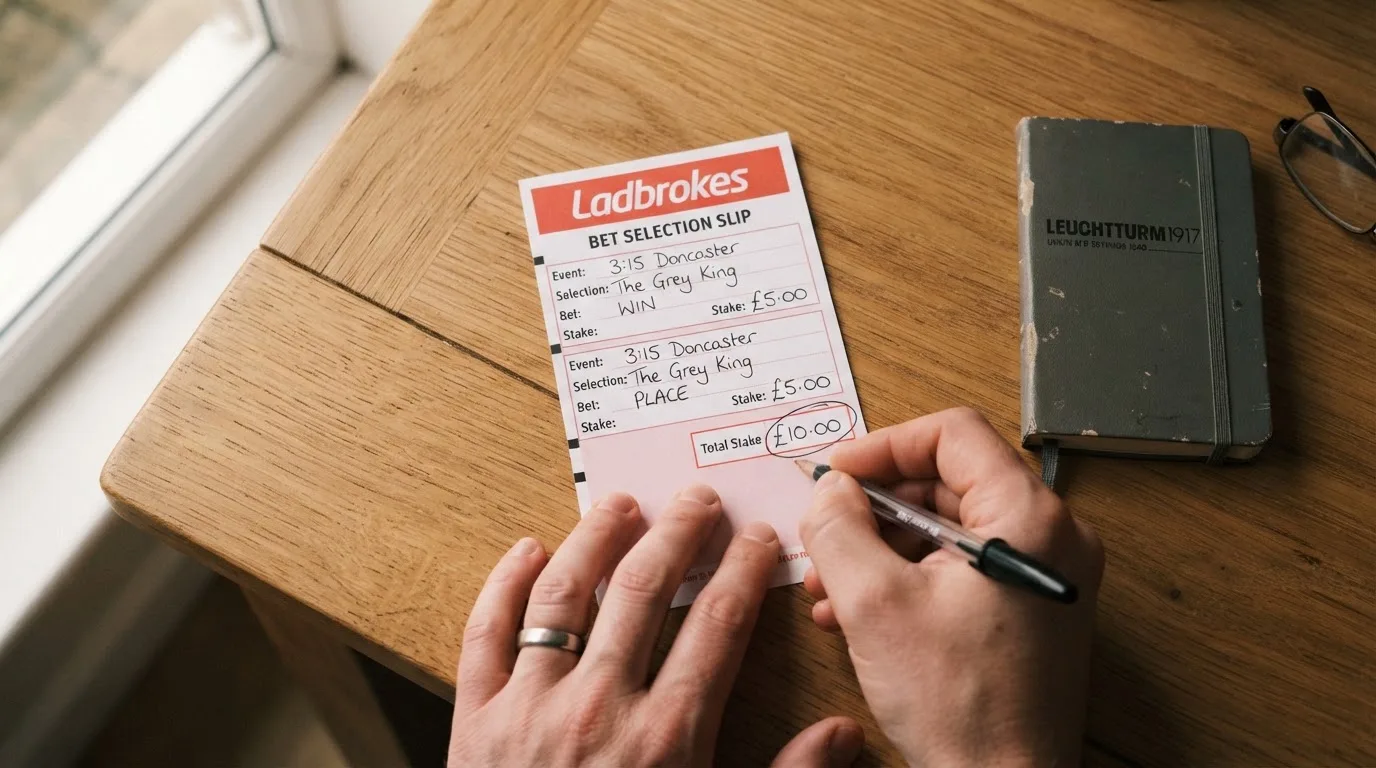
Each-way betting is the British punter’s standard on horse racing. An each-way bet is two bets of equal stake — a win bet and a place bet. A £5 each-way bet costs £10. The place bet pays at a fraction of the win odds, called the place terms, if the horse finishes in the places. UK place terms depend on the type of race and the number of runners: handicaps with more than 15 runners pay 1/4 odds for 4 places; 12 to 15 runners 1/4 for 3 places; other races with more than 7 runners 1/5 for 3 places; 5 to 7 runners 1/4 for 2 places; fewer than 5 runners win only.
A worked example: a £10 each-way bet on a 10-1 horse at 1/4 place terms for 3 places costs £20 in total. The win part returns £110 if the horse wins (£10 × 10 + £10 stake) and the place part returns £35 if the horse finishes in the first three (£10 × 2.5 + £10 stake). A win pays £145 in total; a place at the top three pays £35. The trade-off is that a place-only finish still returns something, but the win return is what every punter wants.
A bet calculator is the punter’s working tool: enter the stake, the odds, the each-way flag and the place terms, and the calculator returns the return on a win, the return on a place, the return on a loss. The major apps include a bet calculator on the slip; standalone calculators do the same job for free. The maths is not the hard part; the hard part is finding a price that beats the bookmaker’s margin.
The bookmaker’s margin is the slice of every pound bet on a market the bookmaker keeps on average. The arithmetic is the inverse of the payout share. For a two-way market at decimal odds 1.90 / 1.90 — a heavily juiced match-result price, not a horse race, but a clean example of the mechanics — the payout share is 1 ÷ (1/1.90 + 1/1.90), which is 0.95; the margin is 1 − 0.95, which is 5%. For a 12-runner horse race at decimal odds 8.00, 9.00, 10.00, 11.00, 12.00, 13.00, 15.00, 17.00, 21.00, 26.00, 34.00 and 67.00, the implied probabilities sum to 1.229, the payout share is 1 ÷ 1.229 = 81.4%, and the margin is 18.6%. The margin of a real horse race book sits between 10% and 30% depending on the meeting, the race and the bookmaker; the more runners, the wider the margin at the extremes; the more liquid the meeting, the tighter the margin across the field.
The takeaway: a margin of 5% is the lower bound of a major bookmaker on a liquid two-way market; a margin of 15% to 25% is the band of a British bookmaker’s pre-off horse race book on a routine meeting; a margin of 25% to 30% is what a smaller bookmaker on a quieter meeting takes. The cost of betting on a horse is the margin of the market, expressed as a fraction of every pound staked. The punter who bets on a 20% margin market is, on average, losing 20p on the pound. The punter who bets on a 5% margin market is, on average, losing 5p on the pound. The difference is the entire long-run game.
Spread betting on horse racing
Spreadex, licensed by the FCA for spread betting and by the Gambling Commission for fixed-odds betting, lets customers take a spread betting position on a horse race: bet that the winning distance of the field will be higher (buy) or lower (sell) than the spread the bookmaker quotes. The mechanic is not the same as a fixed-odds bet. Spreadex states that spread betting losses can exceed the deposit. The same £100 stake that wins £100 if the spread closes 10 points in the punter’s favour loses £100 if the spread closes 10 points against the punter, and the spread can close 50 points or 100 points against the punter if the race plays out unusually. The liability is open-ended in a way fixed-odds betting is not, and the FCA’s regulation is for the financial product, not the gambling product; the punter is treated as a spread-betting customer for some purposes and a gambling customer for others.
A spread bet on a horse race is a derivative trade on the outcome of a race, and the punter’s edge comes from modelling the distribution of finishing distances, not from picking the winner. The market is not for the punter who wants to back a horse at a price; it is for the punter who has a view on the shape of the race.
The racing calendar — fixtures, tournaments and the British Triple Crown
Horse racing in Great Britain runs year-round across three codes: flat racing, jump racing (steeplechase and hurdle) which is called National Hunt racing in Great Britain and Ireland, and all-weather racing. Flat races are run directly between two points around a straight or oval track; jump races involve obstacles. Flat races range from 440 yards (400 m) to more than four miles (6.4 km), with five to twelve furlongs (1.0 to 2.4 km) the most common distances on the British flat programme. Jump races start at two miles and extend to the Grand National course at Aintree, which is four miles and two and a half furlongs with thirty obstacles.
The British flat calendar runs from late March to early November. The showcase meetings are the Classics: the 2000 Guineas and 1000 Guineas at Newmarket in early May, the Derby and the Oaks at Epsom in early June, and the St Leger at Doncaster in mid-September. The 2000 Guineas, the Derby and the St Leger form the British Triple Crown of flat racing, a sweep won in the same season by twelve horses in the history of the British flat programme, the most recent being Nijinsky in 1970. The 1000 Guineas, the Oaks and the St Leger form the Fillies’ Triple Crown, last won by Sceptre in 1902.
The National Hunt calendar runs from late October to late April. The showcase meetings are the Cheltenham Festival in March, the Grand National meeting at Aintree in April, and the Champion Chase and King George VI Chase at Kempton over the Christmas period. The Grand National is the most-watched horse race in Great Britain by domestic audience, and the most-wagered single race on the British bookmaker’s year. The Cheltenham Festival is the most-wagered meeting.
The handicap system is the central mechanism of British racing. In a handicap race each horse is assigned a different weight to carry based on its assessed ability, with the best horse carrying the most weight; in a conditions race, horses carry the same weight with allowances for younger and female horses. Handicaps let horses of different abilities compete on a more level playing field, and they are the bulk of the race programme: most weekday racing is handicaps, and the major handicaps — the Ebor at York, the Cesarewitch at Newmarket, the Grand National itself — are the most competitive betting heats of the calendar.
The bookmaker’s race programme is wider than the racecourse programme. Ante-post markets open weeks or months before a major race, at wider prices and bigger margins. The non-runner rule cuts in if a horse is withdrawn: a Rule 4 deduction reduces the returns on the remaining runners by a percentage set by the bookmaker, depending on the withdrawn horse’s price. The punter who backs a horse ante-post at 25/1 and the horse is then balloted out at the declaration stage loses the stake. The punter who backs a horse on the morning of the race, after the declarations, takes the non-runner risk off the table.
Where the betting sits in the calendar
The punter’s calendar is the racing calendar plus the major bookmakers’ offers layered on top. The spring and autumn are the flat seasons; November to April is National Hunt; the Cheltenham Festival in March is the single biggest betting meeting in Britain. The bookmakers’ offers cluster around the major meetings: enhanced odds on the Classics, Best Odds Guaranteed across the Festival, money-back specials on the Grand National. The punter’s discipline is to take the offers on the meetings they would have bet on anyway, not to bet on meetings the offer has pulled them into.
The top 10 horse racing bookmakers — what they actually do
The ranking below is of GB-licensed remote bookmakers, set out in the order research fixes. Each brand is a separate licensee or trading name of a licensee; the table beneath the write-ups lists the Gambling Commission remote licence number, the licence holder, and what the operator’s own terms state on the book’s subject matter. None of these brands is “the only” licensed one — the register lists many more — and a place in the comparison is not a recommendation to bet.
Tote
Tote is the pool-betting brand, historically the British state pool operator and now a private bookmaker under TDCO Limited on a Gambling Commission remote licence. The pool model is different from the fixed-odds book: the punter bets into a pool, the pool is divided among the winners after the operator’s take, and the payout is set by the pool size rather than by a bookmaker’s margin. The dividend is announced after the race, not before. The trade is that the dividend can be higher or lower than a comparable fixed-odds price; the punter who takes the pool takes the uncertainty of the dividend in exchange for the absence of a bookmaker’s margin.
Tote’s betting offer on horse racing is the traditional pool side plus a fixed-odds book for the meetings where the bookmaker is also taking bets. The Best Odds Guaranteed equivalent is the pool guarantee, which pays the SP if the SP is higher than the pool dividend on selected races. The trade for a British punter is that the pool dividend on a routine race is a tighter price than the fixed-odds book, and the punter who only bets into the pool gives up the bookmaker’s enhanced odds offers in exchange for the lower margin.
Star Sports
Star Racing Limited holds the Gambling Commission licence; the app surfaces the sports book, the trading desk and the customer-service number. The service level is the differentiator: customers can speak to a trader directly on 08000 521 321 to open an account, place bets or ask queries, and a parallel email route at [email protected] handles the same questions asynchronously. The major apps do not sell a trader on the phone. The trade is that a phone trader is a more expensive way to place a bet than a tap on a slip, and the prices on the more liquid meetings are competitive but not consistently the best in the market.
Fitzdares
Fitzdares Limited runs the brand on a Gambling Commission remote licence. The app surfaces cash out, accumulators, Lucky 15s, specials and ante-post markets on horse racing, football, tennis, rugby, cricket, golf and American football, with in-play live odds. The brand positions itself at the premium end of the British market — a higher-touch experience, a deeper ante-post offering, and a stronger phone-based service than the major houses. The trade is the price: the prices on Fitzdares’ book are competitive but not consistently the sharpest on the most liquid meetings, and the premium positioning is what the punter pays for.
London Bet
Thistle Bet Limited runs the brand on a Gambling Commission remote licence. The app combines sports betting — football, tennis, horse racing, greyhounds, darts, golf, cricket, NFL, NBA, MLB, snooker — with Pragmatic Play casino slots and live in-play betting. The shape is the standard major-bookmaker app with a casino leg attached. The trade is the depth of the racing book: London Bet takes the major meetings but does not always price the smaller fields at Newmarket or Lingfield as competitively as the bigger houses.
Betboro
Webmedia Development N.V. runs the brand on a Gambling Commission remote licence. The sports welcome offer is a 100% matched free bet up to £25 on the first qualifying wager, requiring a debit-card deposit of at least £10 and a first bet of between £5 and £25 on at least three selections at 3/5 (1.60) or higher. The minimum price of 1.60 rules out accumulators built from the very short odds on heavy favourites, and the £25 ceiling caps the upside for a punter who would have placed a larger qualifying bet. The brand is a smaller player in the British market and the offer is the most visible tool for drawing new accounts. The trade is the qualifying conditions: a punter who cannot place a three-selection accumulator at the minimum price within the qualifying window does not get the free bet.
Kalooki Sportsbook
Kalooki Sportsbook Limited, company number 12938274, holds the Gambling Commission licence under account number 57730 and is a GAMSTOP member. The brand is a smaller player with a strong compliance posture; identity verification before the first deposit, GAMSTOP coverage and a sports book that takes the major meetings are the headline. The trade is the depth of the racing book relative to the major houses; Kalooki’s offer is a competent book, not a deep ante-post room.
Paddy Power
PPB Counterparty Services Limited holds the Gambling Commission licence for Paddy Power, and Paddy Power Betfair is the parent group. The Paddy Power Sports Betting app is published by Paddy Power PLC and covers football, horse racing, boxing, rugby, tennis, golf, darts, snooker and F1. The brand is a major house with a strong racing book, an aggressive money-back special cadence, and a long history of headline offers that read larger than the qualifying conditions deliver. The trade is that Paddy Power’s racing prices are competitive but not consistently the best in the market; the specials, the money-back clubs and the Paddy Power newsroom are the customer-acquisition engine. The punter who bets on Paddy Power for the specials is paying for them through the rest of the book.
BoyleSports
Boylesports Enterprise holds the Gambling Commission licence. The sports welcome offer for UK players is £20 in free bets when a £10 bet is placed, with a separate €30 in free bets for a €10 bet for Irish players. The brand is the strongest Irish bookmaker in the British market by presence, with a competitive racing book and a strong in-shop and online footprint across Ireland and the UK. The trade is that BoyleSports’ liquidity on the smaller British meetings is thinner than the major houses, and the prices on the bigger meetings are competitive without being the sharpest.
Octobet
Octopus Game Limited holds the Gambling Commission licence. The sportsbook welcome offer is 50% back as a free bet up to £50, plus a £10 casino bonus for new customers. The brand is a newer entrant to the British market, and the welcome offer is structured to convert a £50 first bet into a £25 free bet plus a £10 casino bonus. The trade is the casino leg: the £10 casino bonus sits under a separate set of wagering conditions, and the punter who only wants the sports side pays for the casino leg through the size of the matched free bet.
Matchbook
Triplebet Limited holds the Gambling Commission licence for Matchbook under the betting intermediary category, which is the licence type for betting exchanges. The app offers Bet Builder, multiples, in-play betting and live streaming of horse racing and greyhounds. The exchange model is structurally different from the rest of the ranking: punters back and lay against each other rather than against a bookmaker, and Matchbook takes a commission on net winnings rather than building a margin into the price. The trade is liquidity: an exchange is only as good as the money on the other side of the bet, and Matchbook’s liquidity on smaller meetings is thinner than the major bookmakers’ prices on the same meetings. The punter who wants the best price on a major race and is willing to bet at the prices the exchange offers, with commission, gets a structurally lower margin than the bookmaker alternative. The punter who wants a price on a smaller meeting may not get one.
How the brands compare
| Brand | Gambling Commission remote licence and holder | What the operator’s own terms state |
|---|---|---|
| Tote | 054779-R-331321-008 (account 54779) — TDCO Limited | Pool betting with a fixed-odds book on major meetings; pool guarantee on selected races |
| Star Sports | 009177-R-104555-019 (account 9177) — Star Racing Limited | Phone-based trading desk on 08000 521 321; [email protected] support |
| Fitzdares | 000400-R-103839-030 (account 400) — Fitzdares Limited | Cash out, accas, Lucky 15s, specials, ante-post and in-play markets across horse racing and other sports |
| London Bet | 066162-R-340278-004 (account 66162) — Thistle Bet Limited | Sports betting on horse racing and other sports, with Pragmatic Play casino slots and live in-play |
| Betboro | 044181-R-324363-007 (account 44181) — Webmedia Development N.V. | 100% matched free bet up to £25 on a qualifying bet of £5 to £25 with at least three selections at 1.60 or higher |
| Kalooki Sportsbook | 057730-R-333396-005 (account 57730) — Kalooki Sportsbook Limited | Sports book on major meetings; GAMSTOP member; identity verification before first deposit |
| Paddy Power | 039439-R-319330-013 (account 39439) — PPB Counterparty Services Limited | Sports book on horse racing and other sports; Paddy Power PLC app covers football, horse racing, boxing, rugby, tennis, golf, darts, snooker, F1 |
| BoyleSports | 039469-R-319383-025 (account 39469) — Boylesports Enterprise | UK players: £20 in free bets on a £10 qualifying bet; €30 in free bets on a €10 bet for Irish players |
| Octobet | 062545-R-337248-006 (account 62545) — Octopus Game Limited | 50% back as a free bet up to £50, plus a £10 casino bonus for new customers |
| Matchbook | 039504-R-319407-024 (account 39504) — Triplebet Limited | Betting exchange with Bet Builder, multiples, in-play betting and live streaming of horse racing and greyhounds |
Overview — what online horse racing betting is in Great Britain
Online horse racing betting in Great Britain is the activity of placing a bet on a horse race through a website or app operated by a bookmaker licensed by the Gambling Commission. The bookmaker takes the bet, the punter pays the stake, the result settles the bet. The price, the market, the bet type, the offer and the payment method are all chosen by the punter from the options the bookmaker surfaces. The Commission licences the operator; the operator offers the markets; the punter decides whether to bet.
The shape of the market is set by the licence conditions and codes of practice the Commission publishes, by the major bookmakers’ competitive offers, and by the racing calendar the British Horseracing Authority sets. The punter’s choice is between fixed-odds books, betting exchanges, pool betting, and the spread-betting firms that take a derivative position on the outcome of a race. Each model has a different cost structure: fixed-odds books take a margin in the price, exchanges take a commission on winnings, pool betting takes a take from the pool, and spread betting prices the race as a spread the punter trades against.
The activity of betting is regulated, the offer of betting is licensed, and the enforcement of the licence conditions is the Commission’s job. The punter is licensed to bet by being 18 or over, and is verified by the bookmaker on the first deposit. A punter who bets with a bookmaker licensed outside the Commission’s regime is taking the same bet, but loses the British consumer protections — the GAMSTOP self-exclusion, the approved dispute-resolution route, the 10x bonus cap, the £150 vulnerability check, and the right to complain to the Commission if funds are withheld. The cost of an unlicensed brand is the absence of the protection, not a higher price.
The trade-off the punter makes is between price and protection. The licensed bookmakers’ prices are wider than the sharpest international books; the exchanges’ prices are tighter but the markets are thinner; the spread betting firms’ prices are the price of the spread, not the price of the horse. The punter who wants the sharpest price takes the exchange; the punter who wants the broadest offer takes the major bookmakers; the punter who wants the highest touch takes the smaller brands with the phone desk.
The legal frame — what is and is not licensed
The Gambling Commission is the regulator. The Gambling Act 2005 is the statute, covering Great Britain — England, Scotland and Wales. Northern Ireland is outside the Act and has its own older law; a GB-licensed operator is licensed for Great Britain, not for Northern Ireland, and a Northern Ireland punter betting with a GB-licensed operator is using a brand licensed for the rest of the UK.
Since the Gambling (Licensing and Advertising) Act 2014, an operator whose remote facilities are used in Great Britain needs a Commission licence wherever it is based, under sections 33 and 36 of the 2005 Act as amended. A Curaçao, Maltese or Gibraltar licence is not a substitute. The Commission’s public register can be searched by business name, trading name, domain or account number, and is the whole test of whether a brand holds a licence. A punter who wants to check a brand goes to the register, not to a comparison site.
Betting licence types relevant to a horse racing punter are: remote general betting standard (real events), which is the standard bookmaker licence; remote general betting standard (virtual events), for virtual markets; remote pool betting, for tote and pool operators; and remote betting intermediary, for exchanges. A single licensee can hold more than one category. A bookmaker licensed for real events only is not licensed to offer virtual racing; a bookmaker licensed for pool betting is licensed for the pool and not for a fixed-odds book unless the same licensee also holds the general betting standard category.
The minimum age is 18. Identity verification is required before the first deposit or bet, including on free bets and bonuses, and has been since 7 May 2019. The verification is of name, address and date of birth. A punter who cannot verify does not deposit; a brand that takes a deposit before verification is breaking its licence conditions.
What may be bet on
There is no statutory list of permitted bets or markets. An operator holds a licence for a category and offers markets under its own rules and the Commission’s LCCP. In-play betting is offered by GB bookmakers; the controls are the operator’s licence conditions and the customer-protection duties. Esports are treated like any other event; virtual events are a separate licence category. Bets on politics, TV shows and novelty markets are offered by GB bookmakers and no statutory prohibition was found. The punter who wants to know whether a market is offered checks the bookmaker’s site, not the statute.
Betting exchanges run under a betting intermediary licence. Rates and rules specific to exchanges are stated only from each exchange’s terms. Spread betting that is not a financial product is inside General Betting Duty, the operator’s tax on gross profits; financial spread betting is regulated by the Financial Conduct Authority. Off-course pool betting on horse or dog racing is a separate licence and duty. The punter does not need to know the duty structure; the punter needs to know whether the bookmaker is licensed, and at that point the duty structure is the bookmaker’s problem.
No statutory cap on stakes in sports betting was found. Operators set their own maximum stakes and may restrict customers. The punter who is winning consistently will be staked-restricted; the punter who is losing will not. The bookmaker’s risk team sets the limits, and the limits are the bookmaker’s commercial decision, not a regulatory one.
Tax
The punter pays no tax on betting winnings in Great Britain. This is general information, not tax advice; a professional gambler should ask HMRC or an adviser, because the line between a punter and a professional gambler is a line HMRC draws on the case, not on the activity. General Betting Duty is the operator’s tax on gross profits, currently 15%. From 1 April 2027 a new remote betting rate of 25% applies within it, while remote bets on UK horse racing, self-service betting terminal bets, pool betting and in-person betting stay at 15%. Whether operators pass the duty on through odds is not established; the punter is not charged duty directly.
Offshore
A GB licence is compulsory at the point of consumption. Providing gambling facilities in Great Britain without the licence the Act requires is an offence under section 33 of the Gambling Act 2005, on summary conviction up to 51 weeks’ imprisonment, a fine up to level 5, or both; six months in Scotland. The offence is aimed at the operator. No offence aimed at a customer who merely bets on an unlicensed site was found.
The cost of an unlicensed site to the punter is the loss of British protection: no GAMSTOP coverage, no Commission complaints route, no approved dispute-resolution body, no British consumer redress if funds are withheld, not bound by the 10x bonus cap, not bound by the £150 vulnerability check. The punter is also not subject to the LCCP marketing conditions, which means the advertising the punter sees on an unlicensed site is not held to the British standard. The bookmaker may not enforce a self-exclusion; the bookmaker may not offer a deposit limit; the bookmaker may not verify identity before the first bet. These are not the punter’s protections, but they are the operator’s duties, and the operator is licensed to discharge them.
Enforcement is disruption, not blocking: cease-and-desist notices, search-engine referrals, work with registrars, hosts and payment providers. The Commission has been given, or is about to receive, court-order DNS blocking powers. ISP blocking as a general policy is not in operation. The honest framing is: licensed means checks, limits, GAMSTOP, bonus cap, but also verification before the first bet; unlicensed means none of those protections and possible loss of funds. Neither is “the safe choice” by default.
Safer gambling — the cost of a stake you cannot afford
GAMSTOP is the national multi-operator online self-exclusion scheme and a mandatory licence condition for online operators since 31 March 2020. The exclusion periods are six months, one year, five years, or five years with auto-renewal; after the minimum period the exclusion stays in place for a further seven years unless the customer asks GAMSTOP to remove it. GAMSTOP covers online sites and apps; betting shops use a separate service. A punter who self-excludes through GAMSTOP is excluded from every GB-licensed online bookmaker and casino; the punter who bets with an unlicensed brand is not covered by GAMSTOP, and the self-exclusion does not apply.
A financial vulnerability check (LCCP condition 3.4.4, in force since 30 August 2024) applies to licensed remote betting when a customer’s deposits minus withdrawals exceed £150 in a rolling 30 days (since 28 February 2025). The check is a public-record check — bankruptcy or county court judgments, for example — not an income check and not a credit reference check. The punter is not asked to provide payslips; the punter is checked against public records. A punter who flags on the public-record check is asked for further information; the bookmaker’s safer gambling team makes the call.
Financial risk assessments — the affordability checks of the press — are announced in a staged plan by the Commission, with a Commission article of 7 July 2026 setting out the timeline, and no start date. The plan is announced, staged, and not in force. A punter who reads about “affordability checks” in the press is reading about a future framework, not a current one.
Deposit limits are a licence condition. The first changes applied on 31 October 2025; a second phase was postponed to 30 September 2026. There is no state-set deposit or loss ceiling for betting: limits are the customer’s choice. The bookmaker must offer the limit; the punter sets the limit. A punter who wants to set a daily, weekly or monthly deposit limit can do so on every GB-licensed bookmaker, and the limit applies across deposits only — withdrawals are not restricted. A punter who wants to increase a limit usually has to wait 24 hours and re-confirm; a punter who wants to decrease a limit can do so immediately. The decrease is instant because the protection works in one direction only.
Help is available outside the bookmaker. GamCare runs the National Gambling Helpline. GambleAware funds treatment and education. The NHS runs gambling clinics in several regions. Gamblers Anonymous runs peer-support meetings. The bookmakers licensed in Britain link to these services from their safer gambling pages; Fitzwilliam Sports links to GambleAware, GamStop and Gamblers Anonymous from its home page. The punter who wants help has a route; the punter who does not ask does not get it.
The cost of a stake the punter cannot afford is not a one-off loss. It is the rent not paid, the bill not met, the relationship damaged, the job risked. The bookmaker’s safer gambling tools are not there because the bookmaker cares; they are there because the Commission’s licence conditions require them, and because the punter who gambles responsibly is the punter who comes back. The cost of not using them is paid by the punter, not by the bookmaker.
Crypto and anonymity — what licensed bookmakers do not offer
Crypto horse racing betting is a search term that meets a different market in the British frame. A GB-licensed bookmaker is required to verify identity before the first deposit; no anonymous play at a licensed site. A bookmaker licensed outside the Commission’s regime can offer a crypto deposit and an account opened with a wallet address and an email; the punter gets pseudonymity in exchange for the loss of British consumer protection.
The trade-off is exactly the same as the offshore trade-off in the previous section, restated in a payment rail. A punter who deposits in Bitcoin at an unlicensed bookmaker gets the bet and loses the GAMSTOP coverage, the 10x bonus cap, the £150 vulnerability check, the approved dispute-resolution body and the Commission’s complaints route. The crypto rail is faster and pseudonymous; the British protection regime is incompatible with either.
No GB-licensed bookmaker is established as a crypto-only brand. Some licensed bookmakers accept crypto-to-fiat conversions at the payment processor (the punter pays in Bitcoin, the bookmaker receives pounds), but the punter is verified before the first deposit in the same way as a debit-card customer. The conversion is a payment-method feature, not a regulatory one. The licensed bookmaker that advertises “Bitcoin accepted” is advertising a payment option; the unlicensed bookmaker that requires Bitcoin is advertising the absence of verification.
The licensed path is closed to the punter who wants anonymity. The unlicensed path is open. The punter’s choice is between the British protection regime and the absence of identity checks. The price of anonymity is the protection; the price of the protection is the identity check.
A British named-account rule, a state list of permitted payment methods, and any rule for or against cryptocurrency deposits at licensed operators are not established. The licensed bookmakers each set their own accepted payment methods within the LCCP and the credit-card ban. Credit cards are banned for gambling in Great Britain since 14 April 2020 (LCCP condition 6.1.2), including credit-card-funded payments through an e-wallet. Debit cards and bank-based payments are not covered. The punter who tries to deposit on a credit card is blocked; the punter who deposits on a debit card is verified and allowed.
The tax question on crypto betting is the same as on any other betting: the punter pays no tax on winnings in Great Britain, the operator pays General Betting Duty on gross profits, and a professional punter should ask HMRC. The crypto rail is not, from the tax point of view, a different bet.
The margin of a market — a worked example
The bookmaker’s margin is the slice of every pound bet on a market the bookmaker keeps on average. The arithmetic is the inverse of the payout share: for any market, the implied probabilities of the prices sum to a number greater than one, and the excess is the overround. The margin is the overround divided by the sum of the implied probabilities; the payout share is one minus the margin.
For an illustrative two-way market at decimal odds 1.90 / 1.90, the implied probability of each outcome is 1 ÷ 1.90 = 0.5263, the sum of the implied probabilities is 1.0526, the margin is 1 − 1 ÷ 1.0526, which is 1 − 0.95 = 5%, and the payout share is 95%. A punter staking £100 split £50 / £50 across the two outcomes gets back £95 in the aggregate: £50 × 1.90 = £95 on the winning side, £0 on the losing side. The bookmaker keeps £5 of the £100 stake.
The same arithmetic on a 12-runner horse race with decimal odds from 8.00 to 67.00 across the field gives a margin in the band of 15% to 25% on a routine meeting, depending on how the bookmaker has shaped the book. A major bookmaker on a major meeting sits towards the lower end; a smaller bookmaker on a quieter meeting sits towards the upper end. The punter’s expected loss per pound staked is the margin: a 20% margin market costs 20p on the pound across a long sample.
The result of the worked example: a margin of 5% is a clean two-way market at 1.90 / 1.90; a margin of 15% to 25% is the band of a British bookmaker’s horse race book on a routine meeting; a margin of 25% to 30% is the band of a smaller bookmaker or a quieter meeting. The cost of betting on a horse is the margin, and the punter who bets on a 20% margin market is, on average, losing 20p on the pound.
The margin of one market is not the margin of another. The 1X2 margin on a football match is not the same as the over/under margin; the win market on a horse race is not the same as the place market or the each-way market; the pre-off margin is not the same as the in-play margin. The numbers in this section apply to the markets described, and to the bookmaker and the meeting at the prices quoted, on the day the prices were set. The numbers in a real bookmaker’s racecard on a real meeting in 2026 are a different sample and will give a different margin.
Frequently asked questions about online horse racing betting
How do I bet on horse racing?
Pick a bookmaker licensed by the Gambling Commission, complete the identity verification on the first deposit, find the race in the app or site, choose the horse and the bet type (win, each-way, or a multiple), enter the stake and confirm. The bet is settled when the race finishes; the return is calculated from the price the bet was struck at and the stake. Withdrawals are processed back to the original payment method after the bookmaker’s verification window.
How do I work out a horse racing bet?
Use a bet calculator: enter the stake, the decimal odds, the each-way flag and the place terms, and the calculator returns the return on a win, a place and a loss. The return on a single win bet is stake × odds. An each-way bet is two bets at equal stake, so a £5 each-way costs £10, and the place return is the place terms (commonly 1/4 or 1/5) of the win odds if the horse finishes in the places.
How do betting odds work on horse racing?
British bookmakers display odds in fractional form (5/1, 11/4, evens) and decimal form (6.00, 3.75, 2.00). The conversion is a/b → a ÷ b + 1, so 5/1 is 6.00 and 11/4 is 3.75. The decimal odds are the total return per unit stake, including the stake; the profit is the decimal odds minus one, times the stake. The shorter the odds, the more likely the bookmaker considers the horse to win; the longer the odds, the less likely.
How can I check that a bookmaker holds a Gambling Commission licence?
Search the Commission’s public register by business name, trading name, domain or licence account number. Every GB-licensed remote bookmaker is on the register, and the register is the whole test. A bookmaker that is not on the register is not licensed for Great Britain, regardless of any other licence the operator holds; the punter who bets with an unlicensed brand loses the British consumer protections.
How is the return on a bet worked out from the stake and the odds?
For a single win bet, return = stake × decimal odds, and profit = stake × (decimal odds − 1). For an each-way bet, the stake is doubled (a £5 each-way costs £10), the win part returns stake × odds if the horse wins, and the place part returns stake × (1 + place terms × (odds − 1)) if the horse finishes in the places. For a combination bet the odds of the legs multiply into one price, and the return is stake × combined odds.
What is the bookmaker’s margin and how can I see it in the odds?
The margin is the slice of every pound staked the bookmaker keeps on average. To see it, convert each price in the market to an implied probability (1 ÷ decimal odds), sum the probabilities, and subtract from 1; the result is the margin. A two-way market at 1.90 / 1.90 has a margin of 5%; a 12-runner horse race typically sits between 15% and 25%. The margin is the bookmaker’s edge, baked into every price, and the punter who bets on a higher-margin market pays more per pound staked on average.
Horse racing & greyhounds – Cricket betting
Content created by the «Cricket betting» team
