
Betting on Corners in the UK: Markets, Margin and the Real Cost of a Corner Bet
 Available in US
Data current as of 27 October 2026 and checked against the Gambling Commission’s public register of remote betting licences.
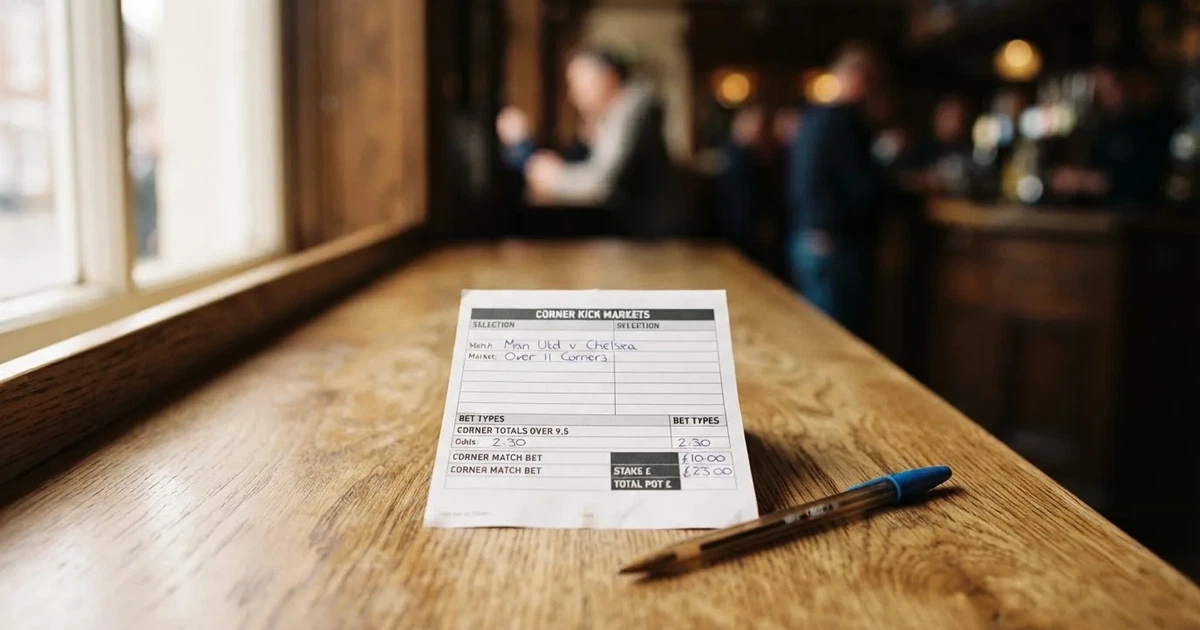
The first thing to settle on a page like this is what a corner actually is, because the market is built on top of a single event in a football match that is easy to under-count. A corner kick is awarded when the ball wholly crosses the goal line outside the goal frame after last touching a defending player, and the touch does not have to be deliberate. The kick is taken from the corner of the field nearer to the point where the ball crossed the line, with the ball stationary within a quarter circle of one yard (one metre) at the corner flag. Opposing players must stay at least 10 yards (9.15 metres) from the ball until it is in play, and an attacker receiving the ball directly from a corner cannot be penalised for offside. Scoring directly from a corner — an *Olimpico* goal — was legalised by the IFAB on 14 June 1924, and an own goal straight from a corner is not allowed. The corner kick entered the Football Association’s code in 1872 via the Sheffield Association. None of that is betting, but the market sits on top of it: every line on a corners market counts a real event with these rules behind it.
What this guide covers, in plain order, is what a corner bet costs the bettor. The angle is cost — what a stake turns into on a win, what the bookmaker keeps of every pound bet on this market, what a free-bet welcome offer really takes to clear, and where the bookmaker’s own terms add a restriction that the marketing page does not flag.
Bankroll, Forecast, Analytic: How Bettors Plan a Corner Bet
Corners Betting Strategy and the Logic Behind a Selection
The phrase “corners betting strategy” turns up more than the phrase “corners betting odds” in British search, which is a tell. Bettors are not looking for the next price; they are looking for a reason to back one. The reason almost always has the same shape: a team that plays a high defensive line concedes a lot of corners, a team that presses high forces the opposition into a lot of corners, and a match between two such sides is the profile that pays out the most on over-markets. The opposite profile — a low-block side playing a low-block side — collapses the same markets.
The most common selections, in the order most bettors work through them, are these. First, total corners over a line set by the bookmaker, settled on the official count at full time. Second, a handicap on corners, which gives one side a fictional lead in corners to flatten the price on the favourite. Third, the race to a corner count, settled on which side hits three (or five, or seven) first. Fourth, individual corner tallies by team, settled on each side’s count separately. Fifth, a corners match bet — which side wins the corners count, settled on who took more, with a tie returned if the count is level. Each is a different way to express the same view, and the price moves with the form of expression.
A strategy worth keeping is a small one: pick a league, learn its average corners per game, and only back over-markets when the line is below the average and under-markets when it is above. The bookmaker sets the line using its own model, and the line is sharper in the Premier League than in the Cypriot first division, because the data is denser. The same bet at a sharper price is the same bet at a worse one only in name; the margin is wider in the smaller leagues, and a bettor pays for that in every stake.
Corners Betting Tips vs. an Actual Forecast
The next layer down is “tips”, and the honest version of this layer is that no published tip is a forecast. A tip is a price-and-selection pair, sometimes with a stake, and the marketing around it is a confidence score that means nothing. What the tip is, mechanically, is one bettor’s view that the line is too high or too low. The tip may be right; the track record behind it is rarely long enough to test that with any weight.
What a bettor can do with tips is use them as a sieve. A tip that names the line, the league, the snapshot date and the bookmaker is testable. A tip that names none of those is a story. Most published corner-tips services on social media sit closer to the second category. The cost of a tip service is the subscription, but the cost of acting on an untested tip is a stake the bettor can lose, and a tipster who charges a subscription has no stake in the outcome, which is the basic reason the industry looks the way it does.
Betting on Corners System: The Booking-Turnover Trap
A “system” in this context is a staking plan — a way of sizing each bet in a sequence so the wins cover the losses and produce a profit. The Martingale, the Fibonacci and the Labouchere are all in this family. They are not corner-specific. They are accounting, applied to a sequence of bets, and they assume nothing about whether each individual bet wins.
The arithmetic is the problem. A system that doubles the stake after every loss recoups the losses when a win comes in, and the same arithmetic means the stake grows quickly. A £10 starting stake that loses six in a row needs a £640 stake on the seventh bet, and a £10 starting stake that loses ten in a row is not recoverable at any stake a bookmaker will accept. A system that adjusts the stake to a fraction of the bank faces the same issue in slower motion: a long enough cold streak empties the bank. The book’s marketing pages sell systems because systems have names, and named things sell. A corner market is a sequence of independent bets with a margin in every price, and no staking plan changes that.
Selection, Settling, Staking: Bet Types and Odds
What a Corners Match Bet Is
A corners match bet is the simplest expression of the market: pick the side that will take more corners in the match. The bet is settled on the official count at the final whistle, and a tie returns the stake. Two things to read off the bet slip before placing: the line “most corners” on the match outright, which settles on the official count, and the period — most match-bet corners markets settle on 90 minutes plus stoppage time, not extra time or penalties, so a cup tie that goes to extra time is settled on the 90-minute count.
The next step up is the handicap, which gives one side a fictional corner lead. A -2 handicap on the home side settles as a winner if the home side takes three more corners than the away side. The price is closer to evens than the un-handicapped match bet, because the handicap shortens the away side. Bettors who have a strong view on a one-sided fixture use handicaps to keep the price up; the handicap is a way of expressing a view in fewer corners of margin.
Asian Corners in Betting
An Asian corners bet is a handicap line, and the name comes from the way Asian handicap markets on the 1X2 have been built. A whole-line Asian corner bet is settled as a push if the handicap exactly lands — a -2 home handicap returns the stake if the home side takes exactly two more corners than the away side. A half-line Asian corner bet, say -1.5 on the home side, settles as a win if the home side takes two or more corners than the away side, and a loss otherwise. There is no push on a half-line. A split-line bet splits the stake across a whole and a half line: a -1.25 line is half the stake at -1 and half at -1.5, so a one-corner margin returns half the stake and a two-corner margin wins the full stake.
The bookmaker’s price on an Asian line is tighter than the price on a three-way match bet, because the draw is taken out. That is the bettor’s bargain: a sharper price for accepting a finer grain of settlement.
How to Bet on Corners and What the Slip Asks
A corner bet on a UK bookmaker’s app is a standard single. The bettor picks the fixture, the market, the line and the price, sets a stake, and confirms. The slip shows the potential return at the top — return = stake × odds — and the net profit underneath, which is the return minus the stake. Decimal odds make the arithmetic clean: a £10 stake at 2.50 returns £25, and the net profit is £15. Fractional odds carry the same information in a different shape — 3/2 means a £2 profit for every £1 staked, and the decimal form is 2.50. Most UK apps let the bettor switch the display, and the maths is the same either way.
A multi-corners bet is an accumulator, and the price is the product of the leg prices. Two legs at 1.90 and 1.80 return at 3.42 to 1, and three legs at 1.50, 1.70 and 2.00 return at 5.10 to 1. Each leg has to win for the bet to pay out; one leg down and the whole stake is lost. The marketing on accumulators is loud, and the margin compounds with each leg, so the price on a long acca is a worse price than a single.
Over 1 Corner, Over 7.5 Corners, and What the Line Means
“Over 1 corner” reads as a near-certainty — and on most fixtures, it is. The price is therefore short, often shorter than 1.05, and the stake needed to make any money is correspondingly large. The marketing on small over-lines is rarely worth the bettor’s time: the return on a £10 stake at 1.05 is £10.50, and a single corner in the first minute of the match takes the bet out. The price on a 1.05 line carries the bookmaker’s margin, which is the same percentage as on any other line, and the absolute profit is small even when the bet wins.
The shape of the pricing on a totals market is worth understanding. On a typical Premier League fixture, a line of 10.5 corners carries roughly even money on either side, because the average is around 10.5 and the variance is wide. A line of 8.5 corners carries a heavier price on the over and a shorter price on the under, because the average is above the line. A line of 12.5 corners carries a heavier price on the under. The line the bookmaker sets is a function of its own model, and the bettor’s job is to decide whether the model is wrong, not whether the line is “high” or “low” in any abstract sense.
Fixtures, Tournament, Competition: Sports and Corners
Football Corner Betting by League
Corners are a football market, and the league matters more than the team. The Premier League averages just over 10 corners per game across a season, and the variance is wide from fixture to fixture: a high-pressing tie between two top sides can clear 14 corners, a low-block cup tie can come in under six. The Championship averages a touch higher, partly because the football is more end-to-end, and the lower English leagues run a touch higher still because tackles come in more freely.
The European leagues are not the same shape. La Liga averages fewer corners per game than the Premier League, because the league has a tighter share of possession and a higher proportion of attacks down the middle. Serie A is similar. The Bundesliga runs higher, partly because pressing is more aggressive. The Dutch Eredivisie runs higher still. None of this is a tip; it is a baseline a bettor uses to decide whether a line is sharp or loose.
The cup competitions are their own book. The FA Cup early rounds feature ties between sides from different divisions, and the corner rate runs in a wide range. The Champions League knockouts tend to run tight on corners, because both sides defend in low blocks. The EFL Cup and the Europa League sit in between. A bettor who only bets on a single competition sees a partial market; a bettor who reads a couple of leagues has a more honest baseline.
World Cup Corner Betting and Tournament Profile
The World Cup sits in a different bucket from a domestic league, because the sample of matches is small and the variation between sides is wide. A World Cup group game between two attack-minded sides can produce a corner count well above the domestic average, and a knockout between two deep-lying sides can come in well below. The bookmaker’s model on a World Cup fixture is built from international data, which is thinner than domestic data, and the line is therefore looser.
A second quirk of a World Cup market is the timing of fixtures. A bettor in the UK watches a World Cup fixture in different time zones, and the in-play window is short. Live corner markets move quickly and the in-play price is sharp. A bettor who is awake for the full 90 minutes has an information edge that an in-play price partly captures, but the edge is small and the window is narrow.
MMA Corner Betting and What the Phrase Even Means
“MMA corner betting” comes up in the search pool for this subject, and the phrase means two different things in two different sports. In football, the corner is the set piece described above. In MMA, the corner is the team around the fighter — the cutman, the coach, the seconds. “MMA corner betting” sometimes refers to a prop on the corner stoppage — whether a fight is stopped by the corner between rounds — and it is unrelated to the football corner market on the rest of this page.
The point of flagging it is that the search phrase crosses two sports, and a bettor looking for a football corner market is not served by a page that drifts into MMA. The corner-kick rules and the corner count sit on football, and the rest of this page is football.
Walkthrough, Procedure, Sequence: How a Corner Bet Settles
The Corner Award, the Count, and the Settlement
The chain that ends in a settled bet has four links. The first is the event on the pitch: a defending player last touches the ball before it crosses the goal line outside the goal frame, and the referee signals a corner. The second is the count: a corner counts toward the match total as soon as the ball leaves the corner arc, not when the kick is taken. The third is the count being recorded by the data feed, which is the line the bookmaker settles on — Opta and similar feeds are the standard source, and a bookmaker’s own count may differ slightly from a fan’s, because the data feed records a corner from the moment of the signal, not the moment of the kick. The fourth is the settlement: at the final whistle, the bookmaker’s system reads the count, applies the line, and pays out where the bet wins.
A delay is normal. A bet that wins at the full-time whistle is not paid at the full-time whistle; it is paid in the minutes (or, on a busy day, the hour) after the data feed confirms the count. The settlement is automatic; the payment is not instant, and a bettor who wants to cash out before settlement is taking a different bet — the cash-out price, not the original price.
Why “First Corner” Is a Market, and What It Asks
A “first corner” market asks which side will take the first corner of the match. The price is set by the bookmaker’s model of each side’s likely early pressure, and the price on the favourite is short, because the favourite is more likely than not to win this market. A live bet on the first corner after a goal kicks in the second half is settled on the first corner of the rest of the match, not the first corner of the match as a whole.
The first-corner market is one of the few in-play markets where the price is genuinely sensitive to the first few minutes. A side that wins an early corner in the first two minutes has, in some sense, shown the hand. The bettor’s edge is in noticing when the price has not moved enough.
What “3 Way Corner” Means in Betting
A “3 way corner” is a match-bet line with a third outcome: each side to take more corners, or a tie. The price is wider than a two-way Asian line, because the draw is a third outcome, and the margin is wider as a result. A bettor who backs the home side on a 3-way line at 2.10 is paying for the possibility of a tie, which is not paid on an Asian line. A bettor who is sure the home side will take more corners than the away side — and that the home side will not end level — is paying for insurance the bettor does not need.
A 3-way corner line is the standard product on UK bookmakers’ match outrights. A bettor who wants a sharper price moves to an Asian or a handicap line. A bettor who wants the bet to read as a “win, lose, draw” on the slip stays on the 3-way line.
What a Bookmaker’s Own Terms Say About Corners
UK bookmakers’ own terms pages add a layer of rules on top of the on-pitch rules. The most common terms: a corner awarded but not taken is counted; a corner retaken because of an infringement in the arc is counted once; a corner awarded after the final whistle for an incident in the 90th minute is counted. A corner is not counted if the match is abandoned before it is taken, and the bet is voided in that case. A match that is abandoned mid-play is settled on the count at the time of abandonment, unless the bookmaker’s own terms state otherwise.
A bettor who plans to lay a heavy stake on a corners market reads those terms. A bettor who plans to back a small stake reads them too, because the difference between a voided bet and a settled bet is the stake, and a bettor who has not read the terms does not know which one applies.
Operator Comparison and Licensing Overview
How the Comparison Is Built
The ranking below covers ten bookmakers that hold a Gambling Commission remote licence for general betting on real events, and the comparison is built on three matters: the licence number and the licence holder named on the Commission’s public register, the operator’s own terms on corner markets, and the picture the operator presents to a UK bettor in 2026. The licence matter is the floor — a UK bettor who places real money on a corners market needs the operator to be licensed at the point of consumption, and the Commission’s public register is the whole test of who holds one. The terms matter is the working layer — what the operator’s own rules say about how a corners bet is settled and what restrictions apply. The presentation matter is the surface — what the operator puts in front of the bettor on the app and on the site.
What the comparison does not do: it does not name a “best” bookmaker, because a bettor’s own profile decides what best means, and the criteria that suit one reader (a small bankroll, a single-fixture focus) are not the criteria that suit another (an accumulator focus, a long-shot appetite). The comparison places the operators in the same frame so the bettor can see what each one offers.
| Brand | Licence | Licence holder | Corner-market terms |
|---|---|---|---|
| Dabble | Gambling Commission remote licence (account 65677) | Dabble Sports UK Ltd | Welcome offer framed as a free-bet match, free-bet stake not returned, minimum-odds and 7-day expiry rules on the free bet. |
| Coral | Gambling Commission remote licence (account 54743) | LC International Limited | Welcome offer issues free bets after a qualifying bet, minimum odds on the qualifying bet, free bets expire seven days after issue. |
| 10bet | Gambling Commission remote licence (account 43173) | Blue Star Planet Limited | Sportsbook covers football, tennis and horse racing; cash out, bet builder and live streaming are listed. |
| Geoff Banks | Gambling Commission remote licence (account 54095) | GB Sports Advisors Limited | App offers live in-play prices and ante-post prices on future events. |
| Paddy Power | Gambling Commission remote licence (account 39439) | PPB Counterparty Services Limited | Bet builder features plus popular bet builders, Super Sub (selected player’s bet rolls over to the substitute), expanded Win More markets, and player and acca stats. |
| Bet Ahoy | Gambling Commission remote licence (account 100094) | Bet Ahoy Ltd | Welcome offer combines a sports free bet and an acca free bet for new customers, each half the headline value. |
| LiveScore Bet | Gambling Commission remote licence (account 56859) | LiveScore Betting and Gaming (Gibraltar) Limited | Bet builder allows up to ten selections across match result, both teams to score, corners, total goals, player scoring and card markets. |
| BetTom | Gambling Commission remote licence (account 64959) | Bet Tom Limited | Welcome offer returns a percentage of the first stake as a free bet, with a parallel casino free-funds offer under the same terms. |
| Betfred | Gambling Commission remote licence (account 39544) | Petfre (Gibraltar) Limited | Bet builder, Sub Switch, Racing Post data, Extra Places, live casino and bingo on the app. |
| DragonBet | Gambling Commission remote licence (account 64908) | DragonBet Ltd | App features Welsh football and rugby markets, racing, American football, in-play betting and bet-builder markets. |
What the table shows, line by line, is that the licence floor is met by all ten brands and the working layer is where the operators differ. A bettor who needs a bet builder that takes corner selections specifically finds it on LiveScore Bet, where the bet builder’s coverage list names corners, and a bettor who needs ante-post pricing on future events finds it on Geoff Banks. A bettor who is shopping the welcome offers reads each row as a different shape of small print, and the small print is where the cost lives.
What the Margin Looks Like on a Corners Market
The bookmaker’s margin is the slice of every pound bet on a market that the bookmaker keeps on average across all outcomes. The arithmetic is the same for any two-way or three-way market: take the reciprocal of each price, sum the reciprocals, take the reciprocal of the sum, and the result is the share of every pound that returns to bettors on average. The margin is one minus that share.
On an illustrative two-way market at decimal odds of 1.90 / 1.90 (fractional 9/10), each side has an implied probability of roughly 52.6 per cent, and the two probabilities sum to roughly 105.3 per cent. The margin is roughly 5.3 per cent. That is the slice the bookmaker keeps of every pound bet on this market across the two outcomes, and the bettor’s expected cost on this market is the same 5.3 per cent of the stake. A line of 1.85 / 1.85 widens the margin; a line of 1.95 / 1.95 tightens it. The price the bettor sees is the price after the margin, and the price the bettor would have to beat, in probability terms, is the line plus the margin.
The point of the calculation is not that the bettor can do anything about the margin on a single bet — a bet is settled on its outcome, and a winning bet pays the full price. The point is that the margin is the cost of using the market, and the cost compounds on a multi-leg bet. A 5 per cent margin on a single leg becomes a 5 per cent margin on each leg of an accumulator, and the cumulative effect on the bettor’s expected return is wider. A bettor who is shopping prices on a single leg is shopping a single 5 per cent number; a bettor who is building an accumulator is shopping a wider number on each leg.
What the Bookmaker’s Welcome Offer Really Costs
A “Bet £10, Get £10 in Free Bets” headline costs the qualifying bet — the £10 stake at minimum odds, which is around 1.5 to 2.0 on most UK bookmakers. The free bet is the second stake, and the free bet is settled on the same rules: a win pays the winnings, not the stake. A £10 free bet at 3.00 returns £30, and the net value of the free bet is the £20 of winnings. A free bet at 1.50 returns £15, and the net value is £5.
The expected value of a free bet is the free-bet amount times the price minus one, divided by the price, multiplied by the payout share of the market the bet is placed on. A £10 free bet at 3.00 on a market with a 95 per cent payout share is worth roughly £6.33 on average. The free bet’s headline is £10; the free bet’s expected value is the smaller number, and the difference is the slice the margin takes.
The promotional cap is the more important number. A 10x wagering cap on a bonus has applied to UK-licensed bookmakers’ welcome offers since 19 January 2026, and a £10 bonus with a 10x wagering cap needs £100 of qualifying bets before the bonus and any winnings are withdrawable. A bookmaker that ran a 50x cap on the same bonus would have asked for £500 of qualifying bets, and the cap is the change that put the £100 ceiling on that ask. The cap does not change the bettor’s expected cost — the cost is still the margin times the turnover — but the cap limits the worst case a bettor can sign up to.
Fundamentals, Landscape, Primer: What the Market Is
What a Corner Bet Is, in One Sentence
A corner bet is a bet on the count or distribution of corner kicks in a football match, settled on the official count at the end of regulation time. The market covers totals, handicaps, match bets, race markets, player-specific props where offered, and in-play variants. The price carries a margin, and the price the bettor sees is the price after the margin. The rules of the underlying event sit on the football side, the rules of the bet sit on the bookmaker’s terms page, and the bettor reads both before placing.
The other terms that come up around this market: a “corner match bet” is a bet on which side takes more corners, with a tie returned; an “Asian corner” is a handicap line on the corner count, with whole lines, half lines and split lines; a “3 way corner” is a match-bet line with the tie as a third outcome; a “first corner” market is settled on the first corner of the match; a “race to X corners” market is settled on which side first hits the count.
The Landscape in 2026
The licensed UK market in 2026 runs across the operators named in the comparison above, plus a long tail of further brands on the Gambling Commission’s public register. Each of the listed brands holds a remote general betting standard (real events) licence; several also hold a remote betting intermediary licence, which is the licence that covers a betting exchange. The corner market sits under the real-events licence, and the operator offers it under its own rules.
The number of operators in the long tail is wider than the comparison shows, and the comparison is not the whole market. A bettor who is shopping a corner price looks at the comparison as a starting point and walks through the rest of the licensed set in the same way. A price check on a single line is best done in the half hour before kick-off, when the in-play price is fully formed and the bookmaker’s model is closest to settled.
What This Page Does and Does Not Do
This page does not name a winner of any match, a “sure” bet, a system that wins, or a tip that the bettor should follow. No such thing exists. A corner bet is settled on the count at the end of the match, and the count is not predictable. The page describes how the market works, what the bookmaker’s terms say, what the licence floor looks like, what the welcome offers cost, and what the bookmaker’s margin does to the bettor’s expected return. The page does not sell a system, sell a tip, or recommend an operator over another on a single criterion.
Statute, Jurisdiction, Enforcement: How the Market Is Regulated
The Gambling Commission and the Licence Floor
The regulator is the Gambling Commission (UKGC), a non-departmental public body sponsored by the Department for Culture, Media and Sport. The framework is the Gambling Act 2005, which covers Great Britain — England, Scotland and Wales. Northern Ireland is outside the Act and has its own older law, and a “GB licence” regulates only Great Britain, not Northern Ireland.

Since the Gambling (Licensing and Advertising) Act 2014, an operator whose remote facilities are used in Great Britain needs a Commission licence wherever it is based. A Curaçao, Maltese or Gibraltar licence is not a substitute. Sections 33 and 36 of the 2005 Act (as amended) are the relevant provisions, and a brand that takes bets from a UK customer without a GB licence is operating outside the law. The Commission’s public register is searchable by business name, trading name, domain or account number, and the register is the whole test of who holds a licence. Quote no count of licensed operators without an access date, and quote no licence status without a fresh look at the register.
Betting licence types are: remote general betting standard (real events), remote general betting standard (virtual events), remote general betting limited, remote pool betting, and remote betting intermediary (the licence for exchanges). The corner market sits under the real-events licence. There is no state monopoly and no cap on the number of licences. Financial spread betting is regulated by the Financial Conduct Authority, not the Commission — that is the rule that places Spreadex under both regulators for its spread-betting and fixed-odds products.
Verification, Age and Identity
The minimum age is 18. Name, address and date of birth are verified before a customer can deposit or gamble (since 7 May 2019), and the verification covers free bets and bonuses. The bettor’s first deposit is the first moment a licensed operator runs the check, and the check is what stops a UK customer from setting up an account in another name. A licensed site does not run anonymous play, and the verification is part of the cost of using one. The verification is also what stops a self-excluded customer from opening a new account, because the GAMSTOP self-exclusion register is checked at sign-up.
What May Be Bet On, and What Is Not
There is no statutory list of permitted markets. An operator holds a licence for a category and offers markets under its own rules and the Licence Conditions and Codes of Practice (LCCP). The LCCP is the operator’s regulatory bible: it sets the social responsibility code, the technical standards, the marketing code, the bonus conditions and the customer-protection duties. In-play betting is offered by GB bookmakers, and the controls are the licence conditions and the operator’s customer-protection duties, not a statute. The legal conclusion “in-play is unrestricted” is wrong — the controls sit at the licence-condition level.
Esports are treated like any other event under the real-events licence. Virtual events are a separate licence category. Bets on politics, TV shows and novelty markets are offered by some GB bookmakers, and no statutory prohibition was found. Betting exchanges run under a betting intermediary licence, and exchange rates and rules are stated only from each exchange’s terms. Off-course pool betting on horse and dog racing is a separate licence and duty. Spread betting that is not a financial product is inside General Betting Duty.
Stakes, Limits and the Operator’s Own Cap
No statutory cap on stakes in sports betting was found. Operators set their own maximum stakes, and a bookmaker may restrict a customer’s stake or close the account. A stake cap in a promotion is a different thing: a free bet or bonus often has a cap on the stake that counts toward the wagering requirement, and a cap on the winnings that can be paid out from a free bet.
A “stake limit” in a bonus context is the maximum stake on a single bet that counts toward the wagering turnover. A stake above the cap does not count, and the bettor who places a stake above the cap has wasted the stake. The cap is in the bookmaker’s terms; the cap is not in the marketing.
Financial Vulnerability and Deposit Limits
A financial vulnerability check (LCCP condition 3.4.4, in force since 30 August 2024) applies to licensed remote betting when a customer’s deposits minus withdrawals exceed £150 in a rolling 30 days (since 28 February 2025). The check is a public-record check — bankruptcy or county court judgments, for example — not an income check and not a credit reference check. The check is run automatically; the customer is not asked to upload payslips at the £150 threshold.
Financial risk assessments — the “affordability checks” in the press — are announced in a staged plan, with no start date as of the data’s current date. The honest framing is “announced, staged, no start date”. Deposit limits (Remote Technical Standards, RTS 12) are operator-set under a Commission rule, and the first changes have applied since 31 October 2025, with a second phase postponed to 30 September 2026. Whether the second phase is live is not established; describe the limit qualitatively from the operator’s own terms.
Tax, Duty and What the Bettor Pays
The bettor pays no tax on betting winnings in Great Britain. General Betting Duty is the operator’s tax on gross profits, currently 15 per cent. From 1 April 2027 a new remote betting rate of 25 per cent applies within General Betting Duty, while remote bets on UK horse racing, bets on self-self-service betting terminals, pool betting and in-person betting stay at 15 per cent. Until 1 April 2027 the remote rate stays at 15 per cent. Whether operators pass duty on through odds is not established; never write that the player is charged duty. Spread betting has its own rates: 3 per cent on financial spread bets, 10 per cent on others.
The Commission’s statutory levy is a separate charge, not a tax. It is a contribution from operators to research, treatment and prevention, and it is on the operator’s side of the ledger.
Advertising and the Bonus Cap
Advertising is not licensed by the Commission. The CAP Code (non-broadcast) and the BCAP Code (broadcast), enforced by the ASA, sit alongside the LCCP marketing conditions. CAP Code section 16 is the key section: marketing must be socially responsible, must not be of strong appeal to under-18s, and no one who is or seems to be under 25 may be featured gambling or play a significant role, with an exception for marketing placed where a bet can be made directly.
The bonus cap is the change that hit in 19 January 2026. Wagering requirements on bonuses are capped at 10x. A £10 bonus at 50x needed £500 of qualifying bets; under the cap, no bonus at any UK-licensed bookmaker needs more than 10x the bonus in qualifying bets. The cap is a hard ceiling: a 9x requirement is fine, a 10x requirement is fine, an 11x requirement is not allowed. The cap does not cover free bets with no wagering condition. Whether the cap applies to free bets that carry a turnover condition is not established; describe any such condition from the operator’s own terms. The cap on the money value of a bonus is not established.
Mixed-product promotions are banned. An offer that requires gambling on two or more product types — betting and casino, betting and bingo, betting and lottery — is no longer allowed at a UK-licensed bookmaker. An offer that requires a bet on football to get free spins is the kind of offer the ban catches. A standalone free bet on football is fine; the same free bet paired with a casino offer is not.
The “whistle-to-whistle” rule is an industry code, not law. Since 1 August 2019, betting advertisements are not shown on TV from five minutes before a live sporting event to five minutes after it, before the 9pm watershed. Horse and greyhound racing are exempt. The Premier League’s withdrawal of gambling sponsorship from the front of matchday shirts, from 2026/27, is a voluntary club-level decision, not law. Sleeves and hoardings remain.
Payments, Credit Cards and the E-Wallet Rule
Credit cards have been banned for gambling in Great Britain since 14 April 2020 (LCCP condition 6.1.2), and the ban covers credit-card-funded payments through an e-wallet. A deposit funded by a credit card on a Monday and routed through an e-wallet to a betting account on the Tuesday is still a credit-card-funded deposit, and the operator’s anti-money-laundering check should catch it. Debit cards and bank-based payments are not covered by the ban. A British named-account rule, a state list of permitted payment methods and any rule for or against cryptocurrency deposits at licensed operators are not established: describe payments from the operator’s own terms and not from a statute.
Offshore: What the Licence Floor Costs the Bettor
A GB licence is compulsory at the point of consumption. Providing gambling facilities in Great Britain without the licence the Act requires is an offence under section 33 of the Gambling Act 2005 — on summary conviction up to 51 weeks’ imprisonment, a fine up to level 5, or both (six months in Scotland). The offence is aimed at the operator. No offence aimed at a customer who bets on an unlicensed site was found; the cost of using an unlicensed site is the loss of protection.
The loss of protection is the price: no GAMSTOP coverage, no Commission complaints route, no approved dispute-resolution body, no British consumer redress if funds are withheld, and the bettor is not bound by the 10x bonus cap or the £150 vulnerability check. The operator is not required to verify identity, set a deposit limit, or run a self-exclusion check, and the bettor who has self-excluded at a UK-licensed site can place a bet on an offshore brand because GAMSTOP does not cover it. Honest framing: licensed means checks, limits, GAMSTOP, bonus cap, and verification before the first bet; unlicensed means none of those protections and a real possibility of losing the funds. Neither is “the safe choice” by default — the licensed route costs in friction, the unlicensed route costs in protection.
Enforcement is disruption, not blocking. The Commission uses cease-and-desist notices, search-engine referrals, and work with registrars, hosts and payment providers. The Commission has been given, or is about to receive, court-order DNS blocking powers. Never write that ISP blocking is in operation.
Wellbeing, Safeguard, Counselling: Responsible Gambling
GAMSTOP, Self-Exclusion and the National Register
GAMSTOP is the national multi-operator online self-exclusion scheme. It is a mandatory licence condition for online operators since 31 March 2020, and every GB-licensed online operator is part of it. A bettor who registers with GAMSTOP is excluded from every GB-licensed online site and app for the period the bettor chooses. The periods are six months, one year, five years, or five years with auto-renewal, and after the minimum period the exclusion stays in place for a further seven years unless the customer asks GAMSTOP to remove it.
GAMSTOP covers online sites and apps. Betting shops use a separate service. A self-exclusion in a betting shop is run by the shop, not by GAMSTOP, and a self-exclusion at one shop does not extend to others. The bettor who wants full coverage of both channels registers with both.
Help, Counselling and the Routes Available
The routes available to a bettor who is concerned about their own play, or about someone else’s: GamCare, which runs the National Gambling Helpline; GambleAware, which funds research and treatment; the NHS gambling clinics, which run in person and online; and Gamblers Anonymous, which runs peer-led meetings. The helpline is free and confidential, and a bettor can call without giving a name. The NHS clinics are NHS services, and a referral from a GP is one route but not the only one. The peer-led meetings are free and run by members.
What this page does not do is tell a bettor they have a problem, recommend a course of action, or steer a bettor to one service over another. The page names the services, and the bettor decides.
What a Bookmaker’s Own Safer-Gambling Tools Cover
Each GB-licensed bookmaker runs its own safer-gambling tools: deposit limits (daily, weekly, monthly), time-out periods, reality checks, and self-exclusion at the operator’s site. The deposit limits are the customer’s choice, and a bettor can set a daily limit of £10 if that is what the bettor needs. The time-out periods are short self-exclusions, from 24 hours to several weeks, run at the operator’s site. The reality checks are on-screen notifications that pop up after a set time on the site, with the customer’s net position. The operator self-exclusion is in addition to GAMSTOP, and the operator exclusion covers that operator only.
The bookmaker’s marketing pages rarely lead with these tools, because the marketing is about the welcome offer, not the deposit limit. The tools are in the safer-gambling section of the app, and the bettor who wants to set a limit before opening the app does so with a few taps. A bettor who waits to set a limit until after the welcome offer has been claimed has lost the cleanest moment to do it.
Momentum, Unfolding, Whistle: Live Betting and Cash Out
Live Corners Betting and the In-Play Window
A live corners market opens with the first corner of the match and stays open until the final whistle, with the line and the price updating on every corner. The first minute of a match is the most volatile minute, because the data feed is still calibrating and the bookmaker’s model is still settling. The 60th to 75th minute is the second most volatile window, because a side chasing a goal pushes for corners.
The in-play corner market is sharper than the pre-match market, because the in-play model uses the data from the match so far. A pre-match price of 1.85 on over 10.5 corners moves to 1.40 on the over after nine corners in the first half, and the line may move up to 11.5 if the in-play model is aggressive. A bettor who wants the in-play price is watching the match, not placing the bet on the way to it.
In-Play Corner Betting Strategy and the Cash-Out Question
A live corner strategy is a bet-sizing problem. The bettor who has placed a pre-match over bet and is watching the count stay low has a live hedge opportunity: lay the over, or back the under, on the in-play market. The hedge costs something — the in-play price is wider than the pre-match price, because the bookmaker’s margin in-play is higher — and the hedge is a bet of its own. A bettor who hedges every pre-match position has a worse expected return than a bettor who does not, because the in-play margin compounds the cost.
A cash-out is a bookmaker-offered close. The bookmaker offers a price on the bet at the current state of the match, and the bettor can take the price and close the bet. The cash-out price is the bookmaker’s price, not the market’s price, and the price carries a margin wider than the equivalent bet on the in-play market. A cash-out is convenient, and the cost is the wider margin.
The honest framing of cash-out is that it is a bet laid off by the bookmaker at a price the bookmaker sets, and the bettor who treats the cash-out price as a free option has misunderstood the cost. The cash-out price is the bookmaker’s offer, and the bettor’s job is to decide whether the offer is better than the expected value of holding the bet to settlement.
The Operators in Detail
Dabble
Dabble is a GB-licensed sportsbook under a Gambling Commission remote licence (account 65677), with the licence held by Dabble Sports UK Ltd. The welcome offer is the kind of offer a small-stake bettor can clear: a free-bet match on a first deposit for new customers, with minimum odds applying and a 7-day free-bet expiry. The free-bet stake is not returned with a win — a win pays the winnings, not the stake — and the bettor who reads the small print reads it as a £10 free bet at the offer’s headline, with a realisable value that depends on the price the bet is placed at.
The corner market at Dabble is built into the football section of the app, with the standard match bet, totals and handicaps. A bettor who uses Dabble for social betting — the platform is built around a social feed — sees the corner market on the same screen as a friend’s bet, and the social layer is the part that distinguishes the platform from a standard bookmaker. The licence is the floor, and the social layer is the feature that some bettors want and others do not. Dabble is a fit for the social bettor who prefers a smaller, community-focused interface where the free-bet welcome offer provides straightforward headline value.
Coral
Coral sits under the same licensee as Ladbrokes — LC International Limited — and the Gambling Commission account is 54743. The welcome offer is a £40 free-bet bundle on a £20 qualifying sports bet at minimum odds of 2.0 (1/1), with the free bets issued within seven days and expiring seven days after issue. The bundle is broken into smaller free bets in most promotions, and the bettor’s job is to read the split before placing.
Coral’s football coverage is the standard high-street bookmaker’s coverage: Premier League, Championship, the European leagues, the cups. The corner market is full — match bet, totals, handicaps, race markets, in-play — and the in-play price on a Premier League fixture is sharp, because the data feed is dense. Coral is a standard choice for those who value deep football coverage and a robust high-street presence, though the welcome offer structure requires reading the split-bundle terms carefully.
10bet
10bet is licensed under Gambling Commission account 43173, with the licence held by Blue Star Planet Limited. The app covers football, tennis and horse racing, and the platform lists cash out, bet builder and live streaming. The corner market sits on the football section, and the bet builder’s coverage of corner markets varies by fixture — not every match offers corners in the bet builder, and the bettor checks the slip.
10bet’s welcome offer is a sportsbook welcome offer with a separate casino welcome offer, and the two are not linked under the post-19 January 2026 mixed-product rule. A bettor who wants both offers can take both; an offer that requires a sports bet to unlock a casino free spins is no longer the shape of the offer. 10bet suits a bettor who wants bet builder and live streaming on a sportsbook, and a corner market that is robust on the big leagues.
Geoff Banks
Geoff Banks is licensed under Gambling Commission account 54095, with the licence held by GB Sports Advisors Limited. The product is an app with a long-tail focus: live in-play prices and ante-post prices on future events. The corner market is a part of the football product, and the ante-post angle — a price on the total corners in a tournament, for example — is the part that distinguishes the platform.
A bettor who wants a long-tail angle on football and is comfortable with an app-first product finds the Geoff Banks product readable. A bettor who wants a deep Premier League in-play product finds Coral, Paddy Power or Betfred more directly competitive. Geoff Banks suits the bettor who wants ante-post and a smaller platform.
Paddy Power
Paddy Power is licensed under Gambling Commission account 39439, with the licence held by PPB Counterparty Services Limited. The product is the standard large-UK-bookmaker product: bet builder, popular bet builders, Super Sub (a bet rolls over to the replacement if a selected player is substituted), expanded Win More markets, and player and acca stats. The corner market is full, the bet builder covers corners on most fixtures, and Super Sub applies to player-specific props (not to corner counts, where the proposition is on the team).
Paddy Power’s welcome offer changes with the marketing calendar, and the small print changes with it. A bettor who reads the small print on the day of sign-up reads the version that applies, because the offer’s headline and the offer’s terms move together. Paddy Power is a compelling option for those who prioritize a deep football market, a sharp in-play offering, and the flexibility of a bet builder that explicitly supports corner-kick selections.
Bet Ahoy
Bet Ahoy is licensed under Gambling Commission account 100094, with the licence held by Bet Ahoy Ltd. The welcome offer is a £10 free-bet bundle for new customers, made up of a £5 sports free bet and a £5 acca free bet. The split is the offer’s shape: half the headline value is a single-bet free bet, half is an accumulator free bet, and the bettor who does not want an accumulator is sitting on half the headline.
The platform covers football with the standard set of corner markets, and the rest of the sport book is football-led. Bet Ahoy suits a bettor who is happy with a smaller platform and is comfortable using a free bet on an accumulator.
LiveScore Bet
LiveScore Bet is licensed under Gambling Commission account 56859, with the licence held by LiveScore Betting and Gaming (Gibraltar) Limited. The product is built around the LiveScore brand, with the bet builder covering up to ten selections across match result, both teams to score, corners, total goals, player scoring and card markets. The corner market is one of the named bet-builder legs, which is the part of the product that suits a bettor who wants to combine a corner selection with another market on the same match.
The welcome offer is a sportsbook welcome offer, and the small print sets the minimum odds, the qualifying bet and the free-bet expiry. LiveScore Bet is designed for those who require a single-platform bet builder that integrates corner-kick markets, and the platform operates under a Gibraltar licence that adheres to the same regulatory standards as a UK-licensed operator.
BetTom
BetTom is licensed under Gambling Commission account 64959, with the licence held by Bet Tom Limited. The welcome offer is a 50 per cent return as a free bet of up to £50, with a parallel 50 per cent return up to £50 as free slot funds for casino play. The two halves of the offer are separate under the mixed-product rule, and the bettor can take the sports half without taking the casino half.
The sportsbook product is football-led, with the standard corner markets. The platform is smaller than Coral or Paddy Power, and the bettor who is shopping a sharp in-play price on a Premier League fixture finds the bigger platforms more competitive. BetTom is a suitable alternative for the bettor looking for a percentage-back welcome offer on a small initial stake, even if the platform is less expansive than the larger industry names.
Betfred
Betfred is licensed under Gambling Commission account 39544, with the licence held by Petfre (Gibraltar) Limited. The app features bet builder, Sub Switch, Racing Post data, Extra Places, live casino and bingo. The product is football-led with a strong racing product, and the corner market is on the football side. Sub Switch, like Paddy Power’s Super Sub, applies to player-specific props.
Betfred’s welcome offer is a sportsbook welcome offer, and the small print on the day of sign-up is the version that applies. Betfred is well-suited for those who combine football-corner betting with an interest in a broad racing product, operating under the same regulatory standards as UK-licensed platforms.
DragonBet
DragonBet is licensed under Gambling Commission account 64908, with the licence held by DragonBet Ltd. The product is a Welsh-rooted platform: Welsh football and rugby markets, racing, American football, in-play betting and bet builder. The corner market sits on the football side, and the bettor who bets on Welsh football and rugby has a market the bigger platforms do not match.
The welcome offer is a sportsbook welcome offer, and the small print applies. DragonBet suits a bettor who follows Welsh football or rugby and wants a platform that covers those markets in depth. A bettor whose focus is the Premier League finds a deeper product at Coral, Paddy Power or Betfred.
Frequently Asked Questions
How do I bet on corners?
Pick a football match, open the corner market on your bookmaker’s app, and choose the line you want to back: a total (over or under a set number of corners), a match bet (which side takes more), a handicap, a race-to market or a first-corner market. Set a stake and confirm. The bet is settled on the official count at the end of regulation time (90 minutes plus stoppage), and a winning bet pays the return shown on the slip at the price you took.
How do I bet on Asian corners?
An Asian corner bet is a handicap line on the corner count. A whole-line bet, say home -2, settles as a winner if the home side takes three or more corners than the away side and as a push (stake returned) if the difference is exactly two. A half-line bet, say home -1.5, has no push: a one-corner margin is a loss, a two-corner margin is a win. A split-line bet, like -1.25, splits the stake across a whole and a half line, so a one-corner margin returns half the stake.
What is a corners match bet?
A corners match bet is a bet on which side will take more corners in a match, with the stake returned if the count is level. The bet is settled on the official count at the final whistle, and 90 minutes plus stoppage is the standard window (extra time and penalties do not count). A “3 way corner” version is the same bet with the tie as a third outcome and a third price.
How can I check that a bookmaker holds a Gambling Commission licence?
The Commission’s public register is the whole test of who holds a licence. Search by business name, trading name, domain or account number at the Commission’s site, and the register returns the licence status, the licence type and the licence holder. A brand that is not on the register is not licensed for Great Britain, and the bettor who places a real-money bet on an unlicensed site loses the protections named earlier in this guide.
How is the return on a bet worked out from the stake and the odds?
Return = stake × decimal odds. A £10 stake at 2.50 returns £25, and the net profit is £15 (the return minus the stake). On a fractional price of 3/2, the decimal form is 2.50, and the maths is the same. On an accumulator, multiply the leg prices to get the combined price, and the return is the stake times the combined price.
What is the bookmaker’s margin and how can I see it in the odds?
The margin is the slice of every pound bet on a market that the bookmaker keeps on average. To estimate it, take the reciprocal of each price on the market, sum the reciprocals, take the reciprocal of the sum and subtract from 1. On a two-way market at 1.90 / 1.90, the implied probabilities sum to roughly 105.3 per cent, and the margin is roughly 5.3 per cent. A sharper price (say 1.95 / 1.95) tightens the margin; a wider price (say 1.85 / 1.85) widens it.
Bet types & in-play – Cricket betting
Content created by the «Cricket betting» team
