
What a Heinz bet actually costs you in 2026
 Available in US
Last verified 27 October 2026 against the Gambling Commission’s public licence register. Every price on this page sits inside a bookmaker’s margin; every multiple inside a Heinz sits on top of the price beneath it. A Heinz is the point those two ideas meet, and the cost of doing it badly is the point this guide starts from.
Starting from the stake, not the return
Five of the six legs win on a six-fold and the sixth lets you down — and the book still takes your money. Two of the six let you down and not one of the 57 bets pays. That is the math behind the Heinz, not the mythology.
A Heinz is a full-cover bet on six selections. It is not a single wager; it is a package of 57 wagers covering every possible multiple across those six picks: 15 doubles, 20 trebles, 15 four-folds, 6 five-folds and 1 six-fold. There are no singles. The package runs across all six selections in some configuration, but the singletons are deliberately excluded — that is what makes it a Heinz rather than a Lucky 63 or a Lucky 15 extended.

The bet earned the name from the “57 varieties” advertising slogan of a US food brand. The math is older than the name. Picking six things and pressing “Heinz” tells the bookmaker to place one stake unit on each of the 57 lines beneath the header. The total outlay is therefore 57 unit stakes before a single outcome is decided. A £1 Heinz costs £57. A £2 Heinz costs £114. A 50p Heinz costs £28.50. That arithmetic is the first thing to fix in the head, because everything that follows is built on it.
Where the 57 comes from
The 57 lines are not arbitrary. For any number of selections *n*, the count of multiples from 2-leg combinations upward to the full accumulator follows the binomial pattern: sum *n* choose *k* for *k* = 2 to *n*. For *n* = 6, that sum is 15 + 20 + 15 + 6 + 1 = 57. The same pattern gives the family of bets around the Heinz: a Trixie on 3 selections is 4 bets, a Yankee on 4 is 11, a Canadian (also called Super Yankee) on 5 is 26, a Super Heinz on 7 is 120 and a Goliath on 8 is 247. Each is a full-cover package — every combination included, singles deliberately left out.

That last point matters for one comparison readers often make. A Lucky 15 on four picks includes 4 singles; a Yankee on four does not. A Lucky 63 on six picks includes 6 singles; a Heinz on six does not. If a price or offer description dwells on “luckies”, those singles are the difference and the cost is six extra bets. The Heinz is the pure full-cover version — every bet on the slip needs at least two of the six selections to come in.
Why anyone picks one
The Heinz exists for an audience who thinks the six selections are strong enough to win more often than not and who wants a payout large enough to absorb the cost of the five or six losing lines that typically come with five winners. It is not the bet for a cautious punter picking six short-priced favourites; the six-fold alone swallows most of the stake. It is the bet for someone who has done the work to find value across six separate events and wants the upside from combining them. The way to read it is as insurance against near-misses — three or four winners still pays something, and that something often recoups a meaningful slice of the £57 stake. But the bet only functions as a system if each individual selection has been chosen on its own merits. Slapping a Heinz on the six most popular teams in the Saturday coupon is a way to lose £57 with very little drama.
This is the strategy question that sits behind the bet type, and it is where most external Heinz “tips” pages fail the reader. The bet itself is mechanical — 57 multiples, no singles, full cover. The outcome is statistical. Punters who treat it as an investment usually discover the difference: a fair-odds Heinz on six 1/2 shots has roughly a 1.8% chance of taking the six-fold and around a 35% chance of returning less than the £57 stake. The house edge accumulates across 57 lines, not one. Strategy, to the extent it exists, is keeping the stake per line low enough that the losing weeks do not end the bank and high enough that a five-of-six weekend actually pays the rent.
How a Heinz settles — and where it costs
Leg-by-leg: bookmakers settle a Heinz once every selection has a result. Any selection that is declared a non-runner, gets voided or loses during the event reduces the bet to the next-lowest combination of the remaining lines. A six-fold with one void becomes a five-fold on five runners; a four-fold with one void becomes a treble on the remaining four. Across 57 lines that means cascading downgrades through every combination the voided leg touched — and voided stakes on those particular lines are returned to the customer at the bookmaker’s settlement rules. Rule 4 deductions on horse racing cut the effective price of the remaining runners in a race where a horse withdraws, and the same cascading logic applies.
The arithmetic of return is the same as for any multiple: each line pays its own stake × the combined odds of the legs it carries. So a six-fold on selections at 1/2, evens, 6/4, 5/2, 3/1 and 7/2 pays stake × (1.50 × 2.00 × 2.50 × 3.50 × 4.00 × 4.50). At a £1 unit stake the return on just that one line is £472.50. The punters interested in that headline figure are also the ones who notice it requires all six legs to win, and the way the Heinz bills for the privilege is by tying up £57 to win it.
Picking illustrative prices at the odds the calculation block later uses — 1/2 (1.50), evens (2.00) and 6/4 (2.50) — and a stake of £10 on a straight accumulator across three legs in those proportions:
| leg | fractional | decimal | stake | line return at full win |
|---|---|---|---|---|
| 1 | 1/2 | 1.50 | £10 | £15.00 |
| 2 | evens | 2.00 | £10 | £20.00 |
| 3 | 6/4 | 2.50 | £10 | £35.00 |
| acca | combined | 7.50 | £10 | £75.00 |
The accumulator returns £75 from £30 staked across the three legs as singles, but a Heinz-equivalent structure on six lines would multiply that ratio into the headline prices that tempt a bettor onto the page. The multiplication is exactly where the cost compounds. A six-fold at decimal odds 7.50 against a unit stake of £1 returns £7.50 on that line, but the book has already taken £57 of stake to give the bettor the chance at it. The expense sits in the volume of lines, not in any one line.
For a Heinz the right way to think about cost is the cost per line versus the cost per bettor. At 50p per line a Heinz is £28.50 total, which sits inside most recreational budgets. At £2 per line it is £114 — and at that level one six-fold a month is a £1,368 annual commitment with no certainty of any given weekend paying. The bookmakers who price the Heinz as a button do not advertise either of those numbers on their bet-slip preview; what they show is the headline “if all six win” return, with the implied outlay in smaller print below.
A handful of operators run an each-way version of a Heinz. Each-way doubles every line into a win and a place bet, so a 50p each-way Heinz is effectively a £57 stake on the win half and a £57 stake on the place half, totalling £114. The total cost of an each-way Heinz is therefore unit stake × number of lines × 2. That distinction is easy to miss when toggling the each-way button, and most UK operators turn it on by default for horse racing multiples.
The single-line aside that matters more than it looks
A Heinz has no singles. Mention that aloud next time a Heinz is offered beside a Lucky 63, and the difference stops being abstract: a Lucky 63 covers the same six selections across 63 bets — the 57 multiples of the Heinz plus 6 singles. The cost gap is 6 unit stakes, and the practical difference is that on a Saturday where two or three selections win outright, those six singles in a Lucky 63 throw off partial returns the Heinz does not. For punters who back short-priced favourites this can be a meaningful difference, and it usually costs £6 per bet at a £1 unit stake.
What the bookmaker’s margin does to a Heinz
Every price on a sportsbook carries a margin — also called overround — built in. The margin is the slice of every pound staked that the book expects to keep across the long run; on a two-outcome market priced fairly it is the difference between 100% and the implied probability summed from the odds. A 5% margin on 1X2 football means the two sides plus the draw imply a probability of 105% — that 5% is the book’s built-in edge.
Now stack that into a Heinz. Each of the 57 lines carries the margin of the markets it crosses. A line through six football matches, each with a 5% margin and each leg at fair odds of 2.00, returns a cumulative margin that compounds roughly with the number of legs. Six legs at 5% each stack into a margin closer to 26% on the six-fold alone, before the 5% on the doubles, 5% on the trebles, and so on. The 57-line Heinz carries a margin that is, on average across the lines, higher than any single-leg bet on the same bookmaker — measurably higher, because compounding works that way.
The way this surfaces to a punter is in the gap between the headline return and the “all six at fair odds” calculation. On six 2.00 shots a fair six-fold returns 64.00 to a £1 stake. A book at a 5% per-leg margin shows the same six-fold returning around £47 rather than £64. That is not a misquote or a bad price for that particular match — it is what 5% over six legs of compounding does. The Heinz product is the most efficient way the bookmaker has of converting margin into expected profit, because it forces the punter to accept the compounded edge across 57 lines simultaneously.
Practically, this is the sentence that needs to land for punters asking “are Heinz bets a good idea”. They are a fair product for a punter who already likes the underlying selections. They are a punishing product for a punter picking six teams because the coupon is there. The marginal cost of adding a Heinz instead of backing each selection as a single is the compounding of margin across 57 lines — and on a typical Premier League Saturday that compounds fast.
The anatomy of the bet slip
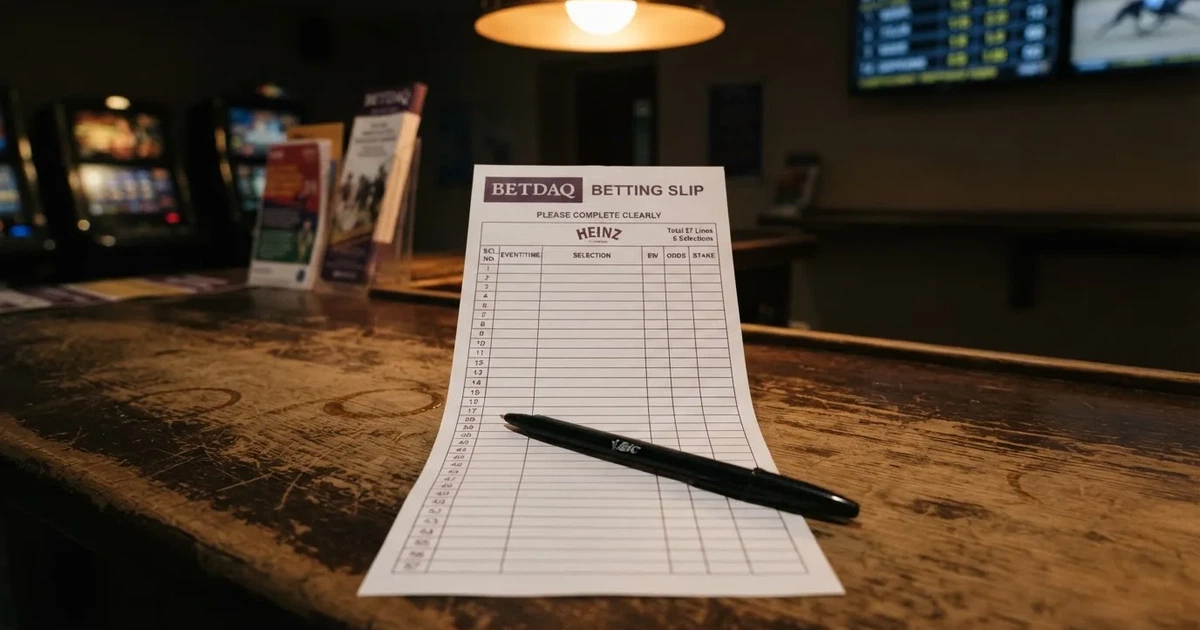
Open a Heinz on any UK bookmaker’s app, pick six selections, tap the bet-type tab. The slip lays out every line as a row, tagged by combination (“1&2”, “1&2&3”, and so on through to “1&2&3&4&5&6”), with a column for the stake per line and the total stake at the bottom. The total stake is what readers should look at; most slips show the headline payout if every leg wins and the cash-out value if the bet is live — neither is the stake.
Stakes are bound to the unit figure and cannot be sliced across lines differently. The slip will not let the punter stake £1 on the doubles and £5 on the six-fold. That option belongs to a different package, the Lucky 31 or the system bets where the stake can vary, or to building multiples manually. For a Heinz, unit stake is unit stake. This is part of the reason Heinzes are popular with casuals — one number to set, everything else calculated by the slip.
Cash-out and edit-my-bet features complicate the settled picture. Most major UK operators let a punter take a cash-out value on a Heinz mid-event, settling some lines early and reinvesting or banking the value across the rest of the slip. The cash-out price offered by the bookmaker is its own valuation, derived from the live prices on the remaining legs after a margin adjustment, and is rarely equal to the fair value of the uncovered lines. It is a feature, not a refund.
A note on what each-way does to total cost
Where each-way is offered, the 50p Heinz becomes a £57 outlay for the win half and another £57 for the place half — £114 in total. The unit-stake column then reads 50p × 2 = £1 per combination, both win and place, and the “total stake” line shows £114. This catches out punters who see the 50p unit figure and miss the doubling. For horse racing multiples the place terms depend on the number of runners and the race type; for a six-horse race the place terms on each leg are usually 1/4 odds for places 1-2. A clearing punter working a value each-way Heinz on short-priced fancies has to underwrite both halves of every line.
Picking selections without paying for the privilege
Three principles that move the cost around, none of which is doing the bookmaker’s marketing job:
- Shorten the number of legs before lengthening the price. A six-fold at six 2.00 shots is a 1.56% probability event. A six-fold at six 5.00 shots is a 0.000064% probability event. The Heinz works for the former in a way it cannot work for the latter. Selecting six short-priced favourites and pressing Heinz is paying bookmaker margin on 57 lines for a return that will only land once in 64 attempts, on average — and through that the math.
- Back the selections as singles first, mentally. If a punter would not back each of the six picks individually, the Heinz is a worse idea, because 57 lines are being staked to combine six bets the punter did not want to make alone. If six picks would each be backed as a single, the Heinz adds a hypothetical payout to working bets at known prices. That is the right relationship.
- Stake to the budget. A £2 Heinz at £114 is a serious weekend commitment for an account betting at the recreational end. Most serious Heinz punters stake either 10p or 20p per line and treat the bet as a lottery-ticket layer over already-backed singles, not as the primary bet on the day.
The bookmaker’s own terms on a Heinz are silent on most of this. The Heinz is a category of bet; the operator sells the category. It does not warrant picks, advise on stake size, or promise that lines settle before cash-out value evaporates. The punters who treat the Heinz like a managed product treat themselves; the punters who treat it like a bet type get what they asked for.
Top 10 UK bookmakers for Heinz bets
All ten brands below hold a remote operating licence from the Gambling Commission for the relevant category, and the Commission’s public register is the check a reader runs against any licence number cited in the trade press. Several brands sit under one licensee; a brand and its licence are not the same thing, and the difference is the difference between the marketing name and the legal name on the register. Every GB-licensed remote operator takes part in GAMSTOP; brand-by-brand differences on the Heinz itself — minimum stake per line, cash-out availability, maximum pay-out cap, each-way availability — vary enough that a reader should check the terms before staking.
The reference column in the table shows the Commission’s account number; readers can search the public register by that number to confirm a brand’s current licence category and any conditions attached.
| Bookmaker | Licence (Gambling Commission account) | Heinz terms in plain English |
|---|---|---|
| Midnite | 101839 | Midnite’s site shows pre-match football and racing markets, an acca builder, popular accas and price boosts with maximum-stake limits stated on each boost. Heinz availability is standard for a UK remote bookmaker; customers should check the slip for each-line minimums and any maximum-payout caps before staking. |
| Smarkets | 39173 | Smarkets is a betting exchange and its commission structure is the operator’s main commercial term — a 2% standard commission on eligible exchange bets, with promotional 0% commission windows for new customers in some periods. Heinz bets on an exchange work across the back and lay sides. |
| 888sport | 39028 | 888sport covers pre-match and in-play betting, Cash Out, Bet Builder, racing streams, BetFinder form tools, a live bet feed and daily boosted odds. Heinz is offered across the same market set, with cash-out available on most lines while events are live. |
| BoyleSports | 39469 | BoyleSports runs an Acca Insurance offer that applies to accumulator-style bets: customers opt in, stake at least £5 at minimum odds of 1/2 (1.50), get a free bet refund up to £20 if one leg lets the accumulator down. The free bet expires in 7 days, and the qualifying bet must be placed and settled on the same day. |
| William Hill | 39225 | William Hill applies Best Odds Guaranteed to UK and Irish horse racing from 8 AM on the day of the race, on both single and multiple bets. The guarantee does not apply to ante-post, tote or pari-mutuel bets — but on a horse-racing Heinz the day’s BOG price is the price that settles the lines. |
| LiveScore Bet | 56859 | LiveScore Bet’s Bet Builder allows up to 10 selections and covers match result, both teams to score, corners, total goals, player scoring and card markets. A Heinz built through the bet builder covers combinations across those markets within one fixture. |
| Betboro | 44181 | Betboro offers in-play markets and cash-out on football, racing and tennis, boosted odds on selected singles from £10 stakes, and responsible gambling tools. Heinz is offered alongside these features; punters should check whether cash-out applies to all 57 lines or only to singles and early lines. |
| Spreadex | 8835 | Spreadex is regulated by both the FCA (for financial spread betting) and the Gambling Commission (for fixed-odds betting). The fixed-odds site offers Heinz bets on the same market set as a traditional sportsbook; the spread side is a separate product and spread-betting losses can exceed deposits. |
| Lottoland | 38991 | Lottoland’s UK app combines casino, lottery, scratchcards and sports, and Heinz availability sits inside the sports vertical. A multi-product account like this complicates bonus eligibility, since cross-product offers are restricted under the Gambling Commission’s promotion rules from 19 January 2026. |
| Paddy Power | 39439 | Paddy Power’s app offers Bet Builder+, Popular Bet Builders, Super Sub (a substitution rollover on selected-player markets), expanded Win More markets and player and ACCA stats. A Heinz built across multiple football fixtures can lean on the popular-builders list for shortlisting. |
What the table does not show is stake size and payout caps, both of which are operator-specific and change with the market. The Heinz itself is uniform across UK operators — same 57 lines, same structure — but the conditions around it, particularly on horse racing each-way and on maximum pay-out per slip, vary enough that the small print is worth a read before committing a few hundred pounds to a Saturday card.
What this means in practice
A Heinz at a £1 unit stake costs £57. A £2 Heinz costs £114. The difference between one bookmaker and the next on a Heinz is rarely the line structure — that is fixed — and is almost always the conditions around stake, payout and how cash-out treats the slip mid-event. For a punter backing the same six picks across two bookmakers to compare prices, the headline return on the slip will match within fractions; the more meaningful comparison is on cash-out quality, BOG timing on horse racing multiples, and whether the operator’s acca-insurance or refund rules apply to a 57-line package or only to straight accumulators.
Regulation, licensing and what a GB licence covers
Every operator above holds a Gambling Commission remote operating licence for the relevant category. The Commission’s public register is the only place to verify that licence — searchable by business name, trading name, domain or account number — and any licence number that does not appear on the register is not a Commission licence, however prominent it is on the operator’s own homepage. Operators licensed under the Commission’s remote betting regime are bound by the Gambling Act 2005 (as amended by the Gambling (Licensing and Advertising) Act 2014) and the Licence Conditions and Codes of Practice that sit under it. A Curaçao, Maltese or Gibraltar licence is not a substitute; the Act applies at the point of consumption, so any operator whose remote facilities are used in Great Britain needs a Commission licence wherever the operator itself is based.
Two practical consequences. First, identity verification before deposit and gambling has been a licence condition since 7 May 2019 — including with a free bet or bonus — so no GB-licensed operator runs an anonymous play model. The customer supplies name, address and date of birth before the first stake. Second, every GB-licensed remote operator is part of GAMSTOP, the multi-operator online self-exclusion scheme in place since 31 March 2020. Excluding through GAMSTOP closes the account across every participating operator at once for six months, one year, five years, or five years plus auto-renewal; the exclusion then stays in place for seven years after the minimum period unless the customer asks for it to be removed.
These are the two protective layers readers who bet on unlicensed sites lose. An unlicensed operator does not run GAMSTOP, does not require pre-deposit identity verification in the same form, does not sit within the Commission’s complaints route, and does not bind itself to the bonus and promotion rules that apply under the LCCP. The 10x wagering cap on bonuses, the financial vulnerability check at £150 net deposits over 30 days, and the mixed-product promotion ban are all Commission-side rules. None of them applies at an unlicensed site. That is the practical difference between licensed and unlicensed — not “safe” or “unsafe” as abstractions, but the specific protections listed above with no counterpart on the other side.
A financial spread-betting caveat matters specifically for any reader considering Spreadex: spread betting on financial markets is regulated by the Financial Conduct Authority, not the Gambling Commission, and on financial instruments losses can exceed deposits. The fixed-odds sportsbook at the same operator is under the Commission’s licence and behaves like any other GB-licensed sportsbook. The two products are priced and settled differently, and a Heinz on the fixed-odds side does not automatically accept a spread-betting position on the named event.
Responsible gambling and what the licence requires
The Commission has hardened the safer-gambling duties on remote operators over the last five years, and the rules that matter for a Heinz bettor sit in three places.
- GAMSTOP. As above. Mandatory for online operators; the exclusion covers apps and websites but not betting shops.
- The £150 net-deposit financial vulnerability check. This applies since 28 February 2025 under LCCP condition 3.4.4: when a customer’s deposits minus withdrawals exceed £150 in a rolling 30-day window, the operator runs a public-record check (bankruptcy registers, county court judgments) before accepting further deposits. It is not an income check and not a credit reference check.
- Deposit limits. Operators must offer gross deposit limits on a fixed time frame. The first phase applied from 31 October 2025; a second phase was postponed to 30 September 2026, and the live state of that second phase is not established. Limits are not state-set — there is no statutory ceiling, and the deposit ceiling a customer sets is the customer’s choice.
- Financial risk assessments. These “affordability checks” have been announced by the Commission in a staged plan from a Commission article on 7 July 2026 with no start date. Operationally, they are not in force on a date-stamped “since” basis; the practical reality is that operators with strong gambling-harm teams already apply soft versions of these checks at higher deposit levels.
For punters looking for help, the four main routes are GamCare (which runs the National Gambling Helpline), GambleAware, NHS gambling clinics and Gamblers Anonymous. None of these is a Commission body; they sit alongside the Commission’s regulatory framework rather than inside it.
What the bonus cap actually changes
The promotion rules in force from 19 January 2026 cap wagering requirements on bonuses at 10x — a £10 bonus at 50x wagering becomes non-compliant; at 10x or lower it stays. The cap on the bonus money itself is not set at a specific level by the rule. For free bets with no wagering condition, the position is not established; the cap is structured around the wagering multiple rather than around a headline figure. Mixed-product promotions — offers that require gambling on two or more product types — are banned outright. A bet on football to unlock free casino spins is the kind of offer that no longer complies.
The cap means a £10 bonus at 10x wagering requires £100 of qualifying bets — and the qualifying bets typically must be at minimum odds (often 1/2, 1.50 or evens depending on the operator) before they count. The Heinz structure, with 57 lines, can theoretically be the wagering target on a bonus, but operators usually exclude multiples from qualifying-bets lists because a Heinz is not a single-leg wager. Read the small print.
Bonuses, free bets and how a Heinz fits around them
Every welcome offer on the table above carries a wagering or qualifying-bet structure on the qualifying side, and a free bet or refund on the reward side. The structure that matters for a Heinz bettor is usually the qualifying bet. Where the welcome offer rewards a £10 single at minimum odds of evens (2.00), a £57 Heinz is not the qualifying bet the operator was looking for — most UK operators exclude multiples from qualifying for their headline welcome offer, on the principle that a wagered accumulator could not be cleanly audited. The free bet rewards from these offers also tend to be single-use and stake-not-returned: a £25 free bet that wins returns winnings only, and the £25 stays with the operator.
That is the betting industry’s quiet economics of free bets. The stake is the price of admission, and on an each-way Heinz that compounds into 114 unit stakes of implicit admission cost. A punter who claims a free bet on the same Saturday as running an each-way Heinz on the racing card is paying for the privilege twice over, and the £25 in free bets winning on a six-fold at the right prices is by no means certain. Operators specifically allow multiples on free bets because the stake-not-returned math favours them; the punter is paying full price for the right to a partial upside.
BOG (Best Odds Guaranteed) is the friendlier side of the Heinz-sportsbook relationship. On UK and Irish horse racing, William Hill pays BOG from 8 AM on the day of the race on both singles and multiples — including a Heinz whose six legs all sit on the same Saturday card. The practical consequence is that the lines settle at the day’s best declared odds rather than at the price the punter took at the time of staking. Across 57 lines on a card with several non-runners, BOG is doing real work, and that is the structural reason it sits on William Hill’s offer rather than only on the racing-specific operators.
BoyleSports’s Acca Insurance is the second piece of the bonus-on-Heinz picture: punters opt in, stake from £5 at 1/2 (1.50) minimum odds, and if one leg of an accumulator fails, the stake comes back as a free bet — capped at £20 — for 7 days. The offer is structured for accumulators specifically, and bookmakers’ standard definition of an accumulator tends to require that every leg must win for the bet to settle. On a Heinz with one losing leg, 56 of the 57 lines still have at least one losing leg and would settle as losers; the offer therefore pays the £20 (or lower) free bet refund rather than a payout on any of the 57 lines. The interaction between an acca insurance offer and a Heinz is therefore “refund only, not payout” — and that interaction is rarely advertised as prominently as the offer itself.
What an exchange looks like for a Heinz
Smarkets is the only exchange on the list — and the only operator whose commercial proposition is commission rather than margin per line. A Heinz on an exchange bets against other punters rather than against the bookmaker, with the operator taking a 2% commission on net winnings from eligible bets. The 2% is far lower than the per-leg margin on a Heinz at a traditional bookmaker, which compounds across 57 lines — meaning the effective cost per line on an exchange is much closer to the headline decimal price than it is at a margin-stacked book. The trade-off is that exchange liquidity thins out beyond the major markets and major fixtures, and a Heinz on a six-leg card with one minor-market selection may not find enough counterparties to fill all 57 lines at the requested back odds. The exchange punter who treats the Heinz as a casual weekend bet is paying a sharper price, on lines that exist, and accepting that some lines may not.
Picking operators by what the Heinz actually costs
The angle of this guide is cost, and three cost-cutting decisions sit in the operator choice:
- BOG and acca insurance on horse racing. Heinz punters running a Saturday card benefit from operators running BOG on multiples — William Hill is the case study in the table. Acca insurance applies to accumulators and to the Heinz only for the single-leg-loss case; both reduce the implicit cost over many weeks.
- Cash-out quality on multiple-line bets. Cash-out on a 57-line Heinz is harder to value than on a single. 888sport, Betboro and William Hill are the candidates on the list; the smaller operators vary. The cash-out offered is the operator’s valuation, not the punters, and varies on the live leg prices after a margin adjustment.
- Commission versus margin. For punts at modest unit stakes, an exchange-based Heinz with a 2% commission is cheaper per line than a traditional bookmaker’s Heinz at 5% compounded margin across six legs. The exchange cost is in time spent getting lines matched, not in headline price.
A reader using this page to pick a single Heinz bookmaker is, frankly, reading the table wrong. The table shows the conditions each operator attaches to a Heinz; the operator at the top of the list is not “better” at the Heinz in any structural sense — every Heinz on the list is 57 lines, same as every other Heinz. The variation is on the conditions. A punter who picks on cash-out quality rather than headline welcome-offer value is reading the page correctly.
How returns are worked out, in plain English
The calculation the page requires uses illustrative odds at 1/2 (1.50), evens (2.00) and 6/4 (2.50) and a £10 stake for the accumulator side, with a £2 per line full-cover equivalent for the Heinz shape. The headline numbers:
- For the three-leg accumulator at the stated odds, the combined decimal price is 1.50 × 2.00 × 2.50 = 7.50, so a £10 stake returns £75 if all three legs win.
- For a six-leg extension of the same illustrative pattern (say six legs at the same average odds for the purpose of the example), the combined price is 7.50² ≈ 56.25, so a £1 unit stake on the six-fold returns £56.25, and a £2 unit stake returns £112.50 — for that single line, before any of the other 56 lines pay.
- Across the full 57 lines of a Heinz at a £2 unit stake, total outlay is £114, and the return on a complete clean sweep of all six legs depends on the combined odds. On the three-leg accumulator at a £10 stake the all-win return is £75 from £30 staked across three separate bets — a £10 stake singles-only equivalent would have laid out £30 and returned £15 + £20 + £35 = £70 (and additionally paying on each individual leg).
A more readable illustration picks a smaller Heinz structure: suppose a punter lays out a £2 Heinz across six selections at average odds of 3.00 (2/1 in fractional). The six-fold alone pays roughly £2 × 3.00⁶ ≈ £1,458 on a £2 stake, but the 57-line total outlay is £114 — and that is the bet they are actually placing. The outlay recovers on the higher-line combinations before the six-fold, with various lesser multiples returning smaller amounts on a five-of-six weekend or a four-of-six bad Saturday.
The result, stated as a band with the condition set out: on the illustrative odds of 1/2 (1.50), evens (2.00) and 6/4 (2.50), a £10 stake accumulator returns £75 on a winning line (a 7.50 combined price); a £2 per line full-cover equivalent returns a band from nominal recovery on a small partial-win case up to a high four-figure sum on a complete all-six-win case. The exact top of the band is set by the combined odds across all six lines, not by the stated three, and a reader should treat the specific accumulator example as a three-leg illustration of the math, not as a stand-in for a real six-leg Heinz price.
This calculation is a statistical estimate of what the package costs and what it pays out, averaged over many bets under stated assumptions. It is not a forecast of any individual bet. No calculation can tell the reader which leg will win, and treating the band as a guarantee is the kind of behaviour the licensed-operator framework assumes a reader is not doing.
Heinzes versus the full-cover family
The Heinz sits between the Yankee on four selections and the Super Heinz on seven, with the Canadian on five just below. Each of the package bets in this family bills the same way: unit stake × number of lines = total outlay. The numbers, working through the binomial pattern:
- Trixie (3 selections) — 3 multiples (3 doubles), total bets 3, plus a single three-fold. 4 bets.
- Yankee (4 selections) — all doubles plus trebles plus the four-fold. 11 bets.
- Canadian / Super Yankee (5 selections) — all doubles, trebles, four-folds and the five-fold. 26 bets.
- Heinz (6 selections) — 57 bets as set out above.
- Super Heinz (7 selections) — 120 bets.
- Goliath (8 selections) — 247 bets.
The whole family excludes singles by design. That is what makes them “full-cover” bets — every combination from 2-up to n-fold is covered, and no leg stands alone. By contrast, the “Lucky” family — Lucky 15, Lucky 31, Lucky 63 — adds the singles on top, so a Lucky 63 on six picks is 63 bets, the 57 of the Heinz plus 6 singles.
The move between Trixie and Goliath on the same set of six picks is a cost move from 4 bets per unit stake to 247 bets per unit stake. That is 62× the outlay for 62× the lines; the question for the punter is whether the extra lines at the higher-tier full cover (more four-folds, more five-folds, an extra six-fold) hit at prices the punter expects to clear. For six picks at moderate prices, often the answer is no — the extra higher-tier multiples are very-low-probability events and the marginal cost of staking on them is high relative to the marginal probability of payout.
What a Heinz actually does at the bookmaker’s end
The way bookmakers settle a Heinz is mechanical: every line is calculated independently, with the stake on each line being the unit stake. Where a leg is void (a non-runner, a walkover), the line settles on the remaining selections as a smaller multiple and the voided leg’s odds are treated as 1.00 for the purpose of the combination. Where a leg loses, every line that included it settles as a loser at full stake. Cash-out values the slip by looking at the live prices on remaining legs and discounting the cash-out value at a margin the operator applies — typically wider than the per-leg margin on the original bet. Edit-my-bet features let the punter add or remove a leg or change the stake structure; most UK operators exclude Heinzes from edit-my-bet because the line structure is too rigid to support safe adjustments.
The bettor’s edge against this structure is the same as the edge against any bookmaker: the margin, the bonuses and the price they can get elsewhere on the same line. The Heinz amplifies the edge — both the book’s and the customer’s — because 57 lines stack the per-line edge. A 2% edge compounded across six legs is a 12.7% edge on the six-fold; a 5% edge compounded is closer to 34% on the six-fold. Both edges are on a low-probability event, but the compounding is real.
For the bookmaker, the Heinz is therefore the most efficient bet to take from a punter who does not have an edge. For a punter with an edge on the underlying selections, the Heinz is the most efficient way to leverage that edge across combinations — at the cost of taking the book’s margin compounding alongside. The two readings are not contradictory; they depend on who is on which side of the edge.
Frequently asked questions about Heinz bets
What is a heinz bet?
A Heinz is a full-cover bet on six selections, made up of 57 bets across 15 doubles, 20 trebles, 15 four-folds, 6 five-folds and 1 six-fold. There are no singles in a Heinz, and each of the 57 lines is staked at the same unit stake — so a £1 Heinz costs £57 in total before any outcome is decided. The bet is named for the same reason as the “57 varieties” advertising slogan and settles leg-by-leg against the same event results as any multiple bet, with a voided leg dropping the relevant lines to the next lowest combination.
What is a super heinz bet?
A Super Heinz is the same full-cover package extended to seven selections, totalling 120 bets across all doubles, trebles, four-folds, five-folds, six-folds and one seven-fold. There are still no singles, and a £1 Super Heinz costs £120 in total. The structure is mathematical: for *n* selections, the line count is the sum of *n* choose *k* from *k* = 2 to *n*. For *n* = 7 that sum is 21 + 35 + 35 + 21 + 7 + 1 = 120. The Super Heinz is to the Heinz what the Heinz is to the Canadian — a step up in lines, outlay and combined edge on a complete sweep.
How many bets in a super heinz?
A Super Heinz on seven selections is 120 bets. The package covers every combination from 2-fold up to 7-fold: 21 doubles, 35 trebles, 35 four-folds, 21 five-folds, 7 six-folds and 1 seven-fold. The total cost at a £1 unit stake is £120; at 50p the outlay is £60; at £2 it is £240. A Super Heinz is the natural step up from a Heinz for a punter who has the bankroll to back seven selections they have already worked through individually and is willing to underwrite a £240 outlay for a long-shot seven-fold upside.
How can it be checked that a bookmaker holds a Gambling Commission licence?
The Commission’s public register at the regulator’s website is searchable by business name, trading name, domain, or Commission account number. Type any of these in and the register confirms whether a licence is currently in force, what category the licence covers (remote general betting standard, remote betting intermediary, and so on), what conditions are attached, and who the licence holder is. A licence number quoted on a marketing site is a clue, not a confirmation — the register is the test. The register entry for any of the brands on this page includes the seven-digit Commission account number alongside the company’s legal name and registered address. Brands run by the same licensee appear under that licensee’s record; a marketing name without a separate record is trading under another company’s licence.
How is the return on a bet worked out from the stake and the odds?
The return on a single bet is stake multiplied by the decimal odds. Net profit is stake multiplied by (decimal odds minus one). For a combination bet the odds of each leg multiply into a single combined price, and the stake is multiplied by that combined price — so an accumulator at three legs priced 1.50, 2.00 and 2.50 has a combined price of 7.50, and a £10 stake returns £75 if all three legs win. For a Heinz at a £1 unit stake across six selections, every line settles independently at its own combined price, and the lines that win are added together to give the day’s payout. The total cost is unit stake multiplied by 57 regardless of how many lines pay. Bookmakers’ slips show the unit stake, the total outlay and the headline “if all six win” return; the cash-out value at any moment before settlement is the bookmaker’s own valuation of the live lines after a margin adjustment.
What is the bookmaker’s margin and how can it be seen in the odds?
The margin is the slice of every pound staked that the book expects to keep, expressed as a percentage. It is the difference between 100% and the implied probabilities summed across all outcomes of a market, where each implied probability is 1 divided by the decimal odds. On a football 1X2 market priced 2.10 / 3.40 / 3.50, the implied probabilities are 47.6%, 29.4% and 28.6%, summing to 105.6% — the 5.6% above 100% is the margin. The opposite side of the margin is the payout share, which is 1 minus the margin: a 5.6% margin means the book expects to pay out 94.4% of stakes in winnings over the long run. Across a 57-line Heinz, every line carries the underlying markets’ margins, and they compound across the number of legs — which is why the effective margin on a six-fold is higher than on any single leg in the same bookmaker’s market.
Bet types & in-play – Cricket betting
Content created by the «Cricket betting» team
