
Bitcoin Betting Sites in Great Britain: What Licensing, Deposits and Bonus Terms Actually Cost
 Available in US
A punter searching for a “bitcoin betting site” lands in two markets at once: the regulated Great Britain one run by the Gambling Commission, and a parallel offshore one that markets itself on speed, anonymity and crypto rails. The two do not offer the same product. In the GB market, the test of who may lawfully take your bet is whether the operator sits on the Commission’s public register with a remote general betting licence. Since the Gambling (Licensing and Advertising) Act 2014, an operator whose remote facilities are used in Great Britain must hold that licence wherever it sits in the world — a Curaçao, Malta or Gibraltar licence is not a substitute, and a brand that takes pounds from a laptop in Manchester without one commits an offence under section 33 of the Gambling Act 2005. No British rule was found for or against accepting cryptocurrency at a licensed operator; the question of which payment methods a GB bookmaker takes is settled in its own terms, not by statute. What the Commission does require is that licensed operators treat crypto-funded play as a high-risk indicator and apply enhanced due diligence when customers fund accounts that way.
Seven licensed bookmakers are reviewed below. None publishes a Bitcoin payment option that has been verified for the current cycle; what each operator does state, in payment-method tables and in licence entries, is the basis for the comparison. The angle of this page is cost — what a bitcoin-funded account actually costs the punter in time, in lost protections, in bonus conditions, and in the absence of what an unlicensed alternative offers.
Current as of 27 October 2026. Licence claims verified against the Gambling Commission’s public register; payment-method claims verified against each operator’s own published terms.
What this page is, and what it is not
A bitcoin betting site, in the plain sense, is a bookmaker that lets a customer deposit and (sometimes) withdraw in bitcoin. The honest lead is that in Great Britain the term is mostly aspirational: a bookmaker serving GB customers holds a Gambling Commission licence or it does not, and the only thing different about cryptocurrency at a licensed brand is how the operator weighs the funds for anti-money-laundering purposes. The Commission’s own digital-currencies guidance classes cryptoassets as high-risk and expects enhanced due diligence on crypto-funded accounts, but says nothing that bars them. Several operators in the featured set do not list bitcoin at all in their published payment terms, and where that is the case, this page says so plainly rather than filling the gap with second-hand claims.

What this page is not for: it does not list offshore crypto sportsbooks. A brand without a GB licence cannot route customer complaints through the Commission, sits outside GAMSTOP, and binds no British dispute-resolution service. The loss of protection that follows is real and is covered in the section on offshore books further down.
How bitcoin became a thing you might deposit with
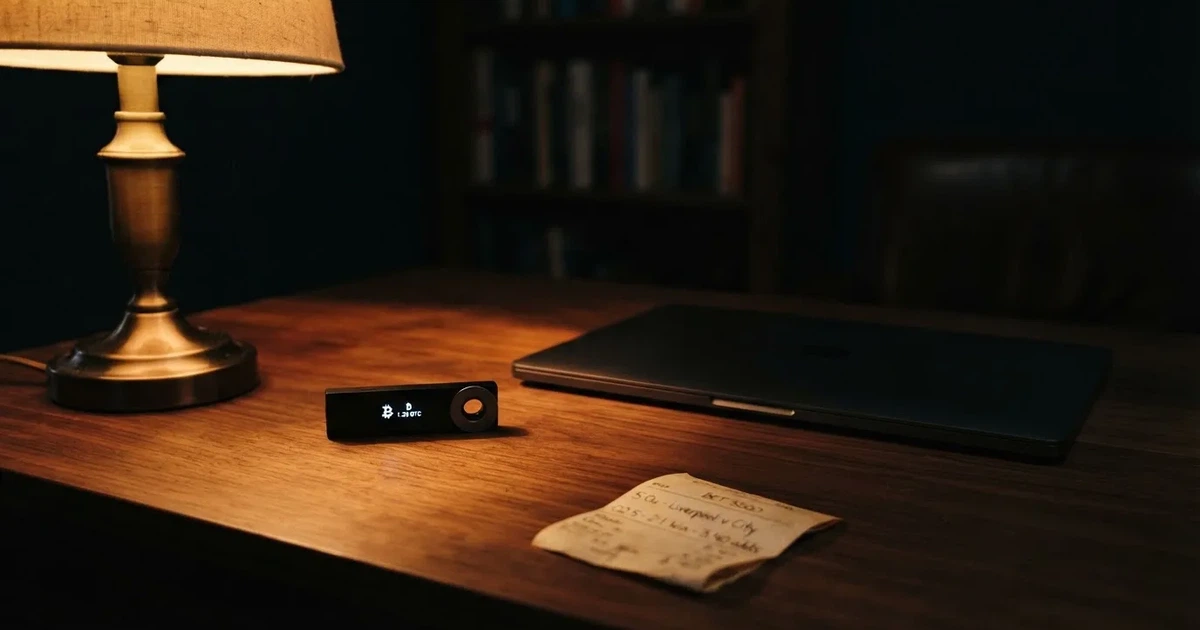
A hardware wallet and a closed laptop on a desk in dim light. Bitcoin’s genesis block was mined on 3 January 2009 by its pseudonymous creator, Satoshi Nakamoto.

Bitcoin’s history is short and concrete enough that the dates matter. Satoshi Nakamoto published the Bitcoin white paper on 31 October 2008, and the creator’s real-world identity has never been verified. A new block is added to the chain roughly every ten minutes on average, and the network uses a proof-of-work consensus mechanism based on SHA-256 hashing to validate transactions. Total supply is capped at 21 million coins, with full issuance expected around the year 2140. The mining reward halves every 210,000 blocks, the so-called halving, and started at 50 BTC per block. None of that is betting, but the dates and the cap are what make bitcoin a payment rail worth distinguishing from pounds in your account: deposits settle in minutes rather than days, and the same coin can move between an exchange, a wallet and a betting site without an intermediary’s sign-off.
That last property is the bit the marketing leans on. It is also the bit British regulation has caught up to.
The legal frame: GB licensing, crypto, and the offshore gap
The legal test for taking a bet in Great Britain is the Commission’s remote operating licence. The relevant categories for a sportsbook are remote general betting standard (real events) and, where virtuals are offered, remote general betting standard (virtual events); other categories cover pool betting, the betting-intermediary model used by exchanges, and the limited licence for smaller operators. The Commission’s public register is searchable by business name, trading name, domain or account number, and is the whole test of whether a brand holds a licence. Several brands can run under one licensee — Ladbrokes and Coral, Paddy Power and Betfair — and they must not be presented as independent operators. No licensed brand is “the only” licensed one; the register lists far more than this page features.
The relevant statute is the Gambling Act 2005, covering Great Britain — England, Scotland and Wales. Northern Ireland is outside the Act and follows older law, so “GB-licensed” is the correct frame, and a GB licence does not regulate bets placed in Belfast. Since the 2014 amending Act, an operator whose remote facilities are used in Great Britain must hold a Commission licence wherever it sits; offshore licensing does not substitute. A Curaçao sub-licence, a Malta Gaming Authority permit, or a Gibraltar Gambling Division licence does not satisfy the GB test. The Commission’s enforcement is disruption-led — cease-and-desist notices, search-engine referrals, registrar and host work, payment-provider friction — and it has been given, or is about to receive, court-order DNS blocking powers; customer-side ISP blocking is not in operation and should not be written as if it were. No offence aimed at a customer who bets on an unlicensed site was found in the Act; what the customer loses is protection rather than liberty.
The payment-method question is governed by the operator’s licence conditions and codes of practice (the LCCP), the Remote Technical Standards (RTS), and the operator’s own terms. Credit cards have been banned for gambling in Great Britain since 14 April 2020 (LCCP condition 6.1.2), including credit-card-funded payments through an e-wallet. Debit cards and bank-based payments are not covered by that ban. Cryptocurrency sits between the two: a payment, but not a card, and the operator’s job is to decide whether to accept it and how to test the funds. There is no state list of permitted payment methods and no rule that a GB bookmaker must accept, or must refuse, bitcoin; an operator that does accept it must register with the Financial Conduct Authority as a cryptoasset business under the Money Laundering Regulations if it handles the conversion itself, and either way the operator applies enhanced due diligence to crypto-funded play.
The bitcoin-specific layer: AML, FCA, and the punter’s tax position
Bitcoin’s role in a GB-licensed betting account is governed by three separate regimes, none of which is “betting law” on its own.
The first is the Commission’s own high-risk-payment guidance. The Commission classes cryptoassets, including bitcoin, as high-risk payment methods and expects licensed gambling operators to treat crypto-funded play as a high-risk indicator requiring enhanced due diligence. Practically, that means source-of-funds questions the operator might otherwise leave alone: where the bitcoin came from, which exchange, and where the exchange is regulated. The verification happens before play, not after the win.
The second is the FCA’s cryptoasset register. The FCA became the anti-money-laundering supervisor of UK cryptoasset businesses, including bitcoin exchanges, on 10 January 2020, under Regulation 8L and Regulation 9 of the Money Laundering Regulations. Cryptoasset exchange providers and custodian wallet providers operating in the UK must register with the FCA before starting business. Since registration opened the FCA has received 417 applications, of which 68 (17 % of determined applications) have been registered and 263 (67 %) withdrawn — the rest being under review or rejected, which gives a sense of how thin the registered cryptoasset sector actually is.
The third is HMRC’s tax frame. HMRC treats cryptoassets held by individuals as subject to Capital Gains Tax on disposal — including selling, swapping, spending or gifting them. Mining and staking rewards, and bitcoin received as non-cash employment income, are subject to Income Tax and National Insurance. A deposit of bitcoin into a betting account is, in HMRC’s view, a disposal for CGT purposes; a withdrawal in pounds after a winning bet is not the only taxable event the punter triggers. The player pays no tax on betting winnings in Great Britain; the bitcoin leg of the loop is a different question, and it is a question to ask an accountant, not the operator.
Verification before the first bet, and what it means for “anonymous” books
The single biggest difference between a GB-licensed bookmaker and an offshore crypto sportsbook is what happens at the door. Since 7 May 2019, licensed remote operators must verify a customer’s name, address and date of birth before the customer can deposit or gamble — including with a free bet or a bonus. That is the rule that closes the door on anonymous play. Whatever an unlicensed site markets as “no KYC” or “play without ID”, the licensed alternative does the opposite: it checks you before you stake.
The deeper layer of the same regime is the financial vulnerability check (LCCP condition 3.4.4, in force since 30 August 2024). It applies to licensed remote betting when a customer’s deposits minus withdrawals exceed £150 in a rolling 30 days (active since 28 February 2025). The check is a public-record check — bankruptcy, county court judgments — not an income check and not a credit-bureau check, and the £150 figure is the trigger rather than a per-bet cap. Beyond it, financial risk assessments — the press’s “affordability checks” — are announced, staged, and have no start date: write the rule as the Commission published it, not as a columnist summarised it. Deposit limits under RTS 12 are a separate obligation: operators must offer a gross deposit limit on a fixed time frame; the first changes have applied since 31 October 2025, and a second phase was postponed to 30 September 2026 — whether it is live was not established in this cycle. There is no state-set deposit or loss ceiling; limits are the customer’s choice.
GAMSTOP is the national multi-operator online self-exclusion scheme and has been a mandatory licence condition for online operators since 31 March 2020. Exclusion periods are six months, one year, five years, or five years with auto-renewal; after the minimum period the exclusion stays in force for a further seven years unless the customer asks GAMSTOP to remove it. GAMSTOP covers online sites and apps; betting shops use a separate service. Every GB-licensed online operator takes part. A crypto sportsbook with no GB licence takes part in none of it.
Help lines that exist in the licensed frame: GamCare (operator of the National Gambling Helpline), GambleAware, NHS gambling clinics, and Gamblers Anonymous. The licensed frame’s cost is that the punter who is in trouble is on the punter’s own recognisance; the unlicensed frame has no such scaffolding to point at.
How the seven operators stack up
| Brand | Gambling Commission remote licence and holder | What the operator’s own terms say about cryptocurrency |
|---|---|---|
| QuinnBet | Remote licence 061011-R-335683-004 (account 61011); holder QuinnBet (Gibraltar) Limited | Payment methods are debit-card-led; no published bitcoin option. Free-bet terms give a useful read on bonus cost. |
| Spreadex | Remote licence 008835-R-104580-022 (account 8835); holder Spreadex Limited | Spread-betting side regulated by the FCA, fixed-odds side by the Commission; spread losses can exceed the deposit. No crypto advertised for fixed-odds stakes. |
| Geoff Banks | Remote licence 054095-R-330366-010 (account 54095); holder GB Sports Advisors Limited | App-led offer (live in-play, ante-post); app publisher named. No published bitcoin method. |
| DAZN Bet | Remote licence 048756-R-327274-019 (account 48756); holder DZBT Limited | Published minimum deposits: £5 by debit card, Apple Pay, Paysafecard, Trustly and Skrill; £20 by PayPal. No crypto listed. |
| Fitzdares | Remote licence 000400-R-103839-030 (account 400); holder Fitzdares Limited | Apple Pay, Mastercard and Visa; Visa withdrawals usually same-day, Mastercard up to 48 hours. No crypto listed. |
| LiveScore Bet | Remote licence 056859-R-332720-005 (account 56859); holder LiveScore Betting and Gaming (Gibraltar) Limited | Debit cards (Visa, Mastercard), Apple Pay, PayPal, Pay by Bank via Open Banking, Revolut Pay. No crypto listed. |
| Kwiff | Remote licence 044448-R-323408-017 (account 44448); holder Eaton Gate Gaming Limited | App-led, 17+ rated. No published bitcoin method. |
Several brands run under the same licensee (Ladbrokes and Coral, Paddy Power and Betfair) — those are not separate operators, and a comparison that lists them as such misreads the register. The seven above are distinct licensees on the Commission’s public register; no shared-licensee doubling has been carried into this table.
QuinnBet
QuinnBet sits on the Commission’s public register under remote licence 061011-R-335683-004 (account 61011), held by QuinnBet (Gibraltar) Limited. The free-bet terms give a useful read on what a typical bonus actually costs the punter: free bets are valid for 7 days from credit, usable on any market at odds of 1/2 (1.5) or greater, with a maximum odds of 50/1, straight accumulators allowed, and Trixies, Patents and Yankees excluded. That is a narrower bonus than it looks — the maximum-odds ceiling alone cuts off long-shot singles, and the 1.5 floor rules out the lowest-priced favourites from qualifying. The 7-day clock matters more than the headline “free bet” implies, because the punter who takes a price-boosted selection to qualify at 1.5 only has a week to use the credit before it expires. Payment-method coverage at QuinnBet is debit-card-led; a published bitcoin option was not carried in the current terms.
Spreadex
Spreadex is the book’s split personality, and the split is the point. The FCA regulates Spreadex for spread betting; the Commission regulates the firm for fixed-odds betting. The headline on the firm’s own site is the one the punter needs to read first: spread-betting losses can exceed the deposit. That single sentence is the cost of the spread-betting side — a product where a £100 stake is not the floor of the loss, and the punter who treats it like a fixed-odds book can owe more than they put in. Fixed-odds sportsbook customers sit under the Commission’s licence and the usual GB protections. No cryptocurrency option for fixed-odds stakes was carried in the current terms.
Geoff Banks
Geoff Banks runs under remote licence 054095-R-330366-010 (account 54095), held by GB Sports Advisors Limited. The book is app-led; the App Store publisher is GB Sports Advisors Ltd, and the in-app offer covers live in-play prices and ante-post prices on future events. App-driven books are convenient and tend to sacrifice the more exotic payment methods to a tighter terms page. No published bitcoin option appears.
DAZN Bet
DAZN Bet holds remote licence 048756-R-327274-019 (account 48756) through DZBT Limited. The payment-method details in the current cycle are the kind of operational data worth knowing before depositing: minimum deposits are £5 by debit card, Apple Pay, Paysafecard, Trustly and Skrill, and £20 by PayPal, with no processing fees. The £5 floor on five of six methods is the more useful number — a punter testing the book is not forced to commit a larger unit to find the product. Bitcoin is not on the published list.
Fitzdares
Fitzdares sits on the Commission’s register under remote licence 000400-R-103839-030 (account 400), held by Fitzdares Limited. The brand shapes itself as a premium book, and the payment set matches that positioning: Apple Pay, Mastercard and Visa, with Visa withdrawals usually same-day and Mastercard withdrawals up to 48 hours. Same-day settlement on the dominant rail is the operational convenience most punters actually feel; the 48-hour ceiling on Mastercard is the rail to avoid when timing matters. Bitcoin does not appear in the published methods.
LiveScore Bet
LiveScore Bet is the operator under remote licence 056859-R-332720-005 (account 56859), held by LiveScore Betting and Gaming (Gibraltar) Limited. Payment methods cover debit cards (Visa and Mastercard), Apple Pay, PayPal, Pay by Bank via Open Banking, and Revolut Pay — a broader rail set than most licensed books, with the Open Banking rail the one that closes the e-wallet-vs-bank-account choice. Bitcoin is not on the published list.
Kwiff
Kwiff is licensed under remote licence 044448-R-323408-017 (account 44448), held by Eaton Gate Gaming Limited, and markets itself with a 17+ age rating on its app store listing. Kwiff is the closest the licensed set comes to a casual, app-first book, and the published terms do not show a bitcoin option.
What the licensed frame does not show: crypto rails and offshore books
A licensed brand’s not-publishing-bitcoin is a fact about that brand, not about the licensed frame as a whole. The honest read is that a GB-licensed operator that wanted to take bitcoin could, under the Commission’s high-risk-payment guidance, by applying enhanced due diligence to crypto-funded customers. None of the seven operators above has carried that option in this cycle.
The categories of bookmaker this page does not list are not listed for one reason: a customer who bets with them gives up protections that the GB frame exists to provide. No GAMSTOP. No Commission complaints route if a withdrawal is delayed. No approved dispute-resolution service if a settled bet is voided on grounds the punter does not recognise. No £150 vulnerability-check trigger that requires the operator to look at a customer’s public record. No 10x wagering cap on bonuses, which means an offer that demands 35x or 50x the bonus before payout is binding if the customer accepts it. No CAP Code restriction on advertising copy. No automatic right of redress under British consumer law if funds are withheld. The list is long precisely because the licensed frame is dense; each item is a thing the licensed frame provides. None of them is on the page because the bookies that supply them are off the page.
Two related points the reader will meet in the offshore marketing. First, “anonymous” is not the same as “no KYC” in the way the marketing uses it. An unlicensed book that does no checks at withdrawal and then asks for source-of-funds documents only when a customer tries to take £4,000 out has done no KYC at the deposit stage and an aggressive form of it at the withdrawal stage; the punter who thinks they have stayed invisible has only delayed the question. Second, “no verification” at a licensed book is impossible by design — the Commission’s verification rule predates the deposit, not the withdrawal. The licensed frame’s cost is paid at the front door.
The bonus cost: how the 10x cap and the free-bet rules change the bill
Bonus terms are where the angle — cost — does the most work on this page. The promotion rules in force since 19 January 2026 cap wagering requirements on bonuses at 10x — a £10 bonus at 50x would have needed £500 of bets; under the cap no more than £100 of staking clears it. The cap is a ceiling on the multiplier, not a floor on the offer, and an offer that demands 10x is still on the high side for sports bonuses. Mixed-product promotions — an offer that requires gambling on two or more product types such as betting, casino, bingo and lottery, for example “bet on football to get free spins” — are banned under the same rules. Whether the cap applies to free bets with no wagering condition and any cap on the money value of a bonus were not established in this cycle.
A free bet’s economic value is not its face value. When the stake is not returned with the win, a £10 free bet at odds of 4.00 (3/1) settles as £30 profit if it wins and £0 if it loses. The expected value of the free bet over many placements at a market of the book’s usual margin is the face value multiplied by (odds − 1) ÷ odds and the market payout share, which for an event priced around the 5–7 % margin band most GB books operate in is roughly 60 % of (odds − 1) divided by odds, times the face. A £10 free bet at 4.00 settles out at a meaningful fraction of the face value, not the face; the exact number depends on the operator’s margin on the chosen market.
A free bet is also not the same as a “risk-free” bet refunded as a free bet. The marketing tends to flatten the two; in practice the customer who loses the qualifying bet on a “risk-free” offer and is refunded in free-bet credit has lost nothing on the qualifying leg and gained credit on the refund — and on the credit, the stake is not returned with the win. The same flat reading of “free” and “risk-free” is what makes the wagering cap matter: a wagering multiplier of 10x at 1.5 minimum odds is a £100 turnover bill on a £10 bonus at minimum-stake bets; an offer that demands 50x at 1.5 minimum odds on the bonus is the offer the cap removes.
What to check on the operator’s own page before depositing
The single cheapest audit a punter can run is reading the payment-method page, the bonus terms page, and the licence footer of any book they intend to deposit with. The licence footer names the legal entity; that name should match the Commission register’s licence-holder name, and the licence number should resolve on the public register when searched by it. Several brands run under shared licensees; both Ladbrokes and Coral under Entain, both Paddy Power and Betfair under Flutter — a comparison that lists them as four separate licensees misreads the register, and a comparison that lists one of them twice misreads the data the other way.
The bonus terms page tells the punter the real cost. Three figures matter: the wagering multiplier (10x is the cap; below it is fine), the minimum qualifying price (1.5 is the standard floor; 1.8 or 2.0 is restrictive; the floor sits on the customer’s side, not the operator’s), and the expiry window (the 7-day clock on QuinnBet’s free bet is the published figure here; other operators publish 7, 14 or 30 days). A headline that names the bonus value without those three figures is the headline the customer should treat as the start of the search, not the end.
The payment-method page tells the punter what they actually pay in fees. Skrill and Neteller deposits at some books carry a fee that runs from 1 % to 5 % of the deposit; Trustly and Pay by Bank run no fee but slower settlement; debit cards cost the customer nothing directly and cost the book a small interchange fee. Crypto at an unlicensed book is the rail the marketing pushes because it is cheap to the operator, not because it is cheap to the punter — the operator’s saving is the only saving the rail guarantees.
What the reader does not get from a licensed book
Three things a licensed book cannot give a customer, and three things an unlicensed book cannot.
The licensed book cannot give the customer anonymity: identity is verified before the first deposit by Commission rule. The licensed book cannot give the customer a bonus on top of crypto at the moment of deposit that is processed more cheaply than the same bonus in pounds (the operator’s processing cost is internal and not a customer-facing discount). The licensed book cannot give the customer an offshore dispute forum because the Commission is the dispute forum.
An unlicensed book cannot give the customer the LCCP’s safer-gambling scaffolding (deposit limits, time-outs, the GAMSTOP route in or out). The unlicensed book cannot give the customer a Commission complaint if the operator voids a winning bet. The unlicensed book cannot give the customer a British consumer-law route if funds are withheld. None of the three things the licensed book cannot do is something the punter usually wants; none of the three things the unlicensed book cannot do is something the punter can replace. The audit on either side is conducted against the operator’s published terms in the licence-holder’s own jurisdiction.
Cost, in summary
For a punter who wants a GB-licensed bookmaker, the cost is paid at the door and again at the bonus. At the door, identity verification before the first deposit and again at £150 in rolling 30-day deposits-minus-withdrawals under the financial vulnerability check. At the bonus, a 10x wagering cap is the ceiling on what the operator can demand, and an offer demanding 50x is the offer the cap removes. The free-bet stake is usually not returned with the win — a free bet is worth less than its face value to the extent the market is priced in the operator’s favour.
For a punter who wants an unlicensed offshore book, the cost is paid when something goes wrong. No Commission route. No GAMSTOP. No British dispute forum. No bonus multiplier cap. No financial-vulnerability trigger. No funded-by-British-consumer-law recourse if the funds are withheld. The saving at deposit is small; the saving on the bonus is real but conditional on the operator’s terms. The cost on a complaint is total. Both books price themselves in different units. The licensed book’s price is paid up front; the unlicensed book’s price is paid when something goes wrong.
Frequently asked questions
Can you bet against bitcoin?
Yes, in the sense that a punter can place a back bet using bitcoin-denominated funds at any book that accepts crypto and exposes the betting market. The licensed frame does not forbid this, though enhanced customer due diligence is the operator’s expected response to crypto-funded accounts. Betting against other punters (lay bets) is the betting exchange’s model under the betting-intermediary licence category; whether a specific exchange accepts bitcoin is a per-exchange question and is settled in the exchange’s own terms. Outright “betting against bitcoin as an instrument” — that is, treating the price of bitcoin as the outcome to be priced — is a financial product, with financial-spread-betting brands regulated by the FCA, not the Commission. The two regimes do not interchange.
Can you lose on bitcoin betting?
More easily than on pounds, and in two ways. The first is the bet itself: a bookmaker’s margin sits inside every price, on crypto rails exactly as on pounds. The second is the asset leg: depositing bitcoin into a betting account is a disposal of the bitcoin for Capital Gains Tax purposes in HMRC’s frame, and converting winnings back into pounds is a second disposal of any bitcoin received. The bet can win, the pounds can lose, or both at once. The bitcoin position’s tax treatment is independent of the betting outcome and is a question to take to an accountant.
Can you use bitcoin in betting shops?
Not at GB-licensed betting shops. The gambling Commission’s verification rule applies before the first deposit at every licensed remote operator; in-shop operators use a separate GAMSTOP-related scheme and have their own terms. A shop that took bitcoin cash-over-the-counter would be processing a cash-equivalent payment in a credit-card-banned context and would have to treat it accordingly. No licensed shop in Great Britain advertises bitcoin acceptance, and the question is more practically about offshore books with retail fronts, which this page does not list.
What does a player lose by betting on a site without a Gambling Commission licence?
Five things. No GAMSTOP, so the self-exclusion scheme the customer might already be on does not apply on the unlicensed site. No Commission complaints route if the operator voids a winning bet or delays a withdrawal. No approved dispute-resolution body to escalate the case after the operator’s own service has run out. No British consumer-law backstop if funds are withheld. No protection under the 10x bonus cap or the £150 vulnerability-check trigger. The customer can still win and still withdraw; the customer cannot make the operator do either if it decides not to.
How can it be checked that a bookmaker holds a Gambling Commission licence?
On the Commission’s public register, by business name, trading name, domain or account number. The licence holder’s name on the register should match the name in the operator’s licence footer; the licence number should resolve on the register when searched by it. Several brands run under one licensee — Ladbrokes and Coral under Entain, Paddy Power and Betfair under Flutter — and the register makes the relationship explicit. The domain proves nothing: licensed operators use .com as well as .co.uk. The register is the test.
Payments & apps – Cricket betting
Content created by the «Cricket betting» team
