
2UP Bonus Bookmakers: Which Welcome Offers Are Actually Worth Claiming in 2026?
 Available in US
Data current as of 27 October 2026 and verified against the Gambling Commission’s public register.
A 2UP offer sits next to the welcome advertisement in a way that flatters the latter. The operator hands over a free bet, the customer is led to believe the offer removes the chance of losing, and the small print on the next page decides what was actually transferred. In Great Britain the small print has tightened sharply since 19 January 2026, when the Gambling Commission’s promotion rules capped wagering requirements on bonuses at 10x and banned mixed-product promotions that drag a sports punter into a casino lobby. The 2UP early payout sits in a different category altogether: it pays out winning bets as soon as the team backed goes two goals ahead, regardless of the final result. The same first-page headline can refer to either feature, and the difference is what the bookmaker is actually selling.
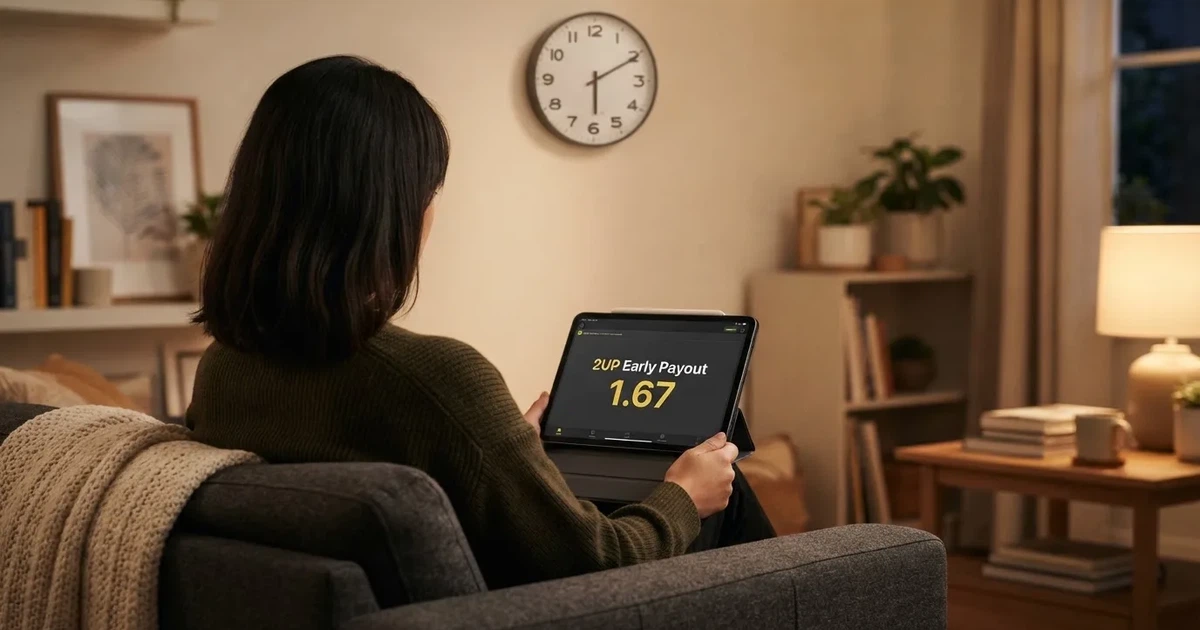
What follows is a ranking of ten UK-licensed operators that offer 2UP early payout on football, scored on what their welcome promotions and ongoing offers cost the customer who claims them. The angle through every section is cost: not the headline number on the landing page, but the wagering multiple, the minimum odds, the expiry window, and the stake-not-returned condition that quietly turns a “free” £30 into the chance to win something that often does not arrive.
How the ten 2UP bookmakers line up
The ranking below cuts the featured set on licence status first — a hard floor, because any operator without a Gambling Commission remote licence sits outside the protections the rest of this page assumes — and from there on three live measures of cost. The wagering multiple on the free bet, the minimum qualifying odds, and the expiry window. Each row states the offer in the operator’s own framing, then the specification that decides whether it is worth taking.

| Brand | Gambling Commission remote licence | What the operator’s own terms state on 2UP and the welcome offer |
|---|---|---|
| bet365 | Remote general betting standard (real events) under account 055148-R-331409-006; licence holder Hillside (UK Gaming) Limited | Bet Builder+ combines markets from one event into a single bet pre-match and in-play; Super Boosts and Winnings Boosts run daily on selected singles and Bet Builders; 2UP pays out as soon as the selected team goes two goals ahead in regular time |
| William Hill | Remote general betting standard (real events) under account 001692-R-313264-011; licence holder WHG (International) Limited | Football Acca Boost runs until 30 May 2027 on accas of 2 or more legs at 1/5 (1.20) or bigger, scaling from 3% on a double to 200% on 20+ legs with a £10,000 maximum boost per online bet; 2UP applies on selected matches |
| Coral | Remote general betting standard (real events) under account 005338-R-325243-006; licence holder Coral (International) Limited | Get £40 in Free Bets when you bet £20 — minimum odds 2.0 (1/1), free bets issued within 7 days of the qualifying bet and expiring 7 days after issue; qualification requires a debit card or instant bank transfer; daily odds boosts on horse and greyhound bets |
| Ladbrokes | Remote general betting standard (real events) and remote betting intermediary under account 054743-R-330863-014; licence holder LC International Limited | Odds boosts on horse and greyhound markets, Best Odds Guaranteed on UK and Irish racing, in-play and Acca Boosts; the licensee also runs Coral, so the same 2UP footprint and similar welcome mechanics apply across both brands |
| Sky Bet | Remote general betting standard (real events) under account 035608-R-333776-001; licence holder Bonne Terre Limited | Free bets expire 30 days after crediting, may be used only on single or each-way markets (multiples excluded), cannot be withdrawn, and do not return the stake with winnings; 2UP early payout is the headline feature, available on selected football matches |
| betfair | Remote general betting standard (real events) and remote betting intermediary under account 006186-R-325040-010; licence holder PPB Counterparty Services Limited | Betting exchange operates under a betting intermediary licence — back and lay — alongside a sportsbook under the same licensee; 2UP on the sportsbook side pays out on a two-goal lead |
| Paddy Power | Remote general betting standard (real events) under account 001483-R-312123-003; licence holder PPB Counterparty Services Limited | Same licensee as betfair, sharing wallet, customer protection and bonus structure across the two brands |
| Betway | Remote general betting standard (real events) under account 001758-R-331870-026; licence holder Betway Limited | Minimum deposit £10; free bets carry 1x wagering at minimum odds of 1.75 (4/5); 2UP covers selected leagues |
| 10bet | Remote general betting standard (real events) under account 043173-R-322899-023; licence holder Blue Star Planet Limited | 100% up to £50 sports bonus on UK sign-ups, plus daily free bets and free spins on casino products (the bonus cap no longer applies to mixed-product offers under the 19 January 2026 rule change) |
| Midnite | Remote general betting standard (real events) under account 101839-R-342850-001; licence holder Midnite Limited | New-customer offer: bet £5 or more on pre-match odds of 2.0 (EVS) or greater within 14 days of sign-up, receive £25 in free bets plus 50 free spins valid for 7 days; in-play, acca builder, price boosts and 2UP markets are surfaced on the site |
The list is not exhaustive. A search of the Commission’s public register returns more licensed operators than any ranking of ten can cover, and no brand below should be read as the only licensed option.
What a 2UP bonus actually is
A 2UP bonus and a 2UP early payout are two different things, and the search results that lead here blur the line.

The 2UP early payout is a market feature on selected football matches. Place a bet on a team to win, and if that team goes two goals ahead at any point in the match, the bet settles as a winner immediately. The final score stops mattering: the favourite can throw away a 3-0 lead and the punter still collects. It is paid in cash, not in free bets, and the original stake comes back with it.
The 2UP bonus, where operators use the term to mean a welcome or ongoing offer attached to placing a qualifying bet, sits in the promotional terms. A £10 free bet on a 2UP match, for instance, is the same free bet any other qualifying match would carry: the 2UP reference describes the early-payout market the free bet was placed on, not a separate pot of promotional credit.
A bookmaker can offer one, both, or neither. Sky Bet made the early payout the brand’s calling card and built the welcome offer around it. bet365 and William Hill treat 2UP as a feature of the platform rather than a flagship. Operators that promote themselves primarily on casino or bingo stock the early payout as an option on the sportsbook but rarely lead with it.
The mechanism that matters is the early payout itself, not the wording on the landing page.
The mechanics of 2UP in detail
A 2UP market is a separate market that has to be bet on. An ordinary Full Time Result bet, the home win / draw / away win market that most casual punters reach for by default, does not qualify. The bookmaker’s slip will not return a winning price on a standard home-win wager once the team goes two goals up; the bet stays live until full time, then settles at the final score.
This is the detail most punters miss. The 2UP toggle on the bet slip is the switch that converts an ordinary match-result bet into the early-payout version, and at the point the bet is placed the price on it is shorter than the standard home-win price, because the bookmaker is selling a settlement that runs to the first two-goal lead rather than to the final whistle. The maths makes sense. The customer pays for the early settlement in a lower headline price, and the bookmaker’s margin on the 2UP market is built into that discount.
A few extra rules define what the early payout settles against:
- 2UP applies to regular time only. Goals scored in extra time do not count, so a match that ends 2-2 after 90 minutes but 3-2 after extra time settles the 2UP bet as a push or loss depending on which side was backed.
- A fully cashed-out bet is not eligible for 2UP early payout. Once a punter takes the cash-out value in full during the match, the 2UP protection lapses and the bet settles on the cash-out amount.
- A partially cashed-out bet settles at the 2UP price on the remaining active stake only. The portion already taken out settles at whatever cash-out value was locked in.
The first rule is structural: extra time is outside the football bet for most markets, and 2UP follows that rule. The second is a customer-protection rule the bookmaker sets, not a regulator’s, and is consistent across the featured set. The third is what most 2UP markets quietly say, and what most customers discover only when a cash-out button has already been pressed.
Why a bookmaker would offer to pay early
The mechanism looks like generosity until the price is examined. A Premier League home favourite at 1.50 (1/2) for the 2UP version might be priced at 1.30 (3/10) — a meaningful discount built into the price. The customer is buying a policy on a scoreline, and the policy has a price the bookmaker sets.
The wagering behaviour is also shaped. A punt at 1.30 in-play, locked in at 2-0, beats the closing line of the same match outcome after the second goal has gone in, because the live prices immediately adjust to the new state of the game. The customer who took 1.30 at 0-0 has captured value the live market no longer offers.
This is why operators promote the feature aggressively. It produces tidy-looking slips, it converts long-running punts into cashed bets, and it moves the customer’s loyalty in a way the standard match-result market does not.
The legality of 2UP in Great Britain
A bookmaker offering 2UP early payout operates under a Gambling Commission remote licence, the same licence it needs to take a £5 bet on a Tuesday-night League Two match. The Commission does not regulate the 2UP feature itself; it regulates the licence under which the feature is sold. The rules that govern how 2UP is marketed and settled are the operator’s, the LCCP’s social responsibility code, and the consumer-rights regime the operator falls under.
A few legal frames the page holds to.
The Gambling Act 2005 covers Great Britain — England, Scotland and Wales. Northern Ireland has its own law, and a Great Britain licence does not extend there.
Since the Gambling (Licensing and Advertising) Act 2014, a remote operator whose facilities are used in Great Britain needs a Commission licence wherever it sits. A Curaçao, Maltese or Gibraltar licence is not a substitute for selling to British customers.
A consumer betting with an unlicensed operator gives up specific protections: no GAMSTOP coverage, no Commission complaints route, no approved dispute resolution, no recourse under British consumer law if funds are withheld, exemption from the 10x bonus cap and the £150 financial vulnerability check. The customer is not committing a criminal offence by betting with such an operator; the operator is the one exposing itself to prosecution under section 33 of the 2005 Act.
In-play betting is offered by every GB-licensed bookmaker in this list, with controls set by the operator’s licence conditions and consumer-protection duties. 2UP itself runs as a pre-match and in-play market on most platforms.
No statutory cap on stakes in sports betting exists. Operators set their own maximum stakes and may restrict individual customers.
The financial spread-betting market is regulated by the Financial Conduct Authority, not the Commission, and operates on its own rulebook. Spreadex, for instance, falls under both regulators because it runs both products.
Payment rules matter for the welcome offer, and they sit elsewhere in the Act. Credit cards are banned for gambling in Great Britain since 14 April 2020, including credit-card-funded payments through an e-wallet. Debit cards and bank-based payments are not covered by that ban.
The promotion rules that landed in January 2026 changed the 2UP-adjacent landscape more than anything else. Wagering requirements on bonuses are capped at 10x, and mixed-product promotions that require gambling on two or more product types are banned. A bookmaker that previously offered a sports bet qualifying a customer for casino free spins can no longer tie the two together in the same offer.
Whether the 10x cap applies to free bets with no wagering condition is not established in the Commission’s published guidance, and that is where 2UP-eligible free bets at most of the operators below currently sit.
Safe gambling when the offer is a free bet
A free bet does not eliminate the risk of gambling harm. It shifts the cost from the customer’s wallet onto the bookmaker’s marketing budget, then back onto the customer through the wagering requirement and the excluded markets. The rules a regulator applies to a deposit don’t necessarily apply to a free bet.
Identity verification kicks in before any deposit or bonus is credited. Since 7 May 2019, name, address and date of birth are verified before a customer can deposit, gamble or claim a promotion at any GB-licensed operator. A punter cannot move through the welcome offer anonymously.
GAMSTOP is the national multi-operator online self-exclusion scheme and a mandatory licence condition for every GB-licensed online operator. Periods are six months, one year, five years, or five years with auto-renewal. After the minimum period the exclusion stays in force for a further seven years unless the customer asks GAMSTOP to remove it. GAMSTOP covers online sites and apps. Betting shops use a separate service.
A financial vulnerability check (LCCP condition 3.4.4, in force since 30 August 2024) applies to licensed remote betting once a customer’s net deposits exceed £150 in a rolling 30 days, with the first phase live since 28 February 2025. The check is a public-record check (bankruptcy, county court judgments), not an income or credit-reference check. Financial risk assessments — the affordability checks that have made the press — have been announced in a staged plan from the Commission (article of 7 July 2026), with no confirmed start date.
Deposit limits (Remote Technical Standard 12) require operators to offer a gross deposit limit on a fixed time frame. Phase one of the limit rules has applied since 31 October 2025; a second phase was postponed to 30 September 2026, and whether it is currently live is not established. No state-set ceiling on stakes or deposits exists for betting.
Help is available whether or not a customer is in a regulated environment. GamCare runs the National Gambling Helpline; GambleAware is the wider commissioning body; the NHS runs gambling clinics in several cities; Gamblers Anonymous runs local meetings. The Commission’s safer-gambling pages route customers to all four.
How the welcome offers in this list really cost the customer
Each promotion below is described in the operator’s own framing and then priced in the language a customer reads before claiming.
bet365
The Super Boost and Winnings Boost promotions run on selected singles and Bet Builders daily, applied at the bet-placement step. The boosts are credited as cash winnings, not free bets, with no wagering and no minimum-odds hurdle on the boost itself, and they are paid with the stake on settled winning bets.
Bet Builder+ is a structural feature, not a promo: it combines markets from one event into a single bet pre-match and in-play with dynamic odds. The 2UP early payout is layered on top of Bet Builder+ in selected competitions.
Cost summary: no welcome offer of the “free bet” type in the headline; the cost of betting here is the bet365 margin on 2UP-eligible markets, which sits lower than most bookmakers on Premier League football but standard on lower leagues. The free-bet equivalent is the regular Super Boost, paid in cash with no wagering — the cleanest structure in this list.
William Hill
The Football Acca Boost scales from 3% on a double to 200% on 20+ legs, with each selection at 1/5 (1.20) or bigger. Max boost is £10,000 per online bet, and the promotion runs until 30 May 2027.
Cost summary: the 1.20 minimum is rock-bottom and lets in selections most accumulators would exclude as too short to qualify. The boost pays in cash winnings on acca settlement — not free bets — and the 200% ceiling on the 20-leg acca is the upper bound of what a UK bookmaker currently offers. A punter who routinely backs short-priced favourites in multiples will harvest more here than at most competitors. No fresh welcome free bet of the type a customer sees at Unibet or Coral.
Coral
Get £40 in free bets when you bet £20. Minimum odds 2.0 (1/1), free bets issued within 7 days of the qualifying bet and expiring 7 days after issue. Qualification takes a debit card or an instant bank transfer, which excludes the credit-card-funded e-wallet route that 0% of GB-licensed operators accept anyway (the credit-card ban since 14 April 2020 catches them all).
Cost summary: the 2.0 minimum odds is the standard bookmaker qualifier and lets in most home-win favourites in competitive football without forcing the customer into longshot territory. The 7-day expiry on the free bets is tight; a customer who waits to use them on a Saturday coupon and finds no qualifying match loses them. The 1x wagering is not stated here because Coral’s free bets do not carry a wagering multiple — they return winnings with the stake not returned. The combined value over the £20 qualifying bet is the £40 free-bet pot, divided by what a 2-leg or 3-leg acca pays at the floor odds.
Ladbrokes
Same licensee as Coral (LC International Limited), same 2UP footprint, similar welcome mechanics. The brand separates itself on Acca Boosts and Best Odds Guaranteed on UK and Irish racing.
Cost summary: the promos overlap with Coral heavily, so the customer is picking between two identical products on different app stores. The odds boosts on horse and greyhound markets are a separate spend (Ladbrokes runs them daily) and add value without requiring a qualifying bet.
Sky Bet
Free bets expire 30 days after crediting. They can be used only on single or each-way markets (multiples excluded), and virtuals are out. They are non-withdrawable and do not return the stake with winnings. The 2UP early payout is the brand’s main promotion, and the welcome offer is built around placing a qualifying bet on a 2UP match.
Cost summary: the 30-day window is the longest in this list and gives customers real time to find a price they like. The single-and-each-way restriction is the cost: a customer with a 5-fold acca in mind cannot use Sky Bet’s free bets on it, and at most other bookmakers they can. This is the most-cited reason Sky Bet’s free bets feel less generous than the headline number suggests. The 2UP early payout is paid in cash with the stake, so the conversion from a free bet to withdrawable cash for a Sky Bet customer runs through finding a single that wins — not an acca that lands.
betfair
The exchange runs under a betting intermediary licence, distinct from the sportsbook licence in the same licensee. The exchange commission on net winnings varies by currency and bet type, and the sportsbook carries standard fixed-odds markets.
Cost summary: a customer whose primary bet is a lay bet on the exchange has no use for the sportsbook free bets; a customer whose primary bet is a back bet on the sportsbook competes directly with Coral’s identical offer structure, because the licensee is the same one. The 2UP early payout is on the sportsbook side only.
Paddy Power
Same licensee as betfair, same combination. Paddy Power tends to run novelty markets and money-back specials that the exchange does not, and the sportsbook 2UP runs the same way as betfair’s.
Cost summary: the loyalty mechanic a Paddy Power customer signs up for is brand-specific (price boosts on novelty bets, Money-Back Specials on named leagues) and is largely irrelevant to a bettor whose betting is on 2UP-eligible football. Welcome offer is broadly comparable to betfair’s.
Betway
Minimum deposit £10; free bets carry 1x wagering at minimum odds of 1.75 (4/5). The 1.75 hurdle is between the floor most other bookmakers set (1.20 to 2.0) and stricter than that, excluding most home-win favourites in mismatched fixtures.
Cost summary: the 1x wagering means winnings from free bets have to be turned over once at 1.75 or higher before withdrawal. This is a real cost on top of the no-stake-returned rule: a £10 free bet at 2.0 has £10 of winnings to clear, and at 1.75 the customer needs a £17.50 bet to clear the wagering. Net cost: the £10 free bet value multiplied by 0.5x (since half of all wagers lose), less the bookmaker’s margin on the clearing market. The 1.75 minimum odds screens out short-priced favourites.
10bet
100% up to £50 sports bonus. Plus daily free bets and free spins on casino products. Cost summary: the headline 100% bonus has a wagering multiple that the operator’s own terms set; 10bet has historically sat at the heavier end of the GB market, with wagering factors that exceed the 10x cap for bonuses awarded before 19 January 2026 — new offers awarded after that date fall under the cap.
Cost summary: the £50 ceiling is the ceiling most UK sportsbooks set, and the daily free bets are layered on top. The total cost of claiming the welcome offer depends on the wagering factor and the minimum odds.
Midnite
Bet £5 at pre-match odds of 2.0 or greater within 14 days of sign-up, receive £25 in free bets plus 50 free spins, valid for 7 days. The 14-day window to qualify is the longest in this list.
Cost summary: the £5 qualifying bet is the lowest in this list; the £25 free bet pot is the highest relative to qualifying stake (5x). The 50 free spins on casino games are an exception to the mixed-product ban — they are awarded without requiring the customer to play casino to claim them, so they sit on the right side of the rule. Free bets carry no stated wagering condition beyond the standard 7-day expiry.
Free bets and bonuses in the UK market
A betting bonus is the operator’s promise to credit the customer’s account with something on top of the stake, in exchange for a specific action. The promise is bounded by terms the customer reads only if they want to. The terms matter.
What a wagering requirement does
A wagering requirement is the multiple of the bonus amount that has to be turned over in qualifying bets before the bonus and its winnings can be withdrawn. A £10 bonus with a 5x wagering requirement asks the customer to place £50 of qualifying bets before withdrawal.
Since 19 January 2026, the Gambling Commission has capped wagering requirements on bonuses at 10x. The rule applies to all GB-licensed operators, regardless of the product. Free bets with no wagering condition are in a grey area not settled by the Commission’s published guidance.
A wagering requirement at the cap is heavy. At 10x, a £10 bonus means £100 of qualifying bets, and that £100 is exposed to the bookmaker’s margin on whatever market the requirement is cleared on. A 5% margin on £100 of turnover costs the customer £5 on average, which is half the bonus value.
What minimum odds do
Minimum odds are the floor below which a bet does not count toward the wagering requirement or, in some cases, does not qualify for the welcome offer at all. Betway’s 1.75 floor screens out short-priced favourites; William Hill’s 1.20 floor on the Acca Boost lets them in. The customer reads the floor and decides whether the bet they wanted to place is still attractive at the floor’s price.
Why the stake is not returned
A free bet’s stake is rarely paid back with the winnings. This is the rule that converts a “free” £30 into a chance to win something. Sky Bet, Betway, Dabble and most of the featured set state it in their own terms. The bet wins, the customer collects the winnings, the original £30 stake is not credited back.
The arithmetic on a free bet whose stake is not returned is straightforward. A free bet of £F at decimal odds O has an expected payout of F × (O − 1) × payout share of the market at those odds. For an illustrative two-way market at 1.90 / 1.90 (fractional 9/10), the payout share is roughly 95%, the margin is roughly 5%, and the expected value of a £10 free bet is approximately £10 × (1.90 − 1) ÷ 1.90 × 0.95 ≈ £4.50. The free bet is worth about £4.50 on average, not £10, and the difference is what the stake-not-returned rule costs.
The 2UP early payout as a marketing line
The 2UP early payout is a market feature, and “free bet” mechanics do not apply to it directly. Where the welcome offer is a free bet on a 2UP match, the free bet’s cost applies as it would on any other match, and the early payout applies only if the bet has been placed on a 2UP-eligible market. Some promotions tie the two together (Sky Bet’s welcome offer requires placing a qualifying bet on a 2UP match); most keep them separate.
What the offer really costs a customer, by offer type
Each welcome offer in this list falls into one of a handful of structural categories. The cost to the customer is a function of the category, not the brand.
A cash bonus with a 10x wagering requirement at minimum odds 1.75 has a clearance cost of roughly £10 of bonus at the cap generating £100 of qualifying turnover, of which the bookmaker’s 5% margin retains £5. Net offer value to the customer: roughly £5, before the customer spends time and consideration on the clearance mechanics. Below the 10x cap, the cost falls in proportion.
A free bet whose stake is not returned has a value roughly half the nominal amount at the floor odds, before considering which markets qualify. The 1.90/1.90 illustrative case above gives £4.50 for a £10 free bet; a 2.0 floor gives roughly £5; a 4.0 floor gives roughly £7.
A price boost pays in cash winnings on the boosted bet, no wagering required, stake returned with the win — the cleanest structure on this page. The cost is the boost amount relative to the unboosted price.
An acca insurance refunds stakes on a losing acca as a free bet when exactly one leg lets the customer down. The cost is the refund structure (free bet, not cash) and the number of legs covered.
A risk-free bet, in the marketing sense, is most often a free bet credited on a losing first bet. The “risk-free” label is a stretch: the customer is locked into the mechanics of a free bet after losing, and that free bet does not return the stake. The risk has been reduced, not eliminated.
In every case the arithmetic reads the same way. The headline number is the marketing language; the cost is what the small print leaves behind.
What the operator reviews say, in summary
bet365 — Ongoing boosts and the Bet Builder+ advantage
The exchange of choice for casual bettors who want Super Boosts and Bet Builder+ on the same slip. The 2UP early payout is a feature of the sportsbook, priced into the market. No fresh welcome offer of the headline-free-bet kind; the value is in ongoing price boosts paid as cash with no wagering. Best for Premier League bettors who prioritise ongoing cash boosts over a one-time welcome bonus.
William Hill — Acca Boost scale and favourite-friendly pricing
The Acca Boost is the headline ongoing offer, scaling up to 200% on a 20-leg acca with a £10,000 cap. The 1.20 floor on each selection lets in heavily-priced favourites most accumulators would reject. The boost is paid as cash winnings on settled accas, with no wagering. The 200% acca boost is the strongest ongoing offer here, provided the customer sticks to short-priced favourites.
Coral — Standard welcome structures and the 7-day expiry
Get £40 in free bets when you bet £20 at 2.0 minimum odds, with the free bets expiring 7 days after issue. Standard structure across the UK market; the 7-day expiry is the constraint that drives real cost. This offer suits casual punters who can clear a 7-day expiry, but it is less compelling for long-term loyalty.
Ladbrokes — Race-day boosts and consistent promotional mechanics
Acca Boosts and Best Odds Guaranteed on UK and Irish racing, plus the same licensee as Coral. The horse-racing Best Odds Guaranteed is the practical differentiator. An excellent option for cross-sport punters who want both football 2UP markets and racing Best Odds Guaranteed.
Sky Bet — The 30-day free-bet cycle and single-market constraints
2UP early payout is the headline feature, supported by free bets with a 30-day expiry, restricted to singles and each-way markets. The single-market restriction is the cost the customer pays for the longer expiry. Ideal for single-bet punters who value the 30-day expiry window more than the ability to build accumulators.
betfair — Exchange liquidity and sportsbook 2UP availability
Exchange and sportsbook under one licensee. A customer who wants both the back-and-lay mechanics of an exchange and the 2UP early payout on the sportsbook finds them in the same wallet. A solid choice for exchange users who also want to place football singles on the sportsbook.
Paddy Power — Novelty-market depth and side-promotion value
Same licensee as betfair; novelty markets and money-back specials on named leagues. The 2UP mechanics are standard; the value is in the side promotions. Suited for bettors who prefer novelty markets and specials over standard outright results.
Betway — The 1.75 minimum-odds hurdle and wagering cost
Minimum deposit £10, free bets with 1x wagering at minimum odds of 1.75. The 1.75 hurdle screens out short-priced favourites, which screens out part of a 2UP-eligible football coupon. The 1x wagering requirement is unusual relative to the rest of the featured set and adds clearance cost. The 1.75 hurdle makes this less appealing for casual 2UP players, but it serves those with a clear betting plan.
10bet — Matched-deposit structure and the wagering window
100% up to £50 sports bonus, with daily free bets layered on. The 10x cap from 19 January 2026 sits over this offer’s wagering factor. A matched-deposit bonus is a reliable alternative to free-bet pots for customers who are disciplined with wagering requirements.
Midnite — Qualifying-stake leverage and the 14-day window
£5 qualifying bet earns £25 in free bets plus 50 free spins. The 14-day qualifying window and 5x qualifying-bet multiplier on the free bet are the most aggressive in the featured set. High free-bet leverage makes this the standout choice for customers who can hit the 2.0 odds requirement early.
Choosing between them
Three lines cut through the ten operators.
If the welcome offer is the priority: Midnite’s qualifying-stake-to-free-bet multiplier of 5x is the largest in the list, followed by Coral and Unibet at 2x. Midnite’s 14-day window is generous; Coral’s 7-day expiry on the free bets is tight.
If the 2UP coverage is the priority: Sky Bet and bet365 run the deepest markets. betfair and Paddy Power cover the same ground under one licensee; Coral and Ladbrokes split the lower-league coupon between them.
If ongoing offers matter more than the welcome: William Hill’s Acca Boost (until 30 May 2027), bet365’s Super Boosts, Coral’s daily odds boosts on racing, and Sky Bet’s 30-day free bet cycle are the ones to plan around.
What the customer should not do is sign up to all ten. The 19 January 2026 promotion rules still allow multiple welcome offers, but the verification cost (name, address, date of birth on each one) and the social-responsibility cost (multiple operators all running financial-vulnerability checks on the same customer past £150 of net deposits) climb fast.
Frequently asked questions about 2UP and welcome bonuses
What does 2UP mean in betting?
2UP refers to the early-payout market on selected football matches. Back a team to win, and if that team goes two goals ahead at any point during the match, the bet settles as a winner immediately. The final score no longer matters, and the payout is in cash with the stake returned.
What is 2UP in betting?
A 2UP bet is any bet placed on the early-payout version of a football match. It is a separate market from the standard Full Time Result, and ordinary home-win / draw / away-win wagers do not convert to the 2UP version automatically. The 2UP price is shorter than the standard match-result price, because the customer is buying a settlement that runs to the first two-goal lead rather than to the final whistle.
What is a 2UP bet?
A 2UP bet is the wager placed on the early-payout market. It is priced into the slip separately, and an ordinary home-win bet at the same match does not qualify for the early payout. The settlement kicks in only once the bet has been placed on the 2UP market.
What is the maximum wagering requirement on a betting bonus in Great Britain?
Since 19 January 2026, the Gambling Commission has capped wagering requirements on bonuses at 10x. A £10 bonus at the cap requires £100 of qualifying bets before withdrawal. The cap applies to bonuses; whether it applies to free bets with no wagering condition has not been settled in the Commission’s published guidance.
What do minimum odds and the wagering requirement mean in a sign-up offer?
Minimum odds are the floor below which a bet does not count toward the wagering requirement, or does not qualify for the welcome offer at all. Wagering requirement is the multiple of the bonus amount that has to be turned over in qualifying bets before the bonus can be withdrawn. Together they define which bets count toward clearance of the offer and how many of them the customer has to place.
Why is the stake of a free bet not paid back with the winnings?
The stake of a free bet is the operator’s cost; paying it back with winnings would double that cost on winning bets and remove the bookmaker’s edge on the offer. Most GB-licensed operators state in their own terms that the stake is not returned, and the free bet’s expected value is therefore the winnings at the bet’s price multiplied by the market payout share, not the winnings plus the stake.
Free bets & offers – Cricket betting
Content created by the «Cricket betting» team
