
Chess Betting Odds in Great Britain: Markets, Margins and What Each Bet Costs
 Available in US
Chess sits in a peculiar corner of the British sportsbook. It has no league table refreshed every Saturday, no injury bulletin to feed a news cycle, and almost no fixture that settles inside ninety minutes. The bookmakers who carry it do so because chess is one of the few individual sports where a single named event — a World Championship match, a Candidates Tournament, a Superbet rapid-play final — can hold a market open for weeks and still bring in volume on the outright. Everything else about it, the markets bookmakers build, the prices they publish, the way they settle and the way they cut, follows from that: a sparse calendar, a small set of headline events, and prices that move because a player blundered on move twenty-seven, not because of a squad announcement.

This page is about cost — what a chess bet asks of the punter, from the first tick of the live market to the moment a stake is settled. It covers the markets British bookmakers actually post on chess, the way a margin hides inside a price, the difference between a pre-match board and an in-play board, and the rules a punter needs to read before backing a player who is down a rook on move forty. It also reviews ten UK-licensed operators against the same chess criterion, names the licences that authorise them and lays out, plainly, what each one asks a customer to do before a single stake is placed.
Current as of 27 October 2026. Licensing details verified against the Gambling Commission’s public register; market mechanics and tournament facts taken from operator pages and the FIDE Handbook.
In-play chess markets and cash out
In-play chess is one of the more unusual products a British bookmaker can offer. A football match produces hundreds of in-play events per ninety minutes; a chess game can produce a settled market every time a draw is agreed, a clock is tripped at time control, a player resigns, or a capture reshapes the evaluation. The bookmaker’s task is to keep a board alive across a session that may run from twenty minutes to seven hours, and to do it without leaking the firm’s position to anyone who can read an engine.

The reason it works at all is that chess is a slow game with discrete moments. The market does not price every position; it prices events that bookmakers know will come — a win for White, a win for Black, a draw at a particular move count, a decisive game before move forty. Between those moments the board is essentially paused. A bookmaker’s in-play product means that on most platforms the price of a match is taken down while a critical move is on the board and reappears seconds after, when the position is stable enough to be priced again.
For the punter the implication is plain: the live market for chess is a thin one. The depth that a Champions League in-play board carries — a dozen outcomes with prices trading several times a minute — does not exist on a chess match. Most bookmakers will offer two or three selections at any given moment: White, Black, draw. Some add a move-count or a time-control market. The rest is suspended.
Cash out is the operator’s mechanism for closing a position before the market settles. On a fast-moving football game it functions as a hedge against a late goal; on a chess match it functions as a hedge against a position collapsing over the next ten moves. The mechanics are identical — the operator offers a price for the bet as it stands, the punter either takes it or leaves the bet running — but the value of the price depends on the bookmaker’s confidence in its own evaluation. A chess engine can read a position to a fraction of a pawn; a human trader cannot. Cash out on a chess market is therefore offered on a wider spread than cash out on a football market, and the price tends to be sticky until something concrete changes.
A practical test for any punter is whether the operator’s cash-out price for a winning position is above or below the original stake once the backer’s advantage is clear. On a football board it usually is; on a chess board it often isn’t, because the bookmaker has not had the courage to grade the position. When the engine evaluation turns decisively, the cash-out price moves with it. Before then it lags. A punter who backs a player with a clear advantage before the move that locks it in can find a cash-out price that is effectively a forced loss.
A second test is whether the bookmaker settles markets quickly when an event happens. The fastest operators settle a resignation within seconds of the move appearing on a broadcast. The slower ones settle at the end of the round, or at the end of the tournament, which leaves an in-play position technically open for hours. In the time between a result and the settlement the cash-out price does not exist, which means a position cannot be closed. This is not unique to chess — it is true of any sport whose live feed the operator has not fully automated — but it shows up in chess more often because the events are fewer and the gaps between them are longer.
What an in-play chess market costs the punter is, in this order: a wider margin than the pre-match board; suspension of the board during critical moments; cash-out prices that trail the true evaluation. None of these are unique to chess. The fact that they all sit on the same product is.
Predictions and strategy: what chess analysis can and cannot do
Chess is one of the few sports where the analysis is mathematically better than the bettor. A modern engine on a modern laptop reads a position to within a small fraction of a pawn, ranks every legal move, and produces an evaluation bar that updates as each move is played. A bookmaker’s trader, working on a screen with the same engine open behind it, sees what the bettor sees. The information edge that a sharp punter might find in an obscure league does not exist here: the engine output is the same on both sides of the screen.
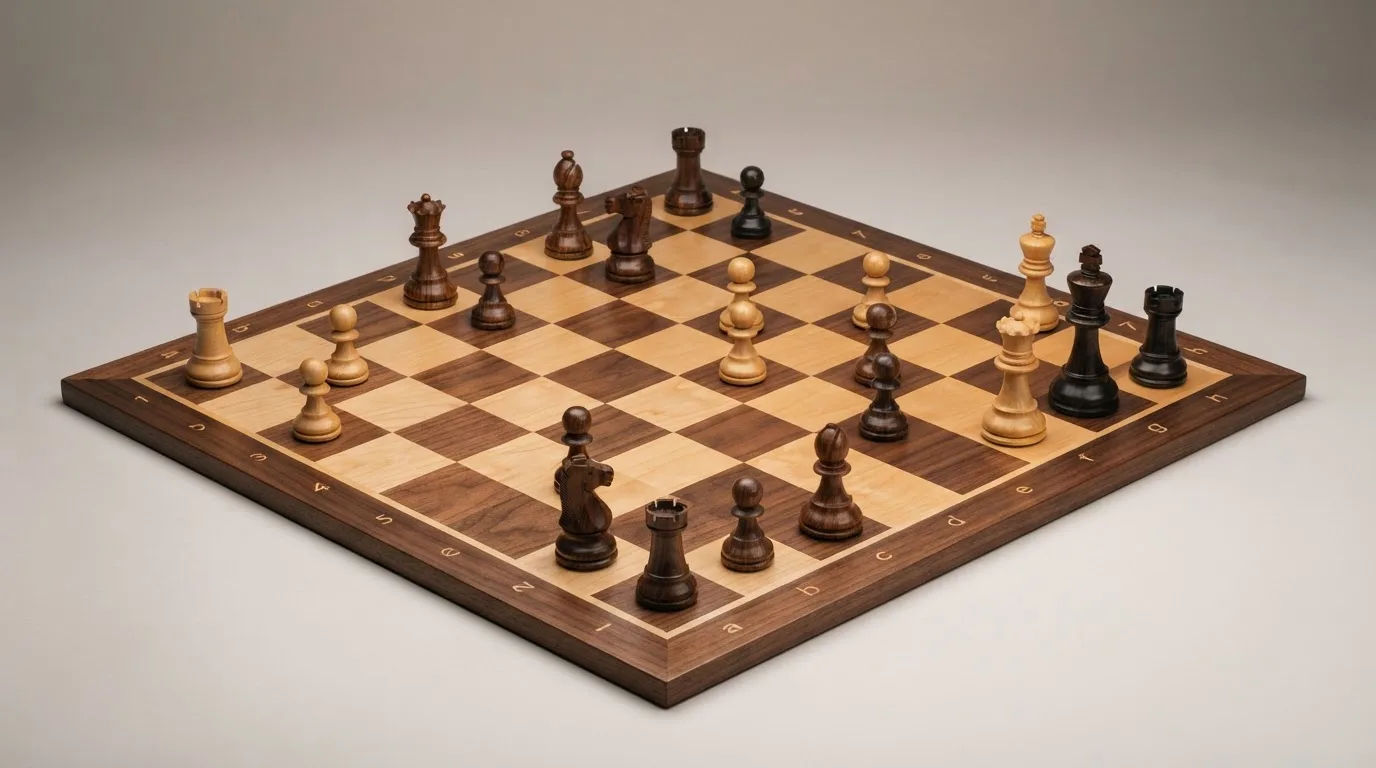
What an engine CAN tell a punter is whether a player is winning. What it CANNOT tell a punter is whether a player will convert the win. Chess is unusual among sports because the difference between an evaluation of +2 (winning) and an evaluation of +10 (decisively winning) is, in human play, often smaller than the gap between the evaluations themselves. Players at the top level draw winning endgames at a rate that no bookmaker’s margin can absorb. A pre-match favourite playing White in a classical game might be priced at 1.55 to win, 4.50 to draw, 6.00 to lose — and the most likely single outcome on the day is the draw. The favourite wins roughly thirty-six per cent of classical games at the elite level, draws roughly fifty, and loses the rest. A punter backing the favourite at 1.55 needs that favourite to win more often than its price implies, and the historical record says it does not.
The strategy that follows is conservative. A chess punter’s edge, if any, sits in three places: the outright market of a multi-game match (where each game is independent enough that variance washes out); the draw price of a classical game between evenly matched players (where the market overweights the favourite in the eyes of the public); and the tournament outright (where a field of eight or ten gives the punter a chance to back a player the bookmakers have priced off the recent form cycle rather than the long-run rating). It does not sit in live betting on individual moves, because the engine is faster than the trader, and it does not sit in predicting who wins from a position, because chess has resisted prediction for a century.
A second, less obvious strategy sits in scheduling. Chess events cluster: the World Championship cycle produces a stream of markets in the months before a match and almost none in the months after. The Candidates, the Grand Prix, the Grand Swiss and the Olympiad each generate their own short bursts of liquidity. A punter who treats chess as a year-round product overestimates the number of bets available and underestimates the number of times the same handful of players are repriced. A punter who waits for the cycle to turn can pick spots the public has not noticed.
The market’s other quirk is the role of draw odds. In a two-horse football race a draw is one outcome of three. In a chess match between two named players a draw is closer to one outcome of two — and at the elite level the draw is the single most common result. A bookmaker’s draw price on a classical game between evenly matched opponents is the line that most rewards careful reading. The favourite/outsider split that dominates football coverage does not apply: the chess match is two-horse, with a draw as the third horse, and the draw is usually the favourite. A punter who treats draw as a residual outcome misses the structure of the event.
A practical rule that follows from all of the above: chess punting rewards the patient, the informed, and the willing to leave the market alone for months at a time. It does not reward the punter who believes an engine evaluation will be cashed in before the move that unlocks it. The strategy that works is the boring one.
Bet types and odds at British chess bookmakers
The chess market at a UK-licensed bookmaker is smaller than the football market and more structured than the horse-racing market. Most operators carry the same set of selections, priced on the same evaluation, settling on the same official result. The differences between bookmakers sit in two places: how many of the selections they post and how quickly they settle them.
The headline market is the match winner. Two players, three outcomes (White wins, Black wins, draw), each priced separately. This is the market most bookmakers carry, and the one with the deepest liquidity. A second market is the tournament winner, where a field of players is priced for an outright result. A third is the draw-no-bet variant, where the stake is returned on a draw — a market that exists for chess but rarely for football, because the chess draw is common enough to make the product viable. A fourth is the total moves market, where the punter backs over or under a number of moves before the result. Beyond those four, the products thin out fast. Some bookmakers offer a handicap on the number of decisive games in a match; some offer a price on whether a particular named game ends in a particular line of play; most do not.
The price of a chess market follows the same construction as the price of any other market: the bookmaker sets a margin, builds a payout share across the outcomes, and presents the resulting odds. The mechanic is invisible to the punter; the result is not. A 1X2 football market at 2.10 / 3.40 / 3.50 carries a margin of roughly seven per cent. A chess match at 1.55 / 4.50 / 6.00 — a price that looks like a strong favourite — carries a margin closer to nine per cent. The favourite is shorter because the public overbets the favourite, and the margin is wider because the bookmaker needs a wider cut to compensate for the slow pace of chess and the higher variance of individual results. The punter who reads a chess price and assumes it is a tight market is reading it wrong.
A worked example makes the construction visible. Take a two-way market — stripped of the draw for clarity — priced at decimal odds of 1.90 / 1.90. The implied probabilities are 1 / 1.90 = 0.5263 each, which sum to 1.0526. The payout share is 1 / 1.0526 = 0.9501, or 95.01 per cent. The margin is 100 − 95.01 = 4.99 per cent, in the region of five per cent. A real chess market priced at the same margin would be tighter than the typical chess line, but the construction is the same. The punter pays five per cent of every pound staked to the bookmaker, on average, and the spread between the price and the true probability is what the bookmaker keeps.
The same calculation on a chess match at 1.55 / 4.50 / 6.00 gives implied probabilities of 0.6452, 0.2222, and 0.1667, summing to 1.0341. The payout share is 1 / 1.0341 = 0.9670, or 96.70 per cent. The margin is 3.30 per cent, which is — surprisingly — tighter than the 1.90 / 1.90 two-way example. The reason is that the draw outcome is priced at 4.50, which adds a fat margin into the calculation. A punter who reads only the favourite price at 1.55 and assumes a five per cent margin is reading the wrong number. The full market carries a margin across all three outcomes, not just across the two-way favourite/outsider split.
This is the cost chess markets ask of the punter. The headline price of a strong favourite looks generous; the full market, including the draw, looks less generous; and the cash-out and in-play products visible on the same match carry a wider margin still. None of this is unique to chess, but chess sits closer to the public’s assumption that a strong favourite should win, and bookmakers price to that assumption.
A second cost sits in settlement rules. Most chess markets at UK bookmakers settle on the official FIDE result, which is the result published by the governing body or the organiser at the end of the game. A few operators settle on the broadcast result, which is the result as reported by the live feed. The two are the same in normal play and different when a game is forfeited, abandoned, or ruled a no-contest. A punter who has backed a player whose opponent’s flag falls and who then loses on appeal is at the mercy of which rule the bookmaker’s terms name. The safer bookmakers name FIDE. The cheaper ones name “official result”, which can mean either.
A third cost sits in stake limits. Most UK-licensed bookmakers cap stakes on chess markets well below their football caps, because chess liquidity is thin and a large stake on a single game can move the market visibly. A punter used to a £1,000 stake on a Premier League match may find a £100 cap on a Candidates game. This is not a regulatory cap; it is the bookmaker’s risk control, and it varies by operator.
Sports and tournaments on the chess calendar
The chess calendar that the British bookmaker prices against is structured around four annual fixtures: the World Championship match, the Candidates Tournament, the Grand Prix series and the team events (the Olympiad in even years, the European Team Championship in odd years). Beyond those, a stream of super-tournaments and rapid-play events fills the gaps, and a long tail of national leagues and online events runs beneath. The British bookmaker’s chess product sits almost entirely on the top of that calendar — the events with named players and broadcast coverage — and disappears into the long tail.
The headline event for any chess punter is the World Championship match, played every two years between the reigning champion and the challenger who emerges from the Candidates. The 2024 match, won by Gukesh Dommaraju at twenty-one, was the headline fixture of its cycle. The next match sits in the cycle’s most bookable window: the months between the Candidates finishing and the match beginning. Liquidity on a World Championship match is the highest chess liquidity the year produces, and it is the only chess market where the bookmaker’s price moves noticeably with news of either player’s preparation. A punter who has watched the chess match before this one will recognise the rhythm: a long pre-match market with stable prices, a tightening market in the final days, and an in-play market that barely exists because classical games run for hours and bookmakers suspend most products for the duration.
The Candidates Tournament is the second headline fixture. Eight players, fourteen rounds, one winner who earns the right to challenge the champion. The Candidates is a longer event than the World Championship match, with more games and more markets: each round carries its own match winner, the overall tournament carries its own outright, and a number of side markets (top finisher by rating band, named-player performance) sit above the headline products. The chess match before the Candidates’ final round is the most volatile event on the chess calendar, because one player wins and seven others lose the chance to challenge.
The Grand Prix series is a four-event rapid and blitz tournament that runs in the year before the Candidates. It produces less liquidity than the World Championship match but more than the typical super-tournament. A punter who wants to back a single named player through a season of events finds the Grand Prix the most bookable product available.
The team events are a different shape. The Olympiad is a biennial event with national teams, played in even years, and the European Team Championship an odd-year equivalent for European federations. The team market is thinner than the individual market because the outcome is harder to read — a team’s result depends on the form of up to twenty named players, not on the form of one or two. A few bookmakers price the Olympiad outright; most do not.
The super-tournaments — the Tata Steel Masters, the Norway Chess, the Sinquefield Cup, the Grand Swiss — are individual events with named fields, played through the year. The headline products (the tournament winner, the top-three finish, the head-to-head between two named players) are bookable at most UK operators, but the liquidity is light and the prices move slowly. A punter looking for a chess bet outside the championship cycle finds the super-tournaments the most consistent supply.
The long tail is invisible to most bookmakers. National leagues, online rapid tournaments, junior events and most club competitions are not priced at all, even by operators with a deep chess product. The punter who wants to bet on a national league match is, in practice, betting on a market that does not exist.
The result is a chess calendar with a clear shape: a small number of bookable events per year, clustered into a few windows, with a long quiet season between them. A punter who treats chess as a year-round product will find it empty. A punter who waits for the windows will find them deeper than expected.
Ten UK bookmakers reviewed for chess betting
The table below summarises how the ten reviewed UK bookmakers look when the chess criterion is applied. The columns are the licence status (Gambling Commission remote licence number, account number and licence holder), and what the operator’s own published terms state on chess. The headings vary across bookmakers; the licence data is uniform.
| Brand | Gambling Commission licence | What the operator’s own terms say about chess |
|---|---|---|
| Betfred | 039544-R-319290-010 (Commission account 39544), held by Petfre (Gibraltar) Limited | A broad sportsbook with 21 sports covered on its app and an in-play section; chess is offered in a limited form, mostly on headline tournaments |
| BetMGM | 039198-R-319450-029 (Commission account 39198), held by LeoVegas Gaming PLC | A sportsbook that lists multiple sports with a focus on football and horse racing; chess appears on headline events only, with limited markets |
| Bet600 | 044731-R-323941-016 (Commission account 44731), held by Tyche Tech Limited | A sportsbook focused on football and racing, with Best Odds Guaranteed on horse racing; chess coverage is thin, mostly on the World Championship cycle |
| 10bet | 043173-R-322899-023 (Commission account 43173), held by Blue Star Planet Limited | A sportsbook with Cash out, Bet Builder and Live Streaming across football, tennis and horse racing; chess is offered in a limited form, on headline tournaments only |
| DragonBet | 064908-R-339041-003 (Commission account 64908), held by DragonBet Ltd | A Welsh-focused sportsbook with football, rugby, racing and American football markets; chess is on the long-tail of the product line and not always available |
| Fitzwilliam Sports | 048760-R-335434-009 (Commission account 48760), held by SBKI Limited | A Dublin-based bookmaker with capped membership and a “High Stakes Welcome”; chess is offered within the headline-event set, with deeper markets for high-stake customers |
| Bar One Racing | 056516-R-332750-007 (Commission account 56516), held by Bar-One Racing Limited | An Irish independent bookmaker with shops and racing sponsorships; chess is offered on headline events but is not a primary product |
| Midnite | 101839-R-342850-001 (Commission account 101839), held by Midnite Limited | A sportsbook with in-play events, an acca builder, popular accas and price boosts; chess is offered with a small set of markets on the championship cycle |
| Paddy Power | 039439-R-319330-013 (Commission account 39439), held by PPB Counterparty Services Limited | A sportsbook with football, horse racing, boxing, rugby, tennis, golf, darts, snooker and F1; chess sits inside a small group of “other” markets, mostly on headline events |
| NetBet | 039170-R-319343-032 (Commission account 39170), held by Netbet Enterprises Limited | A sportsbook with Daily Boosts, Profit Boosts, free bet offers, a Bet Builder and sports stats for major leagues; chess is offered on the championship cycle with a thin market |
The brands reviewed are not the only licensed operators in the British market — the Commission’s register lists dozens more, none of which are covered on this page. The point of the table is not to crown a winner; chess coverage at UK bookmakers is, almost without exception, an add-on product on top of a football-shaped sportsbook, and the differences between the ten brands sit in the depth of the add-on rather than in the shape of the underlying product.
Betfred: a long-established sportsbook with chess on the edge of the product
Betfred is one of the older names on the British high street, and its app — the Betfred Sports, Casino & Games app — covers twenty-one sports and more than two thousand casino-style games. The sportsbook grew up around horse racing and football, and chess sits at the edge of what it offers. The brand’s headline markets are football, horse racing, greyhound racing and a long tail of in-play products; chess is one of the smaller sports in the catalogue and is offered mostly on the World Championship cycle. The Commission’s licence sits with Petfre (Gibraltar) Limited under account 39544.
The chess product is functional rather than deep. A punter backing a Candidates match can find a winner market and a tournament outright; a punter looking for a handicap on total moves or a draw-no-bet variant will find less. The depth is similar to most of the table — a handful of selections on a handful of events. For a punter whose chess interest is the World Championship and one hero feature, that depth is enough.
The verdict is that Betfred offers a stable platform for a punter who plays chess alongside football and horse racing; it is not a suitable choice for a dedicated chess punter.
BetMGM: a US brand with a thin chess product
BetMGM’s UK sportsbook sits inside the wider MGM Resorts International family, with the British operation run by LeoVegas Gaming PLC under Commission account 39198. The sportsbook is broad: football, horse racing, a dozen other sports, an in-play section and a casino. Chess is offered on a small set of markets, mostly on the headline tournaments, and the brand’s promotional activity is centred on football multiples rather than chess markets.
The chess product is limited. If a punter wants to bet on the World Championship, the match winner market is available. However, those seeking the depth of a specialist chess site will find the markets lack variety. The brand focuses on the broader sportsbook, making chess a secondary option.
The verdict is that BetMGM suits a punter who wants a big-brand sportsbook with chess as a side interest; it is not for those who need a deep chess library.
Bet600: a smaller brand with a thin chess product
Bet600 is a smaller UK bookmaker, run by Tyche Tech Limited under Commission account 44731, with a sportsbook centred on football and horse racing. Best Odds Guaranteed is offered on horse racing; chess is offered on a thin set of markets, mostly on the World Championship cycle. The brand’s strength is the racing product and the small-set feel of the operation; chess is a single-digit part of the catalogue.
The chess product is light to the point of being intermittent. A punter who wants a price on a Candidates game during the tournament will usually find one; a punter who wants a price on a Sinquefield Cup game in mid-season will not. The markets on offer when chess is offered are winner and tournament outright, with side markets rare.
The verdict is that Bet600 suits a punter whose interest is football and racing, with chess a once-a-year punt on the World Championship; it does not accommodate a serious chess punter.
10bet: a sportsbook with build products that touch chess lightly
10bet’s sportsbook covers football, tennis and horse racing, with Cash out, Bet Builder and Live Streaming as headline features. The British operation sits with Blue Star Planet Limited under Commission account 43173. The brand’s strength is the build products and the live product; chess is one of the sports on the long tail of the catalogue, with markets on headline tournaments and a thin set of selections elsewhere.
The chess product is limited. A punter backing the match winner on a World Championship game will find a price; a punter looking for a draw-no-bet variant or a handicap will usually not. The Bet Builder feature is not applied to chess on most platforms, because the markets are too thin to support the build. The Live Streaming feature does not extend to chess events at this bookmaker.
The verdict is that 10bet caters to a punter whose primary focus is football and tennis; chess is not its competitive strength.
DragonBet: a Welsh-focused bookmaker with chess on the edge of the product
DragonBet is run by DragonBet Ltd under Commission account 64908, with a sportsbook centred on Welsh football, rugby, racing and American football. The brand’s identity is Welsh sport; chess is offered on a small set of markets, mostly on headline tournaments, and is not a primary product. The brand’s promotional activity is around football accumulators and racing features; chess is rarely the focus.
The chess product is episodic. Users wanting to wager on a World Championship fixture can secure a price; Candidates tournament games are similarly covered, though high-level rapid events often miss out. The selection is largely limited to outright winners.
The verdict is that DragonBet suits a punter who focuses on Welsh sports; its chess market is an intermittent offering for a casual player.
Fitzwilliam Sports: a Dublin-based bookmaker with a capped membership
Fitzwilliam Sports describes itself as a Dublin bookmaker with capped membership, and its “High Stakes Welcome” is subject to compliance criteria. The British operation sits with SBKI Limited under Commission account 48760. The brand’s product line is broad: horse racing, football, a long tail of sports, and a deep in-play section. Chess is offered within the headline-event set, with markets that are slightly deeper for high-stake customers — a reflection of the brand’s positioning rather than a structural feature of the chess product.
The chess product is deeper than most. A punter backing the World Championship match will find a winner market, a handicap, a draw-no-bet variant and a total moves market. A punter backing a Candidates game will find a similar set. The high-stake welcome does not apply to chess specifically, but a customer who has cleared the compliance criteria for a high-stake welcome may find larger stake limits on the chess markets.
The verdict is that Fitzwilliam Sports provides a deeper chess experience for those who can meet its high-stake compliance criteria; it is a specialist’s choice.
Bar One Racing: an Irish bookmaker with chess as a side product
Bar One Racing, now trading as BAR 1 Betting, is an Irish independent bookmaker with shops and racing sponsorships at Dundalk, Fairyhouse, Navan, The Curragh, Curraheen Park and Cork. The British operation sits with Bar-One Racing Limited under Commission account 56516. The brand’s product line is racing-led, with a football book and a long tail of other sports. Chess is offered on headline events but is not a primary product.
The chess product is sparse. A punter backing the World Championship match finds a price; a punter backing a Candidates game finds one; a punter looking for a deeper product will not. The markets are restricted to outrights and side markets are very rare.
The verdict is that Bar One Racing serves a punter interested in Irish racing; its chess product is a peripheral offering.
Midnite: a newer sportsbook with a thin chess product
Midnite is one of the newer UK-licensed sportsbooks, run by Midnite Limited under Commission account 101839. The brand’s product line includes in-play events, an acca builder, popular accas and price boosts with maximum-stake limits. Chess is offered on a small set of markets, mostly on the championship cycle, and the brand’s promotional activity is centred on football multiples.
The chess product is light. The acca builder does not apply to chess at this brand. The in-play section is football-led and rarely carries chess products.
The verdict is that Midnite caters to a punter focused on football accumulators; its chess market is too limited for a dedicated chess player.
Paddy Power: a household name with chess on the long tail
Paddy Power’s sportsbook covers football, horse racing, boxing, rugby, tennis, golf, darts, snooker and F1. The British operation sits with PPB Counterparty Services Limited under Commission account 39439. The brand’s identity is football and racing, with a long tail of other sports; chess sits inside a small group of “other” markets, mostly on headline events.
The chess product is minimal. A punter backing the World Championship match finds a price; a punter looking for depth will not. Markets are restricted to winners and outrights, with side markets rare. The brand’s promotional activity focuses on football boosts and racing features; chess is seldom the priority.
The verdict is that Paddy Power suits a punter who follows football and racing; its chess product is a sporadic market for the casual observer.
NetBet: a sportsbook with chess on the edge of the catalogue
NetBet’s sportsbook carries Daily Boosts, Profit Boosts, free bet offers, a Bet Builder with instant dynamic odds and sports stats for major leagues. The British operation sits with Netbet Enterprises Limited under Commission account 39170. The brand’s product line is broad, with football, tennis and basketball as primary sports; chess is offered on the championship cycle with a thin market.
The chess product is basic. A punter backing a match winner on the World Championship match will find a price; a punter looking for depth will not. Bet Builder is unavailable for chess due to thin markets. Daily Boosts are football-centric and rarely include chess events.
The verdict is that NetBet suits a punter who focuses on major football leagues; its chess market is not for a dedicated chess player.
What chess is and how the bookmakers price it
Chess is a board game played between two players on an 8×8 board of sixty-four squares, with each player controlling sixteen pieces at the start. The object is to checkmate the opponent’s king — a position from which the king cannot escape capture — and the game may also end by resignation, by agreement, by stalemate, by the fifty-move rule, by threefold repetition of position or, since the FIDE rule changes of 2014, by fivefold repetition or the seventy-five-move rule. A chess game is recorded as 1–0 for a White win, 0–1 for a Black win and ½–½ for a draw. The World Chess Championship has been held since 1886; Wilhelm Steinitz was the first universally recognised champion, and the title has since passed through a line of players that ends at Gukesh Dommaraju, who won the 2024 match.
The game’s structure is the reason it is bookable at all. A chess match between two named players is a discrete event with a known start time, a known number of games, and a small set of outcomes. A chess tournament is the same, with a slightly larger set of outcomes. The bookmaker’s task is to price the outcomes, manage the in-play products across games that can run for hours, and settle on the FIDE result.
The cost of a chess market to the punter is the margin the bookmaker builds into the price. The mechanics are simple. For a market with outcomes priced at decimal odds of o₁, o₂, …, oₙ, the implied probability of each outcome is 1 / oᵢ, and the sum of those probabilities is the overround. The payout share is the reciprocal of the overround, and the margin is 100 per cent minus the payout share. The margin is what the bookmaker keeps of every pound staked, on average, across the outcomes. A market with a five per cent margin pays back 95 pence of every pound staked, in the long run, and keeps 5 pence. A market with a ten per cent margin pays back 90 pence and keeps 10.
A worked example on a stripped-down two-way market at 1.90 / 1.90 (the fractional equivalent of 9/10 on each side) gives implied probabilities of 0.5263 and 0.5263, summing to 1.0526. The payout share is 1 / 1.0526 = 0.9501, or 95.01 per cent. The margin is 4.99 per cent — in the region of five per cent, and tight by chess standards. A real chess match priced at 1.55 / 4.50 / 6.00 — a typical World Championship line — carries a margin of around 3.30 per cent across all three outcomes, which is tighter than the headline favourite price suggests. The difference between the headline margin and the full-market margin is the cost the punter pays for not reading the full market.
A punter who backs a single outcome of a chess market pays the full margin of that market on every stake, and the margin compounds across bets. A punter who reads the full market, prices the draw against the favourite, and stakes only when the line is favourable can find a positive expectation, but the band of positive expectation is narrow and the markets on which it is available are few. The chess market is one where the bookmaker’s margin is the single most important number, and the single most often ignored.
How chess betting is regulated in Great Britain
The commercial betting market in Great Britain is regulated by the Gambling Commission under the Gambling Act 2005, which covers England, Scotland and Wales. Northern Ireland sits outside the Act and has its own older law; a “Great Britain licence” or “GB-licensed” describes the regime that applies to operators serving customers in England, Scotland or Wales, not the regime that applies in Northern Ireland. Since the Gambling (Licensing and Advertising) Act 2014 an operator whose remote facilities are used in Great Britain needs a Commission licence wherever the operator is based. A Curaçao, Maltese or Gibraltar licence is not a substitute.
The Commission’s public register is the whole test of whether a brand holds a licence. It can be searched by business name, trading name, domain or account number, and it lists every operator licensed to serve customers in Great Britain, the licence category (remote general betting standard for real events, remote general betting standard for virtual events, remote general betting limited, remote pool betting or remote betting intermediary for exchanges), and the licence holder. Licensed operators use .com as well as .co.uk, so the domain proves nothing; the register is the test.
The minimum age to bet is eighteen. Name, address and date of birth are verified before a customer can deposit or gamble — since 7 May 2019, including where a free bet or bonus is in play. A bookmaker that does not verify a customer’s identity before the first deposit is not a GB-licensed bookmaker. The customer cannot play anonymously at a licensed site.
Player protection has tightened in stages since 2020. GAMSTOP is the national multi-operator online self-exclusion scheme, and is a mandatory licence condition for online operators since 31 March 2020. The exclusion can be set for six months, one year, five years, or five years with auto-renewal, and after the minimum period the exclusion stays in place for a further seven years unless the customer asks GAMSTOP to remove it. GAMSTOP covers online sites and apps; betting shops use a separate service.
A financial vulnerability check has been in force since 30 August 2024 and is applied when deposits minus withdrawals exceed £150 in a rolling 30-day window (the threshold has applied since 28 February 2025). The check is a public-record check — bankruptcy, county court judgments, similar registers — not an income check and not a credit reference check. Financial risk assessments (the “affordability checks” of the press) have been announced in a staged plan, with no start date. Operators offer deposit limits on a fixed time frame; the first phase of the deposit-limit regime has applied since 31 October 2025, a second phase was postponed to 30 September 2026, and whether the second phase is live is not established.
There is no statutory list of permitted bets or markets. An operator holds a licence for a category and offers markets under its own rules and the Licence Conditions and Codes of Practice (LCCP). In-play betting is offered at GB bookmakers, and the controls are the operator’s licence conditions and customer-protection duties. Esports are treated like any other event. Bets on politics, TV shows and novelty markets are offered by GB bookmakers, and no statutory prohibition was found. Betting exchanges run under a betting intermediary licence. Financial spread betting is regulated by the Financial Conduct Authority, not the Commission.
What an operator may ask of a customer is bounded by the LCCP. Operators must offer deposit limits, must offer time-outs, must offer GAMSTOP self-exclusion, must run affordability and vulnerability checks at the thresholds described, must verify identity before the first deposit, must honour withdrawal requests within a stated window, and must comply with the social responsibility code. The Commission can fine, suspend or revoke an operator’s licence for breach.
A customer who bets with an unlicensed operator — an operator whose brand does not appear on the public register — loses the protections the regime provides: no GAMSTOP coverage, no Commission complaints route, no approved dispute-resolution body, no British consumer redress if funds are withheld, and no protection under the 10x bonus cap or the £150 vulnerability check. The page does not say that betting with an unlicensed operator is illegal; it says that the customer who does so bears the cost of the absence of the protections the regime provides.
Safer gambling tools and where to find help
Every operator reviewed on this page is a member of GAMSTOP, and the customer who signs up with any one of them can self-exclude from all of them with a single registration. The exclusion periods are six months, one year, five years, or five years with auto-renewal, and after the minimum period the exclusion stays in place for a further seven years unless the customer asks GAMSTOP to remove it. The service covers online sites and apps; betting shops use a separate service and the GAMSTOP registration does not extend to them.
Every operator reviewed on this page offers the safer-gambling tools the LCCP requires: deposit limits on a fixed time frame, time-outs, session reminders, and the option to self-exclude. The deposit limits are a customer-set choice — there is no state-set ceiling, and the limits are what the customer chooses to apply. The first phase of a more structured deposit-limit regime has applied since 31 October 2025, and a second phase was postponed to 30 September 2026; whether the second phase is in force at the time of reading should be checked against the operator’s own page.
For customers who feel their gambling has stopped being a choice, the national help lines are: GamCare (which runs the National Gambling Helpline), GambleAware, the NHS gambling clinics and Gamblers Anonymous. GamCare and GambleAware are the front doors for most customers; the NHS clinics are a treatment route for those whose gambling has reached a clinical threshold; Gamblers Anonymous is a peer-support group with meetings across the country. None of these are emergency services, and none of them are a substitute for medical help in a crisis.
A practical step for a customer who wants to set a deposit ceiling is to set the ceiling before the first deposit and to keep it set when a promotional offer arrives. The promotional offers reviewed on this page ask the customer to stake a small amount and receive a larger amount in free bets or bonus funds; the cost of clearing the bonus is a turnover requirement that varies by operator. A customer who reads the bonus terms before claiming knows the cost; a customer who claims and reads later discovers it on the way to a withdrawal. The safer-gambling tools and the bonus terms are the two parts of the customer-side cost that are most often read too late.
A second practical step for a customer who wants to back out of gambling for a period is to register with GAMSTOP. The registration takes minutes, the exclusion is binding across every licensed online operator, and the minimum exclusion is six months. The exclusion does not prevent a customer from opening a new account with the same brand — it prevents the brand from accepting the customer’s stake during the exclusion period. A customer who has self-excluded and is still able to deposit at any licensed operator has either mis-registered with GAMSTOP or is dealing with an unlicensed operator.
A third practical step is to read the operator’s terms before the first deposit. The terms state the maximum stake on chess markets, the settlement rule for chess games (FIDE or broadcast), the cash-out policy, the deposit limit, the withdrawal window, and the verification procedure. The terms are not glamorous reading. They are the value the operator places on a customer’s stake, and a customer who has not read them has accepted an offer without knowing its price.
Chess on mobile and the shape of the betting app
The British chess punter in 2026 bets on a phone. The desktop case is rare; the betting shop case is rarer; the phone is the product. The sportsbook apps reviewed on this page — Betfred’s Sports, Casino & Games app, BetMGM’s Online Casino & Sports app, Midnite’s Sports & Casino app, Paddy Power’s Sports Betting app, NetBet’s Sports Betting app and the others — are designed for football-shaped sports, with chess on the long tail of the catalogue. The punter who backs a chess market on any of them backs it through the same interface that backs a football match: a sport selector, an event list, a market tree, a stake box, a bet slip.
The shape of the interface is the same across the ten brands. The differences sit in three places: how the search is performed, how the bet is settled, and how the bonus terms are surfaced. A punter used to one bookmaker’s app knows the shape; a punter switching between two needs a few minutes to find the chess market on the second.
In-play chess on mobile is the most variable product. A football match in-play on a British bookmaker’s app carries live odds that update several times a minute, with a graphic, statistics and a cash-out button. A chess match in-play carries a smaller set of selections, suspended during critical moves, and a cash-out button. The punter who backs a chess market in-play is looking at a thinner version of the football product, and the thinning is what makes it bookable at all.
The verification step is the same on mobile as on desktop. Name, address and date of birth are verified before the first deposit. A punter who tries to skip the verification cannot deposit. The mobile product has no anonymous mode and no anonymous path; the customer is known to the operator from the first deposit, and the operator is known to the Commission from the first customer.
The bet builder feature does not apply to chess at most operators. Bet builder is a single-match multiple that combines markets from one event — a football match with a goalscorer, a total goals, a half-time result — into a single price. The markets on a chess match are too few and too similar for a meaningful build. A few operators extend the feature to chess on the headline events; most do not. The punter looking for a build on a chess match is, in most cases, looking at a product that does not exist.
The live streaming feature is similarly limited. Live streaming on a British sportsbook app is football-led, with tennis, basketball and a long tail of other sports covered. Chess is not streamed by any of the ten operators reviewed on this page; the punter who wants a live video of a chess match uses an external broadcast, such as the channel’s host. A punter who bets on a chess market in-play is betting on a board without seeing it on the app.
What the mobile product costs the punter is the same as the desktop product: a margin across the outcomes, suspension during critical moments, and a cash-out price that lags the true evaluation. The cost is not different because the product is on a smaller screen. The cost is the same because the market is the same. The interface changes; the maths does not.
Frequently asked questions
Where can a punter bet on chess in Great Britain?
A punter who wants to bet on chess in Great Britain backs it at one of the UK-licensed operators whose names appear on this page: Betfred, BetMGM, Bet600, 10bet, DragonBet, Fitzwilliam Sports, Bar One Racing, Midnite, Paddy Power and NetBet. Each of these brands holds a Gambling Commission remote licence and appears on the Commission’s public register. The Commission’s register lists more licensed brands than those reviewed on this page; the reviewed set is a sample, not a complete directory. A punter whose preferred bookmaker is not on the list can check the register for its licence number. Chess coverage at most licensed brands is a long-tail product and is concentrated on the World Championship cycle, with thinner markets outside that cycle.
Can chess be bets on in Great Britain at all?
Yes. Chess is offered as a betting market at UK-licensed bookmakers under the Gambling Act 2005. There is no statutory list of permitted sports or markets in Great Britain; an operator holds a remote general betting standard licence and offers markets under its own rules and the Licence Conditions and Codes of Practice. The bookmakers who cover chess in practice are a subset of those who hold the licence; the market is offered because it has liquidity, not because a regulator requires it. A punter who backs a chess market at a licensed operator is betting on a regulated product; a punter who backs it at an unlicensed operator is not.
How is a chess bet placed and settled?
A chess bet is placed through a sportsbook app or website: the punter selects chess from the sport menu, picks the event (a match or a tournament), picks the market (winner, draw, handicap, total moves, tournament outright), picks the selection, enters the stake and confirms the bet. Settlement happens after the event and follows the operator’s stated rule. Most operators settle on the official FIDE result, which is the result published by the governing body or the organiser. A few operators settle on the broadcast result. The settlement rule is named in the operator’s terms. A punter who backs a player whose opponent resigns finds the bet settled within minutes of the result appearing on a fast feed; a punter who backs the same player on a slow feed finds the bet settled at the end of the round or the end of the tournament.
How can a bookmaker’s Gambling Commission licence be checked?
A bookmaker’s Gambling Commission licence can be checked on the Commission’s public register, which is searchable by business name, trading name, domain or account number. The register is the whole test of whether a brand holds a licence: a brand whose name appears on the register holds a licence in the named category; a brand whose name does not appear does not. The register also names the licence holder (which can be a parent company), the licence category, the licence number and the trading names the licence covers. A punter who checks the register before the first deposit knows whether the brand is licensed, who holds the licence, and what the licence covers. A punter who does not check accepts the brand’s word.
How is the return on a chess bet worked out from the stake and the odds?
The return on a winning chess bet is the stake multiplied by the decimal odds. A £10 stake at decimal odds of 2.50 returns £25; the net profit is £15 (the return minus the stake). For a combination bet — an accumulator that combines two or more selections into one price — the odds of the legs multiply into a single price, and the stake is multiplied by that combined price. The return is the same formula applied to the combined price. The stake is the punter’s only loss on a losing bet; the stake is not returned with the loss. A punter who backs a single at 2.50 and a double at 5.00 (where 5.00 is the product of two legs at roughly 2.24 each) risks the same £10 on both, but the second is a more volatile bet because both must come in.
What is a bookmaker’s margin and how does it show in the odds?
A bookmaker’s margin is the share of every pound staked that the bookmaker keeps on average across the outcomes of a market. It is calculated as 100 per cent minus the payout share, where the payout share is the reciprocal of the sum of the implied probabilities of the outcomes (each implied probability being the reciprocal of the decimal odds). A market priced at 1.90 / 1.90 (a stripped two-way example) sums to 1.0526 and gives a payout share of 95.01 per cent and a margin of 4.99 per cent. A market priced at 1.55 / 4.50 / 6.00 (a typical chess match line) sums to 1.0341 and gives a payout share of 96.70 per cent and a margin of 3.30 per cent across all three outcomes. The margin is what the bookmaker keeps on every pound staked, on average, over many bets. It is the single number a punter reads when comparing markets.
Tennis, darts & cue sports – Cricket betting
Content created by the «Cricket betting» team
