
Chess Betting Tips: What a Tip Is Worth, What It Costs and Where the Edge Lives
 Available in US
Current as of 27 October 2026 · licence status checked against the Gambling Commission’s public register
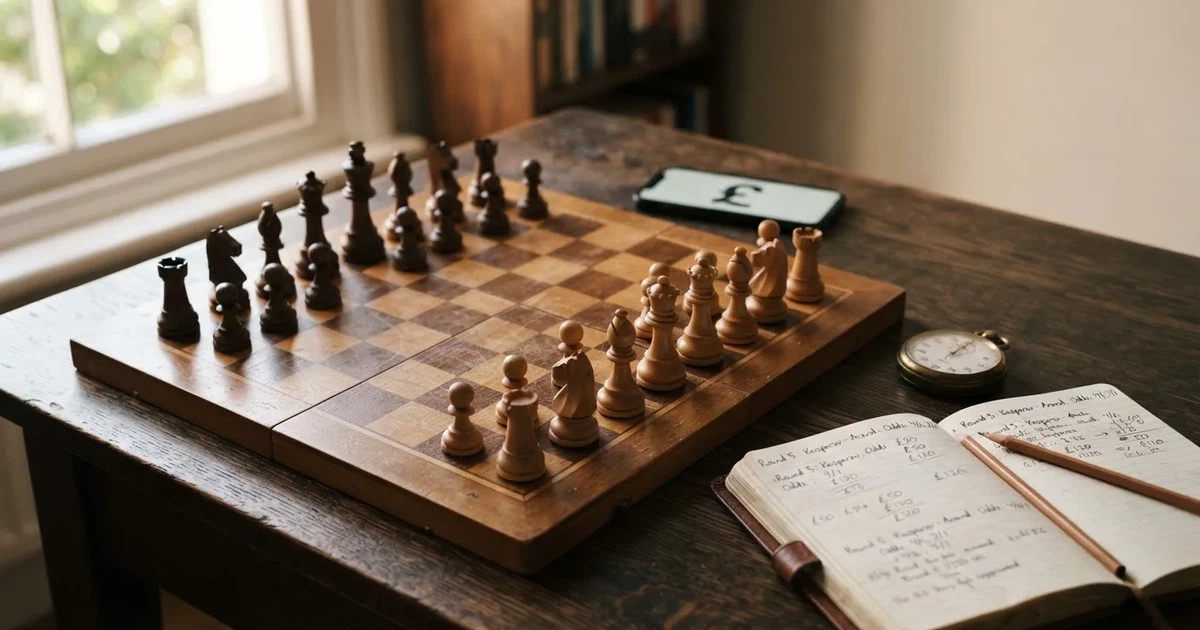
Chess sits in an odd corner of the betting market. The game itself is short on goals, long on outcomes nobody can predict, and the bookmakers covering it are a thin slice of the football-first names most punters already use. That combination produces a market where the headline tip is rarely the interesting part. The interesting part is what sits behind it: the bookmaker’s margin, the structure of the odds, and the cost of every “free” extra the marketing puts in front of you. This guide is built around that.
What follows is a working map of chess betting in Great Britain. It covers live markets and cash-out, the strategy questions punters actually ask (what’s a value bet, why no tip is certain), the bet types a chess market uses, the tournaments where betting is concentrated, and a shortlist of ten operators currently licensed by the Gambling Commission to take remote bets from customers in England, Scotland and Wales. It does not name a winner of any future game. No one can.
Live chess betting and cash-out: how in-play markets work on a 64-square game
A chess game does not behave like a football match. There is no clock running out, no scoreline ticking over, no momentum that a trader can read at a glance. Most professional games finish with a single decisive move after thirty or forty quiet ones, and the bulk of the betting interest sits on the major title events — Candidates, World Championship matches, top-tier Opens — where the field is small and the line-ups are known days in advance.

In-play markets exist on those fixtures. The standard three-way line — White win, draw, Black win — is what most operators offer pre-match, and that same line is what you see in-play once the game has started. The draw’s price is the centre of gravity: a top-level game between closely matched super-GMs is widely modelled as closer to a one-in-three draw event than the casual reader assumes, and a price of 3.20 to 3.60 on the half-point is routine when no live odds are available. Once the move count begins to climb and a clear advantage emerges, the draw drifts and the leader shortens.
Cash-out on chess is a thinner product than cash-out on football. The market is small, the liquidity is shallow, and the price the operator offers to buy you out at tends to be conservative. Punters used to locking in a profit at the 70-minute mark on a football bet will find that chess gives them far less room. The trade is real, the spread is wider, and the timing matters. On a long game that turns decisively in the middle-game phase, the cash-out window is short.
What that means for the reader is simple. Live chess betting is a niche product within a niche sport. The bookmakers who offer it well are the ones with a chess-specific trading team behind the prices; the ones who don’t tend to copy the lead from the bigger exchanges and add a margin on top, which is the worst place to be. The brands reviewed later in this guide that show in-play markets and a working cash-out button have at least cleared that first hurdle.
Predictions and strategy: building a tip without inventing one
A “chess betting tip” in the search-engine sense is almost always a prediction dressed as advice: someone says Magnus Carlsen wins Game 1, or that the underdog holds with Black, and the page that hosts it collects clicks whether the call lands or not. The honest framing is different. A prediction is built out of four ingredients — form, statistics, line-ups, and the market’s own odds — and the value of the tip is the difference between the bettor’s estimate of probability and the price the bookmaker offers. That gap is what the trade is actually about.
Form is the deepest pool. Engine evaluations of past games (centipawn loss averages, accuracy by phase, results against specific opponents), classical rating trends over the last twelve to twenty-four months, and head-to-head history at the same time control all matter. White’s first-move advantage is real, but not so large that form can be set aside: the higher-rated player wins roughly 55 per cent of decisive classical games at elite level, draws do most of the rest.
Statistics come next. Tournament results over the last three to five events, performance rating against the field’s average, draw rates against players of similar strength, and any trend in time-trouble losses tell a sharper story than the headline Elo. The opening repertoire matters less than the pundit class implies; what matters is how the player handles the middlegame positions their repertoire steers them into.
Line-ups in chess are not a squad-list exercise. The pairings of a knockout event, the colour allocation in match one, the rest day a player has had — these are the variables. The colour draw is significant: White wins roughly 52 to 55 per cent of decisive classical games at top level, so going second in game one of a World Championship match is a small but measurable handicap.
The market’s own odds come last because they discipline everything above. A “value bet” is a price that is greater than the inverse of the bettor’s own probability estimate. If a player’s true chance of winning is 40 per cent, the price that pays is 2.50 decimal or longer (6/4 or 3/2 in fractional terms). Anything shorter, and the bookmaker’s margin has eaten the edge. The discipline of checking the price before the bet is what turns research into a trade.
Then the rules that apply on top of all of it. Stake what you can afford to lose. A common bankroll rule is one to two per cent of the bank per single bet, and staking a higher fraction “because this one feels right” is the most common way a chess bankroll is bled. Keep records. Every bet, the price taken, the closing price, the result. The closing line is the market’s last word on probability, and tracking how often you beat it is the honest measure of whether your method works. Specialise. A bettor who follows the elite circuit end-to-end will outread the casual page that splits attention across football, horse racing and three chess events a year.
And the line that has to sit at the top of every page in this subject: no tip is ever certain. Carlsen, the strongest player of his generation, has lost classical games to players rated 200 points below him. Gukesh Dommaraju, the reigning champion, has lost to players outside the world top twenty. A draw at elite level is roughly one game in three. Any source selling certainty on the next game is selling something the chess itself cannot deliver.
Bet types and odds: how a chess market is priced
A chess match or tournament is priced as one of three basic bet types, and each carries a different shape of risk.
Match winner. Two players, three outcomes (White wins, draw, Black wins), one bet settled on the final result. The standard product at every bookmaker reviewed in this guide. The price of the draw is the centre of the market: at elite level a draw is not a long shot, it is the most probable single outcome in many contests, and the half-point line is where most of the value lives.
Tournament winner. A field of players, settled on whoever finishes top after a round-robin or knockout. Each-way betting on outrights is common on the bigger Opens, with a quarter or a fifth the odds for the place part of the bet depending on field size and operator terms. The market is wide, prices drift as the event progresses, and pre-event ante-post bets typically have non-runner-no-bet rules that vary by operator.
Specials. Handicap lines on individual games (White gives Black a half-point or a full-point start), total moves under/over, whether a decisive result happens at all. These are niche products and the bookmaker’s margin on them is usually wider than on the main lines. A bookmaker who offers chess specials at all is a more specialised chess bookmaker than one who does not.
Settlement follows FIDE’s official result. A 1–0 result for White, a 0–1 result for Black, a ½–½ draw. A game abandoned and not replayed is settled on the rules in the operator’s house terms, which almost always follow the official ruling. A forfeit counts as a win for the side awarded it. Punters who want to check the result of an ongoing game can do so on FIDE’s own pages or on any of the major chess servers.
The bookmaker’s margin and why it shows up in every price
Every decimal price on a chess market, and every fractional price, is built around the bookmaker’s margin — sometimes called the overround. It is the commission the book charges for taking the bet, hidden inside the price rather than added on top.
The way to read it is straightforward. Take a simple two-way line priced at 1.90 and 1.90 in decimal. The implied probability of each side is 1 ÷ 1.90 = 0.5263, or 52.63 per cent. Add the two implied probabilities together and you get 105.26 per cent. The extra 5.26 per cent above 100 is the bookmaker’s margin. Take it back out and the true payout share is 100 ÷ 105.26 = 95.00 per cent — meaning the bookmaker keeps 5p of every pound wagered on this market over the long run.
Wider markets carry wider margins. A three-way chess line at 2.60 / 3.40 / 2.60 has implied probabilities of 38.46 / 29.41 / 38.46, summing to 106.34 — a margin of about 6.34 per cent and a payout share of 93.66 per cent. Tournament outrights at the bigger events can run 8 to 12 per cent margin, because the field is large and the liquidity is thinner. The cheaper the market on the surface, the wider the margin often is.
A worked example, the way the calculation comes out on a chalkboard rather than as a number a bookmaker printed. Take an illustrative two-way market priced at 1.90 and 1.90 in decimal. The implied probability of each side is roughly 52.6 per cent, and the two together sum to about 105.3 per cent. The extra 5.3 percentage points above 100 is the bookmaker’s margin on this market. Take it back out and the true payout share to the customer is about 94.7 to 95.0 per cent — meaning the bookmaker keeps around 5p of every pound wagered across a large volume of bets. A three-way chess line with a draw is wider, often in the 6 to 7 per cent band, and outright tournament markets run wider still.
That is the cost of the bet the reader does not see. The marketing copy talks about “best odds” and “enhanced prices”; the arithmetic of margin is what sits underneath.
Reading a price: stake × odds
The mechanics of return are simple. A winning single bet pays back the stake multiplied by the decimal odds. A £10 bet at 2.50 decimal pays back £25 — the £10 stake plus £15 of profit. The same bet at fractional 6/4 pays the £10 stake plus £15 profit for a £25 return.
A combination bet multiplies the prices of the legs into one, then applies the stake. A two-leg accumulator at 2.00 and 3.00 has combined odds of 6.00; a £10 stake pays £60 if both legs win. Each-way bets place two equal stakes — one on the win, one on the place — at the same unit stake, so a £5 each-way single is a £10 total outlay. The place part pays a fraction of the win odds set by the operator, usually a quarter or a fifth depending on field size.
Chess tournaments, the betting calendar and where the volume is
Chess betting in Great Britain is concentrated. The market sits almost entirely on a handful of elite events, and the calendar runs through them in a fairly fixed order.
The World Chess Championship is the headline event, played as a classical match every one to two years. The current cycle has Gukesh Dommaraju holding it after his 2024 win against Ding Liren, and the next classical match is the focus of the bulk of the outright betting. Match-winner and correct-score markets are the standard product; specials on individual games appear when the schedule permits.
The Candidates Tournament decides the challenger for the next World Championship match. The eight-player field, the round-robin format, and the high-stakes nature of every game make it the most heavily bet non-title elite event of the cycle.
The Norway Chess, Tata Steel Masters, Sinquefield Cup and the Grand Chess Tour events fill out the elite super-tournament calendar. These are where world-class players meet in round-robins or Swiss formats, where outright and individual-game markets are priced, and where the live in-play product is most active during the second half of each game.
Open tournaments — Tradewise Gibraltar, the Dubai Open, the British Chess Championships — feature wider fields, more upsets, and a different shape of outright market. The bookmaker’s margin on these is wider and the value harder to find; they suit a bettor who has tracked the specific field and not the casual reader.
Online rapid and blitz events have grown in volume since 2020 and are now priced by the more chess-specific operators, though the betting volume is a fraction of the classical events. The shorter time control compresses the draw rate, raises the variance, and changes the shape of the outright market meaningfully.
Faster formats suit the live in-play product. The longer classical formats suit pre-match outrights and ante-post betting. A punter’s reading list matches their betting window.
Ten UK-licensed operators for chess betting
The ten brands below are the operators reviewed in this guide. Each one holds a current remote operating licence from the Gambling Commission for customers in Great Britain, and each one is reviewed on what it offers for chess specifically rather than on its football product or its welcome offer. The list is not a ranking. A bookmaker that does not list chess outrights is shown anyway — a brand missing the market is itself a finding for the reader comparing options.
| Brand | Gambling Commission licence | What the operator’s own terms state for chess |
|---|---|---|
| Betboro | Remote general betting standard (real events) — account 44181 | In-play markets on football, racing and tennis, with cash-out and boosted odds on selected singles from £10; chess is not listed as a standing product and punters should check the Wettprogramm before a major event |
| Hollywoodbets | Remote general betting standard (real events) — account 53028 | A sports welcome offer in free-bet form, settled within 7 days of the first qualifying accumulator; chess outrights appear around the bigger title events |
| 888sport | Remote general betting standard (real events) — account 39028 | Pre-match and in-play betting, Cash Out, Bet Builder, racing streams, daily boosted odds; chess outrights and match markets priced around elite events |
| Sky Bet | Remote general betting standard (real events) — account 67370 | Free-bet welcome offer credited as three £10 tokens after a qualifying bet at minimum fractional evens; chess outrights available on the bigger tournaments |
| Swifty Sports | Remote general betting standard (real events) — account 58957 | Best Odds Guaranteed on horse racing, daily price boosts, in-play betting and live streaming; Bet Builder listed as coming soon |
| Ladbrokes | Remote general betting standard (real events) and remote betting intermediary — account 54743 | Odds boosts on racing, Best Odds Guaranteed on UK and Irish racing, in-play betting and Acca Boosts; chess outrights priced around the bigger events |
| DAZN Bet | Remote general betting standard (real events) — account 48756 | Deposits from £5 by debit card, Apple Pay, Paysafecard, Trustly and Skrill, and £20 by PayPal, with no processing fees |
| Betfair | Remote general betting standard (real events) — account 39439 | In-play betting, Bet Builder, free live streaming of UK and Irish racing and football inside the app, plus a 90 Minute Payout market |
| QuinnBet | Remote general betting standard (real events) — account 61011 | Free bets valid for 7 days from credit, usable on any market at fractional 1/2 (decimal 1.5) or greater, with maximum odds of 50/1 |
| William Hill | Remote general betting standard (real events) — account 39225 | Best Odds Guaranteed on UK and Irish horse racing from 8 AM on race day, on both single and multiple bets |
Betboro
Betboro runs a standard remote betting licence through Webmedia Development N.V. and is one of the smaller names on this list. Its in-play product is built around football, horse racing and tennis — three sports where live data is plentiful and the trading team has volume to work with. Chess is not a standing product, which means outrights appear only when the bigger title tournaments come around and only if the trading desk chooses to price them. For a chess punter, the practical question is whether the Wettprogramm shows the relevant event in the days before it starts. If it does, the prices are competitive; if it does not, there is nothing else to fall back on.
Verdict — for the punter who wants a bookmaker that prices chess only when the event matters enough to justify the desk time.
Hollywoodbets
Hollywoodbets is a South African-founded brand with a UK licence held by Hollywoodbets International UK Limited, and the welcome offer for new GB customers takes the shape of a stake-back free bet on a first qualifying losing accumulator. The fine print is the kind that pays close reading: a £10 minimum deposit, a £30 maximum free bet, three or more legs, fractional 4/1 or greater, settlement within 7 days, one free bet per customer. Each of those is a term that can be missed. A chess-only punter using the offer has to find an accumulator on the events the operator prices, which on a quiet chess week may mean crossing into other sports.
Verdict — for the punter who reads the qualifying conditions as carefully as they read the chess form.
888sport
888sport is one of the longer-established names on the list and offers the full range of modern betting features — pre-match and in-play markets, Cash Out, Bet Builder, racing streams, the BetFinder form tool and daily boosted odds. Chess outrights appear at the elite events, the in-play product is reasonable for the bigger matches, and the platform has the depth a punter used to a football product would expect. The price on the chess lines tends to be in line with the rest of the major brands on the day of the event, and the value comes from the feature set rather than from any single price advantage.
Verdict — for the punter who wants a full-feature bookmaker with chess as one of many sports, not as the headline.
Sky Bet
Sky Bet’s licence is held by SBG Sports Limited, and the welcome offer is one of the cleanest on the list: £30 in free bets, credited as three £10 tokens, after a deposit of £5 and a first bet of £5 at minimum fractional evens. The minimum-qualifying-bet size is small enough that a chess punter can use it without staking more than they would normally, and the £30 in free bets is competitive against the wider market. Chess outrights are priced around the bigger tournaments. The fine print is in the usual places — free-bet stakes are not returned, settlement rules on voids and postponements apply as the operator’s terms set them out.
Verdict — for the punter who wants a low-friction welcome offer and a familiar mainstream bookmaker behind it.
Swifty Sports
Swifty Sports is the newer brand on this list, run by Swifty Global (UK) Ltd, and its product set leans heavily on horse racing: Best Odds Guaranteed, daily price boosts, live streaming, and in-play markets. The football product is there, the in-play tennis product is there, and Bet Builder is listed as coming soon. Chess is not a headline product, and outrights appear on the bigger tournaments when the trading desk chooses to price them. The trade-off is real — a younger bookmaker often has sharper prices on its chosen sports than the older brands do, and weaker prices elsewhere.
Verdict — for the punter whose betting calendar is racing-first and chess-second.
Ladbrokes
Ladbrokes is one of the longest-established names in British betting, and its UK licence sits under LC International Limited alongside Coral — the two brands share a parent. The product set is full: odds boosts on racing, Best Odds Guaranteed on UK and Irish racing, in-play betting across the major sports, Acca Boosts, and a deep outright book on the bigger chess events when the trading desk chooses to cover them. The price on the headline chess lines tends to be on the cautious side, the specials book is shallower than on football, and the welcome offers for racing are usually stronger than the offers for chess.
Verdict — for the punter who wants a heritage bookmaker behind the bet and is content with the standard chess pricing.
DAZN Bet
DAZN Bet is the sportsbook arm of the DAZN streaming brand, and its licence is held by DZBT Limited. The headline product detail is the payments page — deposits from £5 by debit card, Apple Pay, Paysafecard, Trustly and Skrill, and from £20 by PayPal, with no processing fees. That is a wider range of low-deposit methods than most UK bookmakers offer, and the £5 floor is the lowest on this list. The chess product is not the headline. The brand is a sportsbook first, and the chess book appears around the bigger events when the trading desk chooses to cover them.
Verdict — for the punter who values the deposit-method flexibility more than the depth of the chess book.
Betfair
Betfair runs two products under one licence through PPB Counterparty Services Limited — a sportsbook and an exchange. The exchange is the relevant point for chess outrights: lay bets, trading in and out of positions, and the depth of liquidity that comes from a two-sided market. The sportsbook side offers in-play betting, Bet Builder, free live streaming of UK and Irish racing and football inside the app, and a 90 Minute Payout market — none of which is chess-specific. A punter looking for a price on a smaller chess market will usually find it on the exchange side rather than on the sportsbook side, and the price on the exchange is what sets the benchmark the rest of the market chases.
Verdict — for the punter who wants the exchange price as their benchmark and the sportsbook as a backstop.
QuinnBet
QuinnBet runs a single-licence remote product under QuinnBet (Gibraltar) Limited, and the headline feature of its free-bet terms is the clarity of the rules: free bets valid for 7 days from credit, usable on any market at fractional 1/2 (decimal 1.5) or greater, with a maximum-odds cap of 50/1. Straight accumulators are allowed; Trixies, Patents and Yankees are not. The minimum qualifying odds of 1.5 decimal means a free bet cannot be staked on a heavy favourite at decimal 1.10 — the operator has excluded the obvious low-risk use. Chess outrights are priced around the bigger events. The maximum-odds cap is the rule that bites on long-shot outright bets.
Verdict — for the punter who reads the small print on free-bet rules before they stake.
William Hill
William Hill is the longest-established name on this list and one of the deepest brands in British betting. Its UK licence sits under WHG (International) Limited, and the product set is full — Best Odds Guaranteed on UK and Irish horse racing from 8 AM on race day, on both single and multiple bets, with the standard exclusions for ante-post, tote and pari-mutuel bets. The chess book is priced around the bigger title events, and the price is competitive on the headline matches. The depth of the specials book on chess is shallower than the depth on football or horse racing — a William Hill customer betting on chess is choosing the brand for its mainstream credibility rather than for any chess-specific edge.
Verdict — for the punter who wants the heritage brand and the standard pricing on the headline chess events.
Chess betting fundamentals: the 64-square board behind every price
A chess game is played on an 8×8 board of 64 squares, with each player controlling 16 pieces. The results of every official game are recorded as 1–0 for a White win, 0–1 for a Black win, and ½–½ for a draw. Those three numbers are what every chess betting market settles on.

The mechanics of the result sit inside FIDE’s Handbook. FIDE — the international chess federation — is the world governing body of chess, and its Handbook is the rulebook for the elite circuit. The Handbook sets the draw conditions: a game is drawn by stalemate, by agreement between the players, or by claim of threefold repetition or the fifty-move rule. Since 2014, fivefold repetition and a 75-move rule end the game automatically rather than requiring a claim.
The draw is what shapes the market. A draw is roughly one game in three at elite classical level, and the half-point is the centre of gravity of the match-winner odds. Punters who treat chess as a two-way sport — White wins or Black wins — are ignoring the third outcome that the odds take seriously.
The world championship has its own history. Wilhelm Steinitz claimed the first universally recognised title in 1886, and the lineage has run through every generation since. Gukesh Dommaraju won the title in 2024, becoming the youngest classical world champion in history, and the next match is where the bulk of the chess betting volume sits.
Legality and regulation: who may take your bet, and under which law
Every brand reviewed in this guide holds a current remote operating licence from the Gambling Commission, the regulator that licenses commercial gambling in Great Britain under the Gambling Act 2005. The Commission’s public register is the only test of whether a brand is licensed, and it is searchable by business name, trading name, domain or account number. A brand running on a Curaçao, Maltese or Gibraltar licence is not licensed for Great Britain, whatever its marketing says.
The 2005 Act covers England, Scotland and Wales. Northern Ireland sits under its own older law, so a “GB licence” means a Great Britain licence and nothing more. Since the Gambling (Licensing and Advertising) Act 2014, an operator whose remote facilities are used in Great Britain needs a Commission licence wherever it is based — sections 33 and 36 of the 2005 Act as amended. There is no state monopoly on licences and no cap on how many may issue.
The licence categories relevant to chess are remote general betting standard (real events), which is what every brand in this guide holds, and remote betting intermediary, which is the category for betting exchanges — Betfair holds both. There is no statutory list of permitted bets or markets, and no statutory cap on stakes. Operators set their own maximum stakes and may restrict individual customers.
Identity verification is mandatory before a customer can deposit or gamble at a licensed site, in force since 7 May 2019, and this includes a free bet or bonus. Credit cards have been banned for gambling in Great Britain since 14 April 2020, including credit-card-funded payments through an e-wallet. Debit cards and bank-based payments are not covered by the ban. The player pays no tax on betting winnings in Great Britain. General Betting Duty is the operator’s tax on gross profits, currently 15 per cent, with a 25 per cent remote betting rate applying from 1 April 2027 — and whether operators pass the duty through into the odds is not established.
Bonuses are now subject to a 10x cap on wagering requirements, in force since 19 January 2026, and mixed-product promotions — an offer that requires gambling on two or more product types — are banned. A “free bet to be used on football” cannot be bundled with free spins on the casino side. The cap on the money value of a bonus, and whether the cap applies to free bets with no wagering condition, are not established.
An unlicensed brand is not “safer” by default. The honest framing is the opposite: a licensed brand means identity checks, deposit limits, GAMSTOP coverage, the 10x bonus cap and the Commission’s complaints route. An unlicensed brand means none of those protections, possible loss of funds if the operator refuses to pay, no Commission route to complain, and no approved dispute-resolution body. Neither is the safer choice by default. The choice is between a tighter regulatory frame and no regulatory frame at all.
Responsible gambling: the help that sits alongside every licensed site
Every brand reviewed in this guide is a member of GAMSTOP, the national multi-operator online self-exclusion scheme that has been a mandatory licence condition for online operators since 31 March 2020. Self-exclusion periods run six months, one year, five years, or five years with auto-renewal, and after the minimum period the exclusion stays in place for a further seven years unless the customer asks GAMSTOP to remove it. GAMSTOP covers online sites and apps; the betting shops use a separate offline service.
A financial vulnerability check applies to licensed remote betting when a customer’s deposits minus withdrawals exceed £150 in a rolling 30 days. The check is a public-record check (bankruptcy, county court judgments), not an income check, and it is in force since 28 February 2025. Financial risk assessments — the affordability checks of the press coverage — are announced in a staged plan with no start date. Deposit limits are a customer-set tool, not a state-set cap: every licensed operator offers a gross deposit limit on a fixed time frame, and the first changes have applied since 31 October 2025, with a second phase postponed to 30 September 2026.
Help beyond the operator sits with GamCare, which runs the National Gambling Helpline, with GambleAware, with the NHS gambling clinics, and with Gamblers Anonymous. The minimum age for any gambling product in Great Britain is 18.
Mobile and app: where the bets actually go
The bulk of chess bets placed in Great Britain go through a phone or a tablet, not a desktop. The brands reviewed in this guide all offer an iOS app or a mobile-optimised site, and the practical differences between them sit in the in-play product, the live-streaming integration, and the speed of the bet slip on a small screen.
In-play chess needs a fast slip and a clean price refresh. A bookmaker whose app stutters when the price ticks is a bookmaker whose in-play product is unusable. Cash-out on a small screen is a fingertip decision; the wider the spread on the cash-out price, the worse the trade for the punter. Bet Builder is largely irrelevant to chess — the bet types that build well are football- and basketball-shaped — but a working Bet Builder on the same app is a sign the platform is being actively maintained.
Live streaming is a small point for chess, where the standard product is engine evaluation on a chess server rather than a video feed. Where it matters is on racing, where the bigger brands stream UK and Irish meetings, and on football, where Betfair and 888sport both offer streaming inside their apps.
Deposits and withdrawals on mobile are the same product as on desktop. The £5 deposit floor at DAZN Bet, the £5 floor at Sky Bet, and the £10 floor at Hollywoodbets all apply through the app as much as through the browser. Verification is the same. GAMSTOP coverage is the same. The licence the bookmaker holds is the same.
FAQ
Where can a UK punter bet on chess?
Ten brands currently licensed by the Gambling Commission are reviewed above, and a brand’s licence can be verified on the Commission’s public register. The exchange side of Betfair is the only place where two-sided chess liquidity is routinely available, and the rest of the market prices chess around the bigger title events.
Is betting on chess legal in Great Britain?
Yes, at any operator licensed by the Gambling Commission. The licence requirement applies from the point of consumption — wherever the operator is based, the GB-facing service needs a Commission licence. An unlicensed brand operating from overseas is not legal for the GB market, and the customer who uses one has no Commission complaints route.
How does a bet on chess actually work?
Pick the event, pick the market — match winner, tournament winner, or one of the specials — confirm the odds, set the stake, place the bet. Settlement follows the official FIDE result: a 1–0 result for White, 0–1 for Black, ½–½ for a draw. A combination bet multiplies the prices of the legs into one. Each-way bets are two equal stakes — one on the win, one on the place.
What is a value bet, and why is no tip ever certain?
A value bet is a price that is longer than the inverse of the bettor’s own probability estimate. A 40 per cent chance needs a price of 2.50 decimal or longer to be a value bet. No tip is certain because elite chess contains roughly a one-in-three draw rate at the top level, and the higher-rated player wins only around 55 per cent of decisive games. Form, statistics, line-ups and the market’s own odds discipline a tip. None of them make it certain.
What is the bookmaker’s margin and how does it show up in the odds?
The margin is the commission the book charges for taking the bet, hidden in the price rather than added on top. On a two-way line at 1.90 and 1.90 in decimal, the two implied probabilities sum to about 105.3 per cent, and the extra 5.3 points above 100 is the margin. Three-way chess lines run in the 6 to 7 per cent band, and outright tournament markets run wider still. The cheaper the headline price, the wider it often is underneath.
How is the return on a bet worked out from the stake and the odds?
A winning single bet pays back the stake multiplied by the decimal odds. A £10 bet at 2.50 decimal returns £25, which is the £10 stake plus £15 of profit. A combination bet multiplies the prices of the legs into one and applies the stake to that combined price. Each-way bets place two equal stakes at the same unit stake, doubling the outlay.
Tennis, darts & cue sports – Cricket betting
Content created by the «Cricket betting» team
