
Field Hockey Betting Tips 2026: What the Market Really Costs a Punter
 Available in US
Field hockey betting has a quieter profile than football, which is part of the appeal and part of the cost. A £10 wager on a club friendly can settle on a market that holds a hundred live betting opportunities by the time the ball is in the net, and the price for the moment will have moved before the ink dries. This page is a guide to what is going on underneath those markets — the live betting mechanics, the way odds encode a margin, the strategies that produce a “tip” in the first place, the sport’s own schedule and shape, and what a player licensed in Great Britain is actually being offered by the ten operators reviewed below. No picks, no predictions of winners, no claims that the next 1.85 is “value” because nobody knows that yet.

Data on this page is current as of 27 October 2026 and was verified against the Gambling Commission’s public register.
Live field-hockey markets and cash-out: how a price moves while you watch
Field hockey’s 60 minutes are not one continuous stream of decisions. Since 2017 the sport is split into four 15-minute quarters with a two-minute break between periods and a 15-minute half-time, and a bookmaker’s in-play engine wakes up at every whistle. The longer the live window, the more chances for the operator to reprice, and the harder it is for a bettor to be faster than the feed.

The in-play engine and what it is reacting to
A live market on a Premier League hockey fixture or an international friendly is not the same product as the pre-match market it grew out of. Once play begins, the feed takes over from the trader: each goal, each green card, each video referral moves the line, and the bet builder and cash-out features read the same feed. A bet placed at 1.85 on a side to win can become a 1.40 in the time it takes to drag the stake slider across the slip, which is the reason a “live tip” sits behind both an odds drop and a market margin the trader never gave up.
What the punter pays for in-play is the price of immediacy. The bookmaker hedges by widening the margin on the in-play book; the in-play margin tends to be higher than the pre-match one, because the trader is protecting against information latency, not just outcome. That gap is the live market’s own quiet surcharge, and a sharp in-play bettor reads it as part of the price.
Cash-out and the trader behind it
Cash-out is a settlement offer made by the bookmaker while the match is still live. The trader quotes a price based on the current score, the time left, the in-play margin and the firm’s view of how the remaining minutes are likely to unfold. Accepting the cash-out settles the bet early at that price; rejecting it leaves the position running to the final whistle on the original price. The offer is rarely a gift, because the operator’s quote embeds a wider margin than the underlying market — the same mechanism that powers price boosts in pre-match.
What cash-out actually does is move the decision point. The bettor who would normally have to wait for a 60-minute result can pull winnings (or cut losses) at 35 minutes; the cost is that the cash-out price is the trader’s price, not the market’s. A punter who cashes out at 1.60 with two minutes left is taking the firm’s view of the closing minutes, and the firm is rarely a charity on this point.
Bet builders and same-game multis during a match
Most major bookmakers fold field hockey into a same-game multi or bet builder product. The bettor stacks two or three legs from the same fixture — for example a side to win, both teams to score and over 2.5 goals — into one combined price. The math is multiplicative: each leg’s price multiplies into the combined price, and the combined price is the one the bettor is paid on if every leg wins. Two legs at 1.60 each become 2.56, and a five-leg acca at 1.40 per leg becomes 5.38.
The catch is that every leg carries its own margin, and the combined margin is the product of the legs’ margins minus the legs themselves — meaning the combined margin is wider than any single leg’s. A punter who stacks five in-play legs is paying five separate margins, and the compounded price reflects that. A two-leg pre-match combination is a different product from a five-leg in-play acca on the same fixture, even when both settle on the same final outcome.
Field hockey betting predictions and strategy: what a tip actually is
A betting tip is not a forecast; it is a comparison between a price and a probability. The punter’s edge, where one exists, comes from finding prices that are higher than the true chance of the outcome once the bookmaker’s margin is stripped out. Everything else — form, line-ups, head-to-heads, weather — feeds into that probability estimate.
Form, statistics, line-ups and the basics of a read
The raw material for a field hockey prediction is the same as for any sport: recent form, goal difference, head-to-heads, injuries and suspensions, the playing surface and the weather. Indoor hockey is a different sport from outdoor hockey, and the same goes for club versus international fixtures: a side unbeaten in five Euroleague games is not necessarily a strong favourite against a national side whose recent schedule has been friendlies. Without a specific match to anchor them to, these inputs are a recipe, not a verdict.
A sound read looks at both halves of the match. Field hockey is unusual in having two natural score-breaks inside the regulation time: the quarter-time whistle at 30 minutes and the half-time whistle at the 30-minute mark of the second half. Some sides score heavily in the first two quarters, others in the last two; some tighten in the closing ten minutes, some loosen. A punter betting on the total goals market who has not checked how the side finishes matches is taking the trader on blind.
Value bets and the overround baked into the price
A value bet is one whose price is higher than the probability the punter assigns to the outcome, with the margin removed. A side at 2.10 implies a roughly 47.6 % chance (1 ÷ 2.10) before any margin is taken out; a punter who prices the side at 55 % is looking at value. The margin sits inside the 2.10 as the bookmaker’s cut, and the size of that cut is the ceiling on how often a tip can be right and still lose money.
The book’s margin is the share of every pound wagered that the firm expects to keep. It is calculated from the implied probabilities of all outcomes: a two-way market at 1.90 / 1.90 implies 52.6 % on each side, which sums to 105.3 % — the overround is 5.3 %, and the payout share to bettors is 95.0 %. On a market with five runners at 4.00 each, the implied probability per runner is 25 %, summing to 125 %; the overround is 25 %, and the payout share is 75 %. The lower the overround, the fairer the price, and the more often the punter can be wrong and still turn a profit.
The worked example for a two-way field-hockey market at 1.90 / 1.90: payout share is 1 ÷ (1/1.90 + 1/1.90) ≈ 95.0 %, meaning the margin sits at 5.0 %. That is a healthy margin for a pre-match two-way line. Where the price is 1.70 / 2.20 the implied probabilities sum to 58.8 % + 45.5 % = 104.3 %, a margin near 4.1 % (and a payout share of roughly 95.9 %). A market at 1.95 / 1.85 implies 51.3 % + 54.1 % = 105.4 %, a margin around 5.1 % (and a payout share of roughly 94.9 %). The narrowest margin a trader can write on a two-way market is the one nearest to 100 %, and the punter’s edge, where one exists, is the gap between their read of the outcome and the implied probability the price carries.
The margin is also a moving target: it widens through the in-play book because the trader is reacting to the same feed the bettor is, and the closer the score gets to a settled position the wider the late-game margin becomes. A punter who takes an in-play price at 1.30 in the final minute is paying more margin than the same side at 1.60 pre-match, and the late minutes of a field hockey game are full of repriced markets.
Staking discipline and bankroll management
A staking plan is what separates a punter with a method from a punter with a hunch. The classic rule is to stake a fixed percentage of bank — typically 1 % to 5 % — on any single bet, regardless of how confident the tip looks. That rule is what stops a winning run turning into a giving-back run, and it is the mechanism that lets a punter measure whether a tip-finding process is actually working over hundreds of bets rather than three.
Bankroll discipline is unglamorous and the only thing that survives a cold run. A 10 % stake on a “lock” can wipe out a month’s worth of edge in one bad beat; a 1 % stake on the same tip loses 1 % and the bettor still has 99 % of bank to find the next one. The arithmetic of a free bet is the same arithmetic: a free bet at 4.00 with a £10 stake has an expected value of £10 × (4.00 − 1) ÷ 4.00 × payout share, which on a healthy margin comes to roughly £6 to £7 of expected value — a long way short of the £30 headline.
Why no tip is ever certain
The fundamental point is the one every guide eventually lands on. A tip is a probability statement, not a forecast. A side at 1.50 is the favourite, and the favourite still loses roughly four times in ten; a 1.10 shot still loses roughly once in eleven. The bookmaker’s margin means a punter who always backs favourites loses in the long run, and the punter who reads form better than the trader still loses on bad nights. No model captures injuries, weather, umpiring and the moment a side decides it does not want to play. The honest framing is the one this page returns to: betting is entertainment with a price, not income.
Field hockey bet types and odds: what is on the slip
The bet types on a field hockey market vary less between bookmakers than between sports. The classic 1X2-style match-result market is joined by totals (over / under goals), handicaps, both-teams-to-score, draw-no-bet and the bet-builder / same-game multi. The price format is, for UK operators, the familiar fractional odds (5/1, 11/4, evens) and the decimal odds (6.00, 3.75, 2.00) that are the international default.
Fractional and decimal odds, in plain terms
Fractional odds show the profit as a ratio to the stake. A £10 bet at 5/1 returns £50 profit plus the £10 stake for a £60 total return. Decimal odds show the total return per £1 stake. A £10 bet at 6.00 returns £60 total, which is the same £50 profit plus the £10 stake. The conversion is a/b → a ÷ b + 1: 5/1 → 6.00, 11/4 → 3.75, 1/1 (evens) → 2.00. A punter who sees 4/6 in fractional terms is looking at a 1.67 decimal price, and a 6/4 shot is 2.50.
The two formats describe the same bet; the difference is how the price reads on a slip. Decimal is easier to multiply when stacking legs into an acca, because the maths is return × stake: three legs at 2.00 / 1.50 / 3.00 become a combined price of 9.00, and the £10 stake returns £90 if every leg wins.
Each-way, accumulators and combinations
An each-way bet is two bets of equal stake — one on the win, one on the place — so a £10 each-way wager costs £20. The place part pays out at a fraction of the win price (typically 1/4 or 1/5 of the odds, depending on the field size), and the place terms vary by event. Field hockey does not run place markets the way horse racing does, so each-way betting is largely a racing product.
An accumulator (an “acca” in British usage) stacks legs into one combined price. The combined price is the product of the legs; a four-leg acca at 2.00 / 2.00 / 2.00 / 2.00 becomes 16.00, and a £5 stake returns £80. The catch is that every leg must win, and the combined margin grows with every added leg. A five-leg acca on five separate field-hockey fixtures is a different bet from a five-leg bet builder on one fixture — the latter shares game state across all legs and offers tighter combined pricing as a result.
Totals, handicaps and both-teams-to-score
Totals are over/under markets on the number of goals scored in a match. Field hockey’s goal-counts cluster in the 2-4 range for international fixtures, with club and lower-tier matches running higher. A typical pre-match line on an international is over 2.5 / under 2.5 goals; the price depends on the form of the two sides and the historical goal-rate.
Handicaps are the bookmaker’s way of evening out an uneven match. A -1.5 handicap on the favourite means the favourite must win by two or more for the bet to pay; the price on a -1.5 favourite reflects that the favourite has to win by a margin, and the price on the +1.5 underdog reflects that the underdog can lose by one and the bet still pays. Both-teams-to-score is a yes/no market on whether each side scores at least once.
Field hockey sports and tournaments: where the fixtures come from
Field hockey is not a top-tier betting sport in Great Britain — the Premier League and Champions Trophy pull more weight, and the international calendar is dominated by FIH events. The clubs, leagues and tournaments below are the calendar a punter works with.
The sport itself
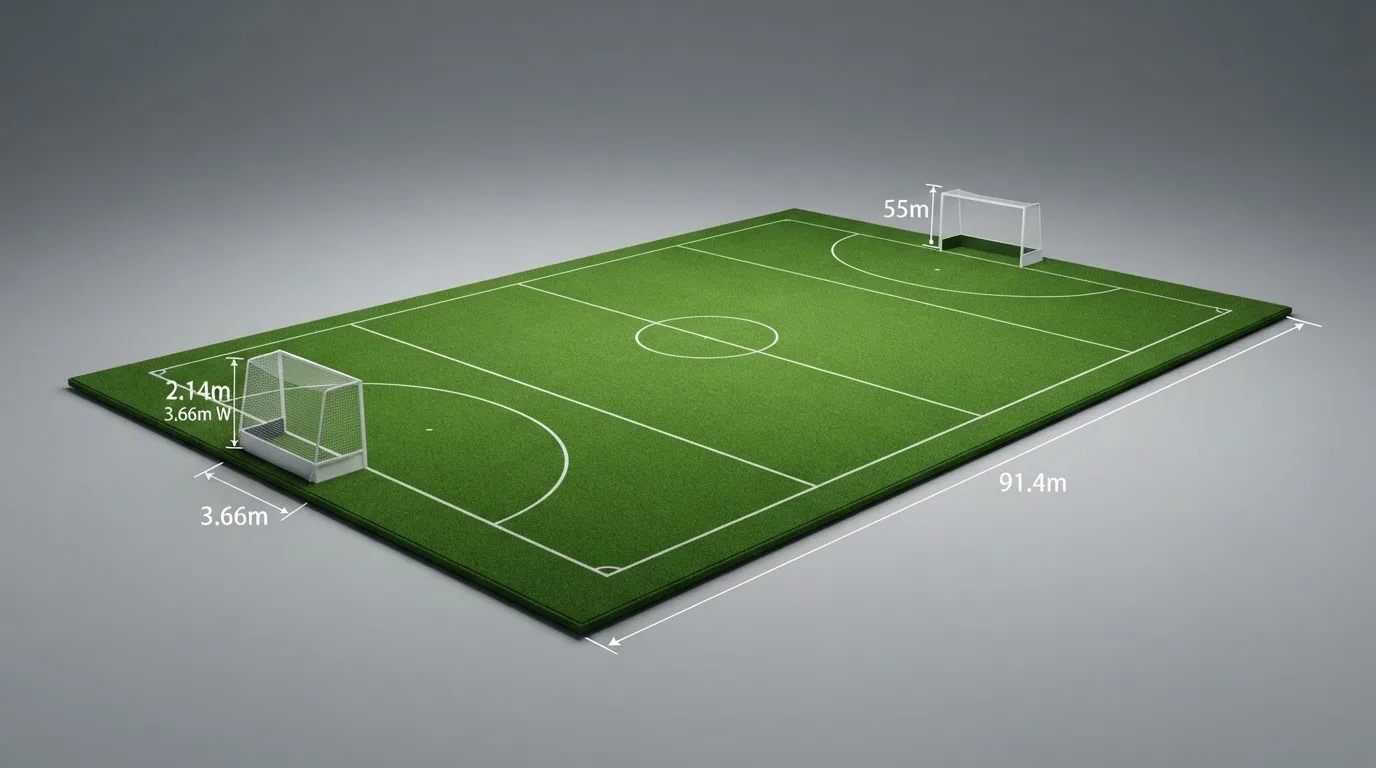
A field hockey side fields 10 field players and one goalkeeper, so each team has eleven players on the pitch. A field hockey pitch measures 91.4 m × 55 m, and each goal is 2.14 m high and 3.66 m wide. Matches are 60 minutes long, split into four 15-minute quarters with a 2-minute break after periods and a 15-minute half-time. Tied matches may stand, go to extra time or be decided by a penalty shoot-out depending on the competition; since March 2013 FIH regulations send tied classification matches directly to a shoot-out.
The sport’s modern form dates from the rule changes of recent decades. The four-quarter structure is a 2017 change; the shoot-out for tied classification matches is a 2013 FIH rule. Men’s field hockey was played at the 1908 and 1920 Olympics, dropped in 1924 and reinstated in 1928; women’s hockey was added in 1980. India dominated the early Olympic era — winning all five games at the 1928 tournament without conceding a goal, and gold in 1932–1956, 1964 and 1980 — and the sport’s international calendar still carries the weight of that history.
International and club calendars
The international calendar is built around FIH events: the Olympics, the FIH Hockey World Cup (men’s and women’s), the FIH Pro League and the continental championships (EuroHockey, the Asia Cup, the Pan American Games). The Pro League runs annually and offers regular-season fixtures that bookmakers price; the World Cup runs every four years and brings a heavier handle.
The club calendar is split along national lines. England’s Premier League runs through the autumn and spring; the Euro Hockey League brings together clubs from across the continent; the Indian Premier League and Hockey India League have moved in and out of the calendar over the years. The depth of the bookmaker’s field-hockey offering tracks the calendar — a heavy week in the FIH Pro League brings deeper markets and longer suspension lists, a quiet week brings the same six fixtures priced by a handful of operators.
What the schedule means for a tipster
A punter working the field-hockey calendar has to know which tournaments the bookmakers are pricing deeply and which are running on a thin book. The pre-World Cup window is the deepest, because the operators know the volume is there; the friendly in November is the shallowest, because the operators do not. A tip on a friendly two months out is a tip on a market that will look very different at kick-off, and the punter who treats it as a value bet is treating a price the trader has not finished writing as a finished price.
Top 10 UK bookmakers for field hockey 2026: who has the licence, who has the in-play
The ten bookmakers below hold a Gambling Commission remote licence for Great Britain — the test the Commission’s public register applies, and the only test this page applies. Each is reviewed against what its own terms state, what its site shows in-play and how its pricing discipline holds on a sport the trader is rarely going to lose sleep over.
| Brand | Gambling Commission remote licence number and licence holder | What the operator’s own terms state on the key’s subject |
|---|---|---|
| BetGoodwin | 002927-R-327985-008 — Goodwin Racing Limited | Pays Best Odds Guaranteed on UK and Irish horse and greyhound racing, up to £1,000. |
| Sky Bet | 067370-R-341330-005 — SBG Sports Limited | New customer offer: £30 in free bets after a £5 deposit and a first single or each-way bet of at least 5p at 1/1 or greater. |
| 10bet | 043173-R-322899-023 — Blue Star Planet Limited | Sportsbook covers football, tennis and horse racing with Cash out, Bet Builder and Live Streaming. |
| bet365 | 055148-R-331498-002 — Hillside (UK Sports) ENC | Offers in-play betting and live streaming worldwide, plus Bet Track, Match Live and a Live Golf Tracker for following bets in play. |
| Copybet | 053774-R-330743-010 — Copybet UK Limited | Pays Best Odds Guaranteed all day on UK and Irish racing, and pays first past the post on horse racing even if the winner is later disqualified. |
| BoyleSports | 039469-R-319383-025 — Boylesports Enterprise | Acca Insurance: opt-in, minimum stake £5, minimum odds 1/2, maximum refund £20 as a free bet expiring in 7 days; bets placed and settled on the same day. |
| Betmaster | 065699-R-339929-002 — BM Solutions GB Ltd | Holds a Gambling Commission remote licence for Great Britain and runs under the Betmaster.co.uk brand. |
| VBet | 044662-R-324273-022 — SCGO Limited | App offers Bet Builder, pre-match and in-play betting, live streaming and a live calendar with results and stats. |
| BetVictor | 039576-R-319370-028 — BV Gaming Limited | Best Odds Guaranteed on UK and Irish horse racing, enhanced live race streaming and a BetFinder feature. |
| Spreadex | 008835-R-104580-022 — Spreadex Limited | Regulated by the FCA for spread betting and by the Gambling Commission for fixed-odds betting; spread-betting losses can exceed the deposit; new customer offer of £60 in free bets for a £10 fixed-odds bet placed within 28 days of opening the account. |
How the licence works
Every operator in the table above holds a Gambling Commission remote licence for the categories stated on the public register. The Commission’s register is searchable by business name, trading name, domain or account number, and it is the only authoritative list of who is licensed in Great Britain. The licence covers real events (the category under which field hockey falls) and binds the operator to the Licence Conditions and Codes of Practice, the social responsibility code and the Remote Technical Standards.
The licence number is not a marketing badge. A Gambling Commission account number and the registered site it ties to are the test: a brand whose domain does not appear on the register, or whose licence has been suspended or revoked, is not a brand this page would name. The Commission has the power to revoke, and the public register reflects the current state of the licence, not the historical one.
How the comparison was built
The ten were chosen against three tests: a live Gambling Commission remote licence, a working sportsbook on the UK-facing product, and a meaningful field-hockey market (pre-match, in-play or both). The comparison above is the licensing position plus what the operator’s own terms state on the feature the operator leads with — for some that is racing (Best Odds Guaranteed), for some it is in-play streaming (live video), for some it is acca insurance on combination bets. The shape of an operator’s offer is what sets one apart from the other nine, and the comparison reflects that.
How field-hockey betting works in Great Britain: the regulatory frame
A bookmaker serving customers in Great Britain needs a Gambling Commission licence, and the licence comes with a list of conditions the operator must meet. The Gambling Act 2005 covers England, Scotland and Wales; Northern Ireland has its own separate regime and is outside the Act, so a “GB licence” is exactly that.
The Gambling Commission’s role
The Gambling Commission is a non-departmental public body sponsored by the Department for Culture, Media and Sport. It licenses operators, sets the LCCP conditions they must follow, runs the public register and enforces the rules. Since the Gambling (Licensing and Advertising) Act 2014 an operator whose remote facilities are used in Great Britain needs a Commission licence wherever the operator is based — a Curaçao, Maltese or Gibraltar licence is not a substitute. The licence categories are remote general betting standard (real events), remote general betting standard (virtual events), remote general betting limited, remote pool betting and remote betting intermediary (the exchange licence). Field-hockey markets fall under real events.
Identity, age and the first deposit
Every GB-licensed operator verifies name, address and date of birth before a customer can deposit or gamble. The rule has applied since 7 May 2019, including for free bets and bonuses: no anonymous play at a licensed site, no matter how small the wager. The minimum age is 18.
The verification is not a courtesy. It is a licence condition, and a brand that does not run it is not a brand the Commission has licensed for the real-events category. The Commission’s public register is the only place this gets verified against the public register; the slip on a betting app is the only place the punter sees it.
Credit cards, e-wallets and the payment frame
Credit cards are banned for gambling in Great Britain since 14 April 2020 (LCCP condition 6.1.2), including credit-card-funded payments through an e-wallet. Debit cards and bank-based payments are not covered by that ban. A punter who funds an account with a credit card — directly or via an e-wallet — is funding an unlicensed transaction at the licensed operator’s site.
Identity verification at the first deposit means the bookmaker has the customer’s name, address and date of birth before the first bet is placed. Source-of-funds questions at higher spend are normal under the money-laundering rules; a financial vulnerability check applies at deposits minus withdrawals over £150 in a rolling 30 days.
Advertising and the ASA
Advertising in Great Britain is not licensed by the Commission. It runs through the CAP Code (non-broadcast) and the BCAP Code (broadcast), enforced by the ASA, alongside the LCCP marketing conditions. CAP Code section 16: marketing must be socially responsible, must not be of strong appeal to under-18s, and no one who is or seems to be under 25 may be featured gambling or play a significant role. The rule concerns who may appear in the advertisement, not who may bet. A punter who is over 18 and on a licensed site is unaffected.
Promotion rules in force since 19 January 2026: wagering requirements on bonuses are capped at 10x (a £10 bonus at 50x needs £500 of bets; under the cap no more than £100), and mixed-product promotions are banned. Whether the cap applies to free bets with no wagering condition is not established.
Tax and what the punter actually pays
Betting winnings are not taxed on the punter in Great Britain. General Betting Duty is the operator’s tax on gross profits, currently 15%; a new remote betting rate of 25 % applies within it from 1 April 2027, while remote bets on UK horse racing, bets on self-service betting terminals in licensed premises, pool betting and in-person betting stay at 15 %. Until 1 April 2027 the remote rate stays at 15 %; whether operators pass duty on through odds is not established.
Offshore and unlicensed sites
Providing gambling facilities in Great Britain without the licence the Act requires is an offence under section 33 of the Gambling Act 2005 — aimed at the operator, not the customer. The customer’s loss is the loss of protection: no GAMSTOP coverage, no Commission complaints route, no approved dispute-resolution body, no British consumer redress if funds are withheld, not bound by the 10x bonus cap or the £150 vulnerability check. A punter on an unlicensed site is on a site the Commission has no authority over, and the brand’s “responsible gambling” page is whatever the brand chose to write.
Responsible gambling tools the licensed operators must offer
A GB-licensed operator carries a set of safer-gambling tools by licence condition, not by choice. GAMSTOP is the national multi-operator online self-exclusion scheme and a mandatory licence condition for online operators since 31 March 2020. The minimum period is six months, with options for one year, five years, or five years with auto-renewal. After the minimum period the exclusion stays in place for a further seven years unless the customer asks GAMSTOP to remove it.
Deposit limits, time-outs and self-exclusion
Operators must offer a gross deposit limit on a fixed time frame under RTS 12. The first changes have applied since 31 October 2025, a second phase was postponed to 30 September 2026, and whether the second phase is live is not established. The deposit limit is the customer’s choice — there is no state-set ceiling for betting — and a punter who wants a £50 weekly cap can set it on any licensed operator’s safer-gambling page.
Time-outs (cooling-off periods of 24 hours to several weeks) and self-exclusion (six months to five years) are also standard tools. A punter who self-excludes with one GB-licensed operator is added to the GAMSTOP register, and the exclusion applies across every operator covered by the scheme.
Financial vulnerability and the staged affordability checks
A financial vulnerability check (LCCP condition 3.4.4, in force since 30 August 2024) applies to licensed remote betting when a customer’s deposits minus withdrawals exceed £150 in a rolling 30 days (since 28 February 2025). It is a public-record check (for example bankruptcy or county court judgments), not an income check and not a credit reference check. The check flags risk; it does not block a deposit.
Financial risk assessments — the affordability checks of the press — are announced in a staged plan, with no start date. The Commission’s article of 7 July 2026 sets the direction; whether it is in force is not established. A punter who hears a brand is asking for payslips is hearing the firm’s policy ahead of any rule, not the rule.
Where to get help
Help is independent of the operator. GamCare runs the National Gambling Helpline; GambleAware funds treatment and education; the NHS runs gambling clinics across Great Britain; Gamblers Anonymous runs peer-support meetings. A punter who is betting more than they planned, chasing losses or hiding bets from family has crossed the line between entertainment and harm, and the path back starts with one of those four names.
Field hockey betting bonuses and free bets: what an offer really costs
Bonuses and free bets are marketed as gifts; the terms say otherwise. A “free bet” is a stake the bookmaker gives the customer, usually with the winnings paid but not the stake; a deposit-gated welcome offer is a bonus unlocked by a real-money deposit, usually with a wagering requirement that must be cleared before any winnings become cash.
Welcome offers and how the maths works
The Sky Bet welcome offer for new customers is £30 in free bets, credited as three £10 free-bet tokens after a deposit of at least £5 and a first single or each-way bet of at least 5p at odds of 1/1 or greater. The trigger is the qualifying bet; the reward is the tokens; the wagering condition is the odds floor and the deposit floor. A punter who deposits £5, places a £0.05 wager at 1/1 and wins has triggered the offer and received the tokens; a punter who deposits £5 and places a £0.05 wager at 4/6 has not, because 4/6 is below the 1/1 floor.
The Spreadex new-customer offer is £60 in free bets for a £10 fixed-odds bet, with the free bets usable across fixed odds and spread betting. The qualifying bet must be placed within 28 days of opening the account. The deadline is the cost of the offer — a punter who opens the account and waits 30 days has lost the tokens.
Free bets and the stake-not-returned rule
A free bet at 4.00 with a £10 stake returns £40 in profit, not £50. The £10 stake is the firm’s, and the firm keeps it. The expected value of a free bet is stake × (odds − 1) ÷ odds × payout share of the market, which on a healthy margin is roughly 60 to 70 % of headline. A £10 free bet at 4.00 on a market with a 95 % payout share has an expected value of about £10 × 0.75 × 0.95 ≈ £7.13. The £30 headline is £30 of nominal stake, not £30 of expected value.
Wagering requirements and the 10x cap
Promotion rules in force since 19 January 2026 cap wagering requirements on bonuses at 10x. A £10 bonus at 50x needed £500 of bets before the cap; under the cap no more than £100. The rule binds GB-licensed operators. A punter on an unlicensed site is on a site that has not signed up to the cap, and the wagering multiple is whatever the firm chose to write.
Acci insurance and the small-print detail
The BoyleSports Acca Insurance requires opt-in, a minimum stake of £5, minimum odds of 1/2 and pays a maximum refund of £20 as a free bet that expires in 7 days; bets must be placed and settled on the same day. The refund is a free bet, not a cash refund, and the maximum refund is £20. A punter who stacks a £25 acca and one leg lets them down has not triggered a £25 refund — they have triggered a £20 free bet that expires in a week. The 7-day expiry is the small print that costs the most when it bites.
Best odds guaranteed and the racing frame
Best Odds Guaranteed (BOG) is a racing product. BetGoodwin pays BOG on all UK and Irish horse and greyhound racing, up to £1,000; Copybet pays BOG all day, every day on UK and Irish racing; BetVictor pays BOG on UK and Irish horse racing. BOG pays the bigger of the price taken and the starting price, which is why it is a racing-only product — field hockey does not have an SP in the same sense.
How to read an offer before claiming it
Three questions a punter reads the small print for: what is the wagering requirement (and is there one at all); what is the minimum odds for a qualifying bet (1/2 is generous, 5/1 is steep); what is the expiry on the free bet or bonus (a week is faster than a month). A punter who answers those three before claiming is the punter who keeps the offer’s value; a punter who claims and reads later is the punter who lets the deadline pass.
Conclusion: what this all costs the punter
A field-hockey betting market is a thinner book than a football one, which is partly why the in-play margin is wider and the cash-out price is more trader’s-price than market-price. The two-way market at 1.90 / 1.90 carries a margin near 5 %, which is healthy for pre-match; the same market in-play will be wider, and the punter paying that wider margin is paying for the immediacy of the in-play feed. A tip that wins is a probability statement that came in; a tip that loses is a probability statement that did not. The bookmaker’s margin sits inside every price, and the punter’s edge, where one exists, is the gap between their read of the outcome and the implied probability the price carries. No tip is ever certain; no system wins forever; no model captures injuries, weather, umpiring and the moment a side decides it does not want to play. The honest framing is the one this page returns to: betting is entertainment with a price, and the punter who treats it that way is the punter who reads the small print, sets a deposit limit and stops at the limit.
Frequently asked questions
What is a value bet and why is no tip ever certain?
A value bet is a price whose implied probability, once the bookmaker’s margin is removed, is lower than the chance the punter assigns to the outcome. A side at 2.10 implies roughly 47.6 % before any margin is stripped out; a punter who prices the side at 55 % is looking at value. The “value” is the gap, and the punter’s job is to find it consistently, not occasionally. No tip is certain because a tip is a probability statement, not a forecast: a 1.50 favourite still loses roughly four times in ten, and a 1.10 shot still loses once in eleven. The bookmaker’s margin means a punter who always backs favourites loses in the long run.
What is the bookmaker’s margin and how can it be seen in the odds?
The margin is the share of every pound wagered that the firm expects to keep, calculated from the implied probabilities of all outcomes. A two-way market at 1.90 / 1.90 implies 52.6 % on each side, summing to 105.3 %; the overround is 5.3 %, and the payout share to bettors is 95.0 %. The narrower the overround, the fairer the price; a market at 1.70 / 2.20 carries a margin near 4.1 %, and a market at 1.95 / 1.85 carries a margin near 5.1 %. The margin is also a moving target — in-play prices carry wider margins than pre-match ones, because the trader is reacting to the same feed the punter is.
How is the return on a bet worked out from the stake and the odds?
A single bet’s return is stake × odds. A £10 wager at 1.90 returns £19, of which £9 is profit and £10 is the stake. A combination bet’s odds are the product of the legs — three legs at 2.00 / 1.50 / 3.00 combine into a 9.00 price, and a £5 stake returns £45. Net profit is the return minus the stake. The arithmetic is the same in fractional odds (a £10 wager at 5/1 returns £60 in total: £50 profit plus the £10 stake) and in decimal odds (a £10 wager at 6.00 returns £60 in total). Each format describes the same bet; the difference is how the price reads on a slip.
How can it be checked that a bookmaker holds a Gambling Commission licence?
The Gambling Commission runs a public register searchable by business name, trading name, domain or account number, and it is the only authoritative list of who is licensed in Great Britain. A punter who wants to check a brand enters the trading name or the domain in the register’s search and confirms the licence status. The Commission has the power to revoke, and the register reflects the current state of the licence, not the historical one. A brand whose domain does not appear on the register is not a brand the Commission has licensed for the real-events category.
Which tools for controlling play does a licensed bookmaker have to offer?
A GB-licensed operator carries GAMSTOP (the national multi-operator online self-exclusion scheme), deposit limits, time-outs, self-exclusion and a financial vulnerability check at deposits minus withdrawals over £150 in a rolling 30 days. GAMSTOP minimum periods run from six months to five years plus seven further years after the minimum unless the customer asks to be removed. The deposit limit is the customer’s choice; there is no state-set ceiling. Help is independent of the operator: GamCare runs the National Gambling Helpline, GambleAware funds treatment, the NHS runs gambling clinics and Gamblers Anonymous runs peer-support meetings.
US & other team sports – Cricket betting
Content created by the «Cricket betting» team
