
Online curling betting 2026
 Available in US
Curling sits in an odd corner of the British betting market. Every bookmaker serious about winter sport runs an in-play football feed you can read in your sleep, and most of them have a curling line tucked somewhere behind the hockey, the darts and the table tennis. A small, well-defined set of events draws a thin but real volume of bets, and the pages those bets sit on are mostly written for the casual viewer who wanders in from the Winter Olympics every four years. This guide is the longer answer. It walks through who takes the bet, what the margin on a curling market actually looks like, how the welcome offers on the major British-licensed apps settle against the sport, and which conditions quietly move the price back into the bookmaker’s pocket.

Data current as of 27 October 2026 and checked against the Gambling Commission’s public register.
The ten bookmakers on this shortlist
Ten brands feature in this comparison. Each one is listed on the Gambling Commission’s public register against a holder of a remote general betting standard (real events) licence, and each one is described below on the basis of its own published terms. The list is not a ranking: the brands are not in a size order, they are not in a recommended order, and a number next to a name is just the order in which they are reviewed below, not a score.

| Brand | Gambling Commission remote licence | Stated position on curling |
|---|---|---|
| Fitzdares | 000400-R-103839-030 (Fitzdares Limited) | The brand’s app lists in-play odds, accumulators, Lucky 15s and ante-post markets across horse racing, football, tennis, rugby, cricket, golf and American football; curling is not among the sports the app copy names, so the bettor checks the Wettprogramm at the time of the event |
| BetMGM | 039198-R-319450-029 (LeoVegas Gaming PLC) | Curling is not listed on the GB app description, so the bettor checks the in-app schedule for live events when the Winter Olympics or the World Curling Championships run |
| Kwiff | 044448-R-323408-017 (Eaton Gate Gaming Limited) | Curling is not in the app-store copy; the brand sells itself on a “surprise” stake-boost mechanic and curling lines appear only on selected events |
| Lottoland | 038991-R-319408-020 (EU Lotto Limited) | The brand’s app is built around lotteries, scratchcards and casino alongside a sports book; curling lines appear when an event is scheduled, with no separate “curling” tab |
| Midnite | 101839-R-342850-001 (Midnite Limited) | The brand’s site shows in-play events, an acca builder, popular accas and price boosts, and lists curling fixtures around the Winter Olympics and the World Championships |
| Octobet | 062545-R-337248-006 (Octopus Game Limited) | Curling is not named in the app-store copy, so the bettor checks the live schedule when an event is on |
| Unibet | 045322-R-324275-019 (Platinum Gaming Limited, Gibraltar) | Unibet has carried curling since the 2018 Winter Olympics on its in-play console; lines are typically match-winner, set winner and totals across the men’s and women’s draws |
| Fafabet | 057385-R-333191-006 (Taichi Tech Limited) | The brand’s app copy focuses on horse racing, football, tennis, basketball and American football; curling is not named, so the bettor checks the schedule on the day |
| Bet600 | 044731-R-323941-016 (Tyche Tech Limited) | Same as Fafabet: curling is not in the app-store copy and lines appear only when an event is scheduled |
| BetGoodwin | 002927-R-327985-008 (Goodwin Racing Limited) | The brand is horse-racing-first; curling is not named in the app copy and lines appear only when a curling event is on the schedule |
The right column needs reading the right way. A dash where the bookmaker’s own copy names curling is not a denial; it is a quiet shrug. A bookmaker can carry curling in its live console for a fortnight every February and never mention it in the marketing. The other side of the same coin is that an absence from the app description can be misleading too: a brand with a thin marketing team may list curling only inside the event page, hours before the first stone. The only honest check is the in-app schedule on the day of the match. What the table does show is which brands lean on which sports, and where curling sits in that lean.
Curling as a betting subject
A curling team has four players (two in doubles), and each player throws two of the team’s eight stones. That is the basic unit the markets are built on. An end ends when all sixteen stones have been thrown, and the team with the stone closest to the button scores one point for each of its own stones that is closer to the button than the opponent’s nearest stone. Only stones in the house count.
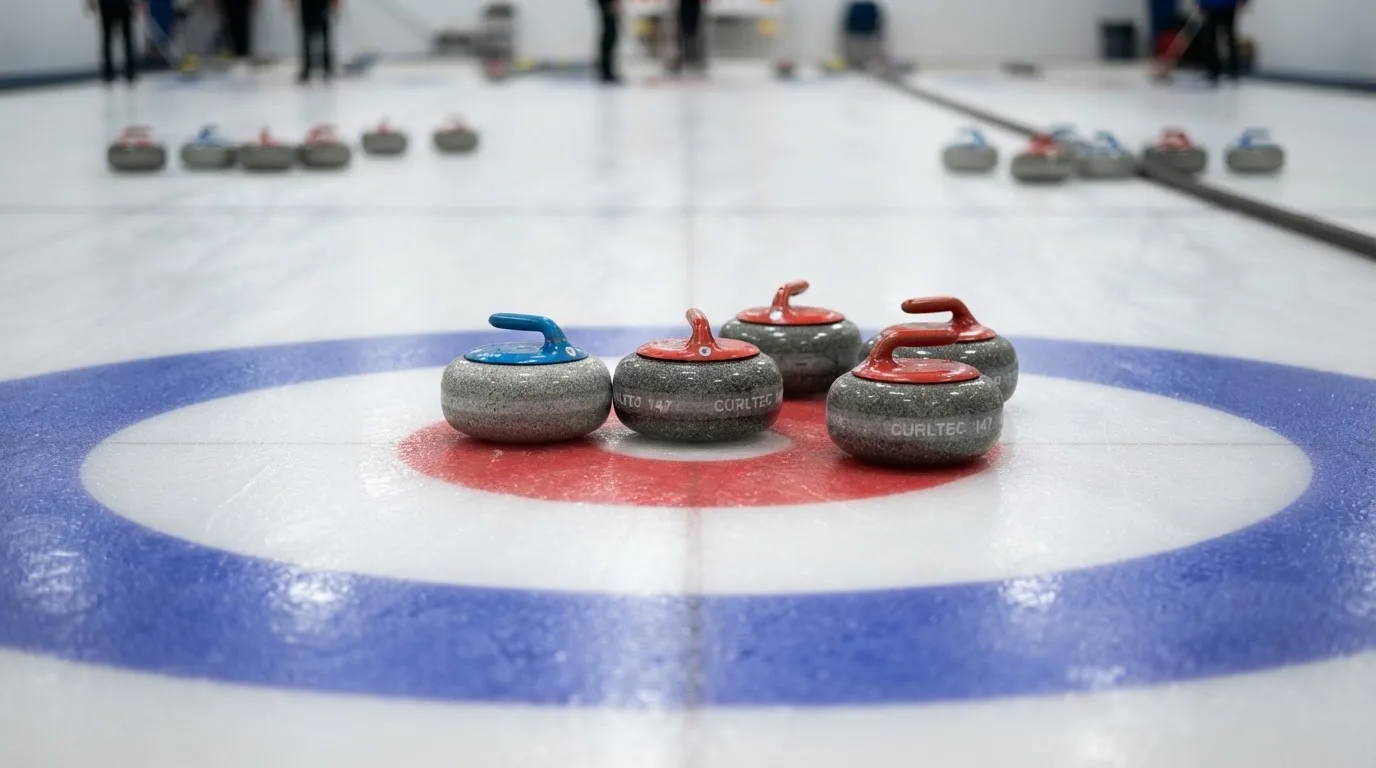
The game is short on goals and long on tension. Curling games usually last eight or ten ends, with international competitive games generally going to ten. Tied games go to extra ends, one at a time, until somebody scores. The hammer — the last stone of an end — is the strategic lever, and the hammer goes to the team that did not score in the previous end. If an end is blanked (no score), the hammer stays with the same team, which is why coaches will sometimes blank an end to keep the hammer into a more favourable one later.
Stones weigh between 17.24 and 19.96 kilograms under World Curling Federation rules. That figure sounds irrelevant to a betting line, but it is the reason the ice matters: a heavier stone curls less, and a sheet of ice that has been used for two hours behaves very differently from a sheet that has just been pebbled. Bettors who watch a lot of curling soon learn that the mid-session change in the ice is one of the things that makes live betting on the sport a different exercise from live betting on football.
Curling has been an official Olympic medal sport since the 1998 Winter Olympics in Nagano, and mixed doubles was first held at the Olympics in 2018. The Olympic cycle is the engine of most of the betting volume, with the World Men’s and World Women’s Championships running every spring. Outside those two windows the European Curling Championships, the Grand Slam of Curling on the World Curling Tour, and a handful of national opens carry whatever small line the major bookmakers have open.
How the markets are built
The shape of a curling market is set by the calendar. In the four weeks around the Winter Olympics, the major British bookmakers price every men’s and women’s match, and they carry match-winner, set winner, correct score after a given number of ends, total points, and an in-play board for each game. Outside the Olympics, the line is thinner: most bookmakers carry match-winner and total points on the World Championships, and a smaller number carry the same two markets on the European Championships. The Grand Slam of Curling on the World Curling Tour gets match-winner, sometimes set winner, and very rarely anything else.
The bookmaker’s margin sits inside every price, and on a curling line the margin is higher than the same bookmaker’s football margin. The arithmetic is the standard one. Take an illustrative two-way market at decimal odds of 1.90 against 1.90 — the kind of even-money line a bookmaker would publish for a tight match. The payout share of that market is 1 ÷ (1 ÷ 1.90 + 1 ÷ 1.90) = 0.95, so the margin is 1 − 0.95 = 0.05, or 5%. That is a usable working number, not a printed one. A real curling line on a real event will usually come back wider, and the wider the line the larger the margin, because the bookmaker is pricing a market with fewer opinions in it. A football match has dozens of betting models feeding into it; a curling match has one or two.
What this means for the punter is that a curling line is not a place to grind out value the way a sharp football bettor grinds Premier League totals. A single 5% margin across a 100-bet curling campaign gives back £5 of every £100 wagered in expectation, before any skill is added or lost. A 7% margin gives back £7, an 8% margin gives back £8, and a curling market with a thin book can run as high as 10% on the more obscure championships. The punter’s edge, if there is one, has to be larger than the margin, and the punter’s edge in curling is usually a question of who has the hammer and how the ice is running — both of which can change inside a single end.
Welcome offers and what they cost
The brands on this shortlist each run a sports welcome offer of their own, and each one carries its own set of conditions. The offers are described below as each brand’s own terms state them; the question of whether to claim one is the bettor’s, and the page does not recommend one over another. What the page does do is name the cost, in turnover and in minimum price, so the punter can read the offer with the page’s figures in hand.
The shape of a British sports welcome offer in 2026 is roughly this: the bettor deposits, places a first sports bet at a minimum price (usually evens, or 2.00 in decimal), and receives free bets in return. The free bets are usually time-limited to seven days, are paid as bet credits rather than cash, and have their own minimum price. Some offers refund the stake as cash; most do not.
BetMGM’s sports welcome offer, as its GB app description states it, gives four £10 free bets — two football accumulators of four or more selections and two sports multiples of two or more — to a new customer who deposits £10 or more and places a sports bet within seven days. The free bets are valid for seven days and carry a minimum price, and opt-in is required. The arithmetic is straightforward: a £10 deposit and a £10 qualifying bet unlock £40 in free bets, of which the bettor sees the winnings and not the stake if the free bet wins.
Midnite’s sports welcome offer, as the same source states, gives £25 in free bets and 50 free spins to a new customer who bets £5 or more on pre-match odds of EVS (2.0) or greater within fourteen days of sign-up. The free bets are valid for seven days. A £5 qualifying bet at minimum price 2.00 unlocks £25 in free bets, which is a 5x return on the qualifying stake. The free spins are a casino product and have no bearing on the curling question.
Unibet’s sports welcome offer, as the brand’s own UK homepage states, gives £40 in free bets to a new GB customer who deposits and bets £20 or more at minimum odds of 2.0 (1/1), using a debit card or instant bank transfer, with the free bets expiring within seven days of issue. A £20 qualifying bet at 2.00 unlocks £40 in free bets, which is a 2x return on the qualifying stake.
Octobet’s sportsbook welcome offer, as its GB app description states, gives 50% back as a free bet up to £50, plus a £10 casino bonus. A £100 qualifying bet at minimum price returns £50 as a free bet, capped at £50; a smaller stake returns a smaller free bet at the same 50% rate. The casino bonus is irrelevant to the curling question.
BetGoodwin’s sports welcome offer, as the GB app description states, gives £15 in free bets — a £5 sports bet, a £5 acca and a £5 Sub-Cover bet — for a £10 qualifying bet. The acca and Sub-Cover are sport-specific products and the punter reads the small print to see which sports qualify for which.
Fitzdares, Kwiff, Lottoland, Fafabet and Bet600 do not run a sports welcome offer of the kind the others run; each brand runs promotions in its own shape, and the bettor checks the in-app promotion page for the current one.
The pattern is a small qualifying bet, a minimum price that sits at or just above evens, a tight window to use the free bets, and a stake that is not paid back. The punter who claims the offer is paying a price for the free bets in the form of the qualifying bet’s expected loss — the qualifying stake times the margin of the market the qualifying bet sits on. On a market with a 5% margin, a £10 qualifying bet costs 50p in expectation; on a market with an 8% margin it costs 80p. The free bet, on the other hand, has its own expected value, which the punter can work out the same way.
The value of a free bet whose stake is not paid back is the free-bet amount times the odds minus one, divided by the odds, times the payout share of the market it sits on. On a £10 free bet at 3.00 on a market with a 95% payout share, the value is 10 × (3.00 − 1) ÷ 3.00 × 0.95 = £6.33. On the same free bet at 1.50, the value is 10 × (1.50 − 1) ÷ 1.50 × 0.95 = £3.17. The free bet is worth more the higher the price it sits at, up to a point, because the stake-not-paid-back haircut shrinks as a share of the return. The punter who takes a £10 free bet at 1.20 and wins is making £2, of which the bookmaker has not paid back the £10 stake, so the punter is up £2 on a free asset and the book’s expected value of the bet is closer to £1.67. The headline “£10 free bet” is a real £10 only when the odds it is taken at are long enough.
Best odds guaranteed and starting price
Two of the brands on this shortlist run Best Odds Guaranteed on horse racing, and the rule is the same on both. Fafabet, as its GB app description states, pays Best Odds Guaranteed on UK and Irish horse racing win and each-way bets from 9am on race days: if the starting price is bigger than the price the bettor took, the bet is paid at the bigger odds. Bet600, as the same source states, pays Best Odds Guaranteed on horse racing: if the starting price is bigger than the early or show price taken, the bet is paid at the SP. Best Odds Guaranteed is a horse-racing product and does not extend to curling. The reason it sits on this page at all is that the punter who is also betting on curling sometimes has the question in their head: does the brand’s price guarantee work on any sport? The honest answer is no, it does not.
The starting price — the SP — is itself a horse-racing concept. In curling the equivalent of the SP is the in-running price at the time the end begins, and the major bookmakers do not run a starting-price guarantee on curling. The punter takes the price on the screen at the moment the bet is placed, and that is the price the bet is paid at if it wins.
In-play and cash out
In-play betting on curling is offered by the larger British bookmakers for the bigger events — the Winter Olympics, the World Championships, the European Championships — and is not offered for the smaller events. The bookmaker’s in-play console prices the next end, the next stone, the next score, and the match result after a given number of ends, with the prices updating as the ends go by. In-play on curling is a different exercise from in-play on football, because the scoring is end-by-end and a blanked end is a real outcome; the punter who backs a team “to win the next end” has to understand the hammer.
Cash out is a separate product. The bettor can close a bet before the event ends, at a price the bookmaker sets in real time, and the price the bookmaker offers is the price the bettor takes. The Fitzdares app offers cash out, accumulators, Lucky 15s, specials and ante-post markets, with the in-play live odds the brand runs on its core sports; the cash-out function is the brand’s own, and the price it offers is not the same as the price the same bet would be worth on a betting exchange. The punter who wants a true second-price on an open curling bet goes to a betting exchange, where a backer can be matched against a layer at a price the exchange sets.
Bet builders and accumulators
Bet Builder+ is a bet365 product: it combines markets from one event into a single bet, available pre-match and in-play, with Winnings Boosts on Bet Builders and selected singles, and daily Bet Boosts. Curling is not named among the sports the product supports, so the punter who wants a curling bet builder checks the in-app event page on the day. Midnite runs an acca builder and price boosts, with maximum-stake limits on the boosts; the punter reads the small print for the boost cap before claiming.
An accumulator is a single bet whose price is the product of the prices of the legs. A four-fold accumulator on four matches at 1.80, 1.90, 1.70 and 2.10 prices at 1.80 × 1.90 × 1.70 × 2.10 = 12.21 in decimal terms. The return on a £10 stake is £122.10, the net profit is £112.10, and the margin on the accumulator is the cumulative margin of the four legs compounded into the single price. Acca insurance is a separate product: if one leg of an accumulator loses, the stake is refunded as a free bet. The terms on each operator’s acca insurance differ on the number of legs required (usually five or more), the minimum price of each leg, and the form of the refund (free bet rather than cash). The punter reads the small print.
How a winning bet pays back
The arithmetic is the same on every British bookmaker. The return is the stake multiplied by the odds. The net profit is the stake multiplied by the odds minus one. A £10 single at 2.50 returns £25, the net profit is £15, and the stake is included in the return. A £10 each-way bet is two £10 bets, one on the win and one on the place, with the place terms set by the race and the operator; the total stake is £20, and the return is the win bet plus the place bet, each at its own price. A £10 accumulator on four legs at 2.00, 2.50, 1.80 and 3.00 prices at 2.00 × 2.50 × 1.80 × 3.00 = 27.00, and the £10 stake returns £270. A £10 Lucky 15 is 15 bets of £10 each, totalling £150 in stakes, with the four singles, the six doubles, the four trebles and the four-fold accumulator, and at least one winning leg pays a consolation on some operators. The punter who plays the Lucky 15 reads the brand’s own terms for the consolation.
Fractional odds and decimal odds describe the same price. A 5/1 fractional is 5 ÷ 1 + 1 = 6.00 in decimal. An 11/4 fractional is 11 ÷ 4 + 1 = 3.75 in decimal. Evens is 1/1, which is 2.00 in decimal. An odds-on price (shorter than evens) has a fractional form less than 1/1 — 4/6, 1/2, 2/5 — and a decimal form between 1.00 and 2.00. The punter who reads a fractional line converts to decimal by dividing the first number by the second and adding one. The punter who reads a decimal line reads the price as it stands.
Identity, deposits and the offshore caveat
Every brand on this shortlist verifies the bettor’s name, address and date of birth before the first deposit can be made or the first bet can be placed, and that has been the rule since 7 May 2019. The bettor who has a free bet to claim goes through the same check, because a free bet is still a bet. Kalooki Sportsbook is licensed by the Gambling Commission under account number 57730 and is a GAMSTOP member; the rule that every licensed brand is a GAMSTOP member applies to the ten brands here as well.
Credit cards are banned for gambling in Great Britain since 14 April 2020, including credit-card-funded payments through an e-wallet; debit cards and bank-based payments are not covered by the ban. Spreadex is regulated by the Financial Conduct Authority for spread betting and by the Gambling Commission for fixed-odds betting, and the brand’s own homepage states that spread betting losses can exceed the deposit. Spread betting is a financial product, not a sports bet, and the punter who is looking at a spread bet on curling should know that the rules are the FCA’s, not the Commission’s.
A bookmaker licensed offshore — in Curaçao, in Malta, in Gibraltar without a Commission licence for the GB customer — is not a substitute for a GB licence. The 2014 Act made a Commission licence compulsory at the point of consumption, and providing gambling facilities in Great Britain without the licence the Act requires is an offence under section 33 of the Gambling Act 2005, on summary conviction up to 51 weeks’ imprisonment, a fine up to level 5, or both; six months in Scotland. The offence is aimed at the operator, not the customer. The customer who bets on an unlicensed site loses the GB protections: no GAMSTOP coverage, no Commission complaints route, no approved dispute-resolution body, no British consumer redress if funds are withheld, and not bound by the 10x bonus cap or the £150 financial vulnerability check. The honest framing is licensed equals checks, limits, GAMSTOP and the bonus cap, but also verification before the first bet; unlicensed equals none of those and possible loss of funds. Neither is the safe choice by default; the bettor reads the licence before staking.
The legal frame
The Gambling Commission licenses the whole British commercial betting market under the Gambling Act 2005, which covers Great Britain. Northern Ireland is outside the Act and runs its own older law; a GB licence does not regulate Northern Ireland. The 2014 Act made a Commission licence compulsory at the point of consumption, so a bookmaker whose remote facilities are used in Great Britain needs a Commission licence wherever it is based. The licence categories are remote general betting standard (real events), remote general betting standard (virtual events), remote general betting limited, remote pool betting and remote betting intermediary; the brands on this shortlist hold the first. The Commission’s public register is the whole test of who holds a licence, and the bettor who wants to check a brand searches by business name, trading name, domain or account number.
The minimum age is 18. Identity is verified before the first deposit. Since 7 May 2019 that rule has covered free bets and bonuses. A financial vulnerability check, in force since 30 August 2024, applies to licensed remote betting when a customer’s deposits minus withdrawals exceed £150 in a rolling 30 days (since 28 February 2025); the check is a public-record one (bankruptcy, county court judgments) and not an income or credit check. Financial risk assessments have been announced in a staged plan, with no start date, and the page writes that as “announced, staged, no start date” rather than “in force”. Deposit limits, on the operator’s side, are RTS 12: the operator must offer a gross deposit limit on a fixed time frame, with the first changes in force since 31 October 2025 and a second phase postponed to 30 September 2026.
The bonus cap is one of the more concrete rules. Since 19 January 2026 wagering requirements on bonuses are capped at 10x — a £10 bonus at 50x wagering, which would have required £500 of bets, is no longer offered; under the cap no more than £100 of wagering is required. Mixed-product promotions, an offer that requires gambling on two or more product types such as betting, casino, bingo and lottery, are banned. Whether the cap applies to free bets with no wagering condition is not established.
The player pays no tax on betting winnings in Great Britain; that is general information and not tax advice, and a professional gambler asks HMRC or an adviser. General Betting Duty is the operator’s tax on gross profits, currently 15%; from 1 April 2027 a new remote betting rate of 25% applies within it, while remote bets on UK horse racing, self-service betting terminal bets, pool betting and in-person betting stay at 15%. Whether operators pass duty on through odds is not established, and the page does not write that the player is charged duty. Spread betting has its own rates: 3% financial and 10% other.
Responsible gambling
GAMSTOP is the national multi-operator online self-exclusion scheme and a mandatory licence condition for online operators since 31 March 2020. The exclusion periods are six months, one year, five years, or five years with auto-renewal; after the minimum period the exclusion stays in place for a further seven years unless the customer asks GAMSTOP to remove it. GAMSTOP covers online sites and apps; the betting shop scheme is separate. Every GB-licensed online operator takes part.
Deposit limits are the customer’s choice. There is no state-set ceiling for betting. The operator’s terms on a £10 minimum deposit or a £100,000 maximum deposit are the brand’s own, and the bettor who wants a cap sets one with the brand or with a banking tool. The bettor who wants to step back sets a timeout with the brand, or self-excludes through GAMSTOP. The bettor who is in trouble contacts GamCare on the National Gambling Helpline, or GambleAware, or an NHS gambling clinic, or Gamblers Anonymous. The bettor in Northern Ireland uses the same national services, plus the Northern Ireland-specific ones, and reads the Northern Ireland page on those services’ sites.
The bookmakers, one by one
The ten brands are reviewed below. Each review ends on a verdict that is the page’s own judgement of the brand, on the basis of the facts above.
Fitzdares — premium bookmaker with a thin curling line
Fitzdares is the kind of bookmaker that prices itself for the high-end punter. The Fitzdares app offers cash out, accumulators, Lucky 15s, specials and ante-post markets on horse racing, football, tennis, rugby, cricket, golf and American football, with in-play live odds. Curling is not on the list the app copy names, so the bettor checks the schedule on the day. The brand is licensed under account 400 (Fitzdares Limited), and the punter who wants to verify checks the Commission register.
The verdict is short. Fitzdares is a strong fit for a bettor who wants a premium bookmaker with a deep horse-racing book and an in-play console, but less ideal for someone focused solely on curling. The brand is not the right place to come for the World Curling Tour, and the punter who is shopping for the Winter Olympics checks the schedule a fortnight before the first stone.
BetMGM — US-facing brand with a GB sportsbook
BetMGM is the British arm of the US brand, and the GB app description gives a four-part free-bet welcome offer on a £10 deposit and a £10 qualifying bet: two football accumulators of four or more selections and two sports multiples of two or more, each worth £10, valid for seven days. The brand is licensed under account 39198 (LeoVegas Gaming PLC). LeoVegas is the parent; the brand is BetMGM in the British market. Curling is not in the GB app description, so the bettor checks the in-app schedule on the day of the event.
The verdict is that the welcome offer is on the modest end of the British market — £40 in free bets for a £10 qualifying bet is a 4x return, against Unibet’s 2x and Midnite’s 5x — and the curling line is the kind that comes and goes with the calendar. The brand is a reasonable choice for a bettor who is also playing the casino product and wants a single wallet for both, but curling is not its primary focus. The parent is a Swedish-listed company, and the GB brand is the British-facing piece of it.
Kwiff — surprise stake-boost bookmaker
Kwiff is the brand that sells itself on a “surprise” stake-boost mechanic: the punter places a bet, and the brand boosts the stake by an unknown factor, with the maximum stake on the boost shown in the bet slip. The brand is licensed under account 44448 (Eaton Gate Gaming Limited). The app has a 17+ age rating on the App Store, which is the British rating for a gambling product. Curling is not in the app-store copy, so the bettor checks the schedule on the day.
The verdict is that the surprise stake-boost is a quirky product and the punter who likes the quirk will like the brand; the punter who wants a normal price on a normal line will find the brand awkward to read. The curling line is a thin one and the brand is the wrong place to come for the World Curling Tour. The app does not display a fixed welcome offer, so check the promotions page for the current deal.
Lottoland — lottery, casino and a sports book
Lottoland is built around lotteries, scratchcards and casino, with a sports book attached. The brand is licensed under account 38991 (EU Lotto Limited). The brand is a bet on the outcome of foreign lotteries as its main product, with the sports book running alongside. Curling lines appear when an event is scheduled, with no separate “curling” tab.
The verdict is that the brand is a strong fit for a bettor who wants lottery betting and a sports book in one wallet, though it is not a primary destination for curling enthusiasts. The sports book is a smaller piece of the product, and the punter who is shopping for the World Curling Tour will find a thinner line here than at the dedicated sports books. The bettor who is shopping for the Winter Olympics will find a line, and the welcome offer (if any) is read on the day.
Midnite — esports-first bookmaker with a curling line
Midnite started as an esports bookmaker and has built a general sports book around it. The brand’s site cites Gambling Commission licence 101839, and the app offers in-play events, an acca builder, popular accas and price boosts with maximum-stake limits. Curling fixtures are listed around the Winter Olympics and the World Championships, and the brand is one of the better places on the shortlist to come for a curling line. The welcome offer, as the GB app description states, gives £25 in free bets and 50 free spins to a new customer who bets £5 or more on pre-match odds of EVS (2.0) or greater within fourteen days of sign-up, valid for seven days. The £5 qualifying stake is the lowest on the shortlist.
The verdict is that Midnite is the strongest fit on this shortlist for a bettor who wants a curling line as part of a general sports book, and the welcome offer is a 5x return on the qualifying stake, which is the highest on the shortlist. The brand’s esports roots mean the in-play console is built for fast markets, and the curling line benefits from the same build. The brand publishes its own bonus terms, and the new customer reads them carefully before signing up.
Octobet — newer brand with a refund welcome offer
Octobet is a newer British-facing brand, and the GB app description states a sportsbook welcome offer of 50% back as a free bet up to £50, plus a £10 casino bonus. The brand is licensed under account 62545 (Octopus Game Limited). The brand is on the Commission’s register under that name, and the bettor who wants a second check searches the register by the licence number. Curling is not in the app-store copy, so the bettor checks the schedule on the day.
The verdict is that the refund welcome offer is a different shape from the standard free-bet welcome offer: the punter gets a free bet if the first bet loses, rather than free bets for placing a first bet, and the upside depends on the first bet losing. The punter who likes the refund shape will like the brand; the punter who wants a guaranteed free bet will find the shape unfamiliar. The curling line is a thin one and the brand is the wrong place to come for the World Curling Tour.
Unibet — established European brand with a long curling history
Unibet has been operating since 1999, and the UK site is run by Platinum Gaming Limited, Gibraltar, under Gambling Commission account 45322. The brand has carried curling since the 2018 Winter Olympics on its in-play console, and the curling line is typically match-winner, set winner and totals across the men’s and women’s draws. The welcome offer, as the brand’s own UK homepage states, gives £40 in free bets to a new GB customer who deposits and bets £20 or more at minimum odds of 2.0 (1/1), using a debit card or instant bank transfer, with the free bets expiring within seven days of issue.
The verdict is that Unibet is the strongest fit on the shortlist for a bettor who wants a curling line as part of a deep general sports book, and the welcome offer is a 2x return on the qualifying stake, which is on the modest end of the shortlist. The brand’s European roots mean the in-play console is built for the European winter sports calendar, and the curling line benefits from the same build. The minimum odds condition of 2.0 (1/1) applies, and the full terms are on the homepage.
Fafabet — horse-racing-first bookmaker with Best Odds Guaranteed
Fafabet’s GB app copy focuses on horse racing, football, tennis, basketball and American football, with a Best Odds Guaranteed offer on UK and Irish horse racing win and each-way bets from 9am on race days. The brand is licensed under account 57385 (Taichi Tech Limited). The bettor who wants to confirm this can search the register by the licence number.
The verdict is that Fafabet is a high-performing choice for those seeking a horse-racing-first bookmaker with Best Odds Guaranteed, but curling fans should look elsewhere. The Best Odds Guaranteed is a horse-racing product and does not extend to curling.
Bet600 — same shape as Fafabet
Bet600 is the same shape as Fafabet: horse-racing-first, with Best Odds Guaranteed on horse racing — if the starting price is bigger than the early or show price taken, the bet is paid at the SP. The brand is licensed under account 44731 (Tyche Tech Limited).
The verdict is the same as Fafabet’s. The brand is a strong fit for a bettor who wants a horse-racing-first bookmaker with Best Odds Guaranteed, though curling is not a central offering.
BetGoodwin — another horse-racing-first bookmaker
BetGoodwin is horse-racing-first, with a sports welcome offer of £15 in free bets — a £5 sports bet, a £5 acca and a £5 Sub-Cover bet — for a £10 qualifying bet. The brand is licensed under account 2927 (Goodwin Racing Limited).
The verdict is that the brand is a reasonable fit for a bettor who is already on Goodwin for the racing and wants a small free-bet sweetener on the sports book, but is not the best destination for year-round curling betting. The Sub-Cover bet is a sport-specific product and the bettor reads the small print for which sports qualify.
The margin in plain prose
The bookmaker’s margin is what the bookmaker keeps of every unit bet on a market. The arithmetic is the same on every sport. Take an illustrative two-way market at decimal odds of 1.90 against 1.90. The payout share of that market is 1 ÷ (1 ÷ 1.90 + 1 ÷ 1.90) = 0.95, so the margin is 1 − 0.95 = 0.05, or 5%. That is a working number, not a printed one. A real curling line on a real event will usually come back wider, in the band of 5% to 10% depending on the bookmaker and the event, and the wider the line the larger the margin.
The punter can read the margin off any two-way market by dividing 1 by the decimal odds, adding the two reciprocals, dividing 1 by the sum, and subtracting from 1. On a curling match at 1.85 against 2.00, the payout share is 1 ÷ (1 ÷ 1.85 + 1 ÷ 2.00) = 0.957, and the margin is 0.043, or about 4.3%. On the same match at 1.70 against 2.20, the payout share is 1 ÷ (1 ÷ 1.70 + 1 ÷ 2.20) = 0.942, and the margin is 0.058, or about 5.8%. The punter who wants a sharper line finds a bookmaker whose curling line is tighter, and accepts that tighter is rarer than wider.
The punter who is clearing a bonus pays a price in the form of the qualifying bet’s expected loss. The expected cost is the qualifying turnover times the margin of the market the qualifying bet sits on. On a £100 qualifying turnover at a 5% margin, the expected cost is £5; at a 7% margin, the expected cost is £7; at a 10% margin, the expected cost is £10. The free bet, on the other hand, has its own expected value, which the punter can work out the same way. The headline “£10 free bet” is a real £10 only when the odds it is taken at are long enough to outweigh the stake-not-paid-back haircut.
Frequently asked questions
How do you bet on curling?
Pick a licensed bookmaker from the Commission’s public register, deposit, verify your identity, and find the curling event in the schedule. The standard markets are match-winner, set winner, total points and an in-play console for the bigger events. Place the bet, watch the end-by-end scoring, and the bet settles when the event ends, with tied games going to extra ends.
Can you bet on curling in Great Britain?
Yes, on a Gambling Commission-licensed bookmaker. There is no statutory list of permitted sports, so curling is offered at the operator’s discretion, and the line is thinnest outside the Winter Olympics, the World Championships and the European Championships. The bettor checks the in-app schedule on the day of the match.
How do you check that a bookmaker holds a Gambling Commission licence?
Go to the Commission’s public register and search by business name, trading name, domain or account number. The register shows the licence category, the holder’s name, and the trading names the holder is licensed for. A match between the brand’s marketing name and the register is the whole test; the bettor who finds no match treats the brand as unlicensed.
How is the return on a bet worked out from the stake and the odds?
The return is the stake multiplied by the decimal odds. On a £10 single at 2.50, the return is £25, the net profit is £15, and the stake is included in the return. The same arithmetic applies to a leg of an accumulator, with the leg price multiplied by the prices of the other legs into a single accumulator price.
What is the bookmaker’s margin and how can it be seen in the odds?
The margin is what the bookmaker keeps of every unit bet on a market. On an illustrative two-way market at 1.90 against 1.90, the payout share is 0.95 and the margin is 0.05, or 5%. The punter can read the margin off any market by dividing 1 by each price, adding the reciprocals, dividing 1 by the sum, and subtracting from 1; the wider the line, the larger the margin, and a curling line is usually wider than a football line.
How do fractional odds such as 5/1 convert to decimal odds such as 6.00?
Divide the first number by the second and add one. A 5/1 fractional is 5 ÷ 1 + 1 = 6.00 in decimal. An 11/4 fractional is 11 ÷ 4 + 1 = 3.75. Evens, written 1/1, is 2.00. An odds-on price (shorter than evens) is a fractional form less than 1/1, and a decimal form between 1.00 and 2.00.
Tennis, darts & cue sports – Cricket betting
Content created by the «Cricket betting» team
