
Online hurling betting in 2026: what each market and offer really costs
 Available in US
Hurling sits in a small corner of British bookmaking. It is one of the GAA’s two field games, played by fifteen-a-side teams over seventy minutes, with a goal worth three and a point over the crossbar worth one. The sport is most visible in the Championship weeks, when the All-Ireland Senior Hurling Championship takes over the calendar — Limerick beat Galway in the 2026 final at Croke Park on 19 July 2026 — and slips back to a thinner menu for the rest of the year. That shape, a fat peak in summer and a thin shelf around it, sets the price the punter pays for almost every other choice on this page: which markets get priced at all, how many events sit on a Tuesday coupon, what the in-play feed looks like between provincial rounds.

Current as of 27 October 2026 against the Gambling Commission’s public register of remote operating licences.
How live hurling markets price the whistle
The most expensive thing about live hurling betting is what it costs when there is no hurling on. British bookmakers price in-play markets continuously for football, horse racing and tennis. Hurling gets in-play coverage only when there is a fixture worth pricing — championship weekends, club All-Ireland days, and the bigger League games. Outside those windows the “live” tab exists, the section is built, and the events are not there. A reader who treats in-play as a year-round product overpays for it by accepting whatever the bookmaker happens to be showing.
Within a live match, the in-play price carries the same margin as the pre-match price. The mechanism is identical: a bookmaker takes each outcome of one market, prices it, and the difference between the true probability and the implied probability is the bookmaker’s take. Live trading simply runs that calculation again after every score, because a goal is worth three and a point is worth one, and a one-goal swing changes the price of every market on the same match at the same moment. The reader is not buying “live” as a category — they are buying a margin on every update, and the update is what costs.
Cash out compresses the same mechanism into a single decision. When the bookmaker offers a cash-out figure, that figure is a price for the bet at that moment — usually tighter than the price available by backing the other side, because the bookmaker keeps a slice for closing the position. The cost of cashing out a winning accumulator before the last leg is built into the figure on screen. It is not a refund; it is a buy-back at the bookmaker’s price. The punter pays the spread between what their bet would pay at full settlement and what cash out offers now, and that spread is wider on long-acca positions than on singles.
Sporting Index runs an auto cash-out option alongside its fixed-odds and spread products — the bettor can set rules and let the bookmaker settle the position without them clicking. Midnite shows in-play events alongside its acca builder and price boosts; bet365 carries Bet Track, Match Live and live streaming across its sportsbook, which means the live picture of a match sits next to the price the punter is being asked to take. Sky Bet settles Gaelic games on the official result at the end of normal time including injury time, with extra time not counting unless the market states otherwise — a settlement rule that decides what the live price actually pays for.
The lesson of the live section is mechanical: live betting on hurling costs the same fraction of every pound as pre-match betting, but it costs that fraction more often, because every score and every minute price is a fresh margin-bearing decision. The punter who treats live as a way to “save” the cut they had before the goal is paying for the bookmaker’s hedging in the form of a worse price. The punter who treats live as a way to back a faster edge after seeing something on the pitch is paying the same margin they always paid, on a bet they would not have made from a pre-match price.
Bet types and how the odds carry each one
A hurling match produces a small family of markets. Match result — home, draw, away. Score markets — total points, total goals, winning margin. Player markets where the bookmaker lists them. Outright markets on the championship, the provincial title, the league, and a smaller book on club All-Ireland ties. Each market carries its own margin, and the margin is what decides how much of every pound the punter gets back.
A single is one selection, settled alone. A double is two, settled together, the prices multiplied into one. A treble is three, a fourfold four, and the accumulator the British punter calls an “acca” extends the chain. Each leg multiplies the price, which is why a five-fold acca at four short prices looks enormous on the slip and pays out like the bookmaker’s margin multiplied five times. Sky Bet’s free bets are usable on singles and each-way markets but not multiples — a restriction that exposes how the operator values a price it has already taken.
Each-way is two equal bets: one on the win, one on the place. The stake the punter pays is doubled. Place terms vary by event and by operator; the punter reads them on the betting slip because a Rule 4 deduction, a non-runner or a reduced field changes the place fraction. Each-way is the right structure for outright hurling markets where the team at long odds can finish in the top three or top four, and it is the wrong structure for a Saturday match-winner because hurling rarely has more than one winner at full time.
A bet builder combines markets from one event into one bet — match result, total points, the team to score first, all from the same fixture. bet365’s Bet Builder+ runs that combination pre-match and in-play, and the price the punter sees is the multiplied price minus the bookmaker’s combined margin. The cost of a bet builder is that the bookmaker holds every leg at once and prices the correlation, so a popular builder on the favourite to win and over 10 a sum of points prices tighter than either leg alone would suggest. The punter pays for the convenience of one slip.
Margins on hurling markets sit where margins on niche sports usually sit: a little wider than football, considerably tighter than outright novelties, and not as tight as Premier League match result. A two-way market priced 1.90 / 1.90 — the same on both sides, fractional 9/10 — implies a payout share of about 52.6% and a margin of roughly 47.4%, spread evenly across the two outcomes. A bookmaker who prices 1.85 / 1.95 on the same two-way market keeps about 5% of every pound bet on the match. Three-way markets on the match result, with home, draw and away, take more margin because the bookmaker is pricing an outcome that rarely lands. Hurling championship outrights are thinner still — a bookmaker pricing the field at the start of the summer will hold a margin closer to a tenth on every pound, because each team is a long shot and the favourite’s true probability is small. The fraction that does not come back to the punter is the price of the market.
Payout is straightforward: return = stake × odds, net profit = stake × (odds − 1). On a £10 single at 3.50 the return is £35 and the profit £25. On a £5 accumulator with three legs at 2.00, 3.00 and 4.00 the return is £120 and the profit £105. The arithmetic does not change with the sport or the market — what changes is the price the punter is offered at the moment they click, and that price already carries the margin.
Fixtures, tournaments and the calendar the bookmaker prices against
The bookmaker’s year on hurling divides into three stretches. The first runs from January through to the provincial rounds of the All-Ireland Senior Hurling Championship — league fixtures, early championship group games, a book on the Division 1 and 2A leagues. The second covers the provincial finals, the All-Ireland quarter-finals, and the All-Ireland semi-finals in June and July. The third runs from the All-Ireland final through to the club championship in the autumn and the new league in the new year. Limerick beat Galway in the 2026 All-Ireland Senior Hurling Championship final at Croke Park on 19 July 2026, and Tipperary won the previous year’s title.
The Championship structure in 2026 has six Leinster teams and five Munster teams, each in a round-robin group; the top two in each province meet in a provincial final, the third-placed team goes to the All-Ireland quarter-finals. That shape is what produces the markets: a round-robin phase with three or four fixtures per team, a knockout phase that narrows from there, and a final. The bookmaker’s market count follows the calendar. The Leinster and Munster championships produce round-robin markets in May and June; the All-Ireland series produces knockout markets in July; the club championship produces a smaller book in the autumn. A punter who shops for a price on the Leinster final in March will find few; a punter who shops for the All-Ireland quarter-finals in late June will find more.
The club championship adds a separate shelf. The All-Ireland Senior Club Hurling Championship runs from October through to St Patrick’s Day, with county champions competing in provincial rounds and the All-Ireland final closing the season. The bookmaker’s club book is thinner than the inter-county book — fewer teams priced, fewer markets per match — and the margin is correspondingly wider. A punter who wants a price on a county championship match in late spring often finds no bookmaker carries it at all.
League hurling runs from February through to the spring. The Allianz Hurling League structures its divisions so that Division 1 carries the strongest teams, with promotion and relegation across the divisions. Bookmakers price League matches as exhibition matches — the margins are wider, the markets thinner, and the volume of betting lower than championship weekends. The punter pays for this in two ways: a wider margin on whatever matches are priced, and the absence of a book on most of the rest.
Outright markets sit outside any single fixture. The All-Ireland Senior Hurling Championship winner, the provincial winners, the league winners, the All-Ireland club championship winner — each is priced as a single market with every team in the field. The margin on these markets is the widest margin the punter pays on hurling: a long field at long odds, with the favourite’s true probability small and the tail of weak teams padded out. The punter who backs the favourite pays for the bookmaker’s risk on the rest of the field; the punter who backs a long shot pays the wider margin that comes with a thin book.
The fixture shelf is the operating constraint of the whole page. Markets, in-play, cash-out, bet builder, accumulators — every product the punter buys from a British bookmaker on hurling — exists in the shape the fixture calendar gives it. The bookmaker does not price a market no one will bet on, and the fixture calendar decides what the punter pays to bet on.
The licensed bookmakers and how each one is set up
The comparison that follows is built from the Gambling Commission’s public register of remote operating licences for Great Britain, against each operator’s own published terms. A place on this list is a GB licence, not a recommendation; no single brand is “the only” licensed one, and the rank order is editorial, not regulatory. The bookmakers examined in detail below are VBet, Sporting Index, Hollywoodbets, BetGoodwin, bet365, Bet Ahoy, Paddy Power, Geoff Banks, Sky Bet and Matchbook — ten holders of a Gambling Commission remote general betting standard licence for real events, each describing its own product on its own terms.
The comparison is built around four matters: the Gambling Commission remote licence number and the licence holder named on the register, and what each operator’s own terms state on the key subject of this page. The licence detail is the test of who may lawfully take a bet from a customer in Great Britain. The terms column is the test of what each bookmaker actually offers on hurling — markets, in-play, bet builder, settlement rules — because no comparison can be built without each side’s own statement.
| Brand | Gambling Commission remote licence | Licence holder | What the operator’s own terms state |
|---|---|---|---|
| VBet | 044662-R-324273-022 (account 44662) | SCGO Limited | Sports welcome offer is a £10 free bet if a verified new customer stakes £10 or more on a first-ever bet that loses |
| Sporting Index | 027343-R-308898-011 (account 27343) | Sporting Index Limited | Lets customers switch between fixed odds and spread betting, with in-play betting, Bet Builder for football, auto cash-out and Multi-Markets |
| Hollywoodbets | 053028-R-330019-013 (account 53028) | Hollywoodbets International UK Limited | New players depositing £10+ by card get stake back as a free bet up to £30 on first qualifying losing accumulator (£10+, 3+ legs, odds 4/1+, settled within 7 days); one free bet per customer |
| BetGoodwin | 002927-R-327985-008 (account 2927) | Goodwin Racing Limited | Sports welcome offer is “Bet £10 & Get £15 in Free Bets”, made up of a £5 sports bet, a £5 acca and a £5 Sub-Cover bet |
| bet365 | 055148-R-331498-002 (account 55148) | Hillside (UK Sports) ENC | Bet Builder+ (pre-match and in-play), Super Boosts, Winnings Boosts on Bet Builders and selected singles, daily Bet Boosts, in-play betting and live streaming of events worldwide, plus Bet Track, Match Live and a Live Golf Tracker; UEFA Champions League global betting partner; the most downloaded sports betting app in the UK |
| Bet Ahoy | 100094-R-341742-003 (account 100094) | Bet Ahoy Ltd | Welcome offer is “Bet £10 & Get £10 in Free Bets”, made up of a £5 sports bet and a £5 acca |
| Paddy Power | 039439-R-319330-013 (account 39439) | PPB Counterparty Services Limited | Paddy Power Sports Betting app covers football, horse racing, boxing, rugby, tennis, golf, darts, snooker and F1 |
| Geoff Banks | 054095-R-330366-010 (account 54095) | GB Sports Advisors Limited | Live in-play prices and ante-post prices on future events |
| Sky Bet | 067370-R-341330-005 (account 67370) | SBG Sports Limited | Gaelic games settle on the official result at the end of normal time including injury time; extra time does not count unless stated otherwise |
| Matchbook | 039504-R-319407-024 (account 39504) | Triplebet Limited | A betting exchange where customers bet against other users, with Bet Builder, multiples, in-play betting and live streaming of horse racing and greyhounds |
The shape of the comparison is the shape of the market. Eight of the ten brands run fixed-odds sportsbooks; two — Sporting Index on the spread-betting side and Matchbook as an exchange — run a different mechanism. The eight fixed-odds brands share most of the same products in form, but their terms differ enough that the punter reads each before staking. Sporting Index’s regulatory split between the Financial Conduct Authority for spread betting and the Gambling Commission for fixed-odds betting is the part the comparison carries plainly, because the spread side carries a risk spread betting does not — losses that exceed the deposit — that the fixed-odds side does not.
Bet Ahoy’s hurling coverage is reported in listings only, not as a confirmed product feature; the comparison reads the welcome terms only.
The fundamentals every punter on hurling needs
A hurling match is played by two teams of fifteen players over seventy minutes, in two halves of thirty-five minutes, governed by the Gaelic Athletic Association (GAA). The pitch is longer and wider than a football pitch; the goal is the same shape as a football goal, with a crossbar above which a point is scored and into which a goal is scored. A goal is worth three points, a point over the crossbar is worth one point, and the score is recorded as goals-points, with the totals combined. Limerick 2-18 Galway 1-14, the 2026 All-Ireland final, is six points clear on the scoreboard.
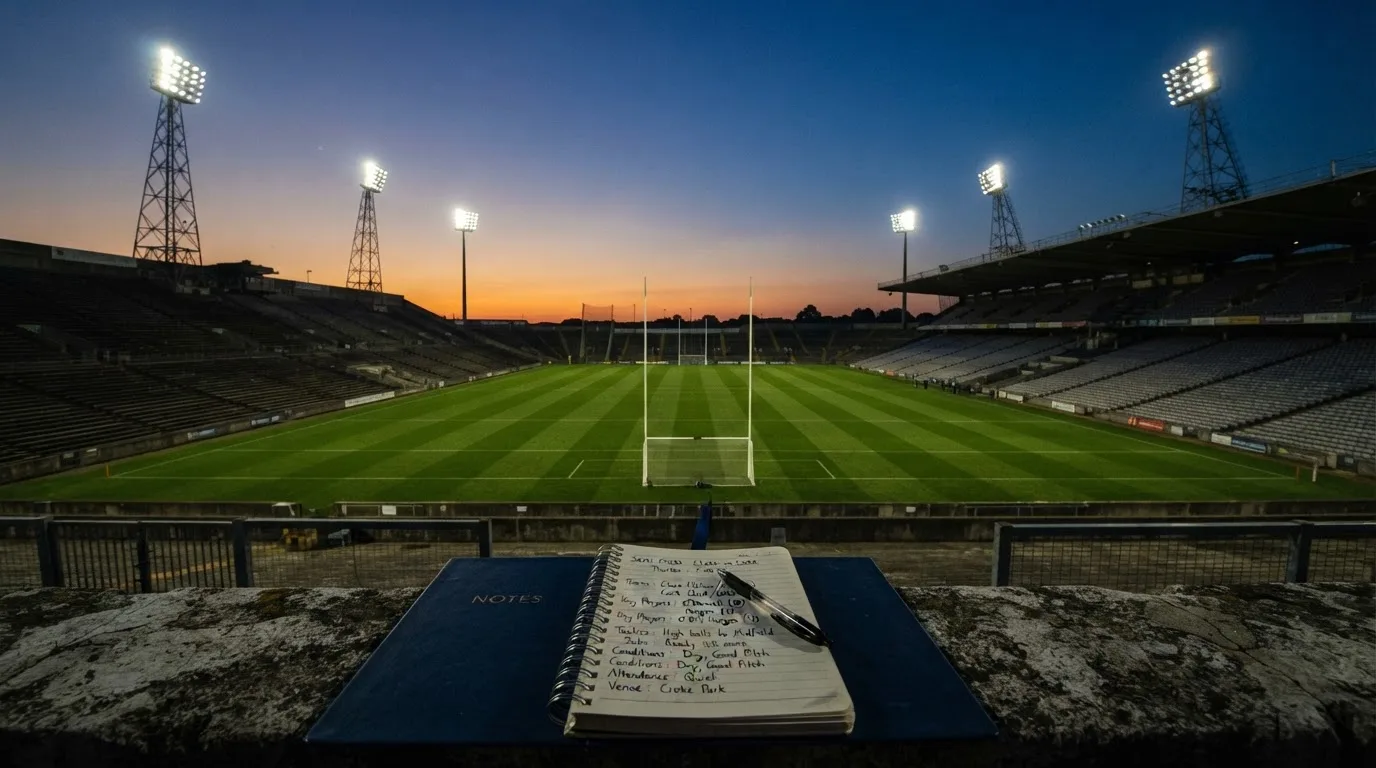
The settlement rule for Gaelic games at one GB bookmaker settles bets on the official result at the end of normal time including injury time, with extra time not counting unless the market states otherwise. That rule is the punter’s protection on the markets that run across normal time and extra time — replayed fixtures, drawn championship matches that go to extra time — and the punter checks it on the betting slip. A market that says “including extra time” prices the longer match; a market that says “result after normal time” prices the seventy minutes.
The Championship structure is round-robin at provincial level, knockout from the quarter-finals. The 2026 Leinster championship had six teams, the 2026 Munster championship five; each ran a round-robin group, with the top two in each province going to a provincial final and the third-placed team going to the All-Ireland quarter-finals. The All-Ireland series runs through July and ends with the final at Croke Park in Dublin.
The punter’s fundamental reading of a hurling match is the scoreboard arithmetic: a goal is three, a point is one, and a five-point swing is roughly the size of a competitive comeback in a tight championship match. The markets the bookmaker prices — total points, winning margin, first scorer, team to score first — are priced against that arithmetic. A bookmaker who prices a total points line of 30.5 is pricing whether the match finishes with fewer or more than 30.5 total scores; the punter who backs the over is taking a position on how often the two attacks will clear the crossbar or find the net.
The 2026 calendar makes the Championship window plain: provincial rounds in May, knockout rounds in late June and July, final in mid-July, club championship from October through to the following St Patrick’s Day. The bookmaker’s markets on hurling track that calendar. The punter’s plan tracks it too, because the price of a bet is the price the bookmaker is willing to take on the fixture list at the moment the punter clicks.
Statute and what a Gambling Commission licence actually tests
The Gambling Act 2005 is the framework; the Gambling Commission is the regulator. Since the Gambling (Licensing and Advertising) Act 2014 an operator whose remote facilities are used in Great Britain needs a Commission licence wherever it is based — sections 33 and 36 of the 2005 Act as amended — and a Curaçao, Maltese or Gibraltar licence is not a substitute. The Commission’s public register is the test of who holds one. The register is searchable by business name, trading name, domain or account number, and a brand’s presence on it is the whole check.

Licensed operators use .com as well as .co.uk, so the domain alone proves nothing. A GB licence means the operator is bound by the LCCP, the social responsibility code, the Remote Technical Standards, and the bonus cap introduced under the 2026 promotion rules. It means verification before the first deposit — name, address and date of birth are checked since 7 May 2019, including when the deposit is a free bet or bonus — and it means the customer is enrolled in GAMSTOP at the operator’s discretion only if the customer chooses to self-exclude. Identity verification is the price of a licensed account; anonymous play does not exist at a GB-licensed site.
The punter who asks what a licence buys them gets four answers. Identity and age verification before the first deposit. A complaints route through an approved alternative dispute resolution body when the bookmaker’s own service fails. A binding by the LCCP social responsibility code on marketing, on bonuses, on vulnerability checks. Coverage by GAMSTOP if the punter chooses to use it. The bookmaker cannot waive those requirements; the LCCP and the operator’s licence are the test.
Spreadex is regulated by the FCA for spread betting and by the Gambling Commission for fixed-odds betting, and its own terms state that spread betting losses can exceed the deposit. Kalooki Sportsbook is operated by Kalooki Sports Book Ltd (company number 12938274), licensed by the Gambling Commission under account number 57730, and is a GAMSTOP member. Midnite cites Gambling Commission licence 101839 and operates its in-play, acca builder and price boosts under that licence. Unibet states it has operated since 1999 and runs its UK site through Platinum Gaming Limited, Gibraltar, under Gambling Commission account 45322. Each operator is bound by the same statute; each is responsible for the products on its own terms.
Northern Ireland sits outside the Gambling Act 2005 and runs on older legislation; a GB-licensed bookmaker is licensed to take bets from customers in England, Scotland and Wales, and the punter in Northern Ireland checks their own local rules. No GB licence regulates Northern Ireland, and no offshore licence substitutes for a GB one. The punter who bets through an unlicensed site loses the protections the statute provides and has no British recourse if the operator withholds funds.
The licence is the cost the bookmaker pays to operate, and the price the punter pays for the protection the licence provides. The punter does not pay the licence; the punter pays the margin the licence requires the bookmaker to charge, in the form of every price on every market.
Safer gambling, the controls that come with a GB account, and what an unlicensed site does not give
GAMSTOP is the national multi-operator online self-exclusion scheme, and a mandatory licence condition for online operators since 31 March 2020. The exclusion periods are six months, one year, five years, or five years with auto-renewal; after the minimum period the exclusion stays in place for a further seven years unless the customer asks GAMSTOP to remove it. GAMSTOP covers online sites and apps; betting shops use a separate service. A GB-licensed punter who wants to stop gambling across every GB operator at once self-excludes through GAMSTOP, and the bookmaker cannot override the exclusion.
The financial vulnerability check sits inside the LCCP at condition 3.4.4, in force since 30 August 2024. It applies to licensed remote betting when a customer’s deposits minus withdrawals exceed £150 in a rolling 30 days — since 28 February 2025. The check is a public-record check, not an income check and not a credit reference check: it looks at bankruptcy, county court judgments and similar public records, and it is the bookmaker’s job to apply it. The “affordability checks” the press describes sit further along the staged plan the Commission has published, with no start date — write “announced, staged, no start date”, never “in force”. A punter who has not crossed the £150-in-30-days threshold is not subject to the check; a punter who has is asked questions, and the bookmaker can pause deposits if the questions are not answered.
Deposit limits under RTS 12 require operators to offer a gross deposit limit on a fixed time frame. The first changes have applied since 31 October 2025; a second phase was postponed to 30 September 2026, and whether it is live is not established. There is no state-set deposit or loss ceiling for betting: the limit is the customer’s choice. A punter who wants a £50-a-week deposit limit sets it at the bookmaker; the bookmaker cannot refuse. Fitzwilliam Sports links to GambleAware, GamStop and Gamblers Anonymous from its safer-gambling page, alongside its timeouts and deposit limits — the controls sit alongside the help, not instead of it.
The unlicensed site carries none of this. No GAMSTOP, no Commission complaints route, no approved dispute-resolution body, no binding by the bonus cap, no financial vulnerability check, no British consumer redress if funds are withheld. The punter who bets at an unlicensed site is not “safe” — the punter is outside the British regulatory perimeter, and the cost of being outside it is the loss of every protection listed above. Section 33 of the Gambling Act 2005 makes providing gambling facilities in Great Britain without the licence the Act requires an offence aimed at the operator: on summary conviction up to 51 weeks’ imprisonment, a fine up to level 5, or both; six months in Scotland. No offence aimed at the customer who merely bets on an unlicensed site was found in the statute, but the customer is the one who pays the price of no protection.
Help is on the licensed side: GamCare runs the National Gambling Helpline, GambleAware funds treatment and education, the NHS runs gambling clinics, Gamblers Anonymous runs peer support. The punter who needs help finds it without paying for it; the bookmaker pays into the system under the levy.
Bonuses, free bets, and what the marketing word costs in real turnover
A welcome offer is a marketing word. The cost is the turnover, the minimum price, the deadline, and the cap on free-bet winnings. The punter who reads the marketing and not the small print pays for the watta.
Vbet’s sports welcome offer is a £10 free bet if a new, verified customer stakes £10 or more on a first-ever bet that loses. The free bet is the stake-not-returned kind: the punter gets the winnings, not the stake. A punter who takes the offer at 4.00 wins £30 if the free bet lands; the £10 is not returned. Hollywoodbets’ sports welcome offer is for new players who deposit £10 or more by card and stake £10 or more on a first qualifying losing accumulator — three legs, odds of 4/1 or greater, settled within seven days — with stake returned as a free bet of up to £30. One free bet per customer. BetGoodwin’s offer is “Bet £10 & Get £15 in Free Bets”, consisting of a £5 sports bet, a £5 acca and a £5 Sub-Cover bet. Bet Ahoy’s welcome offer is “Bet £10 & Get £10 in Free Bets”, composed of a £5 sports bet and a £5 acca. BetGoodwin and Bet Ahoy are not the same offer under a different name; they are different products with different terms.
Sky Bet’s free bets expire 30 days after crediting, can be used only on single or each-way markets (not multiples) excluding virtuals, are non-withdrawable and do not return the stake with winnings. The punter who backs a four-fold with a Sky Bet free bet cannot: the bet type is excluded. The punter who backs a virtual race cannot: the market is excluded. The punter who waits 31 days cannot: the free bet is gone. Three restrictions, each one a price.
The 2026 promotion rules cap wagering requirements on bonuses at 10x. A £10 bonus with a 50x wagering requirement used to need £500 of bets; under the cap no more than £100 of turnover is required. Mixed-product promotions — an offer that requires gambling on two or more product types, such as betting and casino — are banned. The cap is the licence’s answer to the kind of small print that used to make a welcome bonus cost more than it returned. Whether the cap applies to free bets with no wagering condition, and any cap on the money value of a bonus, are not established.
Bonus codes do not appear in the bookmaker’s terms as a code, and the punter does not print a code on this page. The offer is described only as each operator’s own terms state it, and the punter claims the offer through the bookmaker’s own channel. A voucher code is an advertising artefact and stays behind the marketing wall.
The cost of a bonus is the cost of clearing it. A free bet whose stake is not returned is worth its face value multiplied by the implied edge of the price the punter takes it at, minus the bookmaker’s margin on the market. A £10 free bet at 4.00 on a market with a 5% margin is worth roughly £10 × (4.00 − 1) ÷ 4.00 × 0.95 = £7.13 on average. A punter who treats the free bet as £10 of real money has overpaid for it by about £2.87 before the bet is placed. The punter who treats it as a chance to take a price they would not otherwise take has paid the right price for it.
VBet — the licence and the £10 free bet
Vbet holds Gambling Commission remote licence 044662-R-324273-022 (Commission account 44662), issued to SCGO Limited. The licence is the test of who may take a bet from a customer in Great Britain; the terms are the test of what the bookmaker offers.
The sports welcome offer is a £10 free bet if a new, verified customer stakes £10 or more on a first-ever bet that loses. The free bet is stake-not-returned. Verification — name, address and date of birth — is required before the first deposit, so the punter does not collect the free bet on an anonymous account.
Vbet sits in the second tier of the comparison: a licensed bookmaker with a small welcome offer and a marketing identity built around a wider sportsbook. The punter who values the welcome offer as a free shot at a price they would not otherwise take has paid the right price for it. The punter who treats the welcome offer as a £10 windfall has paid the wrong price.
Sporting Index — the split licence and the spread book
Sporting Index operates under Gambling Commission remote licence 027343-R-308898-011 (Commission account 27343), issued to Sporting Index Limited. The licence covers the fixed-odds book; the spread book is regulated by the Financial Conduct Authority.
The operator’s own terms describe a sportsbook that lets customers switch between fixed odds and spread betting, with in-play betting, Bet Builder for football, auto cash-out and Multi-Markets. The split between fixed odds and spread betting is the difference between two regulatory frameworks, two pricing mechanisms, and two risk profiles. Spread betting losses can exceed the deposit; fixed-odds losses cannot. The punter who uses Sporting Index for fixed odds pays the standard margin. The punter who uses it for spread betting pays the spread and accepts the open-ended liability the spread side carries.
The cost of the spread book is the price the punter pays for products fixed-odds does not offer. A spread on total points in a hurling match is a single position with a wider range of outcomes than a totals line; the spread book is not a substitute for the fixed-odds book, and a punter who treats it as one mis-reads both products.
Hollywoodbets — the acca insurance shape of the welcome offer
Hollywoodbets operates under Gambling Commission remote licence 053028-R-330019-013 (Commission account 53028), issued to Hollywoodbets International UK Limited.
The sports welcome offer is for new players who deposit £10 or more by card, with stake returned as a free bet of up to £30 on their first qualifying losing accumulator — three or more legs, odds of 4/1 or greater, settled within seven days. One free bet per customer. The structure is acca insurance: a free bet if the acca loses, the stake returned as a free bet rather than as cash.
The punter who backs a three-fold at 5/1 with the offer and loses gets a free bet of up to £30 back. The free bet is stake-not-returned, so the punter who takes it at 4.00 wins on the free bet, not the stake. The punter who wins the qualifying acca keeps the winnings but does not collect the free bet — the offer pays on a losing bet, not on a winning one. The deadline of seven days is the cost the punter pays for not settling the acca in time.
Hollywoodbets sits in the second tier of the comparison: a licensed bookmaker with an acca-shaped welcome offer and a marketing identity built around the accumulators the book is designed around. The punter who backs accumulators anyway has paid the right price for the offer. The punter who backs singles has paid for an offer that does not match what they bet on.
BetGoodwin — the three-part free bet
BetGoodwin operates under Gambling Commission remote licence 002927-R-327985-008 (Commission account 2927), issued to Goodwin Racing Limited.
The sports welcome offer is “Bet £10 & Get £15 in Free Bets”, made up of a £5 sports bet, a £5 acca and a £5 Sub-Cover bet. The offer is a basket of three free bets at the same qualifying stake, each one usable on a different market. The punter who uses all three bets the terms intend — a single, an acca, and a Sub-Cover — has paid the right price for the offer. The punter who uses all three on accas, or all three on singles, has paid for an offer that does not match what they bet on.
BetGoodwin sits in the second tier of the comparison: a licensed bookmaker with a structured welcome offer that prices the punter into three different products. The punter who reads the structure before claiming pays the right price for it. The punter who reads “£15 in free bets” and stops reading pays the wrong price for the offer the marketing describes.
bet365 — the product depth that justifies the licence
bet365 operates under Gambling Commission remote licence 055148-R-331498-002 (Commission account 55148), issued to Hillside (UK Sports) ENC. The operator is the official global betting partner of the UEFA Champions League and its app is described as the most downloaded sports betting app in the UK.
The terms carry the depth: Bet Builder+ (combining markets from one event into a single bet, available pre-match and in-play), Super Boosts, Winnings Boosts on Bet Builders and selected singles, daily Bet Boosts, in-play betting and live streaming of events worldwide, plus Bet Track, Match Live and a Live Golf Tracker for following bets in play. The product list is the longest in the comparison. The cost is the price the punter pays for the depth in the form of the operator’s margin on every market — a price the comparison does not measure, because the depth does not move the margin, it multiplies the number of margin-bearing markets the punter can buy.
bet365 sits at the top of the comparison on product breadth: the licensed bookmaker with the longest list of features the punter can use on hurling, football, tennis, golf and the rest. The punter who values product breadth has paid the right price for the licence. The punter who values a tight margin on a small book has paid for features they do not use.
Bet Ahoy — the simple basket offer
Bet Ahoy operates under Gambling Commission remote licence 100094-R-341742-003 (Commission account 100094), issued to Bet Ahoy Ltd. Hurling coverage is reported in listings only — the comparison reads the welcome terms only, not the catalogue.
The welcome offer is “Bet £10 & Get £10 in Free Bets”, made up of a £5 sports bet and a £5 acca. The offer is a smaller version of BetGoodwin’s three-part structure — two free bets instead of three, the same qualifying stake, and the same split between a single and an acca.
The punter who backs a single and an acca at the qualifying stake has paid the right price for the offer. The punter who reads “£10 in free bets” and stops reading has paid for a basket they will not use as the terms intend.
Paddy Power — the broad sportsbook, the football-heavy identity
Paddy Power operates under Gambling Commission remote licence 039439-R-319330-013 (Commission account 39439), in the remote general betting standard (real events) category, with the licence held by PPB Counterparty Services Limited. The Paddy Power Sports Betting app is published by Paddy Power PLC.
The operator’s own terms describe coverage of football, horse racing, boxing, rugby, tennis, golf, darts, snooker and F1. Hurling is not named in the listed sports; the punter reads the live betting catalogue for the day they want to bet on hurling, because the broader sportsbook carries GAA markets under a category, not a sport, on its app.
Paddy Power is a licensed bookmaker with a broad sportsbook, a marketing identity built around football, and a hurling book that exists but is not the centre of the page. The punter who already has a Paddy Power account for football has paid the right price for adding hurling to it. The punter who opens a Paddy Power account for hurling alone has paid for a sportsbook they do not use in full.
Geoff Banks — the ante-post focus
Geoff Banks operates under Gambling Commission remote licence 054095-R-330366-010 (Commission account 54095), in the remote general betting standard (real events) category, with the licence held by GB Sports Advisors Limited. The app is published by GB Sports Advisors Ltd.
The operator’s own terms describe live in-play prices and ante-post prices on future events. The product list is narrow: live and ante-post, with the rest of the sportsbook built around them. Ante-post pricing on hurling means long-term outright markets on the Championship, the league, and the club championship — markets that pay off weeks or months after the bet is placed.
The punter who backs the All-Ireland winner in March has paid the ante-post price for the right to take a price the in-play market will not offer until summer. The punter who backs the All-Ireland winner the week before the final has paid the in-play price for the same bet. Ante-post pricing rewards early positions and penalises late ones; the punter reads the ante-post book the day the market opens, not the day the punter wants to bet.
Sky Bet — the settlement rule and the free-bet shape
Sky Bet operates under Gambling Commission remote licence 067370-R-341330-005 (Commission account 67370), in the remote general betting standard (real events) category, with the licence held by SBG Sports Limited.
The operator’s own terms describe Gaelic games settling on the official result at the end of normal time including injury time, with extra time not counting unless stated otherwise. The settlement rule is the punter’s protection on the markets that run across normal time and extra time: a market settled at normal time prices seventy minutes; a market settled including extra time prices more.
Free bets expire 30 days after crediting, can be used only on single or each-way markets (not multiples) excluding virtuals, are non-withdrawable and do not return the stake with winnings. Three restrictions, each one a price.
The punter who backs a single at the qualifying stake has paid the right price for the free bet. The punter who backs a four-fold with the free bet cannot — the bet type is excluded. The punter who waits 31 days cannot — the free bet is gone.
Matchbook — the exchange that does not price its own book
Matchbook operates under Gambling Commission remote licence 039504-R-319407-024 (Commission account 39504), in two categories — remote general betting standard (real events) and remote betting intermediary — with the licence held by Triplebet Limited.
The operator’s own terms describe a betting exchange where customers bet against other users, with Bet Builder, multiples, in-play betting and live streaming of horse racing and greyhounds. The exchange mechanism is the difference: Matchbook does not price its own book, it takes a commission on the bets customers strike against each other. The punter who backs a selection at the price offered by another customer pays the commission on winning, not the bookmaker’s margin on the price. The punter who lays a selection accepts the open-ended liability the lay side carries.
Matchbook sits outside the fixed-odds comparison on mechanism: an exchange, not a sportsbook, with a different pricing structure and a different cost. The punter who wants an exchange has paid the right price for the licence. The punter who wants a sportsbook has paid for a mechanism they do not use.
The cost of the bookmaker’s margin on a 1.90 / 1.90 market
A two-way market priced 1.90 on each side is the cleanest illustration of how a bookmaker’s margin works. The implied probability of one side is 1/1.90 = 52.63%, the implied probability of the other side is also 52.63%, and the two probabilities sum to 105.26% — five-point-two-six percentage points above the 100% a “fair” market would imply. That excess is the bookmaker’s margin, sometimes called the overround: the slice of every pound bet on the market that the bookmaker keeps on average across many bets.
The payout share — the fraction of every pound that comes back to the punter across all outcomes — is the inverse of the implied probability sum: 1 ÷ 1.0526 = 95.00%. So on a 1.90 / 1.90 market, 95p of every pound bet comes back to the punter across the long run, and 5p of every pound is the bookmaker’s margin. On a 1.85 / 1.95 market — a slightly tighter favourite, a slightly longer outsider — the implied probabilities sum to 1/1.85 + 1/1.95 = 54.05% + 51.28% = 105.34%, the payout share is 94.93%, and the margin is 5.07%. The shape of the market changes the spread between the two sides without changing the margin much.
Hurling markets on a Championship weekend sit close to that band — somewhere between 4% and 6% on a competitive match-result market — and wider than that on outright markets with long fields. The punter who backs the favourite pays the same margin they would pay on a tighter sport, because the margin is the bookmaker’s cut, not the favourite’s true probability. The punter who compares two bookmakers on the same hurling match should compare the implied probability sum on the same market, not the headline price on one side: a 1.90 / 1.90 at one and a 1.85 / 1.95 at the other is the same margin to within a hundredth of a percentage point.
The presentation is a band — “around 5 %” rather than “exactly 5 %” — because the same market priced on the same day at two bookmakers can differ by a tenth of a percentage point, and the illustration uses the 1.90 / 1.90 example rather than a real-world price.
Frequently asked questions
How can a punter check that a bookmaker holds a Gambling Commission licence?
The Commission’s public register is searchable by business name, trading name, domain or account number; if the brand is on the register with a remote general betting standard (real events) licence, the brand is licensed to take bets from a customer in Great Britain. The register is the whole check — no other test substitutes.
How is the return on a bet worked out from the stake and the odds?
The return equals the stake multiplied by the decimal odds, and the net profit equals the stake multiplied by the odds minus one; on a £10 single at 3.50 the return is £35 and the profit is £25, before any stake-not-returned rule on free bets. The formula is the same on every market and every sport.
What is the bookmaker’s margin and how can it be seen in the odds?
The margin is the slice of every pound bet on a market that the bookmaker keeps on average; it shows up as the sum of the implied probabilities (1 divided by each decimal odds) running above 100%, with the excess being the margin and 1 minus that sum being the payout share. A 1.90 / 1.90 two-way market sums to 105.26%, an overround of 5.26%, a margin of 5.0%, and a payout share of 95.0%.
How do fractional odds such as 5/1 convert to decimal odds such as 6.00?
Fractional odds a/b convert to decimal odds by dividing a by b and adding 1, so 5/1 is 5 ÷ 1 + 1 = 6.00, 9/10 is 9 ÷ 10 + 1 = 1.90, and evens 1/1 is 2.00; the conversion is mechanical and the same in both directions for any pair of odds on the same selection.
Which tools for controlling play does a licensed bookmaker have to offer?
Every GB-licensed remote operator must offer GAMSTOP self-exclusion (six months, one year, five years, or five years with auto-renewal), deposit limits on a fixed time frame under RTS 12, timeouts and access to GamCare, GambleAware and the National Gambling Helpline; the financial vulnerability check applies once deposits minus withdrawals exceed £150 in a rolling 30 days, and the operator must carry out a public-record check.
Are betting winnings taxed in Great Britain, and who pays General Betting Duty?
The punter pays no tax on betting winnings in Great Britain, and General Betting Duty is the operator’s tax on gross profits, currently 15% with a new remote betting rate of 25% from 1 April 2027; the punter does not pay duty, and the operator may pass part of the duty through the odds, but the punter is never charged duty on a winning bet (general information, not tax advice; a professional gambler should ask HMRC or an adviser).
Rugby, cricket & Gaelic – Cricket betting
Content created by the «Cricket betting» team
