
Online rugby union betting in the UK: what every market, offer and bookmaker actually costs
 Available in US
This is a guide to betting on rugby union in Great Britain. It runs through how the prices are built, what the market list looks like at licensed bookmakers, how live betting and cash out work on a sport with few stoppages, what a free bet or a “100% bonus” actually clears out of a bankroll, where the rules live (the Gambling Act 2005, the Gambling Commission, GAMSTOP), and which of the ten reviewed bookmakers earn their place for which kind of punter. The angle is cost: every offer, every margin, every wagering line is read against what it takes from the reader.

Data current as of 27 October 2026. Operator licence details were checked against the Gambling Commission’s public register.
In-play rugby union and the cash-out question
In-play betting on rugby union is harder than it looks. The sport has almost no stoppages: two halves of forty minutes, injury time on top, and the clock only halts for tries, conversions, sin-binnings and serious injury. A betting market that relies on dead-ball windows — football, basketball, baseball — gets none of them here. That constraint shapes what each bookmaker can actually offer.

A standard in-play menu at a licensed UK bookmaker on a Premiership or Six Nations match runs to match result, the handicap line (usually ±7.5 to ±14.5 points depending on the match), total points (over/under roughly 42.5 to 54.5), next scoring play, and an anytime try-scorer market. The bigger firms add race-to-X-points, winning margin and a small number of player-specific lines. The smaller menus on lower-tier or youth fixtures are match result, handicap and total points only. Every line is updated at the next scoring break, and that is where the cost of in-play on rugby union shows up. Three points are scored at a time by penalty or drop goal; the market has the time between tries, often three to six minutes, to react, and the bookmaker with the faster feed gets the better price.
Cash out on rugby union is similarly constrained. A bet settled at the next major event — a try, a yellow card, a scoreboard gap of more than seven points — gives the bookmaker a confident price. Cash out works on these markets because the next major event is more or less imminent. Cash out at a dead-ball phase, between tries with the score still tight, is usually either suspended or offered at the worst price the bookmaker can run, because the punter is more likely to know the situation than the trader’s screen is.
The licence framework for both products is identical to any other remote betting: they sit under the Commission’s remote general betting standard (real events) category and require no separate authorisation. The friction is operational, not regulatory. A bookmaker that publishes in-play markets on rugby union has built the feed, the trading team and the cash-out algorithm; a bookmaker that does not has decided the feed is not worth the cost.
From the punter’s side, two practical rules hold. First, the in-play margin is wider than the pre-match margin on the same match — the book needs more buffer to absorb late information, and the trader cannot reprice on every phase. Second, cash out on a rugby union match is a real exit, not a courtesy button — the price the bookmaker quotes between tries is a price the bookmaker wants to be hit at, because it has the next scoring break to factor in already. That is not a complaint about cash out; it is the price of a market that pays no compensation to late information.
What predictions, tips and “strategy” actually cost
Search results for rugby union “tips”, “predictions” and “strategy” pages return a thicket of content. Most of them are free, none of them is a system that wins, and the cost of following them is the bankroll the reader has when one of them is wrong. The honest framing is this: a tip is somebody else’s opinion priced as if it were analysis, and a “win rate” attached to a tipster is a self-reported number with no audit. Nobody — not a journalist, not a model, not a former player — knows who will win the next Rugby World Cup, the next Premiership final or the next U20 Six Nations match. A prediction page that names a winner on any of them is selling certainty that does not exist.
What a punter can do, with a clear head, is reduce what each bet costs.
Three mechanics matter more than any tip.
Bankroll sizing. A stake of 1-2% of the bankroll per bet, on a market the punter has actually assessed, is the difference between a losing month and a blown account. The number has a meaning: at a 5% bookmaker margin (the typical figure for a rugby union match-result market), a flat-stake punter staking 2% of bankroll survives losing streaks no tipster can avoid. The math is graceless and it does the job.
Selection discipline. A tip is only useful when the punter would have reached the same conclusion without it. A “pick” that contradicts the punter’s own reading of the form table should be dropped, not run. The strongest predictor of long-term results on rugby union is not a model — it is the absence of impulse bets. A punter who places three assessed bets a week outperforms one who places twenty bets the same week; the gap is the bookmaker’s margin compounded.
Closing line value. A bet placed at the price the book closes the market at — the last price before the off — has historically been a more accurate predictor of long-term profitability than the price the punter took earlier in the week. Bookmakers sharpen lines as kick-off approaches; backing the same outcome a day later, at the higher price, is a small but real gain. It only holds for the same match, the same outcome and a price that has actually moved, and it costs nothing to check.
No bookmaker or tipster gives any of those away as a free product. A tip service that charges a subscription and one that publishes free tips on a website are not different in kind: both rely on the reader’s belief that someone else is reading the form better. The first mechanic above reduces what each losing bet costs in real money; the second reduces the number of bets the punter places to ones worth placing; the third raises the average price the punter gets on those bets. None of them is a system that wins.
Bet types and how the odds are settled
Rugby union has a smaller market catalogue than football, and that is mostly an asset. Less variety means fewer low-margin traps and clearer pricing.
Match result. The win-or-draw on the 80 minutes, with extra time and the golden-point period not counted unless stated. Draws are a real outcome on this sport and bookmakers price them roughly twice as long as a tight match winner.
Handicap. A points line given to one team before kick-off. The favourite giving 7.5 points means a back-the-favourite bet wins if that side wins by eight or more, and the handicap is settled in halves to avoid a push at exactly the line.
Total points. An over/under line, most often between 42.5 and 54.5 points depending on the match. Moving on day-of-fixture rugby union markets is small — bookmakers trust the form table and the weather — so the value is in the line chosen, not the timing.
Anytime try-scorer. Settled on the first try of the match for the chosen player, and on every later try the same player scores. A starting prop who scores only from a rolling maul is a poor-priced selection; a back-line finisher whose tries cluster around the 60th minute is a better-priced one. The market has heavy bookmaker margins (often 12-18% overround) because player scoring is lumpy.
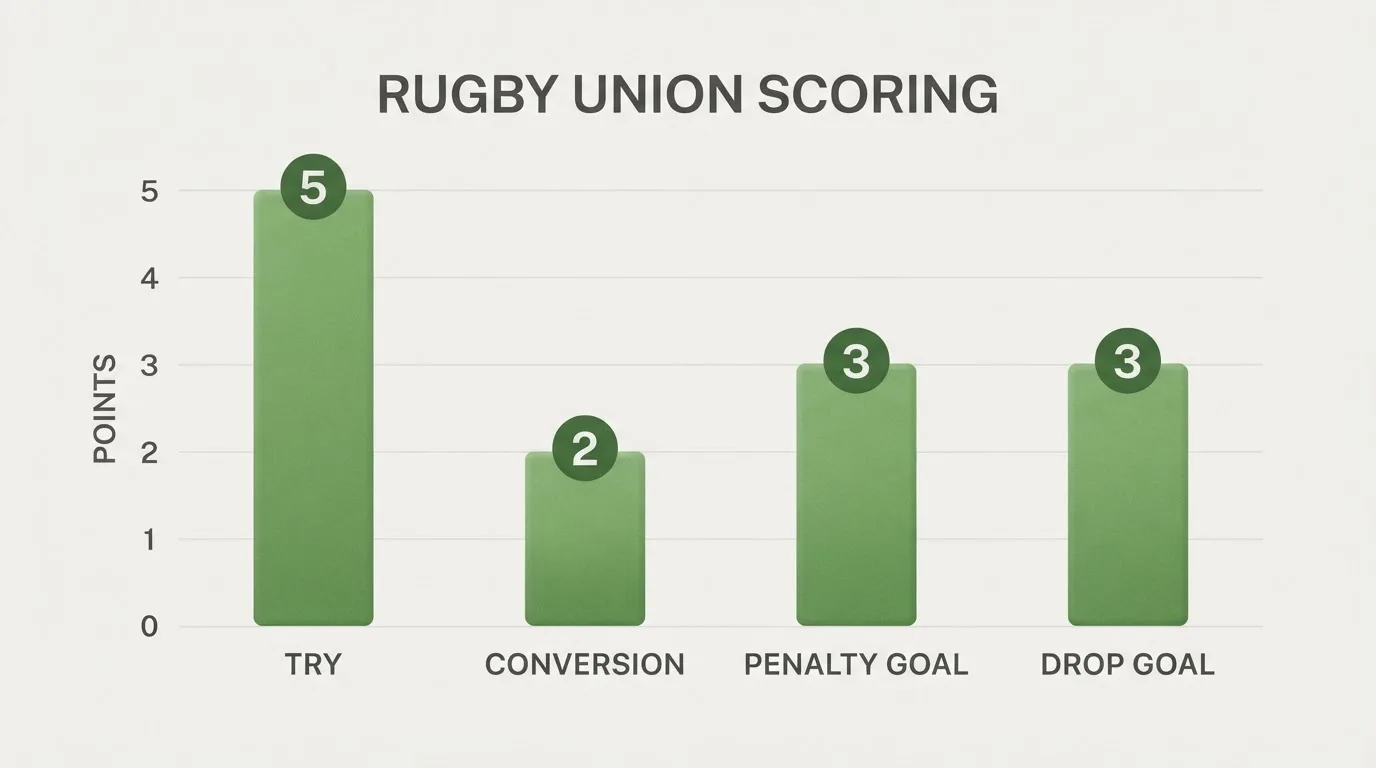
Race to X points. One of the standard markets at the bigger books on televised matches. Settled at whichever side reaches the line first, including on a try worth five or a penalty worth three.
Half-time / full-time. Settled on the score at the half and at the end of normal time, with extra time excluded unless stated. Margin on this market runs wider than on match result because the combinatorics of two scorelines are harsher.
Outrights. Tournament winner, top try-scorer, regular-season winner, wooden spoon (the team finishing last in the Six Nations) and similar season-long or tournament-long markets. These settle early in the calendar and a bookmaker will keep the price live through the group stage, which is where the early matches set the line.
Spread betting (Spreadex-style). Spread betting on rugby union is on the major and minor matches, not the markets above. A buy-sell spread on “total tournament points” or “winning margin” is settled by where the figure lands, with losses that can exceed the original deposit because every point above the buy line is money earned and every point below the sell line is money lost. Spread betting is a distinct product category, separate from fixed-odds betting, and the FCA regulates the financial side rather than the Gambling Commission. For the reader: spread betting is a different licence and a different risk profile, and it is not what a standard fixed-odds coupon settles at.
Accumulators (accas). A bookmaker takes a stake and pays the multiplied price if every leg wins. Two legs are a double, three a treble, four-plus an accumulator or acca. A Lucky 15 is fifteen bets covering four selections in singles, doubles, trebles and a four-fold. The bookmaker’s margin compounds leg by leg, and a four-fold accumulator at a typical per-leg margin of 6% has an effective margin closer to 22%. The punter pays for the kicker.
Bet builders / same-game multis. Combining markets from a single match — for example match result, total points and a try-scorer — into one bet. Most major books build these in-play as well as pre-match. The price is calculated from the underlying markets and then a margin is added by the bookmaker; the published “instant dynamic odds” are set to make the bookmaker the favourite on the coupon.
The phrase “best odds guaranteed” appears on rugby union in some shops but is mainly a horse-racing product; Fafabet runs it from 9 am on race days on UK and Irish horse racing, not rugby union. Anything labelled BOG on a sport where it does not apply should be read as a marketing export from racing.
The fixtures and the calendar
Rugby union runs on a season. The major competitions a UK punter will see priced across the year:
- Gallagher Premiership (England, top flight): twelve clubs, regular season from mid-September to early June, semi-finals and a final at the end of June. Markets open at most books from late July.
- United Rugby Championship (URC): four South African, four Irish, two Italian, two Scottish and four Welsh sides; runs alongside the Premiership calendar with a final in late May or early June.
- Six Nations: England, France, Ireland, Italy, Scotland, Wales. Six weekends in February and March, finishing on the Saturday of the third weekend of March. The tournament has the heaviest handle of the year at most books.
- Rugby World Cup: the men’s tournament ran in 2023 in France (South Africa won), and the 2027 men’s tournament runs in Australia from 1 October to 13 November 2027, with twenty-four teams in six pools of four and fifty-two matches. The 2025 women’s Rugby World Cup was held in England, and 2029 is the next women’s cycle.
- Autumn internationals: the four-Test window in November, hosting the southern-hemisphere sides.
- Super Rugby Pacific, Top 14 (France), and the All-Ireland League sit further down the menu, with thinner markets at most books. The Top 14’s wage bill makes for sharp French-favourite pricing on the European Champions Cup.
Most major matches on the Six Nations, the Premiership and the URC are available in-play, in cash-out-eligible form, and on Bet Builder markets at the bigger books. The further down the pyramid, the thinner the menu; a Championship Rugby or a BKT URC run is sometimes match-result only.
The Rugby World Cup draws the heaviest outright handle of the four-year cycle. Outrights settle at the end of May roughly eighteen months before the tournament, when the pools are confirmed. The earlier a punter takes a price on an outright, the wider the margin the bookmaker is running; later prices sharpen as the squads firm up.
The ten bookmakers, side by side
The brands below hold a Gambling Commission remote licence for general betting standard (real events). The licence register is the only test of who holds one; an offshore brand without a Commission licence is not in this section. None of the brands listed is the only licensed one; every GB-licensed online operator takes part in GAMSTOP.
| Brand | Gambling Commission remote licence number and licence holder | What the operator’s own terms state on the key’s subject |
|---|---|---|
| Fitzdares | 000400-R-103839-030 (Fitzdares Limited) | Cash out, accumulators, Lucky 15s, specials and ante-post markets on horse racing, football, tennis, rugby, cricket, golf and American football, with in-play live odds |
| Bet Ahoy | 100094-R-341742-003 (Bet Ahoy Ltd) | Welcome offer: “Bet £10 & Get £10 in Free Bets”, a £5 sports bet and a £5 acca |
| Betway | 039372-R-319367-029 (Betway Limited) | Free Bet Club: up to £10 in free bets every week after opt-in; spending £25 or more on sports earns 2 × £5 free bets |
| Fafabet | 057385-R-333191-006 (Taichi Tech Limited) | Best Odds Guaranteed on UK and Irish horse racing win and each-way bets from 9 am on race days; if the starting price is bigger than the original price, the bigger odds are paid |
| Betfair | 039439-R-319330-013 (PPB Counterparty Services Limited) | In-play betting, Bet Builder, free live streaming of UK and Irish horse racing and football within the app, and a 90 Minute Payout market |
| NetBet | 039170-R-319343-032 (Netbet Enterprises Limited) | Daily Boosts, Profit Boosts and free bet offers; Bet Builder with instant dynamic odds; sports stats for major leagues |
| Kwiff | 044448-R-323408-017 (Eaton Gate Gaming Limited) | UK Gambling Commission licensed; trademark operated by Spryme Ltd; 17+ App Store age rating |
| Star Sports | 009177-R-104555-019 (Star Racing Limited) | Customers can speak to a trader directly on 08000 521 321 to open an account, place bets or ask customer queries, with email support at [email protected] |
| Dabble | 065677-R-340363-005 (Dabble Sports UK Ltd) | Welcome offer: “Bet £10, Get £10 in Free Bets” on a first deposit for new customers, with minimum odds applying, a 7-day free bet expiry and the stake not returned |
| Midnite | 101839-R-342850-001 (Midnite Limited) | Welcome offer: bet £5 or more on pre-match odds of EVS (2.0) or greater within 14 days of sign-up, receive £25 in free bets and 50 free spins, valid for 7 days; in-play events, acca builder, popular accas, price boosts with maximum-stake limits |
Licences and operator entries on this table were verified against the Commission’s public register; what each operator’s own terms state on the key’s subject comes from each operator’s site or app as cited. Where a row carries no entry, treat the cell as not established in the cited material; the brand is licensed and still on the page on its other fields.
What “regulated” means on this page
The Gambling Commission licenses the whole commercial market in Great Britain under the Gambling Act 2005. Since the Gambling (Licensing and Advertising) Act 2014 an operator whose remote facilities are used in Great Britain needs a Commission licence wherever the operator itself is based — a Curaçao, Maltese or Gibraltar licence is not a substitute. A bookmaker serving customers in Great Britain holds a remote licence for one or more of five categories: remote general betting standard (real events), remote general betting standard (virtual events), remote general betting limited, remote pool betting, and remote betting intermediary (the licence for betting exchanges). Every brand in the table above is licensed under real events.
There is no statutory list of which sports or markets a licensed bookmaker may offer. The bookmaker’s licence category and the Licence Conditions and Codes of Practice (LCCP) define what it may take bets on; the specific menu is set by the bookmaker’s own trading team and terms. In-play betting is allowed and is offered across rugby union by the bigger firms; what is sold is the operator’s own in-play book, not a legally-mandated product.
Identity is verified before the first deposit and the first bet, including with a free bet and a bonus. The customer gives name, address and date of birth at sign-up; the operator runs identity and fraud checks; the customer is not anonymous. A financial vulnerability check applies at licensed remote bookmakers where the customer’s deposits minus withdrawals exceed £150 across a rolling thirty days: the check is a public-record check (bankruptcy, county court judgments and similar) and is not an income or credit check. Financial risk assessments — the heavier affordability checks — were announced in a staged plan on 7 July 2026 with no start date; write “announced, staged, no start date”, not “in force”.
Stakes and limits are operator-set. A bookmaker may impose its own maximum stake on a market, restrict a customer, and ask for source of funds at higher spend — these are normal under anti-money-laundering rules. There is no state-set ceiling.
Northern Ireland sits outside the Gambling Act 2005. A GB-licensed operator’s licence does not extend to Northern Ireland, and operators vary in whether they accept customers there. A reader in Northern Ireland checks the bookmaker’s own terms before staking.
The legal lines around a bonus
The licence frame for advertising and bonuses lives in the Commission’s marketing rules and the Codes administered by the ASA.
- The 10x bonus cap. Wagering requirements on bonuses are capped at 10x: a £10 bonus at 50x would clear at £500 of qualifying bets before withdrawal; under the cap it clears at £100. A bonus with a 10x factor is the ceiling, not the floor.
- No mixed-product promotion. An offer that requires gambling on two or more product types — betting, casino, bingo, lottery — is banned. A “bet on football to get free spins” offer does not comply.
- Marketing of strong appeal. Per the CAP Code section 16, marketing must not be of strong appeal to under-18s, and no one who is or seems to be under 25 may be featured gambling or play a significant role in marketing. The rule concerns who appears in the ad, not who may bet.
- Whistle-to-whistle. Since 1 August 2019 betting advertisements are not shown on TV from five minutes before a live sporting event to five minutes after it, before the 9 pm watershed (horse and greyhound racing excluded). The rule is industry code, not statute.
- No credit cards. Credit cards are banned for gambling in Great Britain as of 14 April 2020, including credit-card-funded e-wallet payments. Debit cards and bank transfers are not covered by the ban.
The cap on the money value of a bonus, and whether the 10x cap applies to free bets with no wagering condition, are not established in the cited material.
Protecting the punter
The protection frame on this page is GAMSTOP, the financial vulnerability check, and a small set of operator-set and customer-set limits.
GAMSTOP is the national multi-operator online self-exclusion scheme. Since 31 March 2020 every GB-licensed online bookmaker has been required to take part. A punter self-excludes for six months, one year, five years, or five years with auto-renewal. After the minimum period the exclusion stays in place for a further seven years unless the punter asks GAMSTOP to remove it. GAMSTOP covers online sites and apps; it does not cover betting shops, which use a separate service.
Deposit limits are a customer-set and operator-set mechanism. The Commission’s Remote Technical Standards require a gross deposit limit on a fixed time frame; the first changes applied on 31 October 2025, and a second phase was postponed to 30 September 2026. Whether that second phase is live is not established here. There is no state-set deposit ceiling; a punter who wants a £50-a-week deposit limit can set one, and a punter who wants the default can leave it.
The financial vulnerability check triggers above £150 of net deposits across a rolling thirty days and runs a public-record check. It is not a credit check, not an affordability check, not an income check. The check is the basic level of “is this person going to lose more than they can carry”.
Help lines. GamCare runs the National Gambling Helpline; GambleAware funds treatment and education; the NHS runs gambling clinics; Gamblers Anonymous runs mutual-aid meetings. These are not commercial, they are how the system works.
A licensed bookmaker must offer GAMSTOP, a deposit-limit tool, time-outs, reality checks (session-length reminders) and access to the help services. An unlicensed bookmaker offers none of them. Funds held with an unlicensed brand are not protected by the Commission’s complaints route or by an approved alternative dispute resolution body. The honest summary: licensed = verification, limits, GAMSTOP, bonus cap, Commission complaints; unlicensed = none of those.
Bonuses and free bets on rugby union
Every bonus the licensed books run on rugby union fits one of a small number of shapes. The shape determines what it costs.
Free bet (stake not returned). The bookmaker gives the punter a sum to wager; if the bet wins, the stake is not added to the winnings. A £10 free bet at 5/1 (6.00) returns £50, not £60. Dabble’s welcome offer — “Bet £10, Get £10 in Free Bets” — is the standard shape, with a 7-day expiry on the free bets. Midnite’s sports welcome offer — bet £5 or more on EVS (2.0) or greater within 14 days, receive £25 in free bets and 50 free spins, valid for 7 days — is the same shape but with a higher free-bet payout on a lower qualifying bet. Bet Ahoy’s “Bet £10 & Get £10 in Free Bets” splits the £10 free-bet total into a £5 sports bet and a £5 acca. The cost of these offers is the gap between the qualifying stake and the price the punter could have got on the same bet unencumbered; that gap is rarely visible because the qualifying bet is at a minimum price, often 2.0 (EV/1), and the free bet is on a coupon that may require an acca.
Free Bet Club. A weekly free-bet tranche based on settled stake volume on the punter’s account. Betway’s club gives up to £10 a week after opt-in: spending £25 or more on sports earns 2 × £5 free bets. The £25-of-sports-spend is qualifying stake at the bookmaker’s minimum price; the £10 free-bet payout is not a guaranteed return.
Profit boost / odds boost. A bookmaker pays the punter at an enhanced price on a chosen market. Daily Boosts at NetBet and Super Boosts at bet365 (where Super Boosts winnings also have caps on singles and selected Bet Builders) are the same shape. The boost is paid in winnings, not in additional stake; the offered price is the capped price, and the maximum stake is operator-set. Midnite publishes price boosts with a maximum stake limit. On a market with a 5% margin, a 50% boost is roughly equivalent to a 2.5%-of-stake price subsidy. It is small, it is real, it is better than a free-bet-on-its-own.
Acca insurance. A bookmaker refunds the acca stake as a free bet (or in some cases a cash credit) if one leg of a pre-match accumulator loses. The insurance is operator-set in the number of legs (typically 4-7), the minimum price per leg, and the maximum free-bet refund. The cost is the higher per-leg overround the bookmaker charges in exchange for taking the insurance risk on its book.
Welcome package (deposit-gated). A bookmaker credits the punter’s account with a percentage of the first deposit in bonus funds, with a wagering requirement. A 100% welcome to £100 means a £100 deposit gets £100 of bonus, subject to the 10x wagering cap on the bonus base. The cap means at most £1,000 of qualifying bets before withdrawal — significant turnover at a 5% margin, around £50 of expected cost to the punter in margin before any withdrawal.
The cost to the punter. Every bonus above is a marketing line. The cost is what the bonus does to the punter’s expected stake-by-stake outcome over the clearing period. A free bet whose stake is not returned has a free-bet value formula: free-bet amount × (odds − 1) ÷ odds, multiplied by the payout share of the market. At 5/1 (6.00) on a market with a 92% payout share, a £10 free bet is worth around £7.70. That £7.70 is the ceiling on what the offer contributes, before any minimum-price or qualifying-bet cost, before any 7-day free-bet expiry fires a forfeit of the unused balance, and before any wagering on the bonus base if the offer is deposit-gated. The headline rarely says this.
The expiry clock. Free-bet expiry windows run from 7 days (Dabble, Midnite) to 30 days at most books. Wagering requirements must be cleared in 30 days on most welcome packages. A punter who doesn’t track the clock loses the balance.
The minimum price. A “free bet on odds 2.0 or greater” qualifier caps the matches the punter can use the offer on. Min-price qualifiers exist to keep the offer’s expected cost to the bookmaker where the marketing budget allows. They do not exist because the bookmaker wants the punter to win.
How the bookmaker makes its margin
Every price has a bookmaker margin built into it. The math is transparent and the reader who runs it once never reads a price the same way again.
On a market with two outcomes (or three, for a match-result market with the draw) priced 1.90 / 1.90 in decimal terms, the payout share is 1 ÷ (1/1.90 + 1/1.90) = 1 ÷ 1.0526 = 0.95 — a 95% payout share, and a 5% margin to the bookmaker. On rugby union match-result markets priced 1.40 / 25.00 / 4.50 for a strong favourite, the marginal pictures is roughly the same: about a 5% margin baked in. The handicap and total-points markets on a tighter contest usually run closer to 3-4% margin; the anytime try-scorer market runs 12-18% margin because player scoring is lumpy and the overround hides in the player prices.
The book’s margin compounds across an accumulator. A four-fold acca built from four markets each at a 6% margin has an effective margin of 1 − (0.94 × 0.94 × 0.94 × 0.94) = 1 − 0.815 = 0.185 — about 22% margin on the coupon. The punter pays for the multiplier.
The “what would a winning bet pay” calculation is straightforward: return = stake × odds; profit = stake × (odds − 1). A £10 stake at 5/1 (6.00) returns £60, profit £50. A £10 stake on a four-fold with combined odds 50.00 returns £500, profit £490 — and the book’s margin between those numbers is roughly £110 of expected cost on that single bet.
Reading the cost in numbers
A worked example. Take a £10 free bet at decimal odds of 3.00 (2/1) on a market with a 95% payout share — typical of a tight rugby union match handicap. The free-bet value formula gives £10 × (3.00 − 1) ÷ 3.00 × 0.95 = £10 × 2/3 × 0.95 = £6.33. That £6.33 is the average value of the free bet to the punter; the realised return sits somewhere higher (when the bet wins) or at zero (when it doesn’t), with £6.33 as the expected middle. Around that average, the punter also qualified by staking at the minimum price, often 2.0 or greater, on a match they would otherwise have had at 2.20 — that 0.20 of price erosion is the real cost of “free” on the qualifying leg.
The 10x bonus cap illustration. A £50 bonus on rugby union betting with a 10x wagering factor at minimum price 2.0 (EV/1) and a stake of £5 per qualifying bet: turnover is £500, number of qualifying bets is 100. At a 5% margin and assuming the punter places every bet on a typical market, the expected cost of clearing the offer is around £500 × 0.05 = £25 — about half the bonus value. A punter who walks away with the bonus in pocket has worked hard for the rest.
The expected loss on a casino-style clearing is the same number expressed differently: a punter clearing a bonus on slots has a higher expected loss because slots carry a higher margin than sports; clearing on rugby union at a typical 5% market margin is the cheap way through, and it is the only reason offers paired with sports (and bingo, lotteries and casino) cross-product promotions are now banned.
The takeaway. The headline number — “£50 bonus”, “100% welcome”, “risk-free bet” — is the marketing cap, not the value. The real value is the formula above, with the qualifying stake and the minimum price subtracted from it. A punter who runs the math takes fewer of these offers, and the ones they take are the ones where the qualifying bet is already one they would have placed.
The ten reviewed bookmakers at full length
The order of brands in this section is not a ranking. The dedicated operator table at the top carries the licences and the headline terms. The paragraphs below carry what the table cannot.
Fitzdares
Fitzdares’ account at the Commission is account 400, one of the more senior on the register, and the product range is positioned at the more affluent end of the market. Cash out is offered on the major sports, with the same in-play feed any major bookmaker offers on rugby union; in accumulators, Lucky 15s and specials the operator runs the standard horse-racing-led product, and ante-post markets on horse racing, football, rugby, cricket, golf and American football underpin the bulk of the menu. The product is a premium bookmaker’s product on a rugby union Saturday: it lacks bet builder or same-game multi on rugby union (the offering there is horse-racing-heavy), and a punter who values wide rugby union lines elsewhere may find it leaner than the bigger firms.
The right reader: a horse-racing-led punter who wants rugby union pricing as a side product and a smaller, quieter interface. The wrong reader: a rugby union only punter who needs bet builder, in-play try-scorer and Super Boost-style price enhancements across the major competitions.
Bet Ahoy
Bet Ahoy splits its welcome offer between a £5 sports free bet and a £5 acca free bet. The structure is a deliberate hedge against two distinct reader habits — the singles-only punter and the acca-only punter — and the £10 qualifying stake is at a minimum price. The free bets expire when the book says they expire, and the sports bet expires faster than the acca one would on a settled-six-legs coupon.
The right reader: a punter placing their first rugby union bet who is happy to take a small free-bet slice and forget about the offer after a week. The wrong reader: a high-stake punter who needs a serious welcome package, because Bet Ahoy’s headline numbers are modest by the bigger books’ standard.
Betway
Betway’s Free Bet Club is a weekly recurring offer rather than a one-shot welcome: up to £10 in free bets every week after opt-in, with £25 or more of settled sports stake earning 2 × £5 free bets. The Club’s value compounds across a season in a way a welcome package does not — a rugby union punter who settles £100 a week on rugby union is into the offer every week of the autumn internationals and the Six Nations.
The right reader: a rugby union punter with a regular settled-stake habit who wants a recurring small free-bet supplement. The wrong reader: a casual punter who bets once a month and never reaches the £25 qualifying bar.
Fafabet
Fafabet’s headline product is Best Odds Guaranteed on UK and Irish horse racing win and each-way bets from 9 am on race days, with the starting price (SP) used as the floor when SP is bigger than the original price. BOG is not a rugby union product; Fafabet offers rugby union in the standard match-result / handicap / total-points / try-scorer menu but the major enhancement runs on horse racing.
The right reader: a horse-racing-led punter with rugby union as a side product who wants the SP-padding. The wrong reader: a rugby union-led punter who expects the book’s headline terms to carry over to the rugby union menu.
Betfair
Betfair is licensed to PPB Counterparty Services Limited (the same group that holds Paddy Power, with the same corporate shareholder), and its product mix includes an exchange and a sportsbook. The sportsbook offers in-play betting, Bet Builder, free in-app live streaming of UK and Irish horse racing and football, and a 90-Minute Payout market. The exchange — a separate commission-bearing interface — is the part other licensed bookmakers do not offer, and is separately licensed as a betting intermediary.
The right reader: a rugby union punter who wants the deepest in-play menu on a major match and a Bet Builder with the biggest catalogue of combinations; a punter who also bets on horse racing or football benefits from the free streaming. This operator is not for a punter who finds the dual exchange-and-sportsbook interface confusing, or who prefers to avoid the exchange’s added commission metric.
NetBet
NetBet’s product is the standard mix of Daily Boosts, Profit Boosts, free bet offers, Bet Builder with instant dynamic odds, and sports stats for major leagues. The interface is more reflective of a mid-tier bookmaker than a tier-one — the menu depth on lower-tier rugby union competitions is shallower than Betfair’s or Betway’s, but the major matches are well priced.
The right reader: a punter who likes a Profit Boost on a daily pick and is happy to consolidate bets on the major matches. For a punter who demands ante-post outright markets on emerging rugby union nations or depth on the third tier, this site is a poor fit.
Kwiff
Kwiff is operated by Spryme Ltd and licensed by the Commission; its App Store listing is rated 17+, which is the operator’s own age policy expressed in app-store metadata rather than a licence condition. The product is built around “surprise” price enhancements on selections at the time of placement; rugby union is in the menu and the enhancement mechanic applies.
The right reader: a punter who likes the random-price-enhancement mechanic and accepts that the “surprise” is the marketing hook. Avoid this bookmaker if you prefer transparent pre-match pricing without randomised enhancements.
Star Sports
Star Sports runs a phone-led account model: customers can speak to a trader directly on 08000 521 321 to open an account, place bets or ask customer queries, with email support at [email protected]. The phone-led interface is unusual for a licensed online bookmaker — most are entirely app-led — and the rugby union menu tends to focus on the major matches at the bigger firms’ pricing.
The right reader: a punter who wants a named trader to place bets over the phone and prefers a smaller bookmaker with a personal-service ethos. A punter who insists on a slick, automated app will likely find this phone-service model too slow.
Dabble
Dabble’s welcome offer is “Bet £10, Get £10 in Free Bets” on a first deposit for new customers, with minimum odds applying, a 7-day free bet expiry and the stake not returned. The offer is the same shape as Bet Ahoy’s; the differentiating feature is Dabble’s social-betting interface, where punters post picks on a feed and follow other punters’ selections.
The right reader: a punter who wants social-betting functionality on rugby union and a simple small-value welcome offer. We recommend looking elsewhere if you want a high-volume professional interface or a more substantial bonus package.
Midnite
Midnite’s licence account is 101839, and the product set is the standard mid-tier mix: in-play events, acca builder, popular accas, and price boosts with maximum-stake limits. The welcome offer — bet £5 or more on pre-match odds of EVS (2.0) or greater within 14 days, receive £25 in free bets and 50 free spins, valid for 7 days — is generous on the free-bet side relative to the qualifying stake, with the £25 free-bet payout available on a £5 qualifying bet. The free spins attach to a casino product rather than the sportsbook, and the casino-wagering rules are different.
The right reader: a punter who wants a £5-qualifying welcome that returns £25 of free bets and accepts a 7-day expiry on the free-bet balance. The wrong reader: a punter who wants cash-clearance on the welcome, or who objects to a casino product line being attached to a sports welcome.
How the page’s worked illustration reads
The page’s worked number is a margin illustration. On a two-way market priced 1.90 / 1.90, the payout share is 1 ÷ 2 × 1.90 = 1 ÷ (0.5263 + 0.5263) = 0.95. The bookmaker’s margin is 0.05 — 5%. This is the typical match-result margin at a major bookmaker on a rugby union fixture, plus or minus a couple of points depending on the operator and the competition. The 5% is a band, not a point, because it varies: a Premiership match at a tier-one bookmaker sits closer to 3-4% pre-match; a handicap or total-points market sits similar; the anytime try-scorer market sits 12-18% because the player-book is lumpy.
A four-fold accumulator built from four markets at 6% per-leg has an effective margin of 1 − (0.94)^4 = 0.215, or about 21.5% — the marginal cost of the multiplier. The punter pays roughly £21.50 of expected cost on a £100 stake, and wins on the rarer outcomes that the multi-leg structure requires. The £21.50 is the overround. It is invisible on the coupon, and it is the price of an acca.
The takeaway on a single number: a 5% margin is what a single market on a major match costs; a 21% margin is what the same markets cost when combined into an acca; a free-bet value of £6.33 is what a £10 free bet at 3.00 is worth on a 95% payout share. None of these are sums the bookmaker prints on the page.
Section recap: where the cost hides
The reading in three sentences: on rugby union, the everyday cost is the margin on every price, and the bigger-the-coupon cost is the compounded margin. The marketing cost is the headline free bet, the expiry clock, the minimum price and the wagering cap. The protection cost is verification before the first bet, GAMSTOP-coverage availability, and a £150-vulnerability-check threshold above which the book asks a few more questions. A punter who reads every offer through all three layers takes fewer offers and keeps more of the bankroll.
Frequently asked questions
How does rugby union betting work in the UK?
Rugby union betting in Great Britain is licensed by the Gambling Commission under the Gambling Act 2005, and the Commission licence is the test of who holds one. Punters register with a bookmaker, verify name, address and date of birth before the first deposit, and place bets on markets offered by the bookmaker under its own terms — match result, handicap, total points, try-scorer, race-to-X, outrights and accumulators. There is no statutory list of permitted bets or markets; each bookmaker sets its own menu within its licence category.
How do you actually place a bet on rugby union?
Open an account at a UK-licensed bookmaker, complete the identity check (name, address, date of birth), deposit (debit card or bank transfer — credit cards are banned for gambling in Great Britain), pick a match or an outright, choose a market and price, enter a stake, confirm the bet. The bet is recorded in the account’s “my bets” or settled-bets list, and a winning single returns stake × decimal odds. Settled accas pay each leg’s price multiplied into the others.
How can it be checked that a bookmaker holds a Gambling Commission licence?
The Commission’s public register can be searched by business name, trading name, domain or account number. The brand or trading name on the bookmaker’s terms page should match the licence holder, and the licence number on the register should match the one in the bookmaker’s terms. A bookmaker with no entry on the register, or whose licence does not cover the product it sells, is unlicensed for Great Britain customers. Note that licensed operators use.com and.co.uk domains, so the domain alone proves nothing.
How is the return on a bet worked out from the stake and the odds?
Return = stake × decimal odds. Profit = return − stake = stake × (decimal odds − 1). A £10 stake at decimal odds 6.00 returns £60 and produces a profit of £50. The bookmaker’s commission is already inside the decimal odds, not added on after the bet. For a combination bet the legs’ decimal odds multiply into one price, and the same formula applies to the multiplied price.
What is the bookmaker’s margin and how can it be seen in the odds?
The margin is the share of every unit staked that the bookmaker keeps on average across all outcomes of a market. On a market priced 1.90 / 1.90 the payout share is 1 ÷ (1/1.90 + 1/1.90) = 0.95, and the margin is 5%. The margin is the gap between a fair market (where the inverse-odds sum equals 100%) and the price the bookmaker offers; it compounds across an acca, so a four-fold at 6% per leg has an effective margin of around 22%.
How do fractional odds such as 5/1 convert to decimal odds such as 6.00?
Decimal odds = fractional odds converted by dividing the first number by the second and adding one: 5/1 → 5 ÷ 1 + 1 = 6.00; 11/4 → 11 ÷ 4 + 1 = 3.75; evens (1/1) → 1 ÷ 1 + 1 = 2.00. The decimal form is what a bookmaker’s bet slip shows the punter, and it is the form used in the return formula. UK bookmakers quote fractional odds in marketing and decimal odds on the bet slip.
Rugby, cricket & Gaelic – Cricket betting
Content created by the «Cricket betting» team
